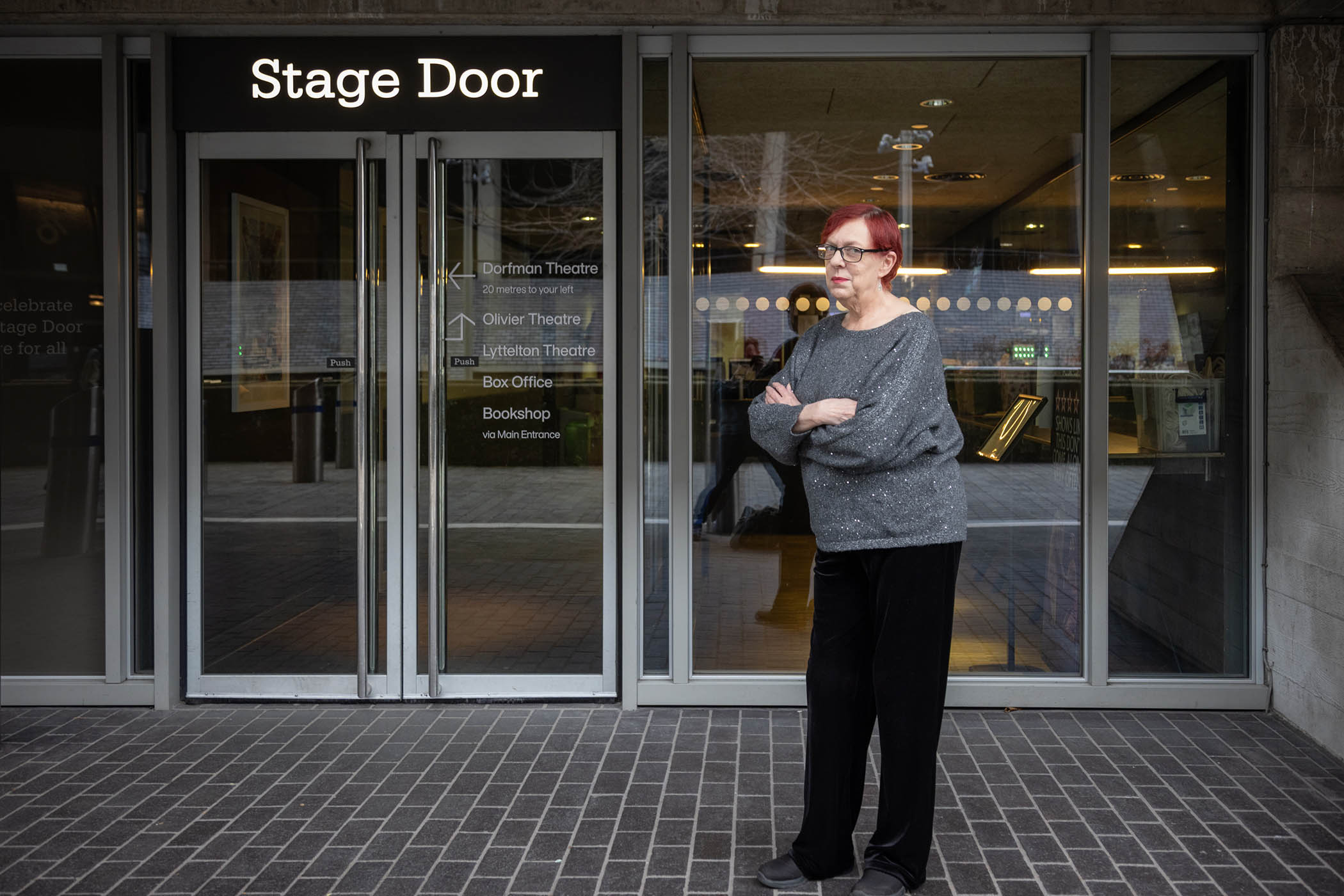

The convenience of the journey from Woolwich station to Waterloo determined the course of Linda Tolhurst’s life.
She was 17 and looking for a job as a secretary when she visited her local job centre in south London. Pinned to the vacancies board was an advert for a secretarial assistant at the National Theatre, a new building just opening on the South Bank. She looked up Waterloo on the A-Z. “It was an easy journey, so I thought I’d give it a go.”
That was more than 50 years ago. This month, Tolhurst was presented with an Olivier Industry Recognition award for her 46-year stint as stage door keeper, the person who acts as a bridge between on and off-stage worlds.
Anyone who has visited the National’s stage door knows Linda, with her gravelly voice and stern demeanour – quickly broken by a broad smile or a raucous laugh. “I was honoured to serve under the leadership of Linda Tolhurst, who has controlled the National with the lightest of touches and with a wicked glint in her eye for generations,” said Nicholas Hytner, one of six National Theatre artistic directors with whom Tolhurst has worked. “There is nothing she doesn’t know, and she usually knows it before it’s even happened.”
Peter Hall was at the helm when she joined as the secretarial assistant, typing up cues on huge old-fashioned typewriters, altering each change in Tippex until the corrections built up layers on the paper. “You could just about work out what it said,” Tolhurst tells me with a laugh, when we meet – naturally – at the National Theatre.
She left the theatre briefly in July 1980, but returned after a few months when a friend who worked the stage door was leaving. “We both went to meet our boss. She walked into his office to tell him she wanted to be a stay-at-home mum and as she walked out, I poked my head round the door and said, ‘Can I do it?’ That’s how I got stage door.” Since then, she has never contemplated leaving her “National Theatre family”.
Tolhurst has witnessed significant changes through the years. In the 1980s, she operated a large telephone exchange, putting through 500 calls a day. Every room in the building had a phone, the theatre’s main means of communication. “I loved hearing people like Tony Hopkins or Clarke Peters ringing up.” Now, hardly anyone uses the phone. Guests are no longer asked to wear circular black stickers, but to sign in via a computer system.
But the theatre’s spirit remains the same, Tolhurst says. One of her proudest achievements is that she has seen generations of the same family come through the door: Roy Kinnear and his son Rory, a long line of Troughtons, and, in the case of Judi Dench (“I love that woman”) and her husband Michael Williams, a lineage that runs through their daughter Finty and their grandson Sam. It’s the same on the technical side, where generations follow each other into the profession. “I look at grown men and think: I remember you when you were a child who could barely reach the top of the counter.”
A love of theatre itself was never behind Tolhurst’s passion. The first play she saw after she joined was Albert Finney’s Hamlet in 1976. “He was great. He’d buy everyone a drink after the show.” At that time, she had no idea of his fame. “When I got home and my mum asked where I’d been, I said I’d been having a drink with someone called Albert Finney. She went: ‘Noooooo!’ I’d never seen Saturday Night and Sunday Morning or Tom Jones, so I didn’t have a clue.”
She once typed up a radio talk for the great Shakespearean actor John Gielgud: he gave her a silver compact in return. But she’s never been a great fan of the Bard. “I love a musical – Guys and Dolls, Carousel, Oklahoma!, South Pacific – but I don’t do Shakespeare,” she says, with a smile. “I went to see Harold Pinter’s No Man’s Land with Sir John and Sir Ralph [Richardson] – after 20 minutes, I sneaked out. I couldn’t take that. All those pauses.”
Newsletters
Choose the newsletters you want to receive
View more
For information about how The Observer protects your data, read our Privacy Policy
She remembers Richardson – “he was absolutely stark raving bonkers, but I still loved him” – racing his motorbike around the perimeter of the building along with Nicky Henson and Michael Bryant: “all riding on their 1000CC motorbikes like Hell’s Angels.”
Later, it was the cast of Alan Bennett’s The History Boys, directed by Hytner, who were “a bit naughty,” Tolhurst says. More than 15 years after the premiere of the play starring a young James Corden, Dominic Cooper and Russell Tovey, Corden and Cooper appeared outside the stage door on bikes, in search of company and a drink during the Covid lockdown. “But the bar wasn’t open and I couldn’t imagine them drinks out of thin air.”
The biggest crowds Tolhurst has had to cope with weren’t for the stage legends of the past, but the stars of the present. The stage door was besieged when Benedict Cumberbatch was starring alongside Jonny Lee Miller in Frankenstein, just as Sherlock aired in 2011. “We used to ring him up when the show had ended and say, ‘There’s 60 people outside.’ He would say, ‘Oh I’ll just have a quick drink and come down.’ He’d still be inside when I was on my way home, and the crowds were still there. Jonny on the other hand would come out – coat on, collar up, cap on – and walk straight through them. Helen Mirren was another one who could do that hat trick and walk through the crowd.”
When Nicola Coughlan of Derry Girls and Bridgerton fame appeared in The Playboy of the Western World last year, staff had to erect barriers around the door. Even with more security measures, fans still attempt to make their way into the building. “You’ve got to keep your wits about you,” Tolhurst says. “Normally just asking ‘Can I help you?’ works to put them off.”
One can imagine the mixture of politeness and ferocity with which she would ask the question – and the contrasting degree of warmth with which she welcomes actors, directors and writers who have worked at the National down the years. Richard Eyre, another of her artistic directors, described her as both the theatre’s beating heart and its “all-seeing eye”.
“I like the people in the building,” Tolhurst says. “It may sound corny, but I like the people I work with.”
Photograph by Cameron Slater