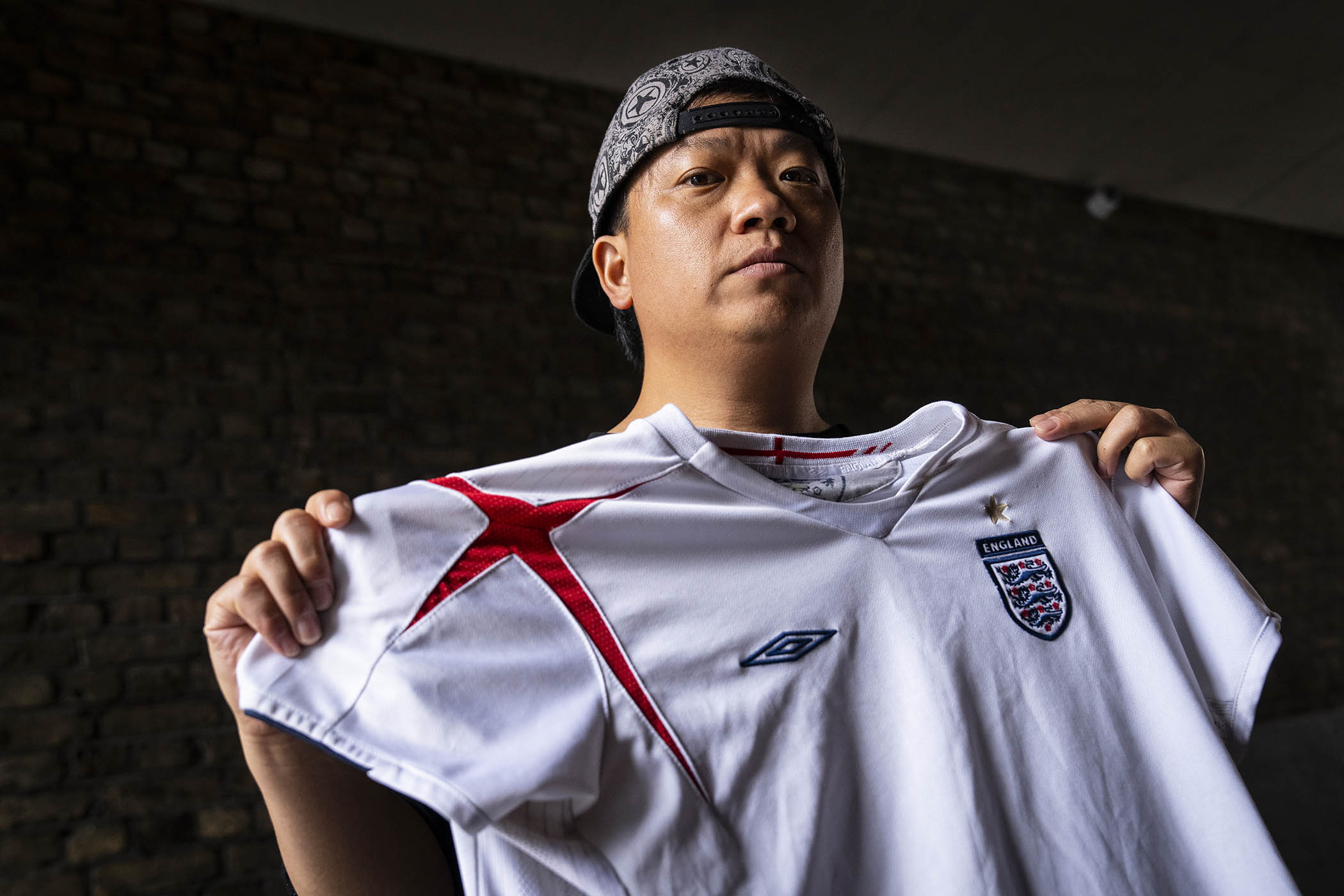



Photograph by Antonio Olmos for The Observer
When Xiao Hai was 15 and his brother two years older, their father told them he could only afford for one of them to continue at school. He asked the brothers to decide between them which one that would be. The one to leave school would also leave their village in central China’s Henan province and follow the flow of migrants to China’s burgeoning cities and factory towns to help earn money for the family.
The two brothers lay awake all night in their shared room. Each time their eyes met, they would avert them again. If one of them could make it to university, it could change their family’s fortunes. Xiao’s brother’s grades were better. Xiao, still a child in terms of the legal work age, knew it was he who needed to give up school.
Twenty-four years later, Xiao is sitting with me in a meeting room at The Observer’s offices in London, telling me about the 22 jobs he worked at in eight cities all over China since that night. During our interview, when he tells me about a low moment or a turning point in his life on China’s factory floors, he stands up to scan the room to look for an example of the product he was making at the time. Each time he finds one: a hidden circuit board, an iPhone, a trouser drawstring.
He’s here to talk about an entirely different product: his memoir, Adrift in the South. It’s a story of one person’s journey to becoming an artist. Many such books are written, but very few from China’s workshop of the world. Xiao is one of the hundreds of millions of factory workers in China, making almost everything we buy – the stuff we use every day – but from whom we usually never see or hear at all.
Four years into his working life, Xiao’s job was to stitch a red line on to the right shoulder of the official England football shirt. The St George’s cross was known to his team as “the aeroplane skeleton”. Xiao had never heard of the World Cup. He became familiar with the roman letters “England” and would space out, staring at the three lions. “They have a fierce energy – I’d feel a strong sense of ambition when I looked at them,” he says. “I was 19. I knew I had a dream – I just didn’t know what it was yet.” In the Haiqi factory in Dongguan, a city of industrial parks in south China, he began to find out.
The England football shirts were made of a breathable fabric shipped in from Hong Kong. When the cloth ran out, he and his colleagues were kept at their stations on the production line. “I didn’t understand why they didn’t save electricity and let us go back to our dorms to rest,” he says. His colleagues would fashion shoe insoles from scraps and chat. “I didn’t believe I’d ever escape the factory life,” he writes. He began to write on the back of the instruction sheets for garment orders, the only paper he had: “A line or two about being young and feeling lost. Short verses. Then I’d toss them in the trash.”
When he started out, he was on $1 a day. Now he was on 2 cents an England shirt, which amounted to about $5 a day (the shirts were retailing for approximately £40 in the UK at the time). He upped his speed, but didn’t get a raise. “So the unit price of my labour has dropped, I reasoned. Of course the capitalists would find a way to make us work for less. But I was happy enough with my salary,” he writes. He could now afford to save for his own phone. He used it to call home, only to find out that this brother had quit school. Xiao was devastated. “I’d stitched all those football shirts for nothing!” he tells me now with a laugh.
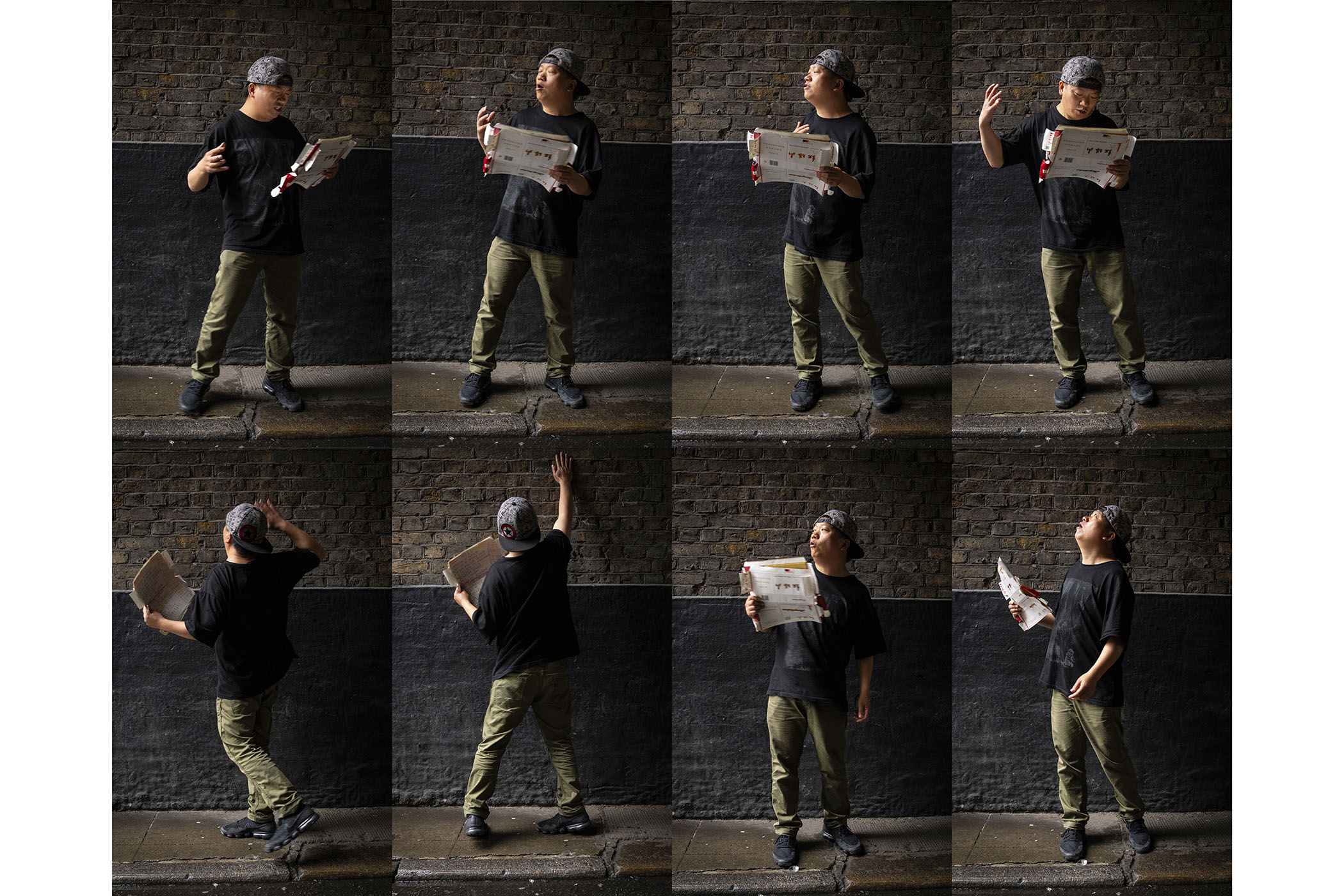
Xiao Hai performing one of his poems
His brother came to join him at Haiqi. Finally, Xiao felt less alone, even though he worked from 8am until 8pm and his brother from 8pm to 8am. One night, his brother got his finger caught in the sewing machine. He stepped on the foot pedal in panic and the needle kept jamming into his finger until it hit his bone. Once it was bandaged, he was straight back on the factory floor. There was no concept of recovery time or compensation for a labour injury. The only way to complain was to resign. The only problem with that was that the next job could be worse.
Xiao did eventually find something better, still at a factory, but not in an industrial park – on an island off Zhejiang province in the East China Sea called Meishan, surrounded by fields and crops. Here he was making pyjamas for the domestic market. The quality was lower, so it didn’t matter as much if his stitching went awry. On a day off, he found a library and picked up a children’s compendium of Tang dynasty poetry. A poem by Chen Zi’ang “jolted something awake within him”: “Where are the great men of the past / And where are those of future years? / The sky and earth forever last; / Here and now I alone shed tears.”
“I had never expected that an ancient verse could offer me the vocabulary to articulate the way I felt,” he recalls in his memoir. “The language of poetry sliced like a bayonet through the layers of numbness I had accumulated over the past few years, and I saw that in allowing myself to become a kind of robot for work, I had anaesthetised myself from all emotion. A primordial passion now flared inside my chest.” He’d begun to stop on his way to work, he writes, to smell the cape jasmine and osmanthus. In the evenings, when he could, he’d gaze at the moon. He was no longer simply on the clock, but now also felt part of “celestial” time. He learned 400 Tang poems by heart and recited them as he stitched. His colleagues thought he’d gone mad.
A week before we met, Xiao performed some of his own poetry at an event in Berlin with one of China’s most famous public intellectuals, Xiang Biao, the director of the Max Planck Institute for Social Anthropology in Halle, Germany. Xiang commented that the acute loneliness Xiao describes in the work represents a kind of global working-class loneliness that only emerged in the 1990s – not only among migrant workers, but also among workers who lost their communities and sense of collective working life when their jobs or industries were off-shored.
This loneliness isn’t simply personal, but is also about being “denied by the world”. It was from this moment, Xiang argued, that working people worldwide lost a sense of identity, and began to find it “difficult to say that they’re working people”. For him, Xiao’s power lies in the way he confronts that difficulty.
Xiao understands that analysis. I tell him his writing feels universal too. Though our lives are profoundly different, and it’s hard to comprehend the scale of his loneliness, when I read his memoir, much of it rang true for me. It’s resonant for anyone who’s ever felt pulled into a life that doesn’t feel like their own, but doesn’t want to … “Give up on themself” – he finds the words for me.
Newsletters
Choose the newsletters you want to receive
View more
For information about how The Observer protects your data, read our Privacy Policy
Xiao was living a life that didn’t feel like his own. He was entirely at the mercy of China’s national policies and global manufacturing flows. In the 1990s, the Chinese government allowed school fees to increase to levels that rural incomes often couldn’t cover. Many moved to the nation’s factory towns or cities, where wages were higher. Migrants would live in factory compounds; this “dormitory labour regime” was an innovation that extracted maximum value from workers and helped turn China into the cheapest place on the planet to make things.
But China’s workers often weren’t given residence permits in these towns and cities. Not only did that mean they had no rights locally, but the police would fine – and often extort – them for being there. One night, Xiao left Haiqi to buy a new toothbrush, and was pushed into a police van and forced into paying a charge for not having a residency permit for Dongguan.
During his first four years of work, he had the sense of achievement of sending money home. His parents owned an acre of land, where they grew wheat in the summer, and corn, peanuts and cotton in the winter. He was the third child of four; when he was born, there wasn’t enough to feed the family, let alone to pay the fine for breaking the one-child policy. He was hidden at his aunt’s home in a different village until he was five while his father left for a salt mine 2,000 miles (3,200km) away in Xinjiang. Now three out of the family’s four children were working, and Xiao was restless. His loneliness deepened. On the factory floor, a question kept recurring to him: was he “creating something of value or just garbage?” He still has no answer.
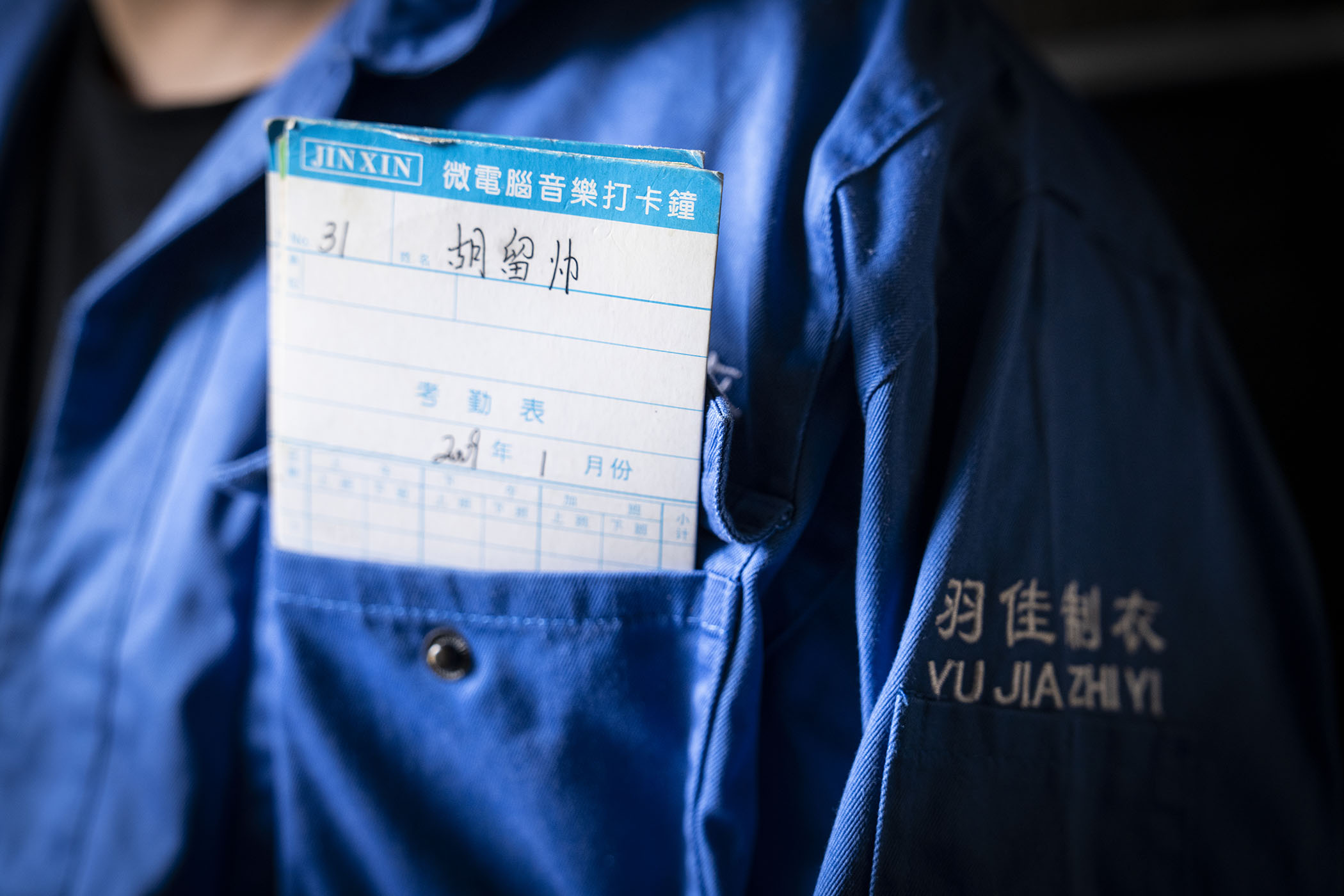
Xiao in his former factory jacket with the time card he used to log his hours
He took off for China’s eastern ancient cities of Suzhou and Shanghai to try to leave factory life behind. He lasted a week as an estate agent, a month on telesales: “You’d say, ‘Hello’, and usually people would yell at you straight away: ‘I’m not interested!’” I nod knowingly (having, like all of us, been that person on the receiving end of those calls). He spent a season as a popcorn vendor, a few months as a delivery driver. “I was collapsing, really coming apart – the reality was too harsh.” He ended up back on a garment factory floor.
Now making clothes for Adidas and Nike, he recalls printing out a six-page translation of Howl by Allen Ginsberg and folding it into his pocket. He’d push a bit of a drawstring along a trouser waistband, read a bit of Ginsberg, push the drawstring, inhale a couple more lines of Ginsberg. He discovered Bob Dylan and the Rolling Stones. “Rock made me feel like I still had spirit,” he says. He identified with Dylan, also a country boy struggling to make it in the city. “I couldn’t believe how well written it was!” While Tang poetry reconnected Xiao with a sense of the universal, rock emboldened in him a resistance to a particular sweep of historical time, mass urbanisation and suburbanisation. He now wrote less in classical Tang style and abstract terms and more in his own voice, naming his sense of loneliness in being a factory worker, but also a pride in making stuff for the world. He wrote his poem Made in China around this time. “Writing became a lifejacket. If I wrote, I wouldn’t feel lonely that day. If I didn’t write, I’d feel panic,” he says.
Xiao messaged a handful of Chinese rock stars he admired and attached some of his verses about factory life. One of them, Zhang Chu, replied with a single rose emoji. Zhang would later send Xiao with an introduction to a worker who’d established the Beijing New Worker Art Troupe in an independent migrant worker cultural village called Picun, outside Beijing.
Now 29 years old, Xiao felt it was time to “gamble on his dreams”. In 2016, he arrived in Beijing with no job. He spent the night in an internet cafe. The owner took his phone when he slept and would only return it to him for a fee.
Picun was a dusty, broken-down stretch near the 6th ring road, the Wenyu River and Beijing airport: “Was this forlorn part of the city really the place I’d been dreaming about?” he wrote.
When he stepped inside Picun’s Migrant Worker Culture and Art Museum, however, something “melted in his chest”. Payslips and temporary residency permits were presented behind glass. He read a remittance letter on display from a young girl who was sending home all her earnings, including a “9 GBP” repayment to a loan from her uncle. She signed off: “Your daughter – a lost cause.” Xiao was moved to tears. (The museum has since been demolished.)
Every Saturday night, he’d join the migrant workers’ literature group. University professors were giving up their time for free, paying their own taxi fares to teach there. His classmates were delivery drivers, security guards, welders, miners. He sat next to Fan Yusu, a cleaner and nanny. In 2017, one of Fan’s responses to a weekly assignment went viral; she became a literary star. Until that point, “we’d thought our lives were a complete mess, who could possibly want to read about them?” Xiao says.
Over the last few years, it has become unusual to walk past a bookshop in London without seeing the latest Japanese or Korean bestseller on display. Taiwanese books in English translation are winning prizes too. But in the same period, there’s been very little published to widespread acclaim in English from China, especially in nonfiction. Xiao’s work is part of a migrant workers’ literary movement that is not only changing this, but is also being credited for helping to revive Chinese literature more generally.
About nine years ago Wu Qi, an editor of Beijing-based literary journal One-Way Street, had almost given up on reading contemporary mainstream Chinese literature. “The whole literature system in China, since the beginning of the 21st century, just isn’t responding to the density of our reality in China,” he says. During the pandemic, he says more people around him in Beijing began to understand what he meant. “I think that’s why some of us have been looking for something stronger, more authentic, and more true to us and the society. We don’t need beautiful words, or references to big names in literature. What we need is to read people being 100% themselves.”
Wu was looking to publish writers outside the Chinese education system, and unaffiliated with the China Writers Association. About a decade ago, he began working with grassroots literary writers in the north-east of the country – the rustbelt, where old industry had collapsed and left people without jobs or hope. This group became known as the “Dongbei Renaissance”: “Their theme is loss,” Wu says. “Loss of dignity, their childhood, their dreams, their parents’ jobs, their own jobs. But they’re reluctant to fight for anything. They don’t know how to. For them, there’s no way out.”
Between a mainstream literary world that had acquiesced to the big China dream, and the Dongbei writers who wrote about “giving up and letting cynicism take over”, Wu was hoping for a different possible response. In Picun, literature felt meaningful again.
Wu dedicated an issue of One Way-Street to the Picun writers, including a piece by Xiao. This is how his work came to the attention of London-based magazine Granta, which then commissioned Xiao’s memoir. For Wu, Xiao’s work stands out. He “is simply saying: ‘No, I’m not OK with this.’ He is asking questions we’ve almost forgotten to ask like: ‘What do you feel as a human being living in your society?’”
Wu feels Xiao’s approach is important beyond China. “We’re all helpless in the current political climate,” he says. “[For ordinary working people] no social system in China, Europe or the US guarantees an alternative or a way out. The old discourses aren’t working. If we want things to get better, we have to start with the kinds of small questions and daily struggles of the kind Xiao Hai raises.”
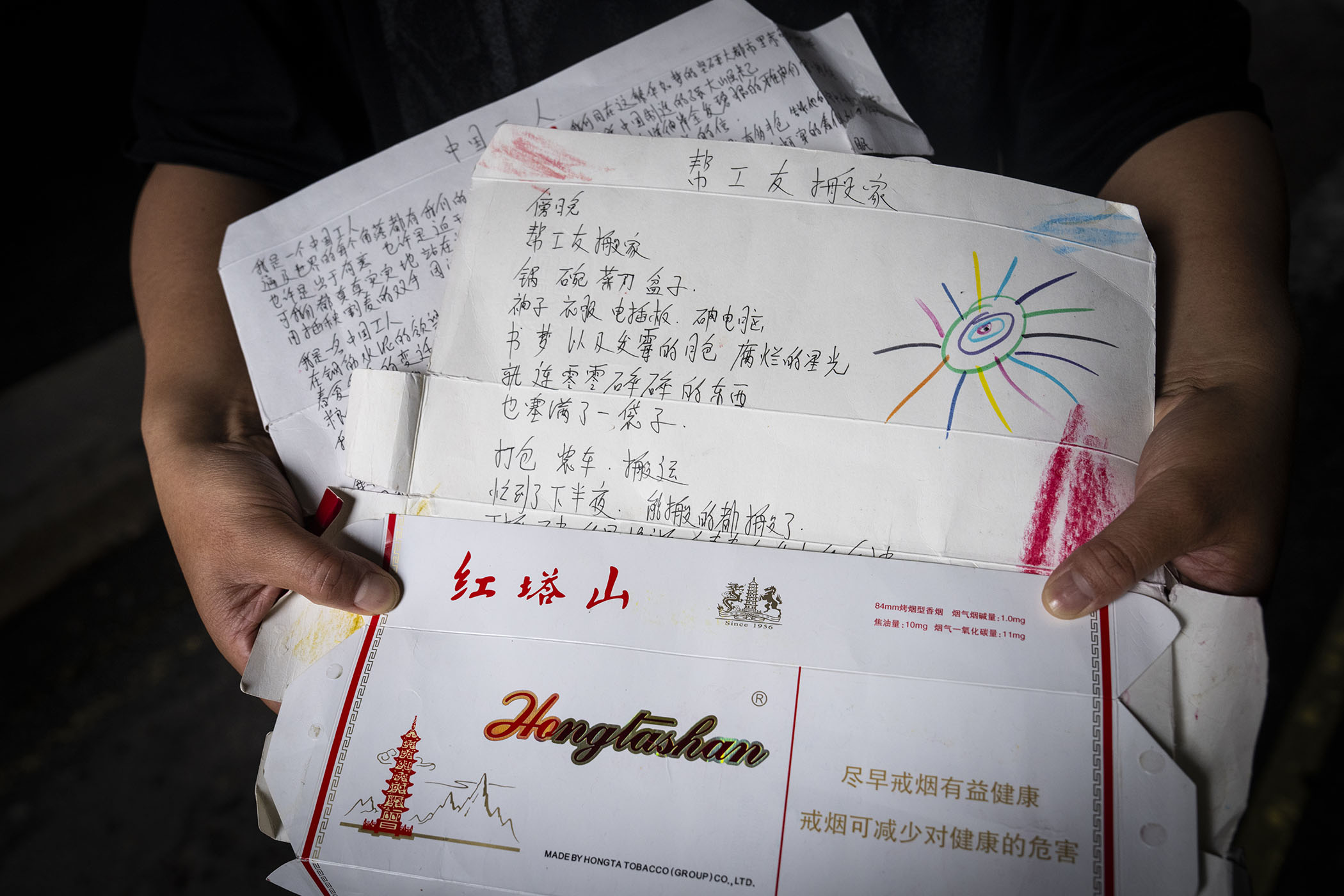
Poetry on cigarette packets
For all the cut-throat brutality Xiao describes in his memoir, he encounters a good deal of generosity and fraternity too. For every highway bandit who preys on his vulnerability as a migrant, there’s a kindly foreman who shuffles the production line to place him next to a girl who likes the same rock songs he does. “Overall, people are good,” Xiao tells me.
The combination of reading Xiao’s memoir, watching him perform his poetry at his London book launch and meeting him left me unusually energetic – and even hopeful. His spirits were enlivened by other people’s verse; he channels this now through his own.
I ask him if his voice had always carried such strength. “Not at all,” he says. “I used to be timid and insecure. It’s poetry that’s given me confidence and force.”
I wonder if literary judges are finding it hard to distinguish between human writers and AI because this kind of life force isn’t being transported to the page by humans quite enough. I also worry if Xiao becomes more visible in China, will he be able to keep it going?
Xiao’s poetry collection, Sisyphus on the Wenyu River, was recently published in Beijing on a print run of 8,000 copies. Its publication was supported by a new state policy, announced in March in the Chinese Communist party’s 2026-30 five-year plan, known as New (meaning digital) Popular Literature and Art. The idea is to promote the creative self-expression of people all around the country, especially workers and farmers online.
China’s digital environment is one of strict censorship, as well as self-censorship. The cynic in me can’t help wondering if this isn’t the Chinese government seeking to control the possibility of more people writing honestly about their lives, just as the migrant workers’ literary movement takes off organically.
Xiao, meanwhile, hasn’t escaped the world of garments. When he is not writing, he now runs a thrift store in Picun. He enjoys marking down the clothes for secondhand resale. The stuff that doesn’t sell, he says, gets shipped to developing countries. A while ago, he found an England football shirt in one of the bags. He has it hanging on the wall.
After he closes the shop each evening, he goes to watch the sun set over Beijing with his girlfriend. Then he begins to write. He sometimes wrote Adrift in the South all night, stopping in the early hours when he heard the swallows sing and cockerels call. This night-time work was, he says, “magical”.
Adrift in the South by Xiao Hai is published by Granta (£12.99). Order a copy from The Observer Shop for £11.69 (10% off RRP). Delivery charges may apply
______________________________
Xiao Hai’s poetry
Made in China
Translated by Tammy Lai-Ming Ho
we manufacture radios cars computer monitors iPhone 7s
we manufacture Nike Puma England team sportswear Adidas
we solder circuit boards plug in resistors tighten screws install motor protectors
we make cuffs fit zippers attach collars
align down jackets inside & out
we befriend machines fall in love with products
on and off off and on through all those years
counting on youth while it lasts
no one’s left behind
but products stay forever young
my countenance has aged
the assembly line not only manufactured goods
it manufactured our youth-life frozen in sameness
the machines grow hotter
yet our hearts turn colder
sharply looking back
heaps of young men and women workers
have also become uniquely made in China
______________________________
The 2006 England national football jersey
Translated by Austin Woerner
what a happy surprise to find this shirt
lying in a pile of old clothes
in this warehouse on a rainy day
i feel like i’ve stumbled across my own younger self
i was living in Humen, Dongguan City i was 18 years old then
working in a factory called Haiqi Sportswear Ltd
where my job was to stitch one edge
of the red piece of fabric we called the “airplane”
onto the right shoulder all day every day
for two cents apiece i did over a thousand of them a day
they said the fabric came from Hong Kong
and the shelf price would be more than 400 yuan
which for a guy making 1000 a month
was pretty hard to believe how could a T-shirt cost that much?
back then i didn’t know anything about football
i’d never heard of the England national team
but i was extremely well acquainted with the seven letters ENGLAND
and those three embroidered lions
which were comforting somehow
for a kid still struggling to figure things out
i remember there was a girl in our unit her name was
Pan Xiuming she was from Hubei province
she was only 15 years old and had gotten a job in the factory
using the name on her older sister’s ID card
she was pretty and a quick worker
she once asked me to go with her to the computer training centre
near the industrial park said she wanted to learn some skills
but nothing came of it the classes were too expensive
it’s been 18 years since then
i’m not young anymore and i haven’t accomplished much of anything
here i am working in a secondhand clothing shop
still on very close terms with clothing
i wonder what kind of life she’s living now
where she’s working whether she got married
whether the factory we worked in is even there anymore
i don’t know if it’s fate or destiny
that the England national team has had only one star on its jersey
for more than fifty years they need a big win
to help them prove themselves
just like me still adrift in this world
now i’m looking at this piece of clothing all full of memory
and feeling like i’m looking at a piece of my own adolescence
what are the chances it must be one in a million
i made this thing and now it’s found its way back to me
after all these years after going through who knows what
i’m thinking maybe i’ll hold onto it
till I’m old and stiff and there isn’t a day of work left in me
i’ll be back in my hometown gazing at it in the dusk
admiring it like a long overdue broken medal of my youth