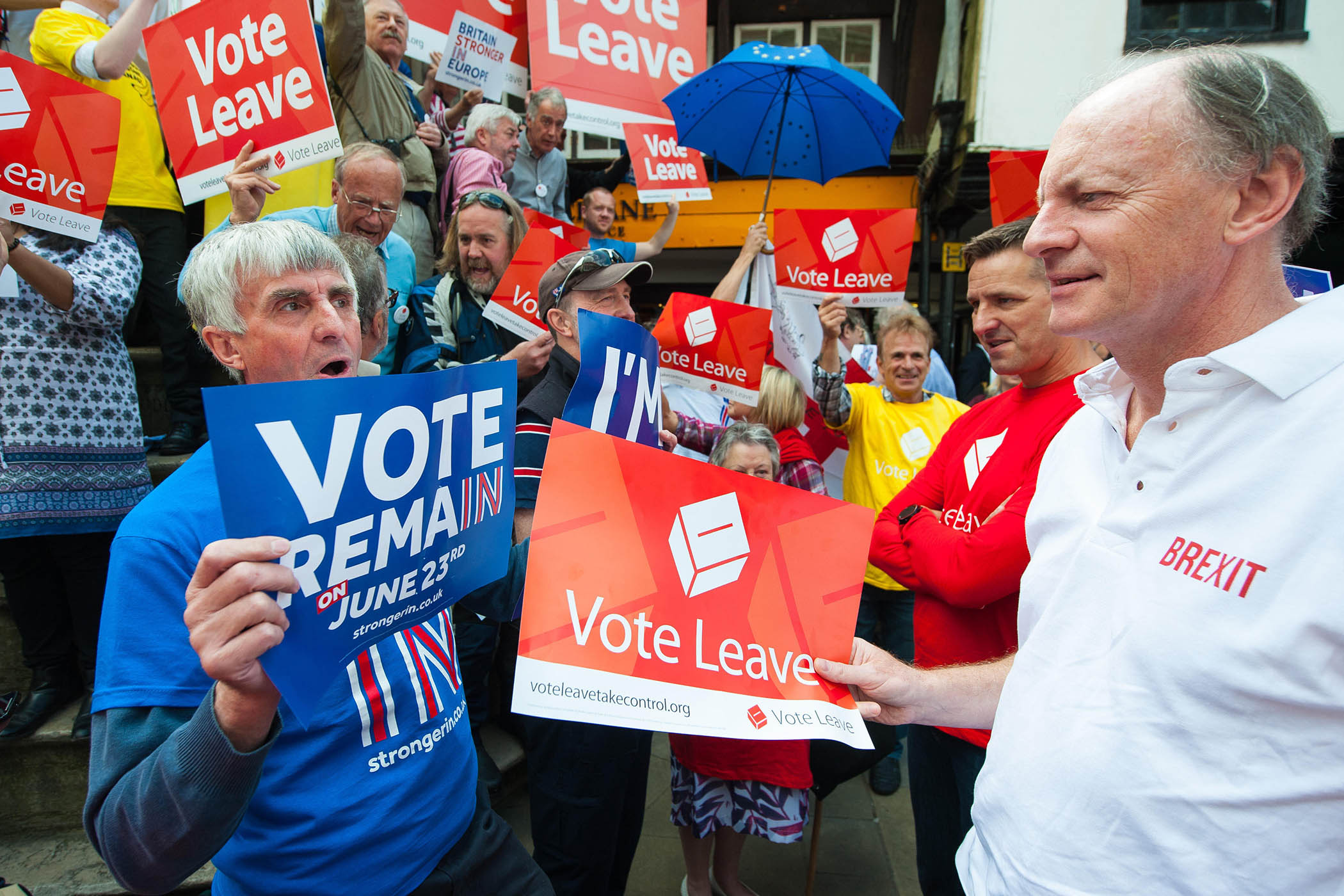


The new two-part BBC Two docuseries Brexit: A Very British Civil War, from the esteemed documentarian Norma Percy, marks the 10th anniversary of the referendum that resulted in Britain leaving the European Union.
For many of us, the memories are painfully fresh. The lies on the side of the Brexit battlebus, claiming the EU was sent £350m a week of taxpayers’ money (the gross figure, not accounting for the negotiated rebate or EU spending in the UK); the surreal sight of Bob Geldof and remainers bobbing about on the Thames, arguing with the leavers’ fishing boat flotilla carrying Nigel Farage; the way remainers were casted as the metropolitan elite (only caring about continental “holibobs”); Boris Johnson’s support for leave helping to swing the vote (he famously wrote himself two essays, arguing for both sides).
Percy’s extensive oeuvre, including studies of Vladimir Putin and Donald Trump, is built on a simple formula: assemble key players and let them talk. Here, as well as all those names mentioned above, there’s an array of talking heads, among them David Cameron, who says the Conservatives’ unexpected 2015 outright election win meant he had to fulfil his referendum pledge to Tory Eurosceptics (erm, no, he didn’t have to drag the country into an internal party dispute). There’s also ex-ministers Michael Gove and Steve Baker, plus Jeremy Corbyn, who fronted a lacklustre remain campaign by Labour. The party’s former leader barely bothers to hide his leave leanings, though his self-important peevishness is always a treat. “There is no ‘I’ in Corbyn,” he bristles at one point.
It’s the first time I’ve thought Percy failed to truly capture her subject
It’s the first time I’ve thought Percy failed to truly capture her subject
Vote Leave’s machiavellian campaign manager Dominic Cummings, the control freak’s control freak, declined to appear. Peter Mandelson, part of the Labour remain campaign, does give an interview – a disclaimer says it was recorded before his Jeffrey Epstein links were uncovered – but he says little of interest and could have been cut.
Otherwise, the series, directed by Max Stern, is as expected. It’s a doomscroll of posh-boy in-fighting and power mongering at establishment level – sometimes over a game of tennis. Former chancellor George Osborne likens Johnson’s manoeuvring to Game of Thrones: “He could see the Iron Throne right there, about to be vacated.” Meanwhile, Johnson – who with his matted flaxen hair increasingly resembles Ben Stiller’s Simple Jack from Tropic Thunder – insists he wasn’t jostling for the top job: “I would have become prime minister, anyway.”
The story is as depressing as ever, not least the xenophobia and racism swirling through the atmosphere. “When we were talking about the economy, we were winning. When we were talking about immigration, we were losing,” says Cameron. Farage is stiff, perhaps trying to convey the “statesmanlike demeanour” of a man preparing for power. Gordon Brown, though, comes across as decent and principled, talking movingly of the killing of Jo Cox, Labour MP for Batley and Spen, a week before the vote.
The docuseries ends sharply with leave’s win, which is understandable: where to start with all those consequences, economic, global, social, cultural? In a recent Ipsos poll, 58% of voters backed rejoining the EU.
But the abrupt ending means the programme feels unfinished and – worse – unserious. It’s the first time I’ve thought Percy failed to truly capture her subject. The tone is too flippant, not to mention the overindulgence of Johnson. After 10 years of the B-word, some of us have had it with the “naughty boy!” takes.
The new Disney+ comedy drama Alice and Steve is … challenging. Billed as a “wrong-com” and written by Sophie Goodhart (whose credits include Sex Education and Rivals), it’s about two lifelong, fiftysomething friends: fashion designer Alice (Nicola Walker) and hairstylist Steve (Jemaine Clement of Flight of the Conchords).
Everything starts marvellously. We see them cavorting on a raucous, drug-fuelled evening out. When Steve stays the night on the sofa, he sees Alice’s 26-year-old daughter Izzy (Yali Topol Margalith), who’s split from her boyfriend. “You’re weirdly hot,” Izzy tells Steve, and after having sex, the pair begin a relationship. Cue, Alice’s furious vengeance, as she tries to humiliate him and ruin his life, and he in turn hers.
Newsletters
Choose the newsletters you want to receive
View more
For information about how The Observer protects your data, read our Privacy Policy
In fairness to Alice, Steve isn’t only her friend; he’s an ex-boyfriend (ugh), and he knew Izzy as a child growing up, and spent Christmases and holidays with the family (double ugh). But most of the criticism is steered towards the new couple’s age gap rather than the quasi-familial connection. Izzy’s father is absent – Alice is married to thoughtful, younger Daniel (Joel Fry) – so we only have to deal with her mum’s rage. Just as conveniently, Steve could not be classed as a predator since Izzy made all the first moves.
Indeed, the series steers clear of any potential grooming issues by making Steve an uncool wimp. The coupling is also kept carefully chaste, with no sex scenes as such, leaving the impression that the show decided not to “go there”. This is in stark contrast to the older-woman-younger-man tropes that tend to be hypersexualised, such as Nicole Kidman in Babygirl. Putting it bluntly, the only thing giving off heat is Clement’s obvious discomfort with his role.
Even if the premise is whiffy, deeper issues could have been explored (societal mores, hypocritical stances, shattered taboos), or at least some properly transgressive black comedy unleashed, as in Hal Ashby’s surreal 1971 masterpiece Harold and Maude. Instead, we’re invited to paddle in the shallows of Steve’s personality and stare at the pyrotechnics of Alice’s rage. As for the escalations of revenge, what should be Beef levels of complexity fizzles out into subplots, leading to a strange, fudged ending.
The show is not a disaster – there are some good lines and moments – but, ultimately, it feels like a waste of two good characters. Alice and Steve is a wrong-com that forgot the golden rule: if you set up a provocative premise, hold your nerve.
Photograph by BBC