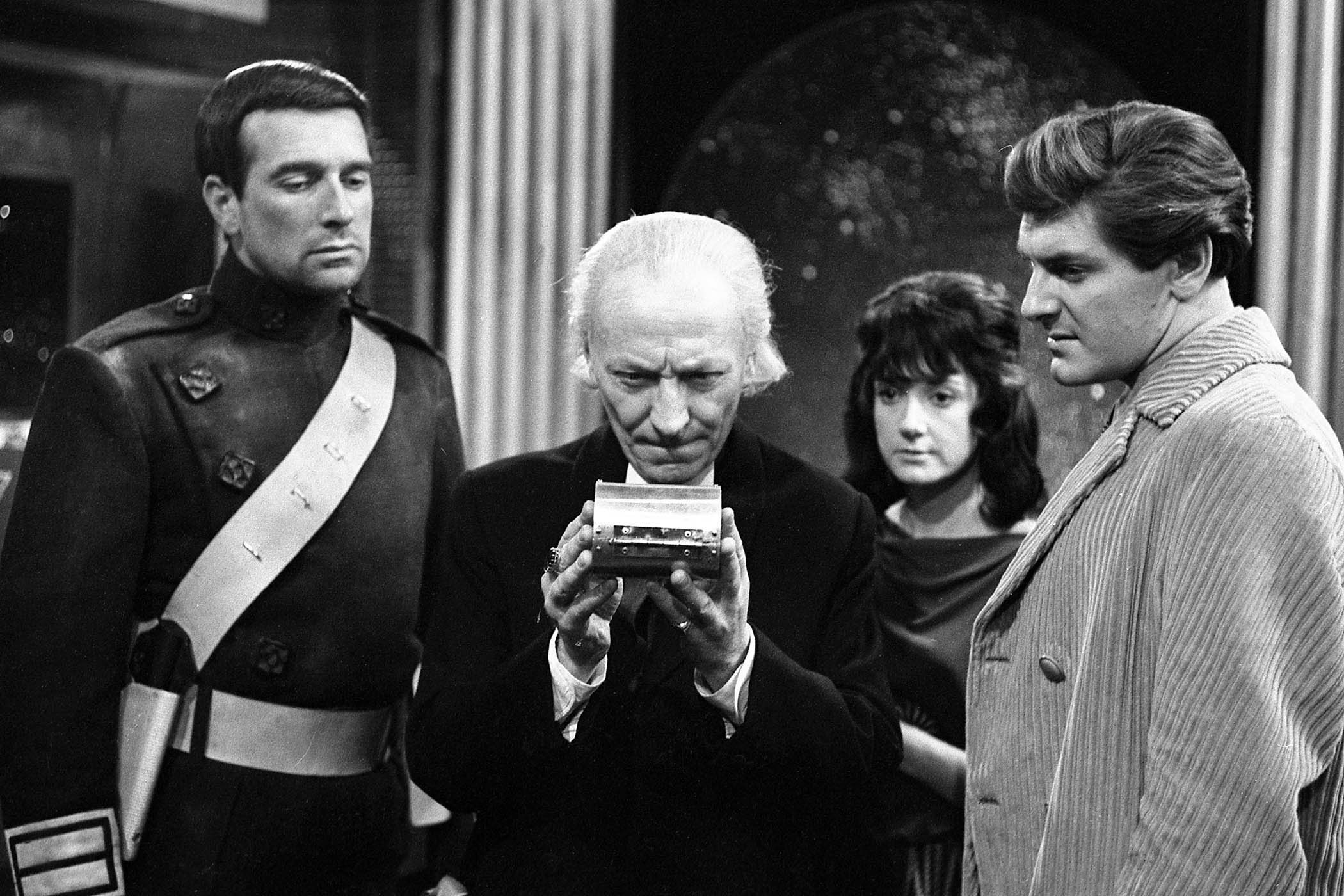

Whovians around the globe are waving their sonic screwdrivers in delight at the news that two episodes of the original series of Doctor Who have been discovered – 16mm black-and-white film recordings of the live transmissions. Like so much early television, no effort was made to preserve The Nightmare Begins or Devil’s Planet (1965), starring William Hartnell – the first Doctor. They are the first to be unearthed for over a decade. Film is Fabulous!, a charitable trust run by cinema lovers and vintage television enthusiasts, announced the find, which had been discovered in the collection of an enthusiast and collector after his death.
I am a late-onset Whovian. My son was six when the ninth Doctor – Christopher Eccleston – shimmered onscreen in Russell T Davies’s brilliant reboot. At seven, David Tennant, the 10th Doctor, landed the Tardis in our home and for the next couple of years my boy would wear nothing but a chalk-striped suit and sneakers. These were, as I recall, just about the last days of “appointment television”: our Saturday night schedule was fixed, immovable.
Now we can watch and rewatch Doctor Who (and we do, even though my son now wears an actual suit to his actual job). But I consider a time when television was almost a kind of oral culture, something that would evaporate once it had been experienced. How has the permanence – or the imagined permanence, we’ll come back to that – of the medium affected how we think about the form?
John Hill, professor of media at Royal Holloway, points me towards a book by the British critic TC Worsley, Television: The Ephemeral Art, published in 1970. “The ephemerality of television was often how it was understood in its origins,” Hill says. “Virtually no programmes were repeated. Studio drama was initially transmitted live: if it ever was repeated, the cast had to perform the production again.”
How we think about television as art – a word usually attached to a sense of permanence – connects to how we think of television as community. When the finale of M*A*S*H was broadcast in the US in 1983, 125 million people sat down at once to watch it: 77% of households watching television. In the age of streaming, that kind of unification – except, perhaps when it comes to sporting events or national events such as the funeral of Queen Elizabeth, as Hill points out – has vanished.
Doctor Who is unique in the pantheon of television: no other single character, from Gallifrey or not, has endured across six decades, attracting generation after generation of devoted fans. In a sense, the series is an outlier when it comes to what Hill calls “forgotten television” – thousands of hours of viewing that have virtually disappeared from public consciousness.
Except: not quite. From 2013 to 2017, Hill ran a project called History of Forgotten Television Drama in the UK, which investigated why many UK television dramas have been “forgotten” while others – Doctor Who among them – have been elevated to the status of “classic” British dramas. There’s no simple answer; but what was striking to Hill was how many people approached him and his team during the project asking about a programme they remembered from decades before and had never seen again. The effect of the art was not lost for its seeming disappearance.
We think we can see anything now, but that’s not really the case. Don’t get rid of your DVDs: anything you have to stream is, in essence, as fragile as those vanished early episodes of Doctor Who.
Yet, as Hill discovered from all the folks who reached out to him, our memories are the real treasure house. I think of what I watched when I was young, what I had to work to remember. There is something especially precious about the ephemeral: it can survive in each individual heart.
Photograph by BBC
Newsletters
Choose the newsletters you want to receive
View more
For information about how The Observer protects your data, read our Privacy Policy