

Laura Marling’s latest album started life as a joke. The singer-songwriter had a young daughter and had just released her eighth record – Patterns In Repeat, which captured the rush of emotions she felt in new motherhood – when Rough Trade asked her to produce a special EP. She decided to “see if we could pass off children’s music as sincere, normal adult music. And then I absolutely loved doing it.”
Laura Sings Raffi is a collection of covers of the Canadian-Armenian children’s artist Raffi, whose music has soundtracked generations of childhood in North America. His 1976 album Singable Songs for the Very Young blended warm folk sounds with a child’s-eye perspective and simple melodies. Marling, who grew up in Hampshire, discovered him when she lived in LA. “I think Listen to the Horses was the first one I heard. I just loved the deadpan, sincere delivery,” she tells me.
“It’s so different from the Mr Tumbles and Blippis. There’s something slightly sinister going on there in how they bombastically approach children’s entertainment.” Raffi, in contrast, “speaks at [the child’s] level. It’s not clownish. It might be goofy, but it’s not clownish.”
Marling’s arrangements are strikingly unadorned. “I just wanted it to be simple and untainted.” They comprise only voice, guitar and the occasional backing vocal. (Her daughter sings and giggles on one: “That took, like, a thousand takes. She was taking the piss out of my American accent.”) In Marling’s hands, the songs are surprisingly poignant. On I Wonder If I’m Growing, she sings: “I wonder if I’m growing / My mom says yes, I’m growing / But it’s hard for me to see.”
The decision to record this album is partly one of principle. Though the children’s media landscape is more oversaturated than ever before, a vanishingly small percentage of it is tolerable to adults. “I have a personal philosophy of parenting where I refuse to do undignified things,” says Marling, 36, who had a second child, a son, with her partner, musician-turned-charcutier George Jephson, this time last year.
Her children only watch or listen to things she would enjoy herself: My Neighbour Totoro, Wallace & Gromit, Ratatouille. “I’m not anti-screen, as long as it’s good quality. I’m anti leaving them alone on a tube with an iPad. I’m opinionated enough to say no child should have an iPad, or a phone. And no teenager should either.” They love The Sound of Music, but fast-forward through the Nazi scenes. As we speak, I hear her partner singing Edelweiss from downstairs (beautifully); later I hear the film playing. “It’s not like they’re growing up in a magical musical household, Maria von Trapp-style,” Marling insists, and I raise my eyebrows. “He’s putting on a good show of it now!” she laughs.
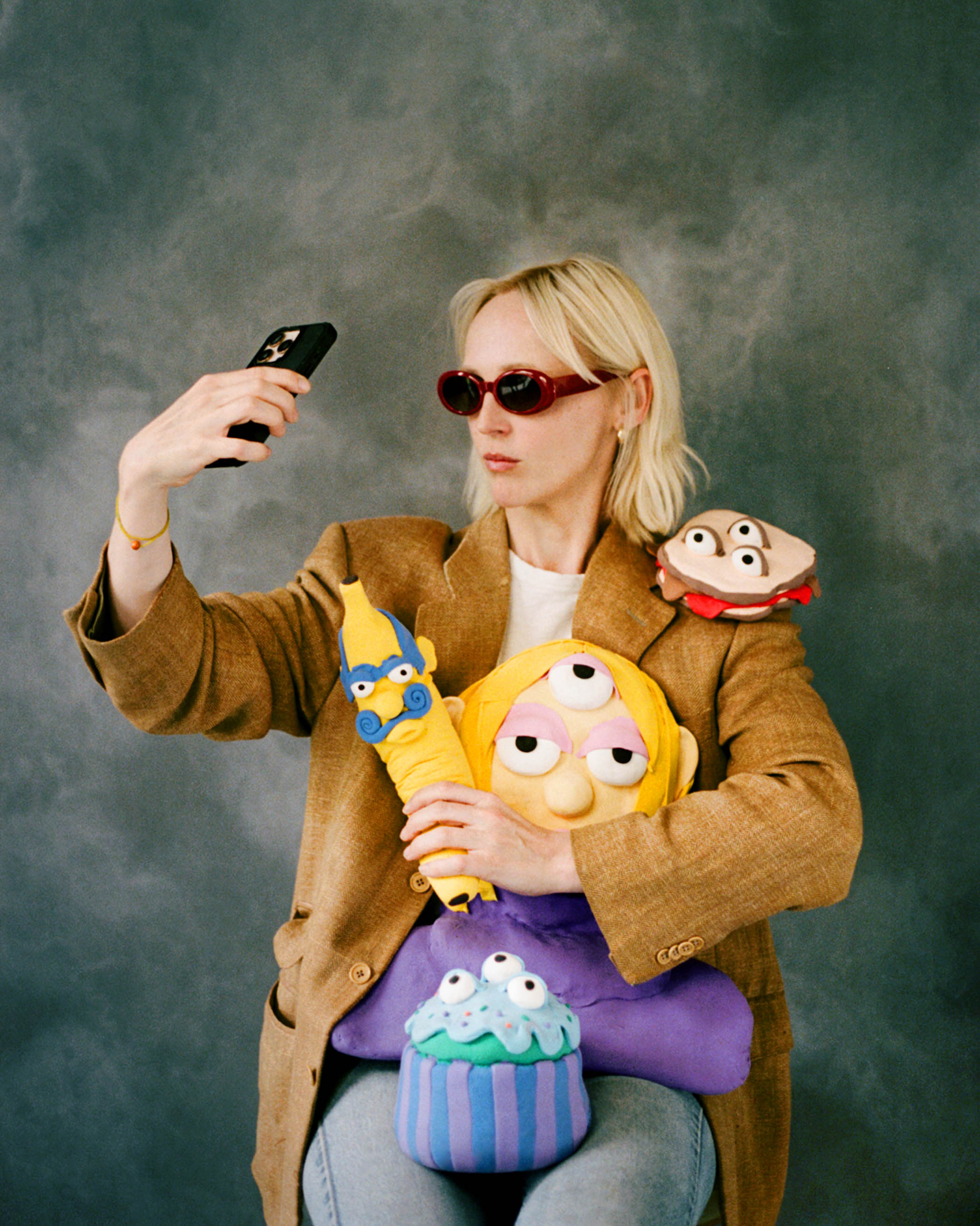
‘I wonder whether I’ve got the sparkle of someone who can perform for children’: Laura Marling
We are speaking in Marling’s front room, in a Georgian terraced house in east London overlooking a park. (It belongs to a friend; the family are living in it for a year while they decide where to move next.) We sit at a wooden table covered with books, wires and microphones. A guitar is propped up against a cabinet; a bike leans against a wall; next to the door sits a double buggy.
Our conversation revolves largely around parenthood, a phase of life I have just entered. I arrive in torrential rain, with my partner and three-week-old daughter in tow: a communication mix-up means Marling isn’t expecting my whole family to appear on her doorstep, and is briefly confused. But she is welcoming, and seems genuinely delighted to have such a fresh baby in the house. (“I love how when they’re that tiny they look almost animatronic.”) Her daughter, now three and a half, pops in to peer into the pram. “I’m so, so honoured you brought your baby,” Marling says. “I would so much rather live in a world where it’s perfectly possible to accommodate these things. And it is; it’s a small ask.” My daughter was born to one of Marling’s songs – For You, from her 2020 album Song For Our Daughter – and I tell her that her Raffi covers have been playing through our early weeks of parenthood: Thanks a Lot has frequently made me cry. “Your door is open,” she says with a knowing smile. “To the other world. I had that after my first.”
Marling’s wholehearted embrace of the maternal role may surprise those who have listened to her moody, folk-inspired guitar music: her songs are often about independent female spirits, pushing back against gendered expectations. Her songwriting drew on “that branch of feminism that began in the 1970s, which I was on, and still admire – the feminism of independence. But for me, the greatest experience of my life, or the experience I needed now, was the feminism of interdependence.”
“I was made ecstatic by becoming a parent,” she says. “I think I had an extended oxytocin experience.” She once feared that having children would extinguish her songwriting, so was thrilled to discover that the birth of her first child was as creatively fulfilling as it was emotionally. She wrote Patterns In Repeat in those early months. “I’d maybe do a couple of takes while [my daughter] was napping, and when she went to bed, I’d work until 11. It was a juggle, but it was a really fun juggle.”
The birth of her son changed that dynamic. “When you have two, you just can’t just do that juggle any more. I found that a real shock.” She put her guitar away and shifted her focus to writing a Substack newsletter at night, on the mysteries of creativity and the art of songwriting – full of diverse references to psychoanalysis, tarot cards, Rilke, Ibsen, Lacan, and the occult; and containing sentences such as, “A few years ago, I took a full dose of magic mushrooms and read Ouspensky’s book about his time as a student of Gurdjieff, In Search of the Miraculous”, and, “Around the time my parents outed themselves as atheists, I developed an obsession with dripping taps.” She has gradually returned to music as her son turns one.
Marling is with her two children most of every day, and has made an active decision not to use nannies or a nursery. “That’s a really important choice to me. Obviously, a very privileged choice,” she says. “I just fucking love it. We go out every morning with the dog and we don’t come back until lunchtime and then we do whatever at home. George comes home at 4.30pm, I take a 10-minute break. And they’re in bed at 6.30pm. It’s wicked.”
In one Substack post, Marling writes: “my capacity for love is somehow tethered to my capacity to tolerate chaos and frustration”. I ask her where the chaos and frustration appears for her. “If I could turn around that pram behind you, you’d see. It is the most horrendous pit of chaos.” The double buggy is piled high with the detritus of life, a scooter hanging off the handle. “There’s the scooter, some soiled pants in there, some sand pit toys, smooshed bananas, several thousand croissants, a lot of the sand pit that comes out of their shoes on the way home… There are all these daily accumulations of frustration: stuff falling out of the pram, we don’t have any snacks, blah, blah, blah, there’s wee on the whatever. It’s maddening, but at the end of the day, you sleep really well. If I haven’t been a dick, and I get to do some work, it’s a perfect day for me.” She smiles.
Newsletters
Choose the newsletters you want to receive
View more
For information about how The Observer protects your data, read our Privacy Policy
In a landscape that so often frames parenthood as a sacrifice, it’s unusual to hear someone speak about motherhood largely as a simple joy. Before she had children, Marling read Rachel Cusk’s A Life’s Work. “She obviously had a really difficult time adjusting,” she says. “I was totally prepared to have the shittest time of my life. I was just pleasantly surprised. I do think there’s an underrepresentation of: it’s magic. It’s an amazing, magic privilege.”
In her song Patterns In Repeat, Marling sings to her daughter: “I want you to know that I gave it up willingly / Nothing real was lost in the bringing of you to me.” The lyric came to her to a tune she had used on her earlier record Once I Was an Eagle. “That album represented the time where I was most free – and most sad, most lost. Motherhood, to my total surprise, made me feel found. And I realised that I put it off because I was afraid of it. I wanted her – my daughter – to have that sense that she could have a maternal ambition, if she wanted to. I don’t think I was permitted to have that maternal ambition.”
Instead of touring while pregnant and with a toddler, Marling performed her Patterns in Repeat album over several nights and matinees at venues in London, Manchester and New York (the New York trip, she says, was “awful”: she didn’t break even). For now, Marling hopes to perform her Raffi covers to young audiences on a small scale, maybe in libraries. “It could be morning shows. The dream! I wonder whether I’ve got the sparkle of someone who can perform for children… but I don’t need to have face paint on.”
She has plans for three more children’s albums: she is finishing recording a collection of French nursery rhymes, is writing her own original music for kids, and is working on a record of Paul McCartney covers interpreted for a young audience. “He represents something about family life. There’s a couple of curvebally ones that I think children would really like, like Jenny Wren. And then the Ram-era stuff. Blackbird, obviously.”
She is grateful to be able to balance her family life and her creative life. “I’m a partner. I’m a mother. I’m a provider. All of these different aspects that are very difficult to span. The world is not set up for it. I’m one of the lucky few who can do their work and their mothering – and not feel completely exhausted by it.”
Laura Sings Raffi is out now
Photographs by Tamsin Topolski