


In the 24 hours before US bombs started falling on Iran on 28 February, several large purchases were made in the booming prediction markets – contracts that would pay out in the event of the country coming under attack. The perfect timing, and the fact that these purchases were the first made by several newly opened accounts, have fuelled suspicions of insider trading by people in the know about when the military action would begin. Similarly timely purchases were made of contracts tied to Iran’s supreme leader, Ali Khamenei, leaving office soon, which he did due to being killed in the attacks.
Prediction markets, notably Polymarket and Kalshi, are flourishing like never before, with 30m trades a week, 10 times the volume a year ago. As they do, and the potential payouts grow, suspicions of insider trading are increasingly common. In particular, rumours abound regarding “event contracts” tied to recent military actions. An Israel Defense Forces contractor was arrested on suspicion of using classified information to profit from trading a contract on Polymarket tied to the timing of a previous strike against Iran. Then there was a suspiciously well-timed buy of a contract anticipating that former Venezuelan president Nicolás Maduro would soon be out, made just before American forces removed him.
All this is adding to a growing debate about the pros and cons of prediction markets, which allow simple yes/no contracts on almost any event anyone cares to imagine, from election results to whether a share price will rise in the next five minutes, or how many fouls a particular footballer will commit during a game, to wilder stuff such as the existence of extraterrestrials (recent prices suggested a 30% chance that the Trump administration will confirm there are aliens this year) and the return of Christ (currently pricing a 5% chance he will reappear in 2026).
This rapid growth has helped Kalshi and Polymarket raise billions of dollars in equity, at fast-rising valuations, and made entrepreneurial superstars of their founders, Shayne Coplan of Polymarket and Tarek Mansour and Luana Lopes Lara of Kalshi.
Traditional financial market businesses are increasingly trying to get in on the action. Intercontinental Exchange Inc, parent of the venerable New York Stock Exchange, recently invested $2bn in Polymarket. This week Nasdaq, the second biggest US financial marketplace, sought permission from America’s main market regulator, the Securities and Exchange Commission (SEC), to launch its version of event contracts, called “binary options”, which pay out on simple yes/no propositions, linked to movements in its main share index.
There has also been a spate of deals between prediction markets and media firms such as CNN, CNBC and Substack, based on the hope that betting on real world events may increase demand for real rather than fake news – and perhaps that prediction markets will improve the quality of information about what is going on in the world.
Nobel prize-winner Robert Shiller and Barack Obama’s adviser, Jason Furman, have long seen prediction markets as a potential force for good, generating better information about the future by tapping the “wisdom of crowds”. Academic non-profit prediction markets, such as the University of Iowa’s Iowa Electronic Markets, frequently out-perform opinion polls in forecasting election outcomes. So why wouldn’t other kinds of event contracts also outperform more traditional forecasting methods?
Innovative financial securities, such as event contracts and binary options, based on this superior crowd-sourced insight, might help people and businesses better manage their risks. Contracts around predicting, say, hurricanes might allow African farmers to insure their crops better, or homeowners in Florida to limit the risk exposure of their real estate.
If that is one reason why prediction markets are moving into the mainstream, the integration of artificial intelligence with crypto finance may be another. According to author and investor Alex Tapscott, prediction markets – especially blockchain-based Polymarket – could become a key element in the DeFi digital wallets being developed by fintech and cryptocurrency firms.
And if the “agentic economy” is the next phase of the AI revolution, in which bots conduct business with each other on behalf of their human customers/bosses, Tapscott foresees prediction markets providing a viable alternative to traditional insurance for these bots. Losses are covered by the other side of the bet.
Newsletters
Choose the newsletters you want to receive
View more
For information about how The Observer protects your data, read our Privacy Policy
Mainstream finance is attracted, above all, by the success of prediction markets in “democratising investing” by appealing to “retail investors” in the general public. Putting your money on predicting the future has been made easy and fun, backed by incredibly sophisticated personalised marketing – tapping into the younger, digitally native crowd that got into meme stocks and cryptocurrency during the pandemic and are now more hooked than ever. That is why prediction markets are being criticised not just for insider trading, but also for contributing to a gambling epidemic, especially among men aged between 18 and 50.
Putting your money into predicting the future has been made easy and fun, backed by incredibly sophisticated marketing
Putting your money into predicting the future has been made easy and fun, backed by incredibly sophisticated marketing
Economists struggle to draw a clear line between investing (mostly good) and gambling (can be fun but often bad). John Maynard Keynes famously saw problems with raising capital for businesses through a stock market he viewed as a casino – albeit one he played, often with the rashness of today’s prediction speculators.
Luigi Zingales, an economist at the University of Chicago and co-host of the Capitalisn’t podcast, doubts that prediction markets will generate very much superior information about the future. Instead, he sees an industry bedevilled with perverse incentives that encourage market manipulation and the exploitation of consumers. The emphasis on topical contracts around politics and other news events is merely a way to initially attract customers who are then pushed into addictive betting on sport – where there is not much, if any, economically useful information to be generated. Since the supreme court liberalised sports betting in 2018, the sums wagered have grown from under $5bn a year to $150bn, bringing with it a host of problems. Four-fifths of the trading on Kalshi, and two-fifths on Polymarket, is sports-related.
In Britain, where spread betting on events such as elections has long been allowed, it has been regulated as a form of gambling, with rules in place to protect vulnerable punters. In the US, gambling used to be largely banned (except in casinos on native American land or betting on horse racing), but was then allowed to be regulated at the level of the state – some of which are very permissive, others not at all.
Prediction markets got their break by being regulated as financial instruments – much more respectable than betting – by one of America’s mainstream regulators, the Commodity Futures Trading Commission (CFTC).
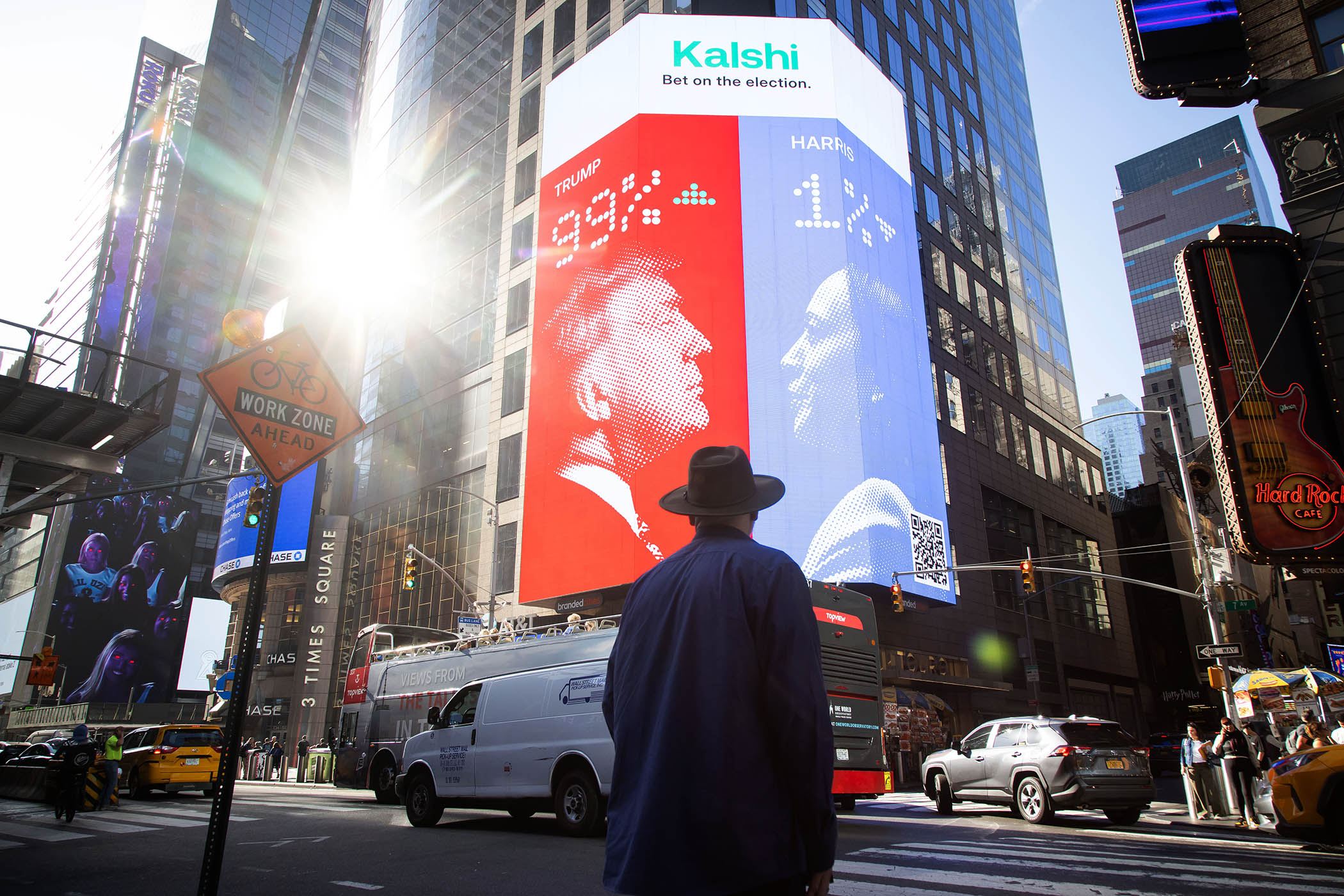
When Kalshi and Polymarket first tried to list contracts on political events, the Biden administration was fiercely opposed. Everything changed in 2024, when Kalshi won a crucial lawsuit against the CFTC, allowing it to list event contracts tied to the US presidential election. These correctly predicted that Donald Trump would win even as traditional opinion polls foresaw a tight race.
Naturally, this made Trump a prediction markets fan. Soon after, his son, Donald Trump Jr, became a paid adviser to both Kalshi and Polymarket. Last July, the Justice Department lifted a ban on Polymarket admitting American customers. It’s understood that the CFTC is working on new rules.
Though there is a strong case for tough regulation to protect the vulnerable from predatory marketing of event contracts, no one expects any regulatory intervention by the current administration that might slow the growth of prediction markets.
However, industry leaders with an eye to the long-term fear that the regulatory pendulum might swing back with a vengeance under a future US administration. That may be why some efforts are under way to improve self-regulation, particularly of insider trading.
Last month, Kalshi, which says it has already investigated a couple of hundred possible cases of insider trading, said it had fined and banned a politician who bought an event contract that would pay out if he were elected governor of California, and an editor working for top YouTube content king Mr Beast, who traded contracts tied to how many views new videos would get. Kalshi also cancelled contracts on leadership change in Iran after Khamenei’s demise, as death-based contracts are not allowed – perhaps because they might incentivise bad behaviour by potential insider traders.
Yet they continue to use the same sophisticated data-driven “gamification” techniques to keep the punters coming back that are used by other sports betting sites, such as market-leading FanDuel. Distancing themselves from the dark side of gambling, and focusing on what makes them genuinely novel and innovative, may be crucial to the long-term success of prediction markets. But currently, the money is flowing in the opposite direction.
Photograph: Michael Nagle/Bloomberg via Getty Images