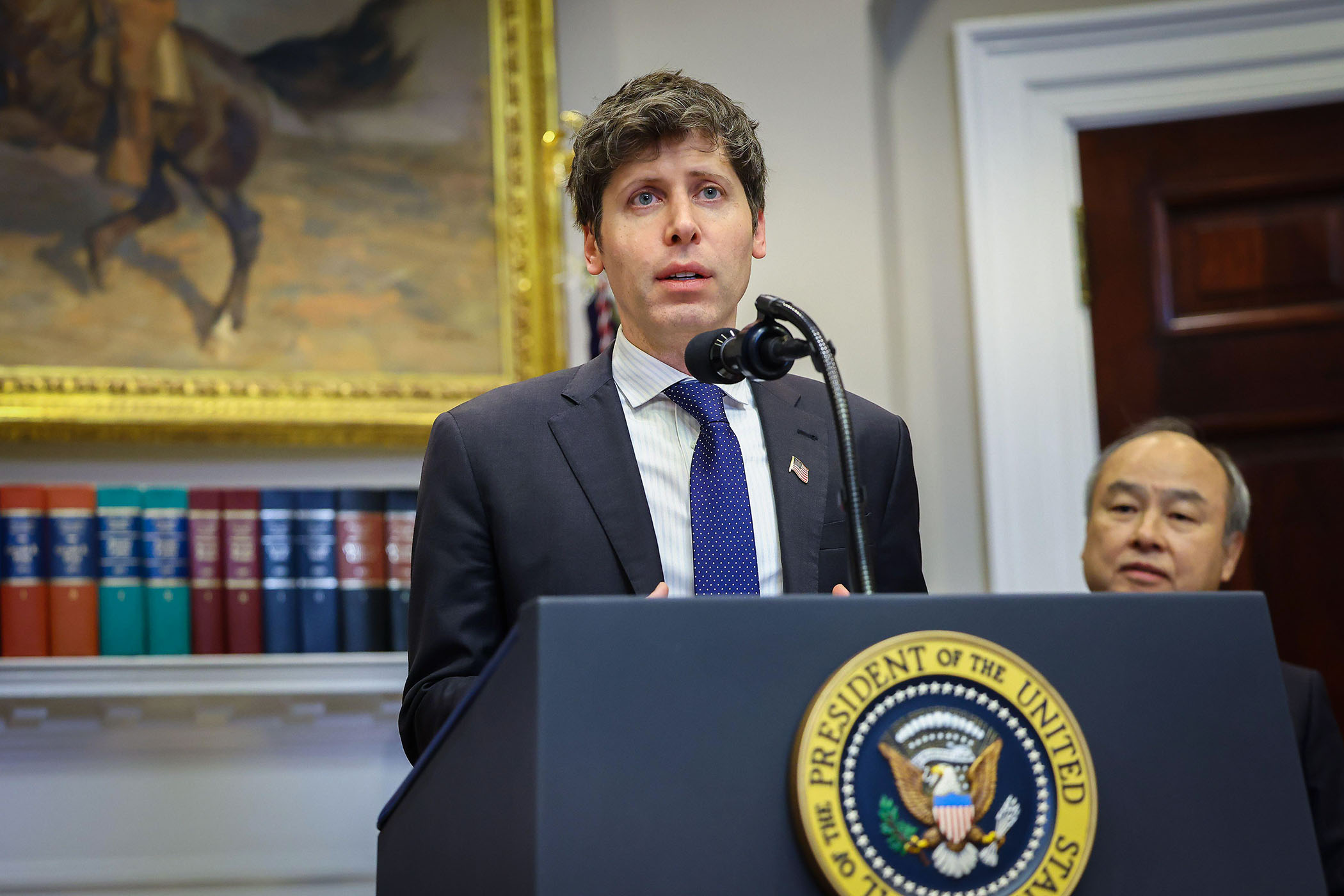

OpenAI’s boss Sam Altman has offered Uncle Sam a 5% chunk of the company’s equity, worth about $43bn on latest estimates, and challenged rival AI firms to do likewise. The idea is to let the American public in on the coming AI IPO bonanza and cushion the blow of the mass job destruction he fears AI will unleash. Donald Trump loves the idea, though probably not for the right reasons.
If AI is going to devour white-collar work, giving citizens a stake in the economic upside seems only fair – and might limit the growing anti-AI backlash. (We should consider something similar here.) Yet adding to the state’s portfolio of stakes in key companies (including most notably Intel) would increase worries about how the state might protect its investment in an economy that is no longer laissez-faire – especially given Trump’s tendency to assume l’État, c’est moi. (Trump owns Intel shares, which for predecessors would have been deemed an unacceptable conflict of interest).
There may be an easy fix to at least part of this problem: give the shares to the newly created Trump Accounts, specially created tax-favoured savings vehicles for America’s children, echoing Gordon Brown’s regrettably short-lived baby bonds. Corporate America is already piling in: Micron just pledged $250m (but cash, not equity) to mark the US’s 250th anniversary, with Nvidia, Coinbase and BlackRock among those following.
If $43bn of OpenAI equity were split between 73m children, it would give each one nearly $600 in a fund they can use when they turn 18. Add stakes in other AI companies and the money could become a significant nest egg.
That would be a tangible benefit for “gen AI”. And while it would put Trump’s name on the money, the structure would prevent him actually getting his hands on it.
BT revives its dream of a happy ending
Last week BT struck a notable deal, folding its international arm, which serves multinationals in 180 countries, into a 50:50 joint venture with the US’s Verizon, which will pay a $625m “equalisation fee” to level up the two sides.
This comes with a strong sense of déjà vu. The business Verizon brings is descended from MCI, an American carrier BT tried to marry in 1996, when the two agreed to create Concert plc – a transatlantic colossus billed as the largest international merger in history. Then BT’s shares wobbled, it trimmed its offer and WorldCom swept in and stole the bride. BT’s global dream staggered on in a venture with AT&T and duly collapsed in 2001. Now the exes are back at the altar.
BT’s Allison Kirkby would probably not be seen dead in the signature cowboy boots of Verizon’s Dan Schulman, but otherwise the CEOs behind the deal are cut from the same cloth: outsiders sent into bloated former national champions, cutting deep (BT will shrink from 130,000 staff to 75,000, Verizon is cutting 13,000 jobs in its largest cull yet), betting on AI and beating a disciplined retreat to focus on their home market.
This seems a classic example of managed decline dressed as strategic focus: two humbled incumbents disposing of the global ambitions that once defined them.
Newsletters
Choose the newsletters you want to receive
View more
For information about how The Observer protects your data, read our Privacy Policy
And yet. Kirkby calls the venture a possible “platform for further consolidation”, and she may be right. The AI boom is reviving demand for the very kind of global plumbing Concert was built to sell, just as Europe’s fragmented market cries out for scale. The dream that broke BT might, second time round, be an idea whose moment has come. Like old flames who reconnect on Facebook decades later, now older and wiser, perhaps they will live happily ever after.
Stop stablecoins playing fast and loose
The rise of stablecoins is crypto-finance’s most serious effort yet to reinvent money, pitting fans of innovation against those who fear they bring fresh risk to the financial system. In Britain, stablecoins have become the subject of a tug-of-war between a Treasury that wants a booming crypto industry for its growth plans and a wary Bank of England, whose governor, Andrew Bailey, dismisses them as no “substitute for commercial bank money”.
Last week important context arrived in the latest annual economic report of the Basel-based Bank for International Settlements (BIS), the central banks’ own club.
It is scrupulously fair. Stablecoins (tokens pegged to real money such as the dollar) offer genuine promise, it says: programmable, near-instant, cheap cross-border payments, and a lifeline where local currencies fail. Yet its worries run deeper than even those of Bailey, who fears that stablecoins will drain deposits and starve British lending.
The BIS sees global risks – of coins greasing crime, and of dollar tokens undermining poorer nations’ control of their own money. Above all, it argues that a stablecoin tied to a real currency is not really money. Its value holds only as long as the assets behind it do – and it need not trade one-for-one, or convert into public money at par. It lacks “singleness”, the guarantee that a pound is always and everywhere a pound. At scale, that flaw could jeopardise the financial system.
The BIS highlights an alternative: a “unified ledger” that gives money the speed of crypto while keeping central bank cash at its heart. Through Project Agorá, eight central banks, including the Bank of England, have built a prototype settling cross-border payments in seconds.
The Treasury and Bank should work together to build central bank-anchored alternatives fast enough to matter – before the US’s looser, faster coins, and perhaps their equivalents here, win by default.