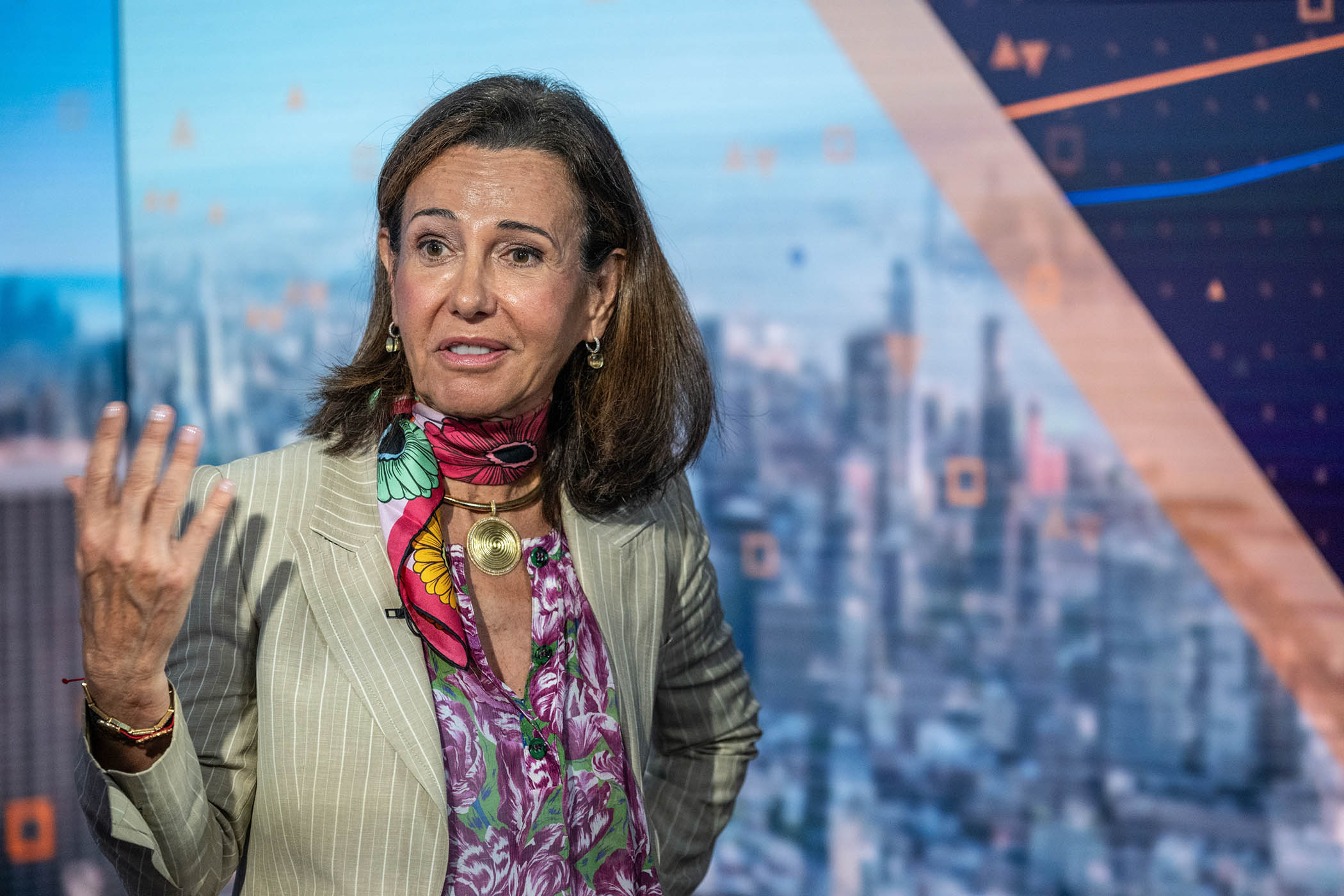



The claim last week by Santander’s Ana Botín that the UK’s tax treatment of banks “makes no economic sense” is all too obviously self-serving. The executive chair has added her voice to a constant chorus of complaints from banking leaders. If Britain needs more tax revenues, as its troubled public finances suggest it does, their message is to go elsewhere. As Botín put it: “If policymakers are looking for sectors earning outsized returns, there are other places to start.”
But are there, really? Bigger margins are indeed earned by big tech and by oil and gas, but both already face special taxes of their own. There is a strong case that the banks themselves are the windfall story Botín denies: the sharp rise in interest rates swelled their net margins, gains they proved notably slow to pass on to savers. Santander has posted record earnings for three years running.
As for the bank levy that Botín wants scrapped, it is paid not as a slice of profits but as a fee for the valuable safety net the banks enjoy courtesy of the government’s consumer protections – deposit insurance and the strong probability of being bailed out (yet again) should things go wrong. Banks are different: they should pay extra for the special privileges and protections they enjoy.
Botín does have a point that the levy, tied to the size of a bank’s balance sheet, may in theory discourage the very lending the government’s growth agenda needs. But the answer to a clumsily designed insurance premium is to design it better, to sharpen its risk-weighting, not scrap the public’s safety net fee altogether. With profits at record highs, the banks hardly need the extra inducement to lend in any case.
Private equity pounces on non-profits
The investment pendulum may be starting to swing towards green again, especially as soaring oil prices remind investors of the case for alternative clean energy. One interesting example of renewed activity was announced last week by the British private equity giant Permira: the first investment from an energy transition fund it opened in 2024. An unusual aspect of this deal was that it paid an undisclosed sum, said to be hundreds of millions of pounds, for a majority stake in what until now has been a non-profit.
The Carbon Disclosure Project (CDP) was started in December 2000 by the green finance pioneer Tessa Tennant and corporate comms and branding expert and Beautiful Corporations author Paul Dickinson, joined soon after by longtime CEO Paul Simpson. Backed initially by 35 institutional investors managing trillions of pounds, it initially sent thousands of companies an annual request for data on their carbon emissions. This soon evolved into structured programmes for public emissions disclosures. The idea: use market pressure from investors to make hitherto private or uncollected information public, putting pressure on companies to do the right thing for the planet.
As voluntary disclosures have turned into mandatory compliance, this information, and the tracking systems companies use to gather it, have become valuable assets – especially attractive to an investor such as Permira with a track record of scaling data and software businesses.
Though tiny compared with artificial intelligence giant OpenAI, which also started as a non-profit before switching, it similarly faces the existential challenge of whether it can retain the sense of mission that brought it to life (and, in the CDP’s case, made it a target of the anti-ESG movement). The rump non-profit, which spun off its commercially valuable assets to Permira but retains a minority stake in them, still has important work to do.
Tech leaders love Tolkien but are missing his message
Newsletters
Choose the newsletters you want to receive
View more
For information about how The Observer protects your data, read our Privacy Policy
First it was Leo XIV, quoting the wizard Gandalf in his recent papal encyclical on humanity and artificial intelligence. Now it is Anthropic’s boss Dario Amodei. In his latest essay, “Policy on the AI Exponential”, Amodei opens with a group of hobbits trying to alert Treebeard, an ancient, slow-moving tree herder, to a looming existential threat – his metaphor for the urgent need for today’s regulators to get to grips with the civilisational threat posed by AI.
Silicon Valley has long found inspiration in the ancient fantasies of JRR Tolkien, almost as much as in the futuristic sci-fi worlds of Star Trek and Star Wars – especially those tech titans who grew up playing Dungeons & Dragons. Famously, Peter Thiel, whose affection for the The Lord of the Rings may have prompted the Pope’s Gandalf reference (tit for tat after Thiel’s recent lectures on the Antichrist), named his much-criticised data company Palantir, after the novel’s “seeing stones” (which, ironically, show selective truths that deceive those who trust them). Defence tech company Anduril, as well as Mithril Capital and Valar Ventures, also owe their names to Tolkien.
But do these tech leaders actually understand Tolkien’s main message, which was about the abuse of power? The author was not opposed to technological progress per se, though he was certainly no early adopter; his inclinations were more maker-artisan than the innovation-at-all-costs hyper-capitalism of Silicon Valley – a place that, before the office parks and tech company campuses, was bucolic orchard country, reminiscent of the Shire home of the hobbits that was brutally “scoured” by the forces of industry.
Even Amodei may be being too kind to himself by putting his arguments in the hobbit camp. When Treebeard finally understood the true nature of the threat, he did not seek to regulate it better but set about destroying it.
Photograph by Victor J. Blue/Bloomberg via Getty Images