
When I interviewed Jack Clark, the co-founder of the AI lab Anthropic last month, he told me the public is living through a moment of “generalised anxiety” about artificial intelligence: a diffuse unease about the future of jobs, the economy and the technology itself. But lately, I think, that anxiety has been bubbling into full-blown rage.
In April, a 20-year-old man threw a petrol bomb at the San Francisco home of Sam Altman, the CEO of OpenAI. And last month, three senior executives were booed by crowds of students while speaking about AI at university commencement ceremonies in the US – most notably Eric Schmidt, the former Google chairman, who was jeered when he told graduates that AI would “touch every profession”. At a panel I chaired in London last weekend, a senior researcher at Google DeepMind told me he had been booed at, of all places, a book club.
New research suggests this sentiment is fast becoming a political problem in the UK – one that the major parties have barely begun to register. The study, by Daniel Stone, a Cambridge-affiliated researcher who runs the AI policy consultancy Diffusion, surveyed 2,911 adults and found that 69% are concerned about the future of AI, a worry that cuts across age, region and income, and may already be loosening voters from their old loyalties.
Labour has shed between 13 and 24 percentage points in every region of the country since the 2024 election, and the voters walking away are consistently more worried about AI than those who stay, more convinced it is moving too fast and less persuaded that anyone is managing it on their behalf, says Stone.
Given the booing at universities, it is tempting to file all this as a young person’s worry about jobs. And while fear about work is real – 74% expect AI to shrink the number of jobs available – AI anxiety actually deepens with age. Nor is it a matter of older people simply not understanding the technology. “People aren’t anxious because they don’t understand [AI],” Stone told me. “It’s because they do. They’ve seen who this stuff is being built for, and they’ve come to the view that it isn’t for them.”
Women are most concerned of all. Just over one in 10 say they are excited about AI, against a quarter of men. The gap is starkest among young university-educated men – the majority of whom believe AI is positive for both the UK and humanity – and women, who are 20 percentage points behind.
Adele Walton, a Gen Z journalist and online safety campaigner, is not surprised. Women are already at the sharp end of the technology’s harms, from deepfakes to the privacy questions raised by a coming wave of AI and camera-equipped smart glasses (“basically perverts in the street using them on women”, as Walton puts it.)
Stone’s data shows that both sexes are uneasy that AI is being built so far from their lives – by a small, wealthy elite in Silicon Valley. But women were also struck that almost all of those building it are men, and that their safety, as a result, is too often an afterthought. “The level of distance between the people building this stuff and [women’s] lives is enormous,” Stone says. Among young men, meanwhile, he found “a blind optimism and hope that it’ll work out. They see this as a technology that’s built for me, by people I get – and may even idolise.”
The generalised rage can take many forms. It manifests itself in artists and creatives, angry because they believe their life’s work has been stolen without their consent; in the women who discover their naked bodies have been deepfaked by strangers on the internet; and in the workers hired and fired by an algorithm they never see. But of course all of these harms are different. AI does not describe a single technology as much as a suite of them. What unites respondents, Stone found, is not fear of the technology itself but a suspicion about the men who control it.
If the anger feels sudden, it is really the latest turn in a longer reckoning with big tech that began with social media. The public, says Walton, have simply learned from last time: “People are just not falling for it any more.” AI, to her, is “a new frontier for extraction – of our emotional lives, our land, our natural resources, our economy”.
Newsletters
Choose the newsletters you want to receive
View more
For information about how The Observer protects your data, read our Privacy Policy
Jonnie Penn, a University of Cambridge academic who teaches AI ethics, casts it as a civil rights question for the digital age: who do these systems serve? Who are they built to overlook. “There are pathways to worlds so bleak,” he says, “that people will fight.”
The very breadth of the grievance, Stone says, is what makes this “dangerous for government”; AI can become a scapegoat for any number of social problems. In Britain, politicians still tend to wave the subject away as a “nerdy London thinktank concern”, Stone says, but he has run the same research in California, where AI became a top-three issue in the governor’s race, and he reckons “the UK is two or three years behind”.
He has glimpsed where this all leads. Presenting his American findings in San Francisco last year, Stone was heckled by activists from a coalition called Stop AI, who accused him of “murdering children” for being too permissive about the technology, even though his work is broadly critical.
So far, the UK government’s instinct has been to sell AI as an engine of growth and innovation – a pitch that, on Stone’s evidence, has badly missed the public mood. The remedy is straightforward: regulation, and regulation “with teeth”. About 85% of Stone’s respondents want stronger laws to make AI safe.
Nuala Polo, UK public policy lead at the Ada Lovelace Institute, says better regulation could bolster AI adoption and help the public harness the benefits of the technology – because there are many, from cutting bureaucratic backlogs to speeding up medical diagnosis.
“It’s clear that the public don’t have a lot of confidence in the companies to navigate this,” says Stone. The solution lies in an independent regulator, he says: a body of experts with the legal power to compel companies to meet safety standards before their products reach the public, and to penalise them when they don’t.
The current oversight is patchy. Ofcom polices some online harms, and the AI Security Institute has no statutory powers and depends on the cooperation of the companies it examines. In effect, the safety of the systems millions already use rests on the goodwill of the firms that build them.
“It’s one thing to say you can’t drive a car until you’re 18,” Stone says. “It’s another to make sure the car has airbags and doesn’t turn into a small cube if you hit a wall. People are looking for systematic oversight of these tools and the way they’re implemented, not just ad hoc corrections at the points where things happen to fail.”
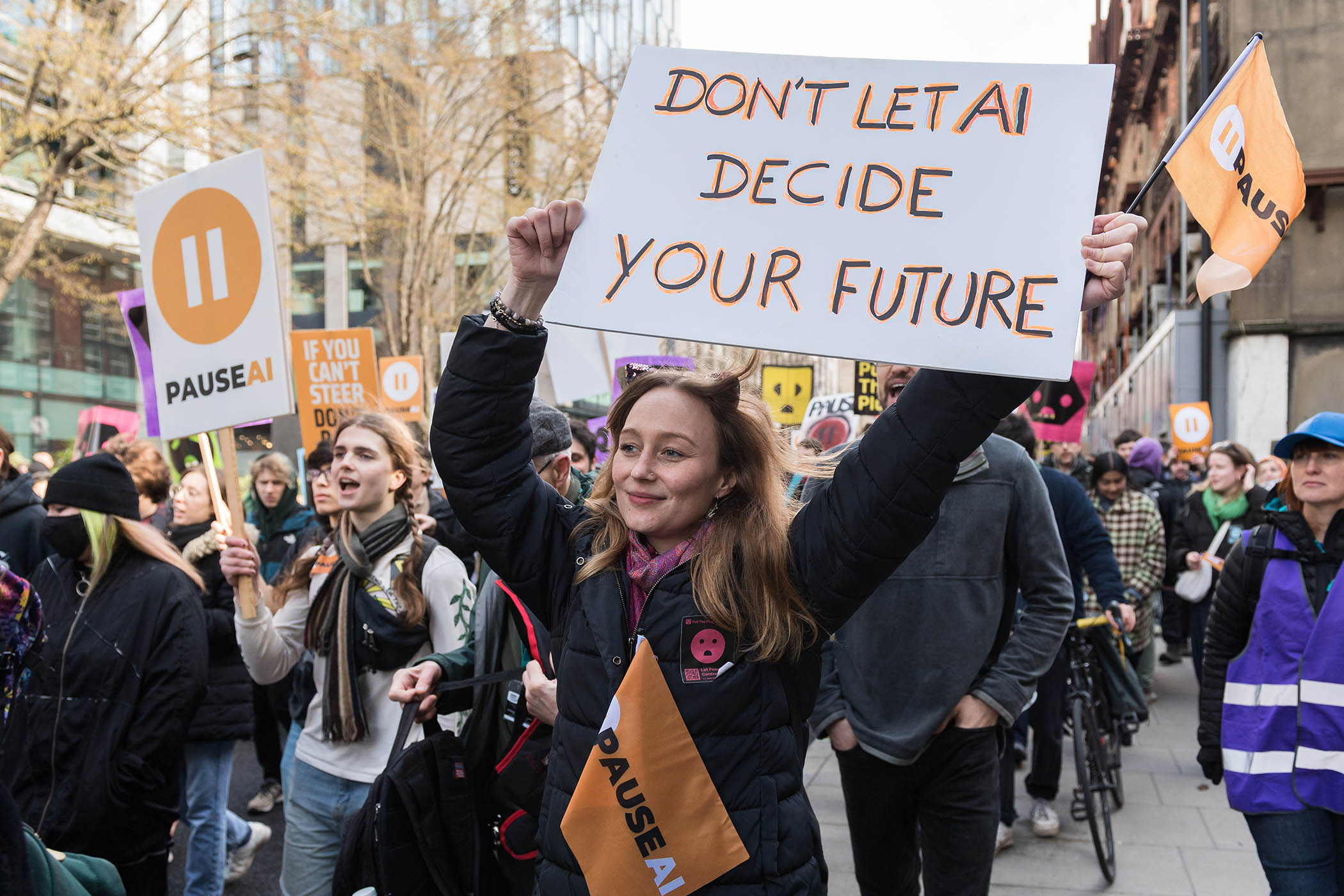
Until that happens, the generalised rage is unlikely to dissipate. More likely it will harden, from a mood into a movement.
Thank you for reading. Tell us what you think by writing to letters@observer.co.uk
Photograph by Wiktor Szymanowicz/Future Publishing via Getty Images