
Recent Israeli estimates suggest Iran has a stockpile of 80,000 Shahed drones and production capacity to build about 400 each day, provided factories remain up and running. Intercepting that arsenal will come at a sizable cost to US and Israeli militaries.
But Iran’s drones face another threat: obsolescence. At a recent Chatham House talk, Al Carns, the UK’s armed forces minister, said the evolution of technology makes some unmanned aerial vehicles (UAVs) redundant after just eight weeks.
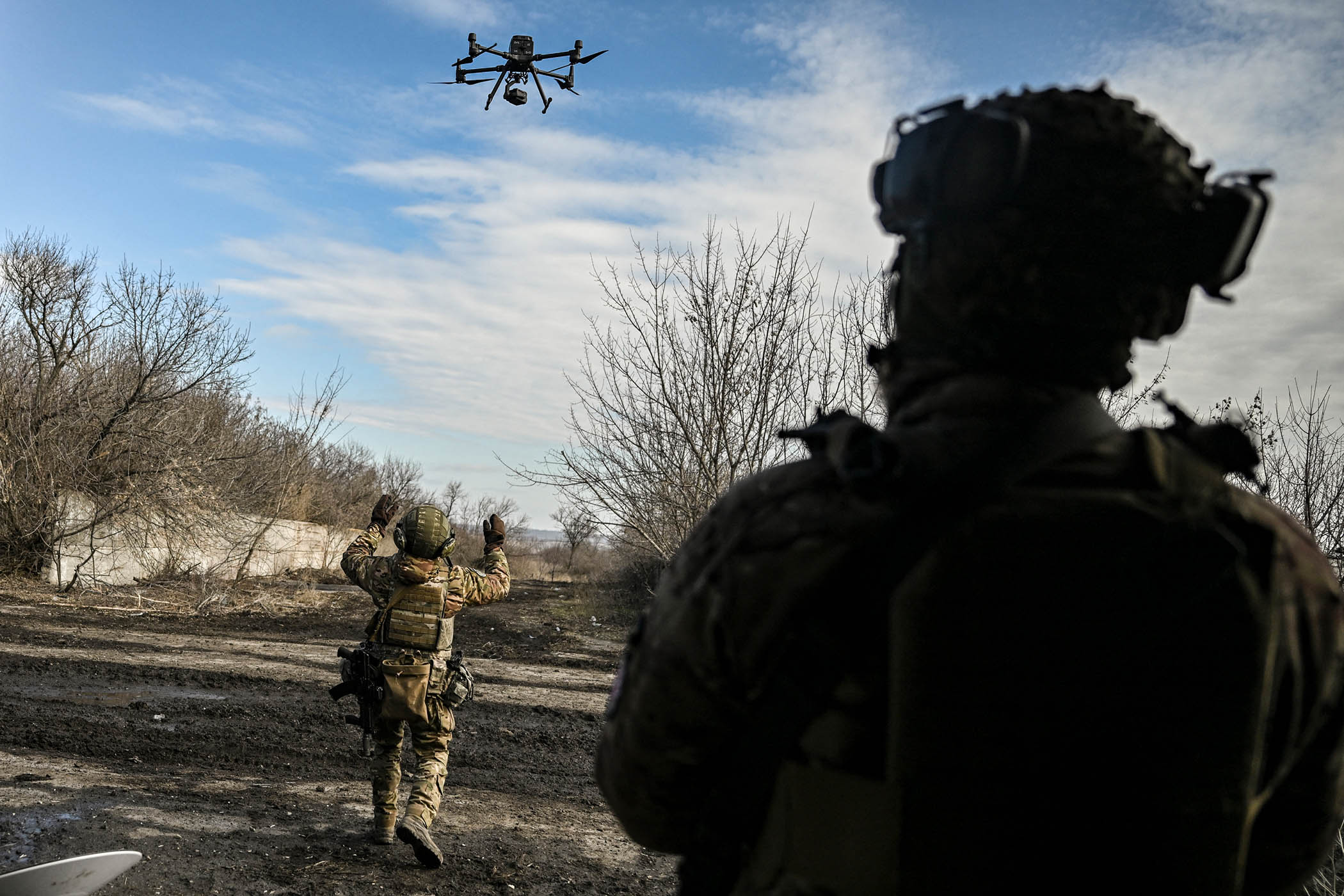
This has prompted dramatic changes within the UK’s defence sector. In just six months last year, the UK supplied 85,000 drones to Ukraine. That included tens of thousands of short-range “first person view” (FPV) drones critical to supporting frontline combat activities.
‘The truth is that within a year or two we will have completely different technology’
‘The truth is that within a year or two we will have completely different technology’
Dmytro Selin, founder of Drone Spices
Remotely piloted using an onboard camera, these relatively cheap, mass-produced so-called kamikaze drones, costing perhaps £400 to manufacture, can travel almost 10 miles beyond the frontline. Travelling at speeds of up to 60mph, they carry a small payload big enough to obliterate a Russian soldier or vehicle. Drones are now responsible for three in every four battlefield casualties in Ukraine.
In just a few short years, the UK industry has been transformed. A plethora of suppliers has sprung up to meet demand: from defence industry prime contractors such as BAE Systems to smaller specialists such as Windracers, Evolve Dynamics, Modini and Tekever. Many are emerging around Swindon – where Spitfires were once made – which is fast turning into a UK hub for the technology.
Tom Redman, chief executive of Evolve Dynamics, says that while startups are agile and adept at innovation, they often struggle to scale production at the level required. Meanwhile, the big defence prime contractors are “fairly risk averse… [and] are not really keeping pace with a rapidly developing landscape”.
All are constrained by supplies of magnets and raw materials, including rare earth minerals such as neodymium, primarily sourced from China. These are essential for manufacturing effective motors and gimbals – the vital sensors at the front of drones that help them manoeuvre through the air.
“The UK as well as many other states are investing heavily in these short-term attack drones,” says Chris Coles from Drone Wars, a thinktank. “They are making hundreds of thousands of these systems.”
Last year, the UK spent £600m on military drones for Ukraine – a significant chunk of the £4.5bn total spent to support Ukraine’s defence.
“The demand is just staggering,” says one UK-based manufacturer, who spoke on the condition of anonymity, citing security concerns. “Because so many drones are now being used on a daily basis.”
Newsletters
Choose the newsletters you want to receive
View more
For information about how The Observer protects your data, read our Privacy Policy
While 85,000 drones may sound a lot, it pales besides the extraordinary numbers being deployed in conflict. Ukraine is aiming to manufacture 4.5m drones a year and using 9,000 a month on the battlefield.
The numbers in the conflict with Iran could be even higher. In recent days officials in Dubai said air defence dealt with 165 ballistic missiles, two cruise missiles, and more than 540 Iranian drones in just two days.
For countries such as the UK and Germany looking to build up their own drone capabilities, the rapid pace of change poses a dilemma.
“The truth is that within a year or two we will have completely different technology,” says Dmytro Selin, the Ukrainian founder of Drone Spices, a manufacturer of personal drone detection devices. “So it’s about having companies that can iterate fast with new developments rather than how many they can produce.”
Stephen Wright, chairman and founder of Windracers, recently told the website BFBS Forces News: “There are iterations nearly every week. It’s quite phenomenal, the pace of development.”
The industry’s ferocious growth is reflected in a policy shift last year by the US Department of Defence, which no longer treats small drones as vehicles but expendable ammunition.
Naturally, the boom in UAVs has proved lucrative. The market for drones is valued at $69bn a year globally but is expected to hit $140bn by 2036. The figure includes both civil and military variants.
Selin, who is now based in the UK, talks of the need for constant adaptation on the frontline. “Things change really fast so it’s that ability to produce in large numbers and to adapt fast enough.”
Redman likens the need to scale production of drones to running a steelmaking furnace which has to be kept constantly fuelled and operational to be economically viable.
“There has to be a sovereign prioritisation and self-reliance that can’t be disrupted,” he says. “You need to pump quite a lot of scale through the supply chain.”
However, not everyone is convinced that drones represent a fundamental or irreversible change on the battlefield. Coles, for one, is sceptical about the long-term potential of drones – especially when it comes to changing the overall momentum in Ukraine. He talks of a grinding stalemate where a growing arms race in drone deployment has failed to make a dent in the outcome.
“Often these systems don’t hit their target,” he says. “They have limited fuel range and often simply fall out of the sky.”
Photograph by Aris Messinis/AFP/Getty Images