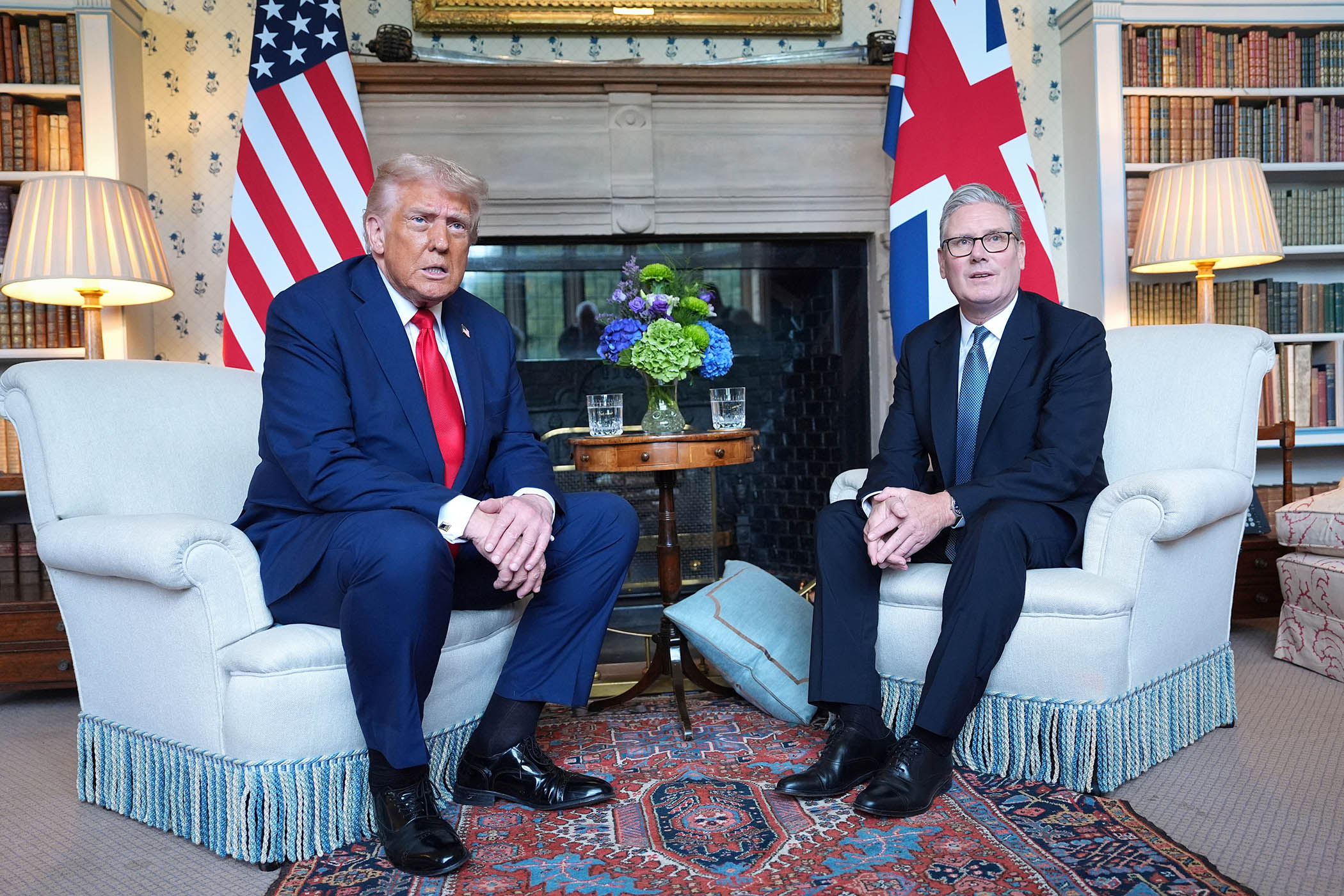



I think we can safely say that the special has gone out of the relationship between Donald Trump and Sir Keir Starmer. With his trademark combination of tantrumy toddler and playground bully, the US president has derided the prime minister as “not Winston Churchill” disparaged the UK’s two aircraft carriers as “toys” and sneered that Britain should “build up some delayed courage” and “get your own oil” from the Gulf. The barrage of insults don’t seem to be harming Sir Keir with his domestic audience; the brickbats may even be doing him a favour. Neither the US president nor his reckless war are popular with Britons, who are justifiably sceptical about a conflict unleashed with the strategic foresight of Elmer J Fudd. “This is not our war,” the Starmer mantra, aligns with the opinion of both the vast majority of his party and the median voter. Some of the public say his handling of the crisis has improved their view of the prime minister and the numbers thinking he should quit Downing Street have declined a bit. Not a sea change, but the tide is running in a slightly friendlier direction.
It is further to his advantage that the crisis invites the nation to scrutinise the judgment of wannabe alternative leaders. Labour is taking every opportunity to remind voters that Nigel Farage was all for joining the war of Donald’s ego before performing a reverse ferret when the leader of Reform clocked how unpopular it is. Kemi Badenoch has imitated the haphazard trajectory of a drone with a scrambled navigation system. Put to the test by a geopolitical emergency, the rival leaders of the British right have flunked this audition for Number 10. They are now making opportunistic demands for cuts to fuel duty and VAT on energy bills, the first refuge of the opposition politician desperate for something to say.
There are other senses in which ministers hope the government might sustain a claim to be having “a good war”. The Iranian blockade of the Strait of Hormuz underlines the perils of having your national prosperity reliant on the supply of hydrocarbons. The prime minister is leaning harder into the argument that switching to renewables and nuclear is imperative to enhance our long-term energy security. The rupture to the relationship with the US has emboldened Sir Keir to sound more ambitious about embracing a closer relationship with our neighbours in the EU.
Though none are so crass as to say this out loud, some of the prime minister’s supporters in the cabinet think these events are enhancing his chances of surviving the May elections. However diabolical the results are for Labour, would not the voters be repelled by the spectacle of the party trying to execute its own version of regime change by ousting its leader amid such acute international stress? So goes the argument from Starmer loyalists. I’m hearing an echo of what Boris Johnson’s supporters said during the onset of the conflict in Ukraine, when they claimed it would be unconscionable to change prime minister at a time of war. That contention did protect him from a challenge, though only for about six months.
What even the most ardent Starmerites can’t deny is that the economic blowback from this war will be grisly, which is unlikely to be beneficial for the government or the man presiding over it. Even if hostilities ceased tomorrow, the energy price shock is going to be jolting the average voter for months to come. Sir Keir kind of admitted this at his news conference at Number 10 last week, when he insisted that the UK is “well-placed to weather” the storm while also referencing the devastating energy shocks of the 1970s “when my family could not pay every bill”.
The biggest fear among government insiders is the unravelling of their recovery strategy
The biggest fear among government insiders is the unravelling of their recovery strategy
The biggest fear among government insiders is the unravelling of their recovery strategy. The most basic explanation for the government’s unpopularity is that people are feeling badly off. From Downing Street’s perspective, most of the point of this year was supposed to be about easing the cost of living, and Easter was expected to be the point in the calendar when voters began to feel palpable improvements. Before missiles started criss-crossing the Middle East, the government hoped to be able to proclaim that the UK had turned a corner as a result of declining inflation, decreasing mortgage rates, falling fuel bills, the freeze on rail fares and prescription charges, and increases to the minimum wage and the state pension. Perhaps, ministers dared to hope, this would start taking the edge off public animosity towards Labour.
Well, you can bin that rosy scenario along with all the growth forecasts rendered redundant by the conflict. The OECD reckons that the UK’s growth prospects will be hurt more severely than any other country in the G20 club of large economies. We actually get relatively little of our oil and gas from the Gulf, but will be hurt by the surging price of both on international markets. The UK’s heavy reliance on gas-fired power is a vulnerability which has more to do with the age of our draughty housing stock and having a chillier climate than most peers than it has to do with the government, but this doesn’t mean they will escape the blame. The bill for the energy shock will not be felt simply in higher prices at the petrol pump and steeper home heating bills. The Food & Drink Federation forecasts that food inflation, which has subsided to around 3%, will shoot back over 9% by the end of the year. One thing we have learned from the recent past is that voters really, really hate it when their groceries suddenly become a lot more expensive and, fairly or not, they focus their ire on whoever is in charge.
The chancellor is indicating that there will be targeted support to insulate the most vulnerable groups from rising energy costs, but the Treasury is fiercely resistant to a repeat of the disastrously expensive blanket energy subsidy introduced by Liz Truss in the autumn of 2022. With growth lower and interest rates higher than they would otherwise have been, the outlook for the government’s finances becomes grim. In the bleaker scenarios which trouble the Treasury, all of the painful work rebuilding the fiscal buffer will be obliterated – a nightmare for Rachel Reeves.
Just because this is not “our war”, the UK won’t be spared from suffering the consequences. That is not Labour’s fault, but it is Labour’s problem.
Photograph: AP/Evan Vucci
Newsletters
Choose the newsletters you want to receive
View more
For information about how The Observer protects your data, read our Privacy Policy