
A couple of months ago, engineers from a Belgian events company, representatives of an American “live experience” firm and officials from the world’s most popular combat sports competition, the Ultimate Fighting Championship (UFC), gathered in a vast hangar an hour or so west of Philadelphia in the town of Lititz, Pennsylvania.
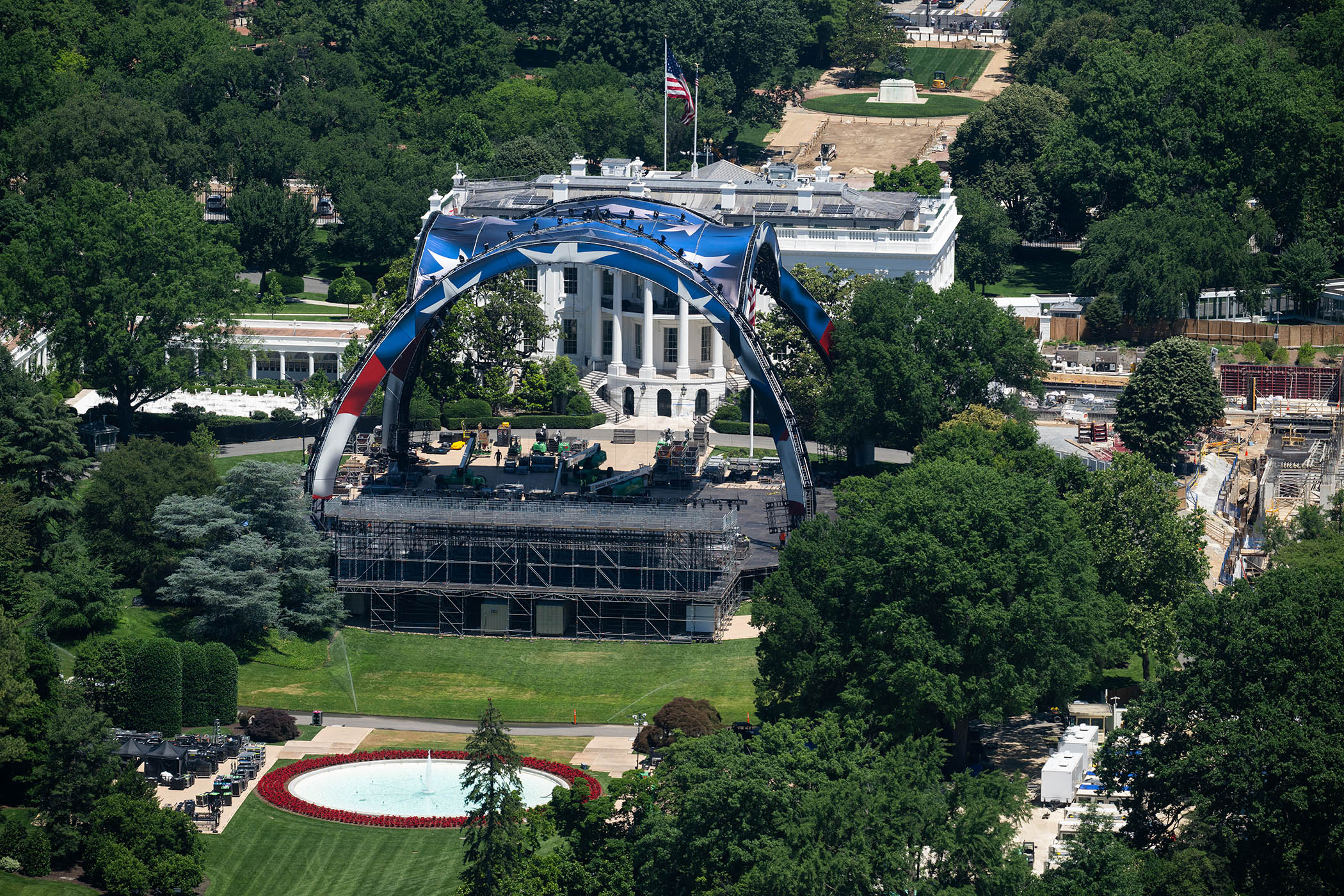
They had a problem to solve. On 14 June, at the express request of President Trump, the UFC will stage a “card” of fights on the South Lawn at the White House. The event, due to be watched in person by 4,000 guests and broadcast live by Paramount Skydance, is a little different from the garden’s more traditional athletic endeavours – the South Lawn is home to the annual presidential Easter Egg Roll.
The various companies tasked with transforming it into the Octagon – the eight-sided cage in which UFC’s (almost) no-holds-barred bouts – are held gathered in Lititz because, in the circumstances, the organisation’s usual setup was out of the question. They needed to check that their solution would work. And to do that, they had to build it.
The issue was with the lighting rig. Designed to be twice its normal height, it would come, once built, to be known as the Claw. The design was the only way to ensure they could get the crucial shot: the Octagon framed by an unobstructed view of the White House itself.
The event caps the astonishing ascent of the UFC from the shadowy backlot of American life to the very heart of the country’s establishment. Three decades ago, the longstanding senator John McCain described the discipline of mixed martial arts (MMA), which the company helped to pioneer, as “human cockfighting”. It is not much more than 20 years since most cable networks in the US were still refusing to carry UFC’s events.
That it should now have been invited to help the US celebrate the 250th anniversary of its founding – the event has been dubbed UFC Freedom 250 – can largely be attributed to Dana White, the company’s bellicose and profane 56-year-old president and chief executive.
In the quarter century White has been in place, he has transformed UFC into the most valuable combat sports company in the world: it claims its 40 annual pay-per-view events are watched by 900m households; it was sold in 2016 to a group led by the talent agency WME-IMG, for $4bn. In 2023 it merged with World Wrestling Entertainment (WWE) to form the publicly listed company TKO Group Holdings. Both divisions now boast revenues of more than $1bn a year.
White has been supported throughout that journey by the other man responsible for the vaguely dystopian look of the South Lawn this week. Trump’s Taj Mahal, in Atlantic City, first hosted a UFC event in 2001, the year White took charge. Trump told Time magazine last month: “That first night, I went home, I said: ‘This is the most unbelievable thing I’ve ever seen.’”
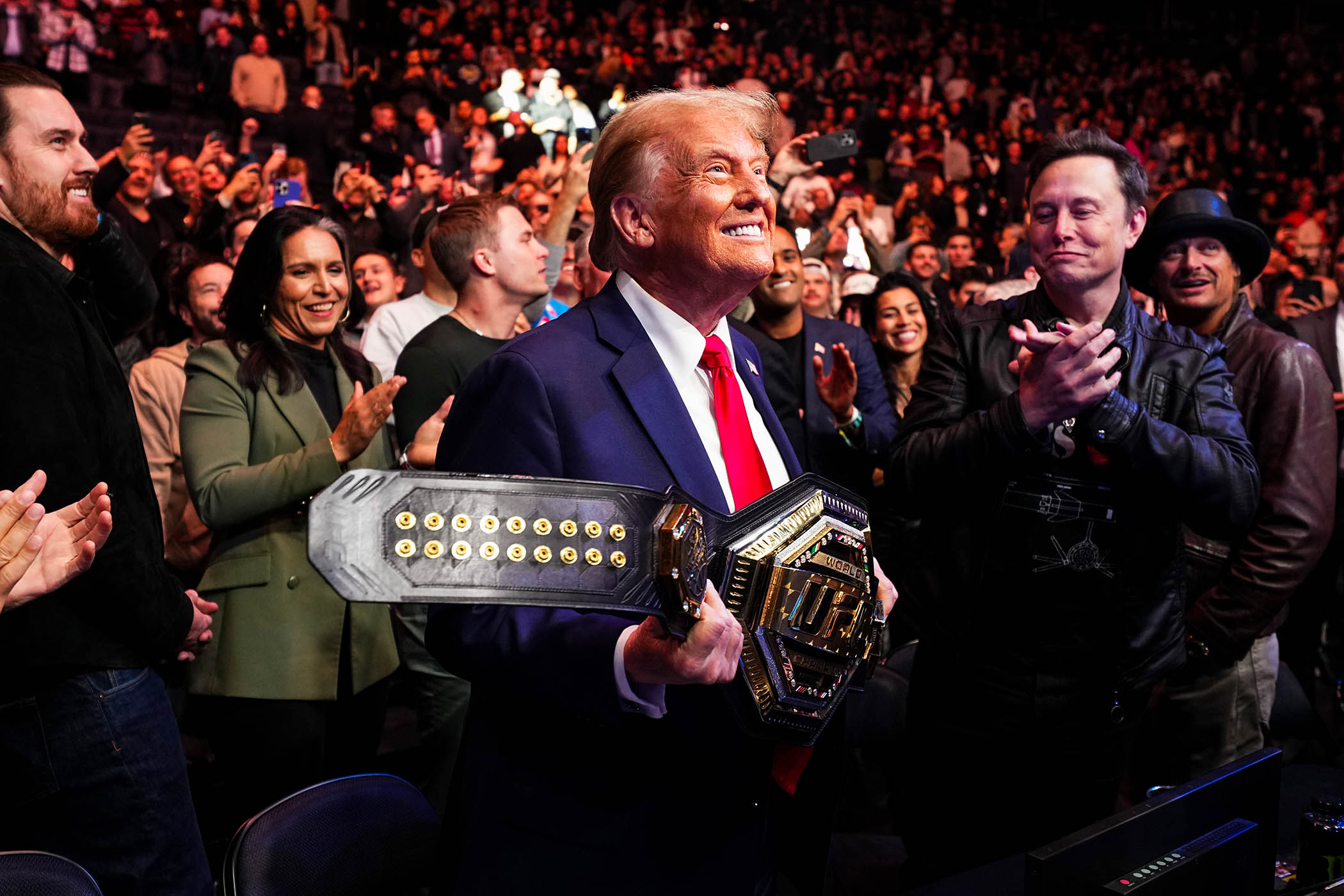
The president has remained in touch with White ever since, sending him the occasional encouraging note and, according to White, calling him a couple of times a month. His first public appearance after being indicted for the 6 January insurrection came at a UFC event. He was given a round of applause. He attended another after the assassination attempt near Butler, Pennsylvania, in 2024, and another after the start of the conflict with Iran. UFC crowds appear to be his safe space.
That relationship has proved to be politically valuable: White, who introduced Trump at the Republican National Convention in 2024, was credited with arranging for the then candidate to appear on a slate of manosphere-adjacent podcasts during the election. He did slots with the Nelk Boys, Theo Von and Bussin’ with the Boys.
Newsletters
Choose the newsletters you want to receive
View more
For information about how The Observer protects your data, read our Privacy Policy
Thanks to White’s persistence, he was granted a three-hour slot on the Joe Rogan Experience, too – followed, eventually, by the host’s endorsement. They have much in common: long before his influential, inscrutable podcast, Rogan cut his teeth as a colour commentator for UFC. Trump’s success in turning his young male audience into voters played no small part in his re-election.
But that convenience should not be confused with inauthenticity. White regards the president as a genuine fan of his sport – a “day one” guy, as he told the New Yorker’s David Remnick. It was Trump who pitched the idea of a fight on the South Lawn to White 11 days after he was restored to the presidency.
To some extent, the explanation for why the White House is being turned into a Hunger Games venue, as one dissenting UFC fighter has put it, is the simplest one: Trump likes White, and he likes UFC.
It is either a coincidence or a secondary benefit that it should also provide the perfect iconography for the “nihilistic hyper-masculinity and violence” that is a “pretty true-to-life reflection of the Maga movement”, as Andrew Elrick, director of the center for sports communication at Marist University, described it.
More interesting is why Trump is drawn to combat sports. He is a longstanding and avowed fan of UFC’s stablemate, WWE. There is one central difference between the two schools: WWE’s bouts are scripted and preordained, whereas UFC’s are entirely real. What they share, though, extends beyond a celebration of brutality.
Both understand, as Trump does, that whether a character is perceived as good or bad is less important than whether they can elicit a reaction from a crowd. Both grasp that people will cheer for the nominal villain if they are compelling enough. Most importantly, both engage in what the author Josie Reisman has called a “melting of reality”. What is true and what is not is not a useful delineation in wrestling. Reality, as Trump knows, can be whatever you want it to be. That insight, either drawn from, or shared with, his beloved combat sports, has informed his assault on politics.
The sight of the Claw looming above the White House, then, is almost a homecoming of sorts. These sports explain Trump better than almost anything else.
Rogan at one point suggested that the fight on the South Lawn was something of a “gimmick” – a term that means “act” or “character” in the carnivalesque language of combat sports. “At first I thought: that’s not nice,” Trump told Time. “And then I realised – it is a gimmick. Life is a gimmick, if you think about it, right? But it’s a good gimmick.”
Thank you for reading. Tell us what you think by writing to letters@observer.co.uk
Photograph by Chris Unger/Zuffa LLC, Saul Loeb/AFP/ Getty Images