As the election race neared its climax, Sebastian Divile-Tóth and two friends headed to the cobbled square in the centre of their home city in western Hungary to see the country’s prime minister, Viktor Orbán.
At the rally in Sopron, they picked up campaign posters painting opposition candidate Péter Magyar as a warmonger who will drag Hungary into the conflict next door in Ukraine.
The 22-year-old and his friends do not support Orbán, but they were curious to catch a glimpse of the man who has shaped Hungary for most of their lives.
“This is unusual that our prime minister is here in the flesh,” said the media and communications student, pausing to light a roll-up cigarette. “It speaks volumes that a two-year-old party has this much effect on our government: they are pretty scared.”
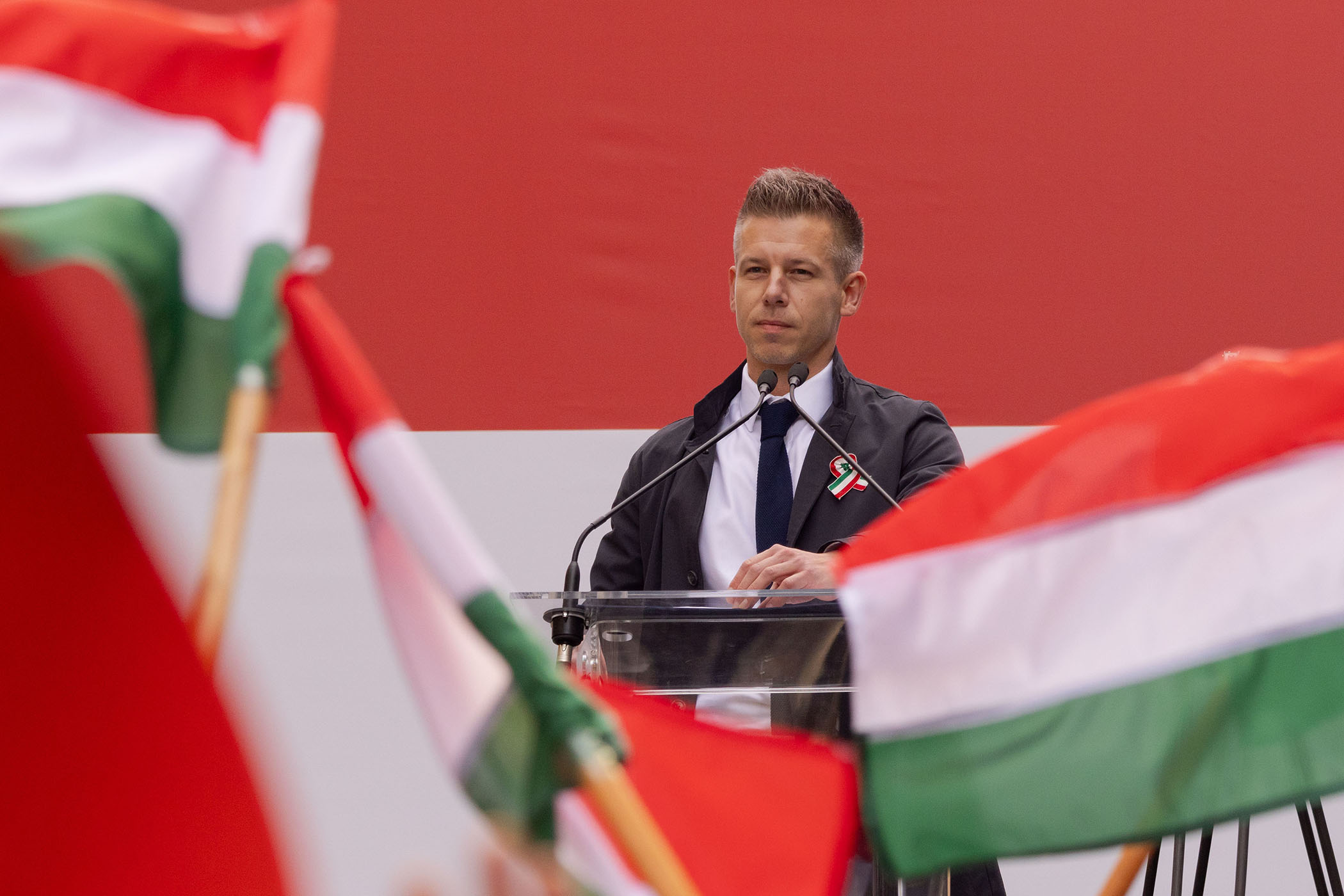
Péter Magyar
It is not just Orbán who is scared of the likely outcome of Sunday’s election. As the pioneer of “illiberal democracy”, he has brought nationalism back to the heart of Europe and found the EU ill-equipped to handle it.
He has founded an international movement with ardent disciples in power in Moscow and Washington who hoped it would spread across the western world. He has co-opted Hungary’s courts and parliament, driven out progressives such as the billionaire George Soros who could afford to go, and tormented those who could not.
Orbán has won four elections in a row by handing control of Hungary’s media to pliant oligarchs. They have captured and corrupted the economy so that the country is now the sick man of Europe, sabotaging efforts by Brussels to save Ukraine and helping Vladimir Putin divide his enemies at every opportunity.
Orbán opponent Magyar is a former ally who knows that years of anti-Ukraine propaganda resonate with much of the electorate. But if Magyar wins on Sunday – and months of polling suggests he will – it will be a turning point for Hungary, Europe and democracy, as well as a slap in the face for Putin.
With Orbán facing the biggest challenge of his 16-year rule, leaders of the populist right have lined up behind him: the Italian prime minister, Georgia Meloni, Israeli leader Benjamin Netanyahu and Argentina’s president, Javier Milei, have all endorsed him.
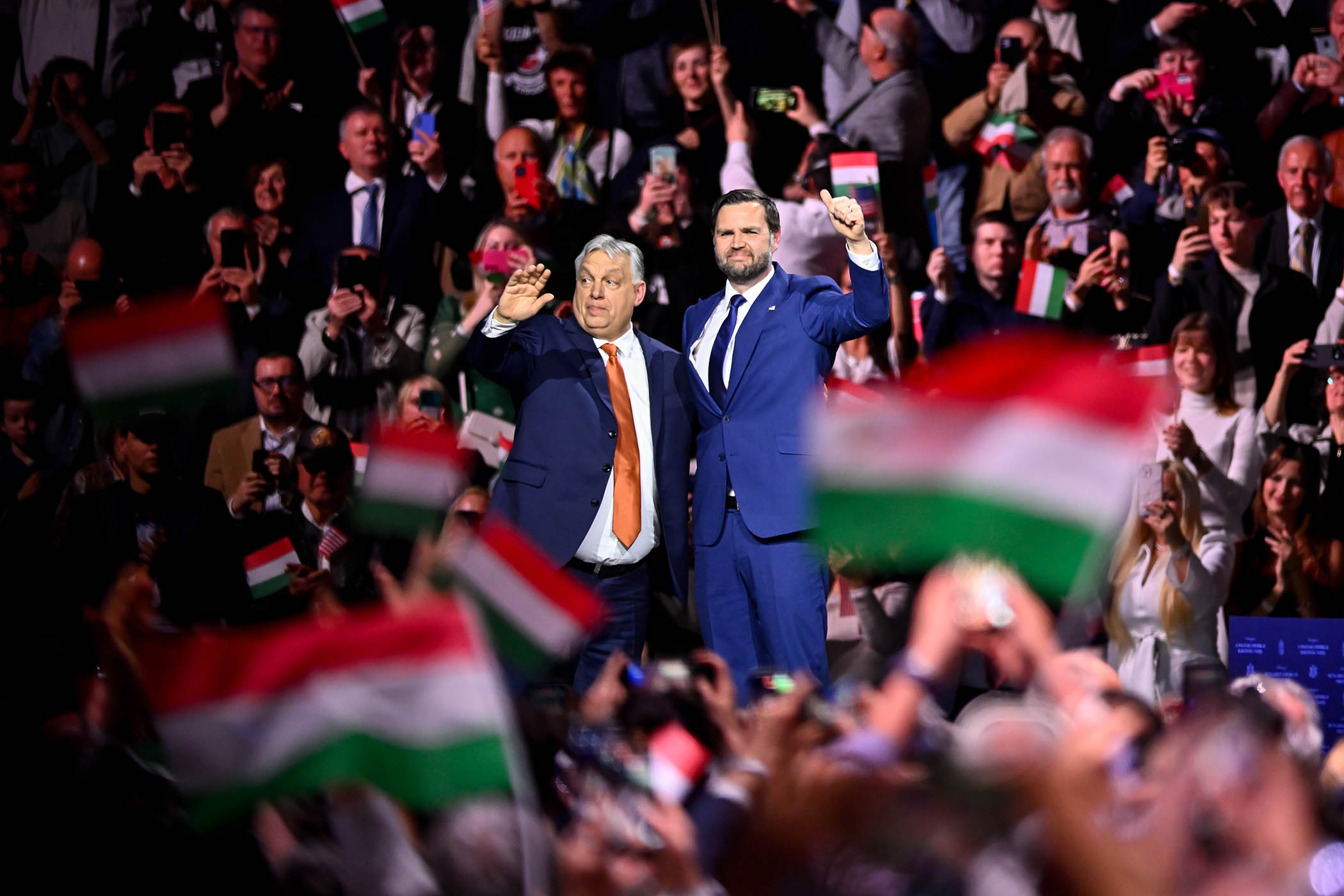
Donald Trump urged Hungarians: “Get out and vote for Viktor Orbán” in a post on Truth Social last week, days after addressing supporters of the prime minister’s Fidesz party at a rally over the phone. The US vice-president, JD Vance, took time out from trying to end the war in the Middle East to travel to Budapest to “help” Orbán’s campaign. With no trace of irony, he accused Europe of meddling in the election and lambasted “Brussels bureaucrats” for destroying Hungary’s economy. A day before the polls opened, Trump pledged to use the “full economic might” of the US to shore up the Hungarian economy.
Newsletters
Choose the newsletters you want to receive
View more
For information about how The Observer protects your data, read our Privacy Policy
On the domestic stage, however, Orbán appears to be struggling. In past elections, Europe’s longest-serving leader gave few rallies, sending members of his party to drum up support. This time, he has been forced to hit the campaign trail. Even in Sopron, which is a reliable bastion of support for Fidesz, the race is tight. The day after Orbán rallied supporters here, Magyar arrived. The two rallies painted contrasting visions of Hungary and its place in Europe.
Divile-Tóth did not hear much of Orbán’s speech, but he is familiar with the rhetoric. He did manage to lay eyes on him for the first time, though. It may be the last.
“We will not become a colony of Ukraine,” read a banner carried by Fidesz supporters on their way to the main square in Sopron’s medieval centre, surrounded by baroque buildings and cherry trees in blossom. The city of 60,000 is one of Hungary’s most prosperous.
Warming up the crowd, its mayor listed his achievements: a municipal swimming pool, a new fire station, the restoration of historic buildings and plans to build a big logistics centre nearby – all thanks to Orbán, he said.
“Viktor! Viktor!” the crowd chanted as Orbán appeared on stage. Jeers and booing welled up from the back of the crowd, where a young man held a piece of cardboard with a caricature of Orbán and Putin in a passionate clinch. “We have guests,” said Orbán, acknowledging the hecklers. Claims that Magyar’s Tisza party was ahead in the polls were a lie, he said.
He soon turned to the political lightning rod of the Fidesz campaign: Ukraine was to blame for Hungary’s economic problems, he said, accusing it of blowing up a pipeline to deprive the country of Russian energy and manipulate the election. A week before the vote, rucksacks full of explosives were found near another pipeline in Serbia that transports Russian gas to Hungary. Magyar has accused Orbán of “panic-mongering” orchestrated by Russian advisers.
Posters on bus stops and billboards nationwide feature a villainous-looking Volodymyr Zelensky, who has replaced Soros as Orbán’s bogeyman-in-chief. On one billboard, Zelensky appears with Magyar and the EU Commission’s president, Ursula von der Leyen, pouring sacks of banknotes down a golden toilet.
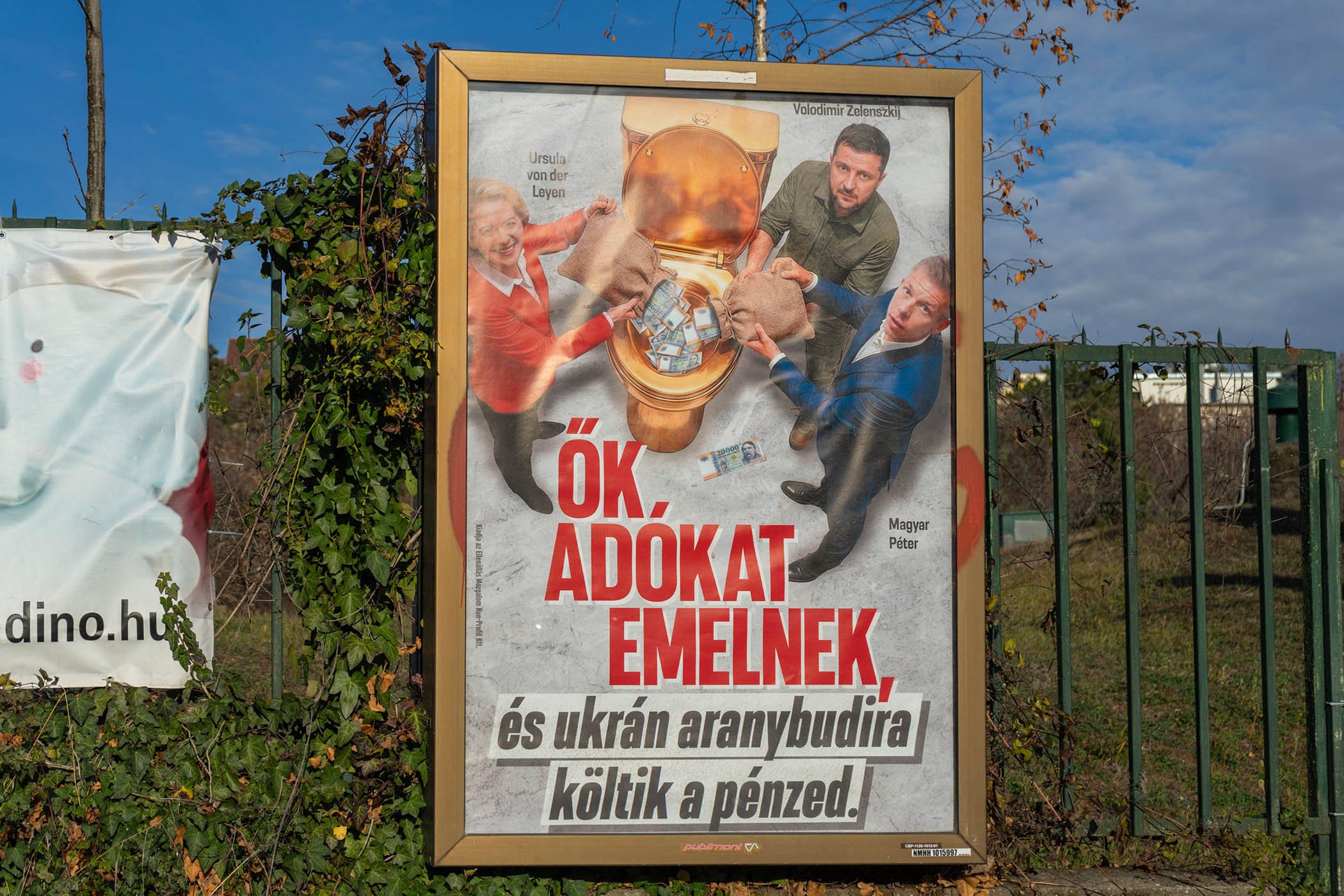
Tensions with Europe have flared as the campaign intensified. Orbán last month blocked a €90bn (£78bn)EU loan for Ukraine, which he had previously agreed to on the condition that Hungary was not made to contribute.
European leaders have largely kept quiet to avoid feeding into Orbán’s narrative that his opponent is a puppet of the EU. But a barrage of leaks is indicative of the stakes for the west’s liberal democracies.
Wiretapped phone calls published last week revealed that Hungary’s foreign minister promised to share confidential EU documents regarding Ukraine’s accession with his Russian counterpart. Western intelligence sources told the Washington Post that Russia had floated the idea of staging an assassination attempt against Orbán to tilt the vote in his favour.
Clearing up after the rally, volunteers at a merchandise stand cleared away hoodies and T-shirts printed with doodles Orbán made during a TV interview last year. Critics seized on the chaotic markings as proof that he was unstable. The prime minister jokingly described his style of drawing as “non-figurative modern”.
His “Hungary first” message resonated with Csaba, a 20-year-old economics student. Many European countries were letting in too many migrants and destroying their own societies, he said. “If Tisza wins, they will help Ukraine and we will not have better roads, better healthcare.”
Attilah Jonas was wearing a T-shirt in the red, green and white of the Hungarian flag. The 59-year-old postman has voted for Orbán every time and intends to do so again. “Either we remain on this path of stability established by Fidesz or go down the road of uncertainty,” he said.
If Orbán loses, he fears energy prices will go up. Hungarian men will also be sent to die in Ukraine, while Magyar is controlled by the EU and will give Hungary’s wealth away.
Under Orbán, the country’s relations with Moscow are pragmatic, Jonas said, pointing to a speech he made in 1989, when Hungary was emerging from communism. At the reburial of a Hungarian prime minister who was executed by Moscow for leading an uprising against Soviet domination in 1956, Orbán – then a little-known student leader – called for the withdrawal of the Soviet army.
It was a radical demand that catapulted him on to the national political stage as Hungary transitioned to democracy.
A short drive from Sopron, a section of the Berlin Wall stands by the border with Austria. It was donated by Germany to commemorate a breakthrough in the struggle against communism in Europe that took place here, three months before the wall came down.
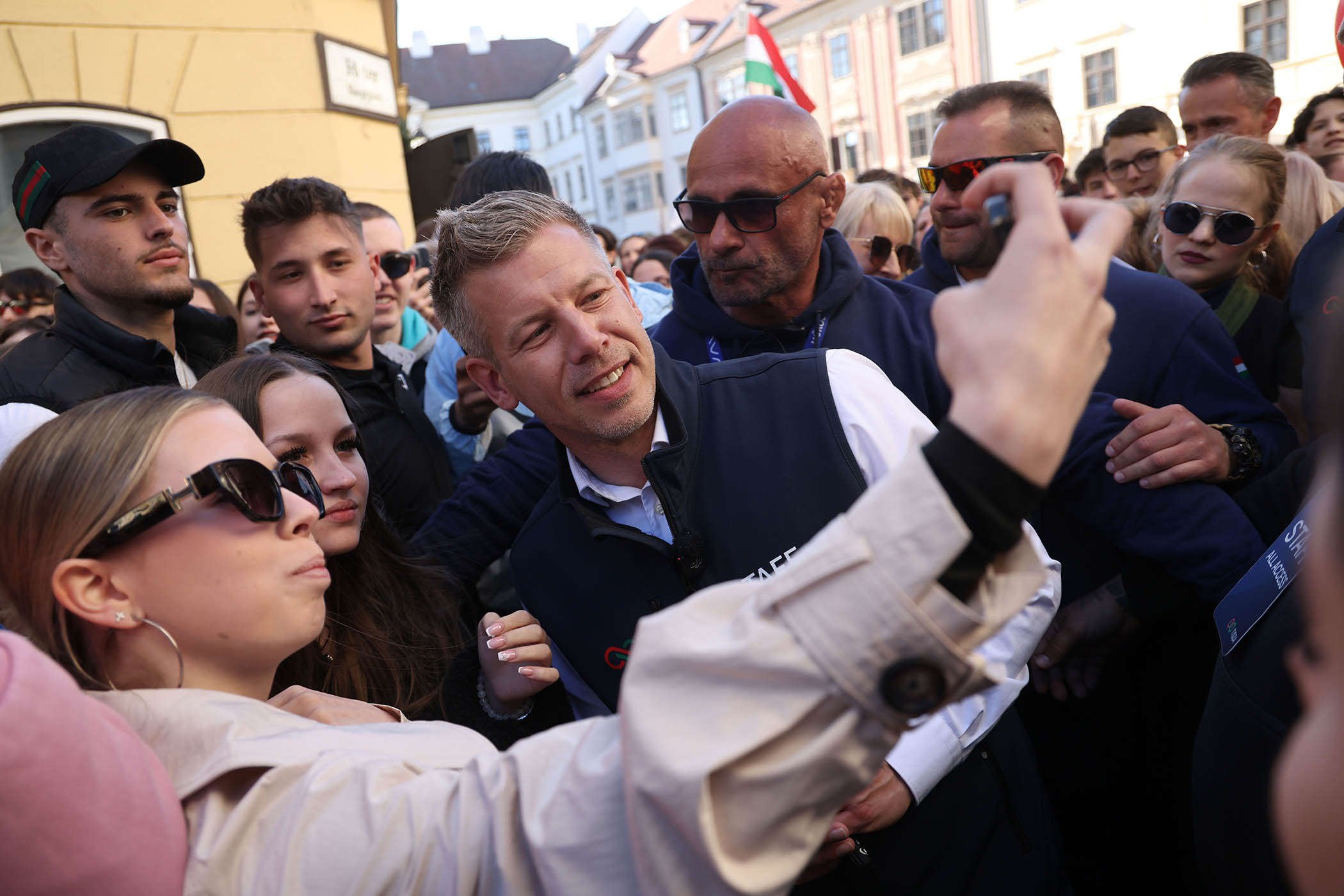
Magyar poses for selfies
On a summer’s day in 1989, thousands of Hungarians and Austrians gathered for a picnic at the fence between the two countries to show solidarity across the iron curtain, as momentum for political change increased and the eastern bloc regimes struggled to keep up with rising popular discontent.
Hundreds of East Germans also joined them and seized the opportunity to dash across the border into Austria, then the dividing line between the communist bloc in the east and the west. Thousands followed in subsequent weeks; part of a chain reaction that ultimately led to the continent’s unification.
Kata Lukács was not yet born when those events unfolded, but they resonate with her now, as Orbán erects ideological barriers between Hungary and the rest of Europe.
“I feel isolated from Europe again,” said the 33-year-old, walking past empty picnic tables at the site of the memorial. “Not physically by a fence, but the whole country is isolated from Europe because of him.”
Travelling across Europe in recent years, Lukacs, who works in finance, has faced questions about what is happening in Hungary. If Orbán wins again, she fears the country’s place in Europe will be in danger.
Beside the border, a sculpture of an open door carved out of marble commemorates Hungary’s accession to the EU in 2004. For border communities such as Sopron, it has been hugely beneficial. Many residents cross the border daily to work in Austria for higher wages. Austrians visit dentists in Sopron because they are cheaper, buoying the local economy.
A group of friends from eastern Hungary in their 40s had stopped for a beer and were taking selfies in front of the monuments. They were on their way to Austria to celebrate a birthday, but planned to return home for the election. Some said it was time for a change; others planned to vote for Fidesz.
One said a Tisza victory would cost her 1.5m Hungarian forints (£3,484) in tax relief promised to mothers as part of Orbán’s efforts to promote traditional family values, which includes increasingly restrictive policies against the LGBTQ+ community.
That is one of a range of issues that have prompted Brussels to suspend €18bn in funding for Budapest, which also include the rule of law, academic freedom, rights of asylum seekers and judicial independence.
“Hungary is a conservative, rightwing country; they [European countries] are liberal,” said a member of the group, who also planned to vote for Fidesz. Still, he wants to remain in the EU – a position shared by 65% of Fidesz voters, despite years of relentless bashing of the bloc by Orbán.
Beyond the benefits of free movement within Europe, Hungary remains a net recipient of EU funds. There are political advantages for Orbán too: “Orbán is much more valuable to Putin within the EU,” said Bálint Madlovics, a researcher at the Democracy Institute at the Central European University in Budapest. “He can play the role of the subversive asset.”
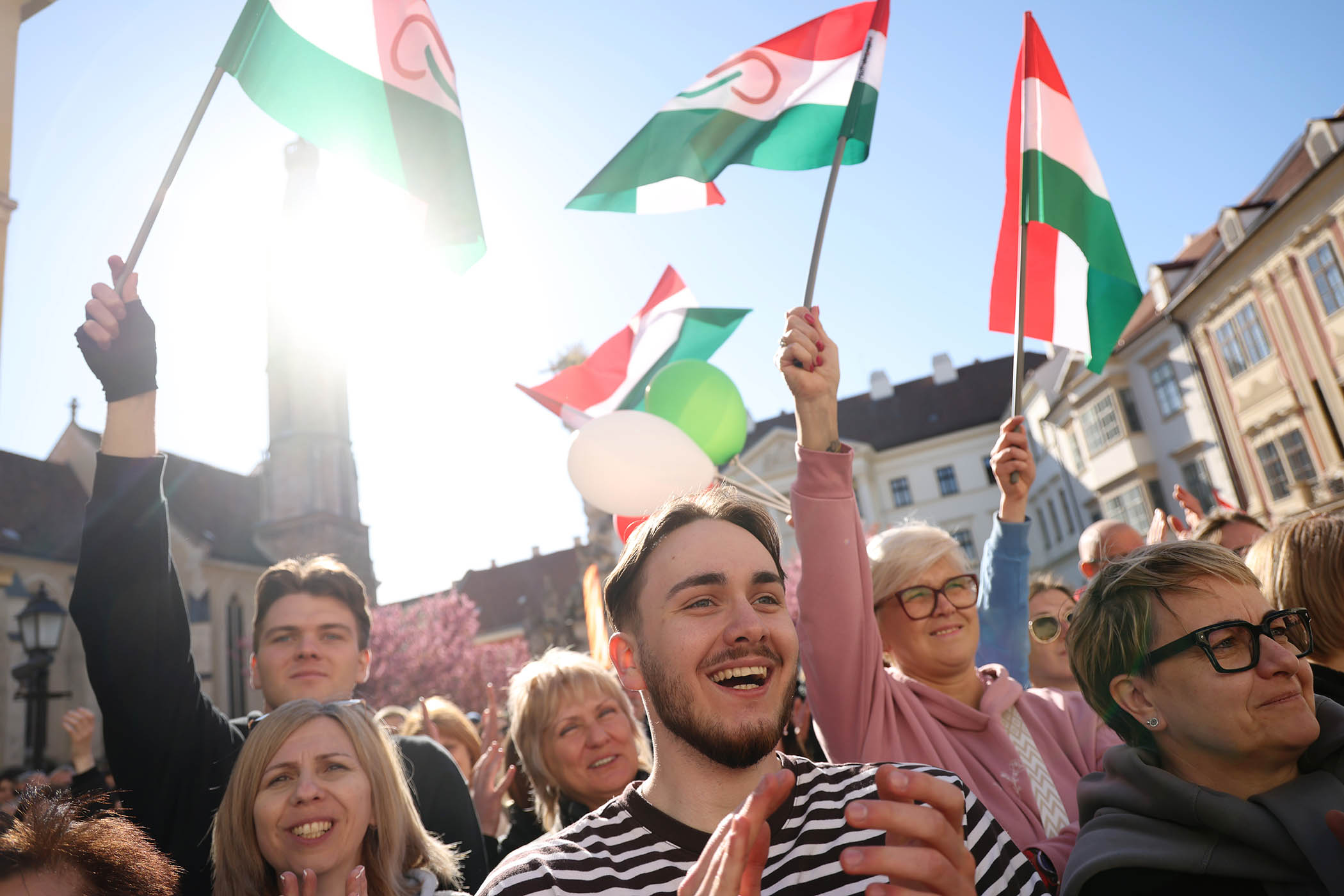
Magyar supporters on Thursday in Sopron
Less than 24 hours after the Orbán rally, activists gathered in the same square to get set up for Magyar. Volunteers blew up red, white and green balloons, and assembled booths to hand out stickers and the Tisza party newspaper.
Magyar was running late. This rally would be his third of the day – and he had two more scheduled after it. A volunteer dismissed Orbán’s warning that young Hungarian men such as himself would be sent to fight in Ukraine if Tisza won. But it is no surprise that many older voters believe Orbán when they get all their news from media controlled by the state, he said.
To overcome the disadvantage, Magyar’s campaign has harnessed social media. In a post last week, the opposition leader urged followers to make as many videos as possible on Facebook, TikTok, Instagram and YouTube.
As the crowd thickened, 23-year-old Albert Schlosser craned to see if Magyar had come. “He is giving me the feeling of being proud to be a Hungarian again,” said Schlosser, who was attending his fifth Magyar rally with his mother. He hoped a Tisza government would recover funds frozen by the EU and spend them on education and healthcare.
While some of Orbán’s opponents are suspicious of Magyar’s former ties to Fidesz, Schlosser said only an ex-insider stood a chance of beating a party that has rigged the system in its favour. “He knows the weak points of Fidesz,” he said.
Magyar arrived. The 45-year-old opposition leader walked through the throng waving a Hungarian flag and stepped on to the stage, clapping in time with party chants. The crowd appeared of a similar size to the Orbán rally, though Magyar claimed Fidesz had bussed in supporters.
“Here in Sopron… you know very well the difference between freedom and oppression; the difference between Europe and a Russian client state; the difference between the iron curtain and open borders,” he said.
Fidesz would take Hungary out of the European Union if it won, he warned. “They want Huxit.” The crowd chanted: “Russians go home!”
Tisza voters overwhelmingly favour a closer alignment with Europe, and a Magyar government would undoubtedly take a more constructive attitude towards Brussels. But it would not necessarily mean a U-turn in Hungary’s foreign policy, particularly towards Ukraine.
Although most Tisza voters view Ukraine as a partner rather than as an adversary, 45% oppose providing further financial support to Kyiv, and 40% do not want it to join the EU, according to a poll by the European Council on Foreign Relations.
In his speech, Magyar mentioned Ukraine just once – and then only to criticise Orbán for talking about it on Hungary’s national holiday.
He did, however, address Orbán’s claims that Tisza would drag Hungary into war. “We won’t send soldiers to international conflicts,” Magyar said.
Hungarians were returning home from across the world to vote for Tisza, he added. Polls show a two-thirds majority for the opposition. Government loyalists are shredding evidence of corruption, he claimed, and Tisza is ready to take power.
“Nothing lasts for ever,” he said before leaving for his next stop on the campaign trail. “Don’t be afraid”.
Photograph by Denes Erdos/AP Photo, Attila Volgyi/Polaris/Eyevine, Sean Gallup/Getty Images