

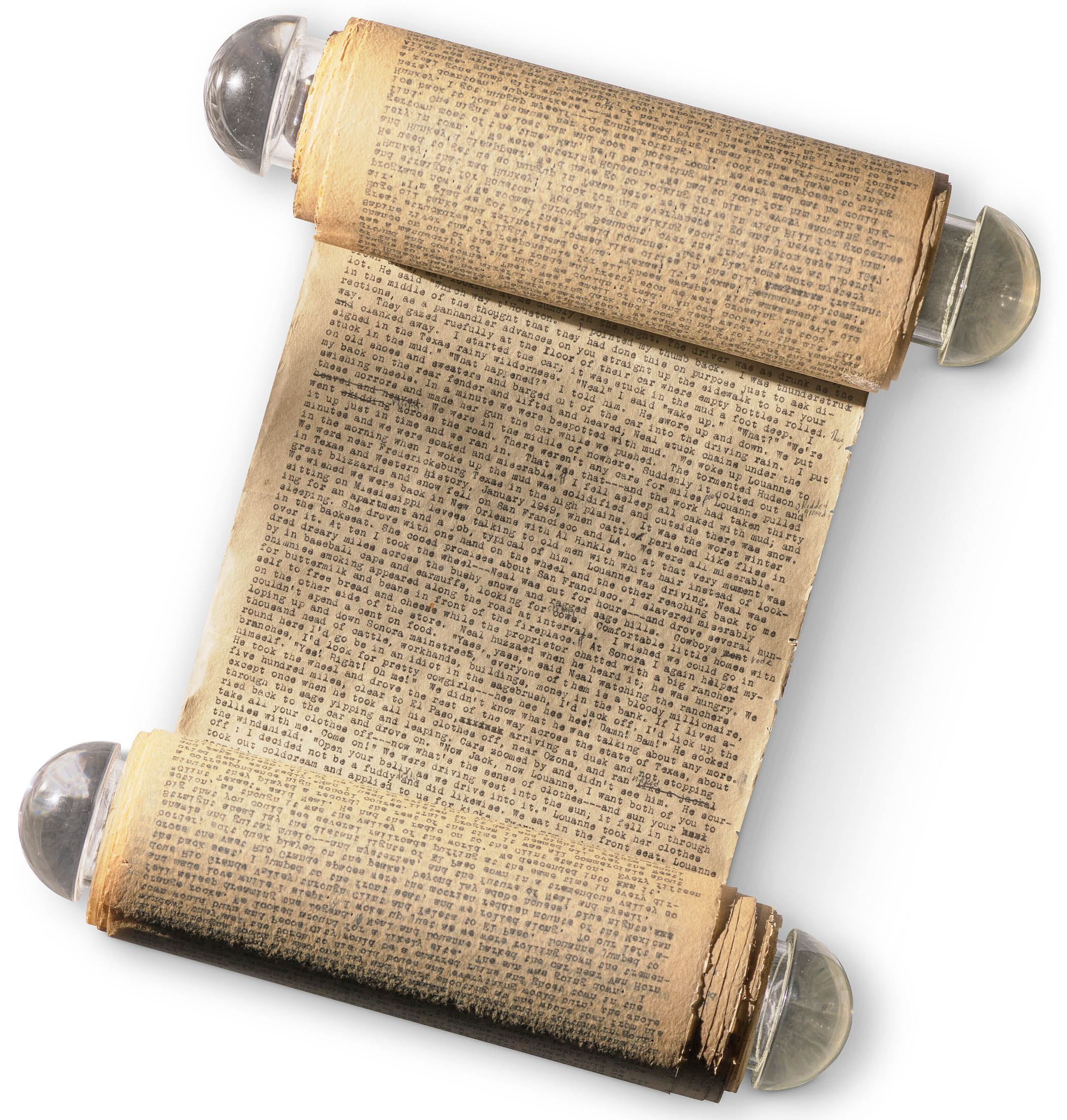
One of the central pillars of Beat Generation lore – the continuous scroll of paper on which Jack Kerouac wrote On the Road in 20 dizzying, Benzedrine-fuelled days – has broken records after selling at auction for more than $12m (£9m).
Sold as part of the vast Jim Irsay Collection of popular culture memorabilia at New York auction house Christie’s on Thursday, the 120ft scroll of the book that would define the Beats when published in 1957 has become the most expensive literary manuscript sold at auction.
The sale was made on what would have been Kerouac’s 104th birthday – he died in 1969 aged 47. The buyer was 29-year-old American country star Zach Bryan, confirmed by Sylvia Cunha from the Jack Kerouac Estate, who said: “The On the Road scroll is coming home. Our friend Zach just bought it at Christie’s. Sometimes the universe knows exactly where things belong. Happy Birthday, Jack. Our birthday wish came true.”
Bryan last year purchased the former Saint Jean Baptiste Church in Kerouac’s hometown of Lowell, Massachusetts, which he intends to turn into a museum to the king of the Beats. In 2024, the singer, who tours the UK this summer, released the song Burn, Burn, Burn, inspired by On the Road. The star – born to military parents while they were living in Japan – has cited the novel as a major influence.
He posted an Instagram story after the auction with a photo of Kerouac in his younger days and the caption: “Happy birthday, Jack. Scroll is headed to Lowell. Thank you for all the moments. Love ya.”
The manuscript was last sold at auction to Irsay in 2001 for $2.4m – setting a new record for a literary work. For last week’s sale, Christie’s had placed a top estimate of $4m on it. The winning bid from Bryan’s winning bid was $10m which, with buyer’s premium, came to $12.135m.
‘It’s a novel about freedom, a country in transition – there’s a lot that resonates with readers’
‘It’s a novel about freedom, a country in transition – there’s a lot that resonates with readers’
Heather Weintraub, Christie’s
Heather Weintraub, Christie’s book specialist, told The Observer: “The auction was a once-in-a-generation chance to own the most iconic artefact of 20th-century American literature in private hands.
“The On the Road scroll is so unique because its form is the perfect embodiment of its author’s story – they share a raw, wild intensity and groundbreaking energy.
“It’s a novel about restlessness, freedom, the romanticism of youth, a country in transition – there’s a lot that continues to resonate with readers, and the story comes even more alive when you’re looking at the scroll.”
If Bryan is the buyer, it would track with his purchase last year of the former Saint Jean Baptiste Church in Kerouac’s hometown of Lowell, Massachusetts, which the singer intends to turn into a museum to the king of the Beats. He has been approached for comment. Bryan released in 2022 the song Burn, Burn, Burn, inspired by On the Road.
Newsletters
Choose the newsletters you want to receive
View more
For information about how The Observer protects your data, read our Privacy Policy
Kerouac scholar Simon Warner, founding editor of the Substack Rock and the Beat Generation, and a visiting research fellow in popular music studies at the University of Leeds, said he was “staggered” by the sale.
“Six times more than the record-breaking sale price in 2001,” said Warner. “I suppose this absolutely unique document is going to be coveted by the extremely wealthy. What also amazes me is that, in a relatively depressed music market, a singer-songwriter has a spare $12m to invest in a venture like this.”
Music stars have a long history of acquiring Beat memorabilia, he added. “Dylan, the Grateful Dead, the Doors, Van Morrison, Bowie, Tom Waits, Joe Strummer, Sonic Youth are only some of the major names who have knelt at the altar. Bryan is just the latest in a long line.”
With any auction of a beloved and important artefact, the danger is that it will go into the hands of a private collector and be locked away. All signs are that Bryan will continue the tradition of making the scroll available to fans as the Irsay collection did.
Warner said: “The late previous owner made the scroll available around the world. I was involved in 2008 when Birmingham University played host in England for the first time. A permanent home for the manuscript might make curation easier to achieve: the transport and storage costs for the item on the move were immense and there was always some risk of damage or deterioration.”
Brian Hassett, author of several books on Kerouac and the Beats, said the sale shows Kerouac still has relevance with young people almost 70 years after On the Road was published.
He told The Observer: “I love that it’s a 29-year-old country singer and navy veteran who grew up in Oklahoma that stepped up to save both Jack’s church in Lowell to turn into a museum and saved his scroll from going to some collector who’d hide it away. It really speaks to how Kerouac still connects with young people of disparate backgrounds and not just the stereotype of old bohemians in New York or San Francisco.”
On the second day of the Irsay collection sale, on Friday, the original manuscript of The Dharma Bums, Kerouac’s 1958 follow-up to On the Road, sold for $1.7m after a top estimate of $500,000.
On the Road, like most of Kerouac’s work, was a roman-à-clef novel detailing the rise of the Beat Generation, with his contemporaries Allen Ginsberg, William Burroughs and Neal Cassady appearing under pseudonyms. He taped strips of paper together to allow him to type uninterrupted. The text is single-spaced and without paragraphs, and the scroll has, as the Christie’s catalogue says, “numerous penciled deletions and word changes, in some cases substituting fictional names for the real names of himself and his companions”. On the back of the scroll is written in pencil: “John Kerouac, 94-21 134th Street, Richmond Hill, NY.” Here, Kerouac lived with his mother, Gabrielle, from late 1952.