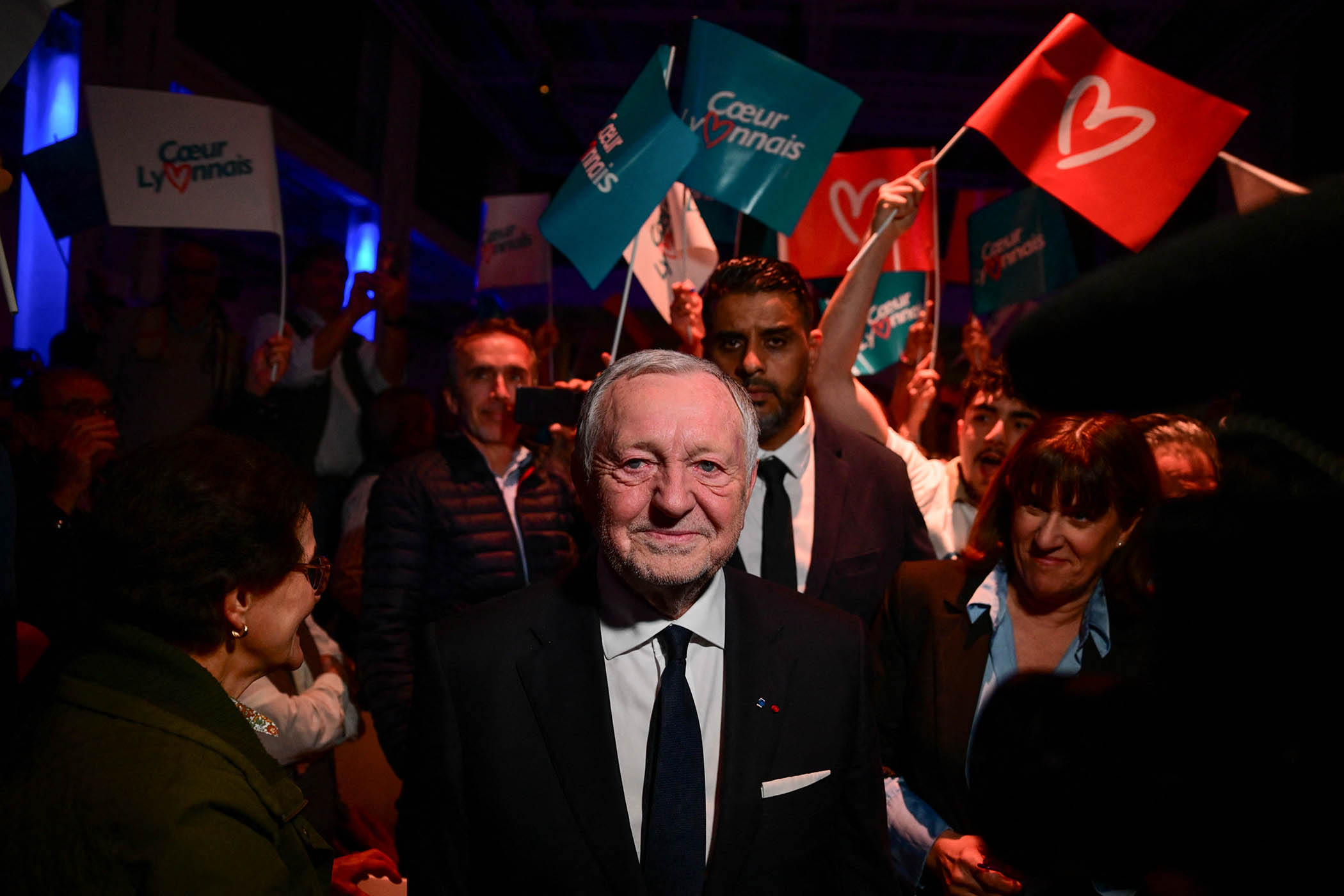

It’s a grey afternoon at the Matmut Stadium, home of Lyon Olympique Universitaire Rugby, who are taking on Toulon beneath a persistent drizzle. The student section of the ground is packed with young people singing, waving flags, banging drums and spilling beer as the match between the two middling teams kicks off. But they are not cheering for the home side. Instead, they chant “Aulas! Aulas! Aulas!”
The man they are saluting, 76-year-old Jean-Michel Aulas, is bombarded with requests for selfies as he claps and bobs along with the chants. He is on familiar terrain. This stadium used to belong to Olympique Lyonnais, the football club he ran as president from 1987 to 2023.
Now he has other priorities. The prize he seeks is the mayoralty of Lyon. In elections on 15 and 22 March, he hopes to unseat the incumbent, environmentalist Grégory Doucet, who was elected as part of a green wave that swept towns and cities in France in the last municipal elections in 2020.
These municipal elections are the last major vote before the presidential race of 2027, which remains wide open – President Emmanuel Macron cannot run for a third term, and the far-right candidate from the past three cycles, Marine Le Pen, might be barred from standing pending an appeal in a criminal case in which she was found guilty of embezzling EU funds.
The winners will shape France’s priorities at grassroots level for at least the next six years
The winners will shape France’s priorities at grassroots level for at least the next six years
As pretenders for the presidency jostle for position, almost 100,000 people are running for local government office in France’s villages, towns and cities. Many contests, including in Paris, are predicted to go down to the wire. Between them, the winners will shape France’s priorities at grassroots level for at least the next six years.
A “civil society candidate” with the support of centrist and right-wing parties, Aulas bemoans the fact that Lyon has become “the traffic jam capital of France” since the Doucet administration began prioritising pedestrians, bikes and public transport.
Doucet says his measures have brought 30 hectares (74 acres) of greenery to the city and dramatically lowered nitrogen oxide levels in one of the French cities most exposed to the effects of climate change. Aulas has said he plans to build a tunnel underneath the city to ease congestion if elected. “I have nothing against bikes,” Aulas told me, and Doucet later insisted that he had never forced anyone to ride one.
But we are a long way from municipal politics as usual: this contest is taking place against a backdrop of deadly political violence.
On 12 February, Quentin Deranque, a 23-year-old far-right activist, was badly beaten in a brawl on the sidelines of a political event held at the Sciences Po Lyon institute. Deranque died two days later in hospital from head trauma.
Several people have been arrested in relation to Deranque’s death, many of them associated with the Young Guard, an antifascist militant group founded in Lyon by Raphaël Arnault, who now sits in the national assembly as an MP for the hard-left La France Insoumise (LFI) political party. One of the men arrested was a parliamentary assistant to Arnault.
Newsletters
Choose the newsletters you want to receive
View more
For information about how The Observer protects your data, read our Privacy Policy
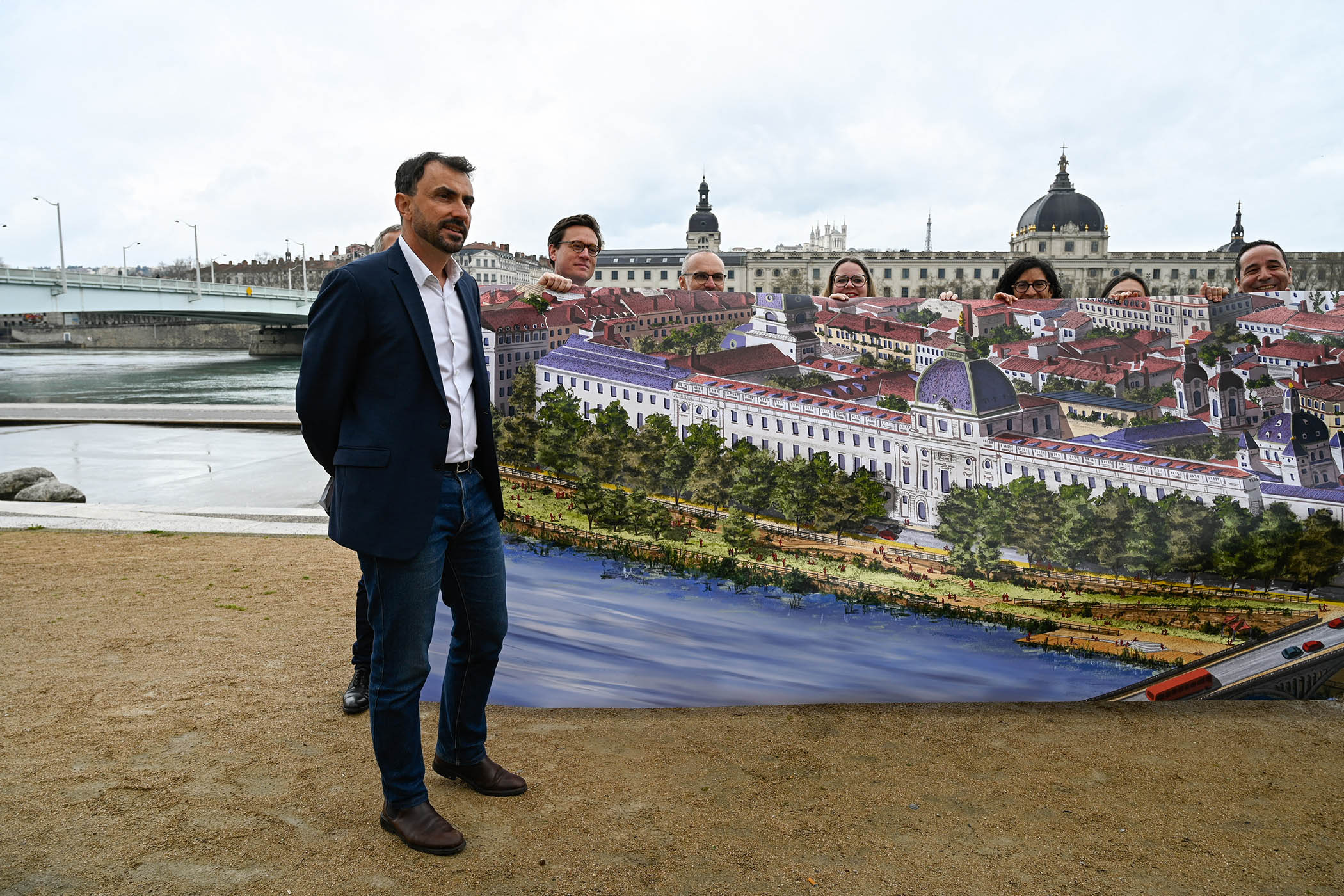
Grégory Doucet, the Green mayor of Lyon, presents his vision for the city at an election rally last week
Deranque cofounded an identitarian group and was known to associate with white supremacists and neo-Nazis. During a march in his honour through the streets of Lyon the weekend after his death, supporters gave Nazi salutes and chanted racist and homophobic slogans. Doucet had called for the march to be banned, but was overruled by the local prefecture.
Deranque’s death has raised the temperature of the campaign. Aulas has called for a portrait of Deranque to be hung outside the town hall as a tribute; Doucet has firmly rejected the proposal.
“Many people have exploited the event politically. I find that indecent and very disrespectful to the family,” Doucet said.
But there is no doubt the events have exposed the mayor politically. LFI is not part of the coalition he leads, but with Aulas leading handily in the polls, Doucet may require a deal with them if he wants to win in the second round on 22 March.
In a speech in support of the LFI candidate, Anaïs Belouassa-Cherifi, in Lyon last week party leader Jean-Luc Mélenchon doubled down on his support for the Young Guard, and made a joke about the pronunciation of Jeffrey’s Epstein’s surname that was widely condemned as antisemitic. He repeated the joke several days later with the name of one of his political rivals on the left, Raphaël Glucksmann.
Aulas said the comments were “nauseating”.
“His goal is to get people talking about him,” Doucet said of Mélenchon’s speech. “All politicians should simply refrain from adding fuel to the fire.”
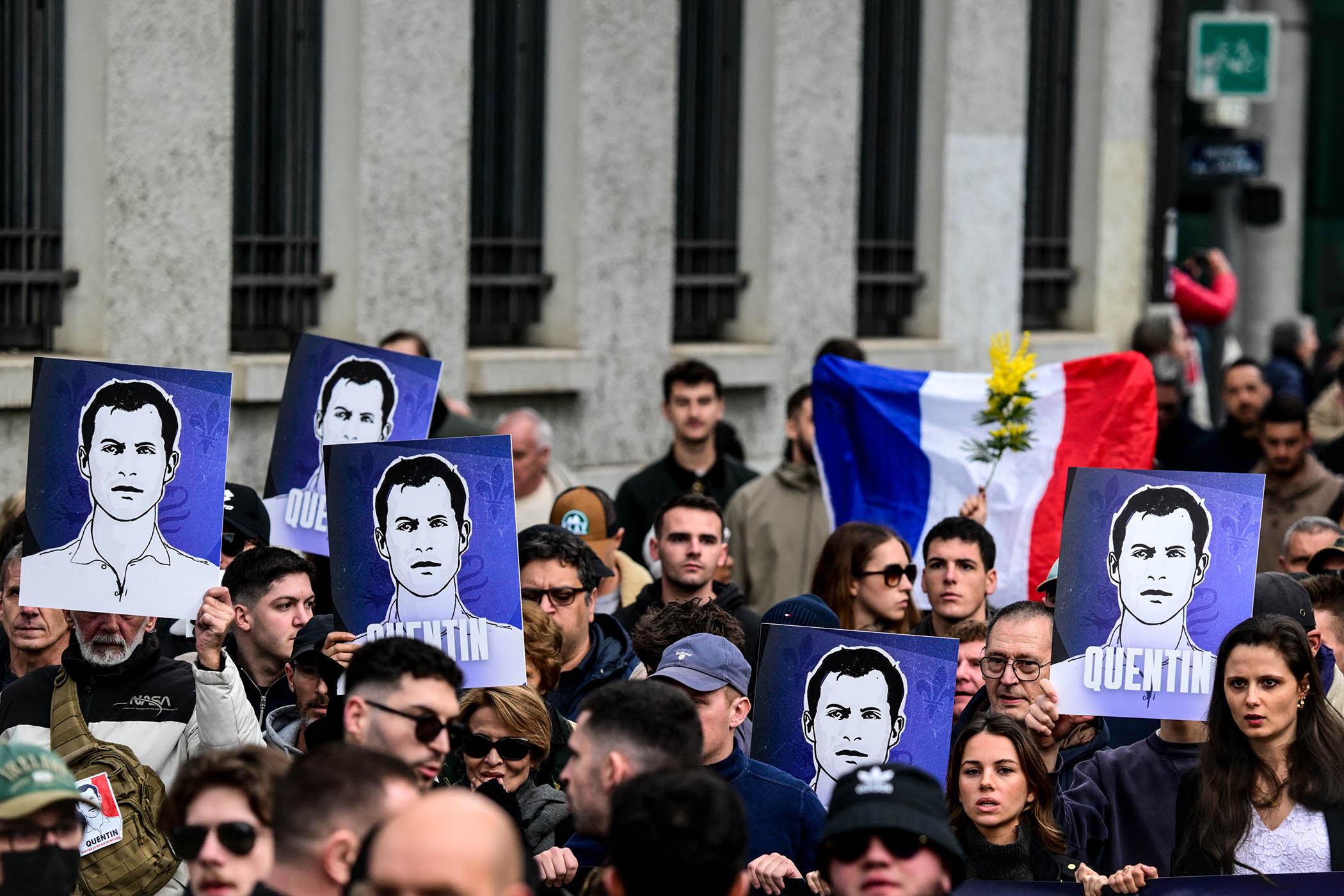
Protesters hold portraits of Quentin Deranque, a far-right activist who died after being beaten up in a brawl at a political event
The fallout from Deranque’s death has resonated far beyond the streets of Lyon. The far-right Rassemblement National, founded by Holocaust denier Jean-Marie Le Pen, has used the opportunity to present LFI as the true extreme of French politics.
Party leader Jordan Bardella has called for the formation of a “united front” against LFI in the elections, a tactic generally and successfully used to prevent his own party from gaining power.
In Paris, a diplomatic spat exploded last month after US ambassador Charles Kushner posted comments from the US state department on X that “violent radical leftism is on the rise and its role in Quentin Deranque’s death demonstrates the threat it poses to public safety”. Kushner then failed to show up to a meeting when summoned by foreign minister Jean-Noël Barrot to explain himself. The ambassador was briefly barred from access to ministers until he smoothed things over with the French state.
The day after the rugby match, as the first signs of spring burst out along the banks of the River Sâone, local official Philippe Carry led a small group of residents through the medieval streets of Old Lyon. Carry, who is running for re-election as part of Doucet’s coalition, was there to show off its achievements – including fixing the Messiah’s posture in a statue in front of the cathedral.
But Old Lyon is also where far-right groups have installed themselves in recent years, giving the city its reputation as a capital of political violence despite its moderate voting record.
Analysis by a local independent media outlet found there had been 102 incidents of far-right violence and aggression in Lyon between 2010 and 2025 – 70% of which went unpunished by authorities.
A study by Isabelle Sommier of Paris-I Panthéon-Sorbonne University found that 90% of the 53 ideologically motivated murders in France since 1986 were carried out by the far right.
‘Throughout history Lyon has been a city of nationalism – but that’s why it is a city of resistance’
‘Throughout history Lyon has been a city of nationalism – but that’s why it is a city of resistance’
Philippe Carry
Doucet credits his administration with cleaning up this part of town, which he says used to be off-limits for the annual Pride march due to the presence of the far right. Aulas says he has “fought against extremes my whole life”.
In the corridors of power, the battle for Lyon will be fought more or less politely between relative political moderates. But as France stares down the possibility of next year electing its first far-right government since the Vichy regime, and with political temperatures rising around the country, the spectre of extremism is ever present.
“Lyon has been a city of nationalism throughout history,” Carry said. “But that’s why Lyon is a city of resistance. And it is always the resistance that has won.”
Photographs by Olivier Chassignole/AFP, Getty; Matthieu Delaty, Hans Lucas/AFP, Getty