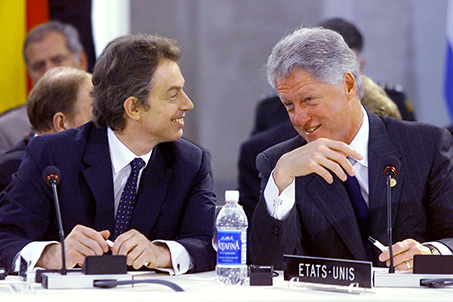

In April 1999, Tony Blair flew to the US for a summit marking the 50th anniversary of Nato. Originally meant to be a celebration, the meeting had become more urgent in the weeks leading up to it. Nato, led by the US and UK, was one month into a bombing campaign against Slobodan Milošević’s Serbia, aimed at preventing ethnic cleansing in Kosovo.
Before heading to Washington, Blair made a speech in Chicago in which he made a moral case for intervention. The speech outlined five key tests that had to be passed if a western power was to take military action for humanitarian purposes, setting out a philosophy that guided western powers’ actions around the world for the next two decades.
For Blair, though, there was a more basic reason for the speech. The air war against Milošević was not working. The UK prime minister wanted to persuade US president Bill Clinton to threaten to commit ground troops but, so far, he was not budging. The speech had the intended effect. It made the front page of the New York Times and as Jonathan Powell, who was then Blair’s chief of staff, told me in 2018: “Clinton called up in a fury from Air Force One and really tore into Tony.” But the White House relented, threats were made, and within weeks Milošević had withdrawn his troops and Kosovo was free.
A lack of political will and military might has meant European leaders have long struggled to deal with security issues in their own backyard. Unless Washington can be persuaded to get involved, very little happens.
Nowhere has this been more obvious over the past 12 years than in Ukraine. After Vladimir Putin annexed Crimea in 2014, Europe’s attempts to stand up to Russia ended in failure. Mediation led by Angela Merkel and François Hollande led to the ineffective Minsk agreements. Putin bided his time and, eight years on, launched a full-scale invasion.
This time around, America took the threat seriously, providing weapons, training and intelligence to Ukraine. That ended in January 2025 when Donald Trump returned to office. He repeatedly professed his admiration for Putin, shockingly humiliated Volodymyr Zelenksy in the Oval Office, and pushed for a peace deal that would have handed victory to Russia.
European leaders spent the first year of Trump’s second term in shock, failing to understand the true nature of the US president’s ambitions. The combination of the national security strategy and the threat to annex Greenland – part of a Nato ally – belatedly woke them up.
And yet a few months on, Europe has yet to come up with a clear strategy to help Ukraine win its war. The E3 of Keir Starmer, Emmanuel Macron and Friedrich Merz held a virtual meeting on Friday with Zelensky but offered little more than warm words. The so-called “coalition of the willing” has yet to draw up a concrete plan to protect Ukraine following any future peace deal. The EU is discussing the possibility of a big figure like Angela Merkel or Italy’s former prime minister Mario Draghi taking the lead on negotiations, but no decisions have been taken.
The window for action is closing. The E3 leaders are all unpopular at home. Merz can stagger on until 2029 assuming his coalition does not collapse, but Macron will definitely be out of office in a year, while Starmer may leave Downing Street far sooner.
European leaders spent the first year of Trump’s second term in shock, failing to understand the true nature of the US president’s ambitions
European leaders spent the first year of Trump’s second term in shock, failing to understand the true nature of the US president’s ambitions
Within three years it’s not impossible that a new E3 will have taken shape, led by Nigel Farage, Jordan Bardella and Alice Weidel. Bardella has tried to distance the National Rally from Putin, but his party was bailed out a decade ago thanks to a €6m loan from a Putin-linked Russian bank. Farage has spoken of his admiration for Putin and has been a constant critic of Zelensky. Earlier this month, Weidel argued that Ukrainian drone strikes inside Russia were a threat to German national security, saying: “You can’t keep poking a big bear in the eye with hot iron… and expect nothing to happen.”
Newsletters
Choose the newsletters you want to receive
View more
For information about how The Observer protects your data, read our Privacy Policy
In the coming weeks, there is an opportunity that Europe needs to grab. Trump appears to have lost interest in Ukraine, Steve Witkoff is focused on Iran, while at a meeting of Nato foreign ministers in Sweden on Friday, Marco Rubio gave the impression of a man who had more important things to worry about. Given that his administration appears to be preparing for its third war of the year, this time in Cuba, maybe that’s true.
A key moment will come in six weeks’ time, again at a Nato summit. Unlike in 1999, European leaders know they cannot simply call on America to come to their aid. If the E3 has a plan to protect their own continent, this would be the time to reveal it.
Photograph by NY Daily News/Getty Images