
The heat shield held out. The parachutes opened. The Orion capsule didn’t capsize. Artemis II concluded with the same pin-point precision that it began, less than two weeks ago, when the first four astronauts to visit the moon in 53 years splashed down safely in the Pacific ocean.
Commander Reid Wiseman, pilot Victor Glover, and mission specialists Christina Koch and Jeremy Hansen flew yesterday from the splashdown site off the California coast to the Johnson Space Centre in Houston, Texas, where their families had gathered to watch the final moments of their journey.
The landing had been a “perfect bullseye”, Nasa said, and it needed to be. After rounding the moon, the Orion capsule, dubbed Integrity by its crew, had been falling back to Earth, accelerating under the force of our planet’s gravity. By the time it reached Earth, it hit the atmosphere at nearly 40,000kmh (25,000mph).
This was the moment of greatest risk. The friction of entering the atmosphere created a 2,700C bubble of plasma around the capsule, and the trajectory used by the previous unmanned Artemis I mission had seen unexpected damage to the heat shield protecting the capsule.
There was no time to design a new heat shield for Artemis II so Nasa changed the angle of re-entry to make it steeper – a hotter, but briefer journey – gambling that this would work.
When an orange glow began to appear around the Integrity at 12.53am BST, the communication link cut out. For six minutes, the families and flight controllers at Houston, the 3 million people watching the YouTube live stream, and people around the world, all waited, watching the capsule emerge, a speck from the cosmos, and plunge Earthwards.
This was a huge physical test for the astronauts. “It’s the most physically demanding for the human body as we come back through the atmosphere [because] that decelerates the spacecraft,” Helen Sharman, Britain’s first spacefarer, said. Slowing down so rapidly means the crew went from weightlessness to feeling force three times their body weight slamming them into their seats.
Then came a voice: Wiseman’s. “Houston, Integrity we have you loud and clear,” he said, prompting whoops and cheers in mission control.
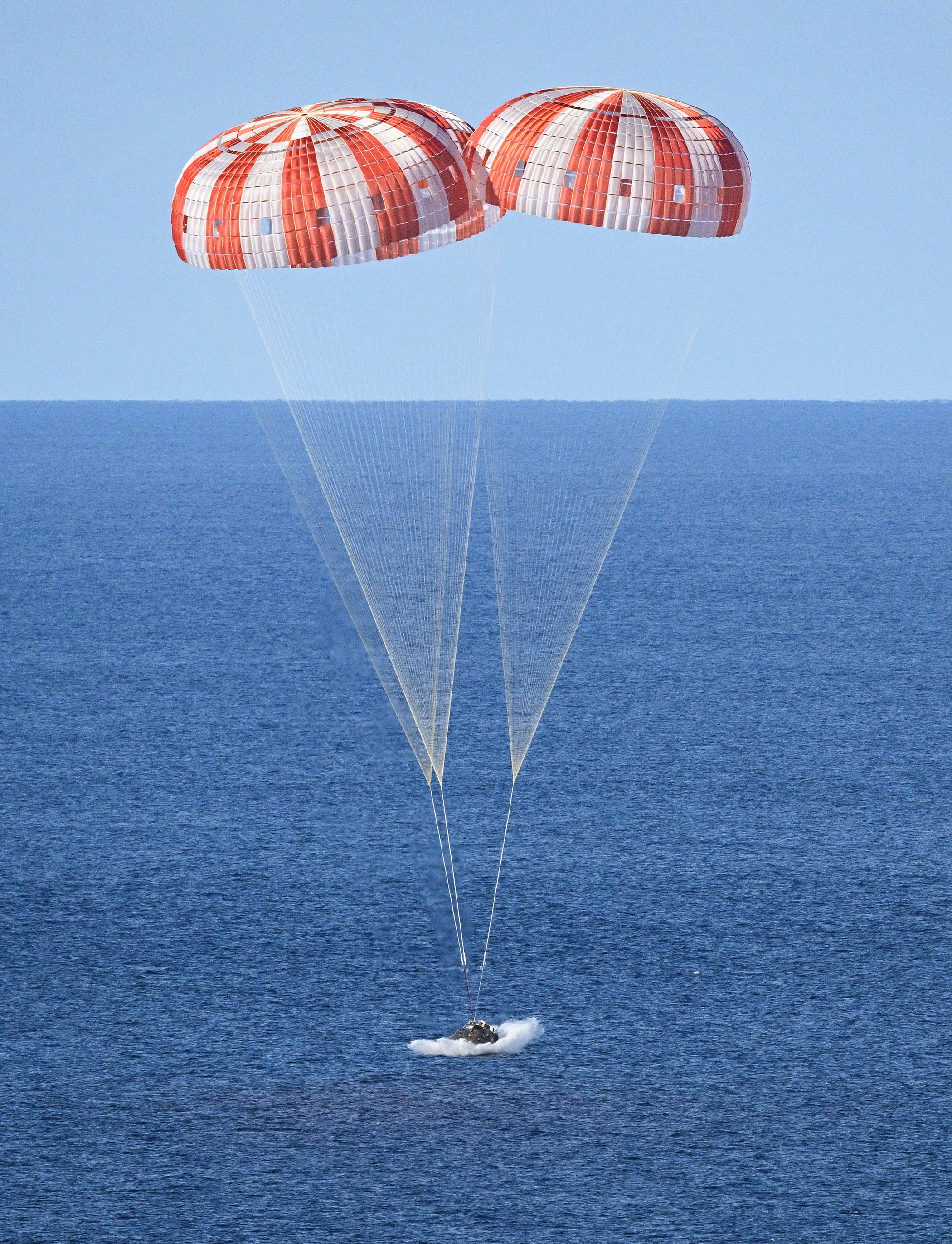
the Orion capsule splashes down in the Pacific Ocean at a sedate 17mph, after re-entering the atmosphere at 25,000mph
Still, the drama wasn’t quite done. Would Orion’s parachutes deploy? They did, all 11 of them, the three final canopies opening to allow the spacecraft to conclude its journey at a gentle 17mph as it hit the Pacific.
Eventually, the capsule door opened, allowing some fresh ocean air into the tiny compartment that the four astronauts shared for 10 days. One of the first tasks on Nasa’s post-flight checklist will be to work out why the toilet broke.
Newsletters
Choose the newsletters you want to receive
View more
For information about how The Observer protects your data, read our Privacy Policy
After an hour of bobbing on the ocean waves, the crew were helicoptered to their recovery vessel, the USS John P Murtha, for medical examinations. It took much of the night for the Nasa and US Navy teams to fish the capsule out of the water and stow it onboard. It is making a slower journey back to the Kennedy Space Centre in Florida for engineers to examine its blasted hull.
“These were the ambassadors from humanity to the stars,” Nasa administrator Jared Isaacman said, after meeting the crew on the recovery ship. Overall they flew 700,237 miles and landed less than a mile from their target.
Job done. But Nasa is definitely not over the moon, and is already planning to go back. The names of the astronauts for the Artemis IV moon landing mission will be announced soon, according to Amit Kshatriya, Nasa’s associate administrator. Artemis III is scheduled to launch next year, to test the landing systems being designed by SpaceX and Blue Origin.
Yet the euphoria of the Nasa teams at their successful mission will be tempered by the threat of swingeing budget cuts that Donald Trump would like to impose on the space agency – a 23% reduction overall. The China National Space Administration intends to land astronauts on the moon in 2030. That’s two years after Artemis IV is scheduled, but the programme has suffered delays previously.
The new space race is a “bit of a land grab”, Sharman said, a race for “the best bits of the moon, which is the south pole”. There is ice, which would allow the US or China, or both, to create a lunar base from which to explore other parts of the solar system – particularly Mars.
Photograph by Apu Gomes/AFP via Getty Images, Josh Valcarcel/Nasa via Getty Images