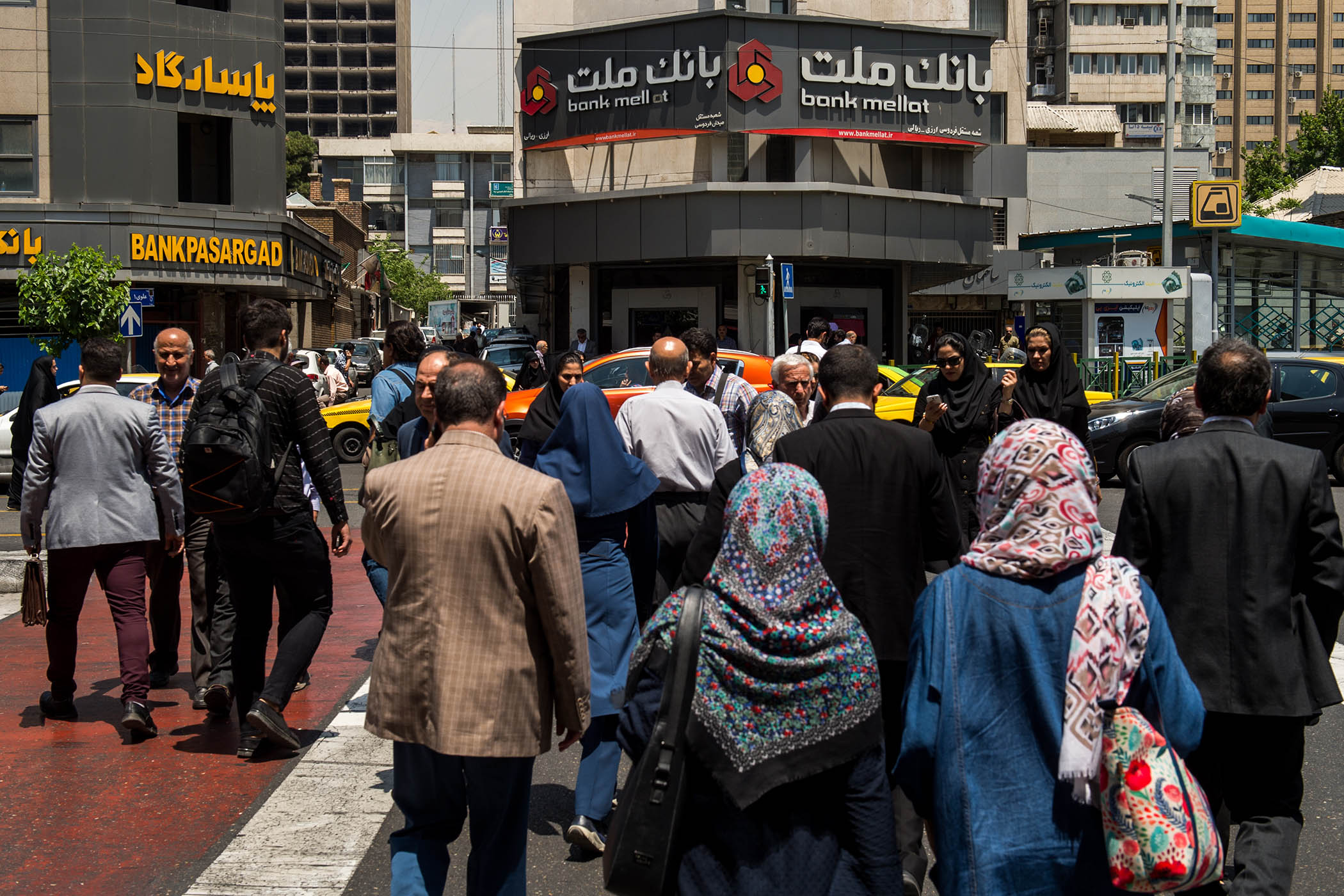


Inside the Bank Mellat building in Istanbul, the quiet is broken only by the sound of three tellers in colourful headscarves typing and taking phone calls from their desks near clocks showing the time in London, Istanbul and Tehran.
The Iranian bank sits among sparkling towers in a busy financial district, but as a polite manager explains, it is entirely cut off from the Turkish banking system. “There’s no connection because of the embargo,” he said.
For as long as Iranian state-owned banks such as Bank Mellat have been the target of American sanctions, they have grown equally adept at evading them. The same goes for the regime as a whole: for decades, it has defied US efforts to collapse Iran’s economy. As those efforts intensify under Donald Trump, Tehran is relying on tested defences: illicit oil sales, which brought in almost $46bn last year, most of it from China; crypto mining by the Islamic Revolutionary Guard Corps (IRGC); and a shadow banking system that endures despite its pariah status.
Trump hoped to have brought Iran to its knees before travelling to Beijing this week, where discussions about Chinese support to Iran are likely to feature. His chances now look remote.
Two UK-based companies processed more than $1bn in crypto payments to Iran, according to researchers at US digital investigations company TRM Labs. Bank Mellat, one of Iran’s largest, reported record profits last year. It has been sanctioned by the US for using front companies in the Isle of Man to bypass sanctions, for facilitating funding for the Iranian nuclear programme and for aiding a financial network tied to the IRGC’s paramilitary force, the Basij, citing its use of child soldiers.
Washington slapped Bank Mellat and 34 other financial institutions and individuals with further sanctions last month as part of Operation Economic Fury, a sweeping attempt to bankrupt the regime and dismantle what the US treasury secretary, Scott Bessent, termed Iran’s “shadow banking system”. Last week, the US went as far as to sanction Iraq’s deputy oil minister, Ali Maarij al-Bahadly, for selling crude to help Tehran and its Iraqi proxies.
Yet, at Bank Mellat, it was business as usual. The branch manager said it mostly facilitates trade with Iran and takes cash payments from Iranians: a financial lifeline for Tehran from Istanbul. “We’re mostly here to give lines of credit for those wanting to do import-export business in Iran. Most of our customers use property here in Turkey as collateral,” he explained.
Washington is looking to stifle the Iranian regime’s finances to force it back to the negotiating table, weaken the broader economy and spur more protests such as those that began last December. Tehran has complained about the US blockade of its ports, but the hardline parliamentary speaker, Mohammad Bagher Ghalibaf, has boasted that no amount of economic pressure will cause the regime to crumble. Far from it: Tehran recently launched a government agency to collect tolls from the Strait of Hormuz.
But a recent clampdown in the United Arab Emirates has the potential to stifle Iranian illicit finance: authorities there arrested Iranian moneychangers as Abu Dhabi reels from Iranian attacks. The Emirates was previously a buyer of Iranian oil and a key conduit for its revenues.
Iranian officials have long laughed in the face of Washington’s efforts. The country’s foreign minister, Abbas Araghchi, declared during a meeting with his Russian counterpart, Sergey Lavrov, last December that Iran and Russia were deepening ties and trade. Tehran was using its experience from decades under sanctions to guide Moscow on sanctions evasion, he said. “Iranians have a PhD in circumventing US sanctions.” Araghchi visited his Chinese counterpart last week.
Newsletters
Choose the newsletters you want to receive
View more
For information about how The Observer protects your data, read our Privacy Policy
Tehran has spread its teachings on sanctions evasion to a network of states, according to Nicole Grajewski, an expert on Iran’s ties to Russia. With Tehran’s guidance, Russia began using Iranian methods of covert oil transfers, while North Korea and the IRGC often use cryptocurrency to bring in illicit funds. “They are all looking to escape the constraints on them; part of this is about observing the others and seeing what works, but another is actively coordinating to evade sanctions,” Grajewski said.
China is a beneficiary of US sanctions, as it is now buying Iranian oil at a discount. Grajewski pointed to Beijing’s “long-established,” methods of support to aid the shadow oil trade, including selling Iran ship components. Earlier this month, China made this plain, announcing it would block US sanctions on five of its smaller, private “teapot” refineries, which are the primary recipients of Iranian crude. Among them, the Hengli refinery was described by the US treasury as “one of Tehran’s most valued customers,” a key player netting Tehran billions of dollars by buying oil from the Iranian military. China’s financial regulator last week advised banks to suspend new loans to the five sanctioned refineries, in a nod to Washington – but it declined to shut down trade.
A week before Trump’s arrival, Washington also sanctioned four Chinese satellite companies, accusing them of providing Iran with technology that helped them target US forces in the Middle East during 40 days of war.
An emboldened regime in Tehran has also been willing to see its own economy suffer in the name of clamping down on dissent, cutting off the internet for more than 70 days in the longest blackout ever recorded, while allowing loyalists and government workers to get online. One website designer named Peyman described struggling amid mass unemployment stemming from the blackout. “I used to work for the website of this pharmaceutical company, but when I called my boss there, he told me he no longer has a job either,” he said.
An exiled vendor selling virtual private networks that Iranians have long used to evade internet blackouts said business had completely dried up as it had become too expensive for most people to afford to get online illegally. “With the price increases, we had way fewer customers – now sales are close to zero. Plus all our bank accounts have been blocked,” he complained.
Small-scale Iranian traders in Turkey who relied on social media have seen their businesses collapse, but those who fall outside the category of regime loyalists are unlikely to consider a visit to Bank Mellat to get a loan. Eric Lob, an expert on Iran with the Washington-based Carnegie Endowment for International Peace, said that while political and military elites inside Iran may chafe as life worsens, “they have access to resources like smuggling networks that leave them better able to withstand sanctions and even in some cases to profit from them”.
Photograph by Ali Mohammadi/Bloomberg via Getty Images