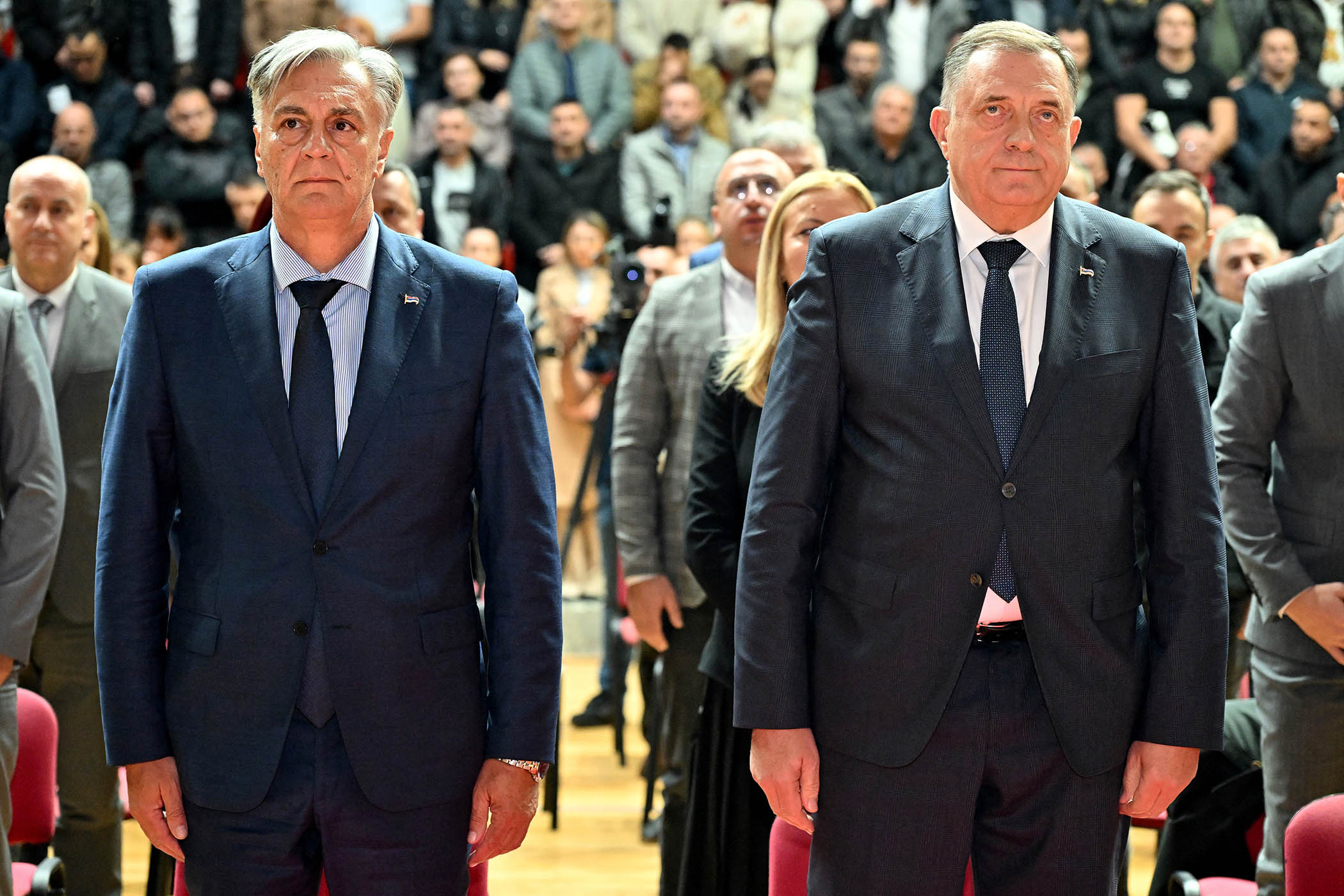
Even Milorad Dodik’s most committed enemies – and there are many – wouldn’t deny his capacity for showmanship. On a Thursday night in late November, several thousand of his supporters packed out an election campaign rally in downtown Banja Luka, de facto capital of Republika Srpska, the Serbian-majority entity that forms half of modern Bosnia and Herzegovina. Dodik, a grandfatherly figure in his well-fed mid-sixties, told the party faithful precisely what they wanted to hear. “I am the guarantor [of] our dream,” he said. “We build [in] a way that ensures every person within it is safe… We have, of course, those who try to create some disorder, but they cannot be a part of us.”
Groups of athletic young men bellowed enthusiastic assent and waved the Republika Srpska flag, its horizontal red, white and blue stripes almost identical to that of Serbia, the territory’s lodestar. Familiar foes and comrades were invoked. The EU and the “gay west” took a beating. Mother Russia and the indomitable spirit of the Bosnian Serb people drew rapturous applause. If Dodik gets his way, the modern Bosnian state – forged in the hard-won peace achieved in the aftermath of the bloody conflicts of the 1990s – will be no more.
The stability of Bosnia cannot be taken for granted. Complex tensions and barely suppressed chaos have been its hallmarks: 30 years on, little has changed. The Dayton Accords split the country into two district entities: Republika Srpska, split across the north and east of the country; and the Federation of Bosnia and Herzegovina, jointly run by Croats and majority Muslim Bosniaks. The two bodies nominally share Sarajevo as a capital and are bound together by a central administration.
Since 2022, Bosnia and Herzegovina has been an EU ascension state. But Republika Srpska is instead pulling east, to both Serbia and Russia, which have been quite happy to stoke secessionist fantasies in a bid to halt European integration in their western Balkan sphere of influence.
Dodik has done much to drive this growing instability. Once seen by western observers as a “moderate” voice in the territory, he has spent the past decade steadily amping up the separatist rhetoric. He is vehemently pro-Russian, equally anti-EU and at least nominally committed to the existential pursuit of breaking off from the Bosnian state and joining their Serbian brothers. He has also denied the Srebrenica genocide. “[Genocide] did not happen there. We all know that here in Republika Srpska,” he has claimed.
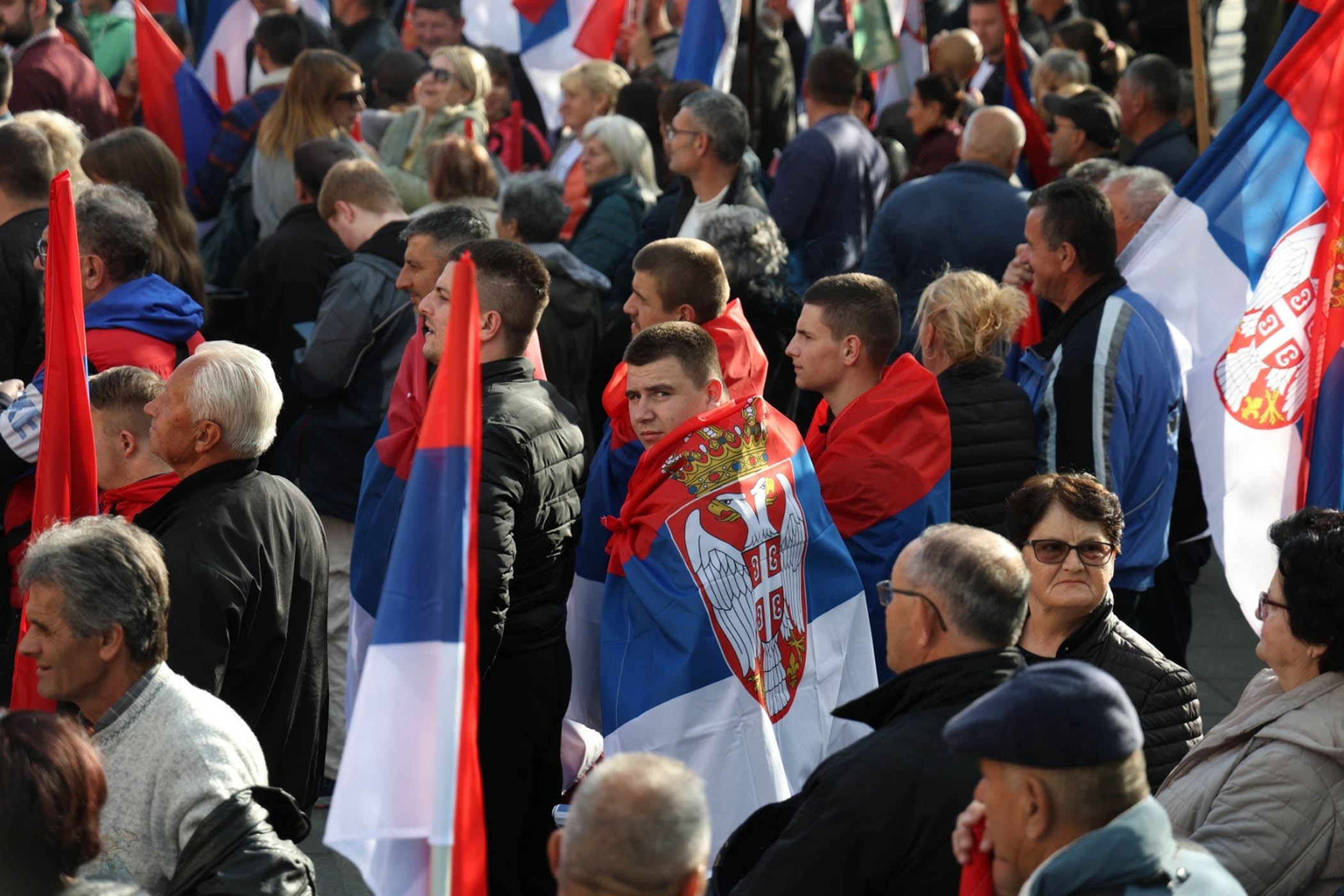
Bosnian Serbs participate in a demonstration in Banja Luka last year denying that the 1995 Srebrenica genocide took place
The staleness of this rhetoric belies a greater seriousness. Dodik, the recently deposed president of Republika Srpska, is not having a good year. In August, he was jettisoned from office after almost 20 years in power. This crisis was prompted after a Bosnian court convicted him of repeatedly disobeying the orders of Christian Schmidt, a German politician who is the international high representative for Bosnia. , who oversees the implementation of the 1995 Dayton Accords, the diplomatic settlement that ended the brutal three-and-a-half-year Bosnian war.
In 2021, Dodik began his campaign against the legitimacy of the recently appointed Schmidt, an easy scapegoat and lightning rod for nationalist anxieties. International sanctions – the UK, Slovenia and the US all imposed their own restrictions – followed. Corruption has also been a well documented feature of his presidency, not least the 2022 general elections, which were mired in allegations of vote rigging and fraud. In February this year, Dodik was convicted of defying the high representative’s edicts. Given a year-long prison term, he vowed to ignore the sentence, which was eventually downgraded to a supervision order. He was banned from frontline politics for six years but was allowed to remain at the head of his Alliance of Independent Social Democrats (SNSD) party.
After his removal from office in August, a snap election was duly announced. The SNSD put up an ardent Dodik loyalist, Siniša Karan, the grey-haired minister for scientific and technological development. No one, not even Karan himself, has bothered to claim that Dodik is not still running the show. Campaign posters showed Dodik looming just behind his hand-picked successor. The opposition coalition, led by Branko Blanuša of the Serb Democratic Party (SDS), a relatively unknown engineering professor, gamely focused its campaign on institutionalised corruption and graft. But it had been difficult to cut through against the full weight of Dodik’s SNSD party machine.
Dodik may be a wily operator, but he cannot claim full credit for the current unrest. In October, the US abruptly lifted sanctions against him, in part due to the support of several high-level Maga operators, including Rudy Giuliani and the influencer Laura Loomer. The news was greeted with astonishment in Bosnia and beyond; a volte-face after years of targeting Dodik for his manoeuvring and increasingly hardline positions. The Dayton Accords were synonymous with the US. For some, the move is akin to handing over the territory as part of a grand geopolitical chess game with the Russians, who have invested significant time and money in the territory. Rumours have circulated that Putin is keen on an unofficial military base in Banja Luka, to go with existing facilities in Serbia.
Few can claim to have got under Dodik’s skin quite like Tanja Topic. In 2021, the political analyst and journalist was the subject of an extraordinary presidential broadside for her critical reporting on the government. Topic, Dodik thundered, was a German agent and “quisling”, whose family were “isolated and excluded from society”. Earlier this year, she won €1,500 in damages from Dodik after suing for libel. In a hotel lobby in downtown Banja Luka, where she is based, Topic said Dodik’s success came from a well-honed capacity for blackmail, but Europe is by no means blameless. The international community's preoccupation with the region’s “stability” led to Dodik consolidating his power almost unchecked, she said: “They closed their eyes to the attacks on media freedom. On human rights. On everything. They accepted the corruption at the last election. And now we must pay the price for that.”
Newsletters
Choose the newsletters you want to receive
View more
For information about how The Observer protects your data, read our Privacy Policy
The Dodik rally was an undeniably slick affair. Speakers were introduced by two smartly dressed local television personalities as drones whizzed overhead, capturing the adoring crowd. But appearances, one Bosnian journalist laughed afterwards, could be deceptive. Many in attendance were public sector workers in Banja Luka who were unlikely to have much say in the matter. Turning up was pretty much compulsory, at least if you valued your job, the reporter explained. That is not to say all of the enthusiasm on offer was faked. To my right, a boy of no older than eight hooted gleefully at Dodik’s pronouncements, encouraged by his adoring grandmother to wave his Republika Srpska flag high in the air.
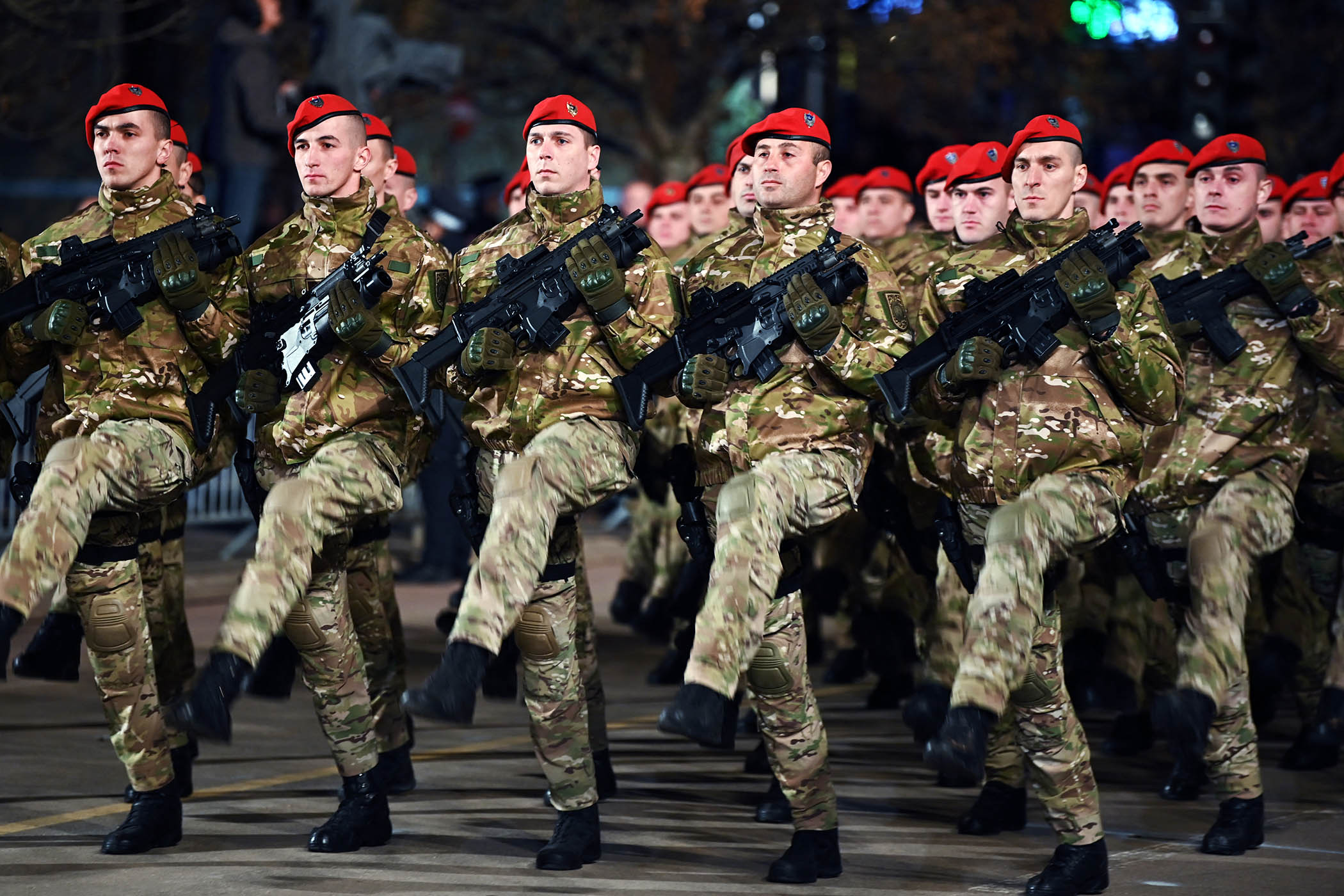
Bosnian Serb police officers on parade on the “Day of Republic Srpska” in Banja Luka on January 9. The controversial holiday marks the declaration of a Serb republic in Bosnia in 1992, three months before war broke out
There was not quite the same triumphalism in the opposition event across town. In a hastily converted school auditorium, the crowd were visibly poorer, the decorative backdrop and election slogan banners shabbier. But the same nationalist fervour was in evidence. Speakers included the formidable Jelena Trivić, a hardline Serb nationalist and Srebrenica genocide-denier, who proselytised about traditional family values and “moral integrity”.
Branko Blanuša, the opposition leader, is a mild-looking man with a slightly downtrodden academic bearing. At the end of a rambling address, he closed his eyes and declared his heart to be as “big as Russia”.
Not everyone in Republika Srpska is a fervent separatist. Many are concerned with a stagnant economy and deepening inequality. Youth unemployment is stubbornly high, as it is across much of Bosnia and the wider Balkans. Few really want a return to conditions that helped provoke the bloody conflicts of the 1990s. “Boli me kurac” is a commonly expressed sentiment – a Bosnian variation on “I don’t give a shit”.
Marko, an energetic man in his late fifties, attended the SDS rally with two friends, though Blanuša and his colleagues didn’t seem to inspire any particularly vivid enthusiasm, at least not in comparison to the feelings raised by Dodik’s manoeuvring. It is safe to say the men were not fans of their ousted president or his party and its powerful internal machinery. “If they are honest, then we will win the election. But these people are frauds. If there is no stealing, 100% we will win. But that is not what [has] happened before. In an hour, you can have the results. We [have been] waiting for a day or two in the past,” said Marko. Trust in the democratic process, he added, laughing, was not in ready supply.
“We do not believe in it,” said Čedo, one of his companions. “That’s why people do not vote… they know whatever you do, he will win.”
This analysis proved well founded. The polls closed on Sunday evening and when the results began to drift through the next day, there was some shock at their closeness. The SNSD had taken 50.89% of the vote, on a 35% turnout. Opposition figures demanded a recount, amid allegations of voter fraud. Dodik gave a triumphant address: “They wanted to remove Dodik and now they have two.” No one really knows where any of this is heading in a region famed for its volatility. But few would argue it is likely to be anywhere good.
Photographs by Elvis Barukcic/AFP via Getty Images and Miomir Jakovljevic/Anadolu via Getty Images