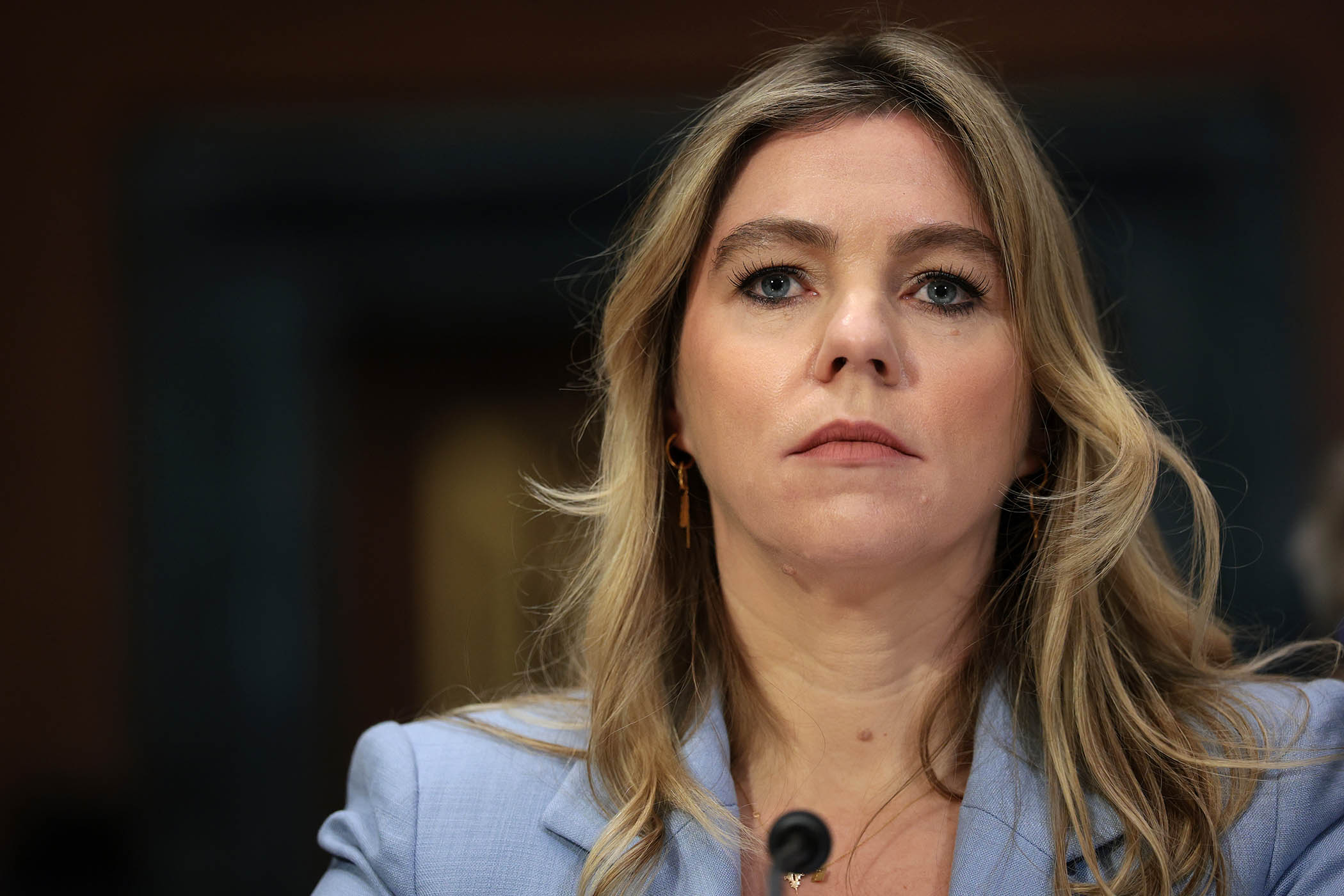
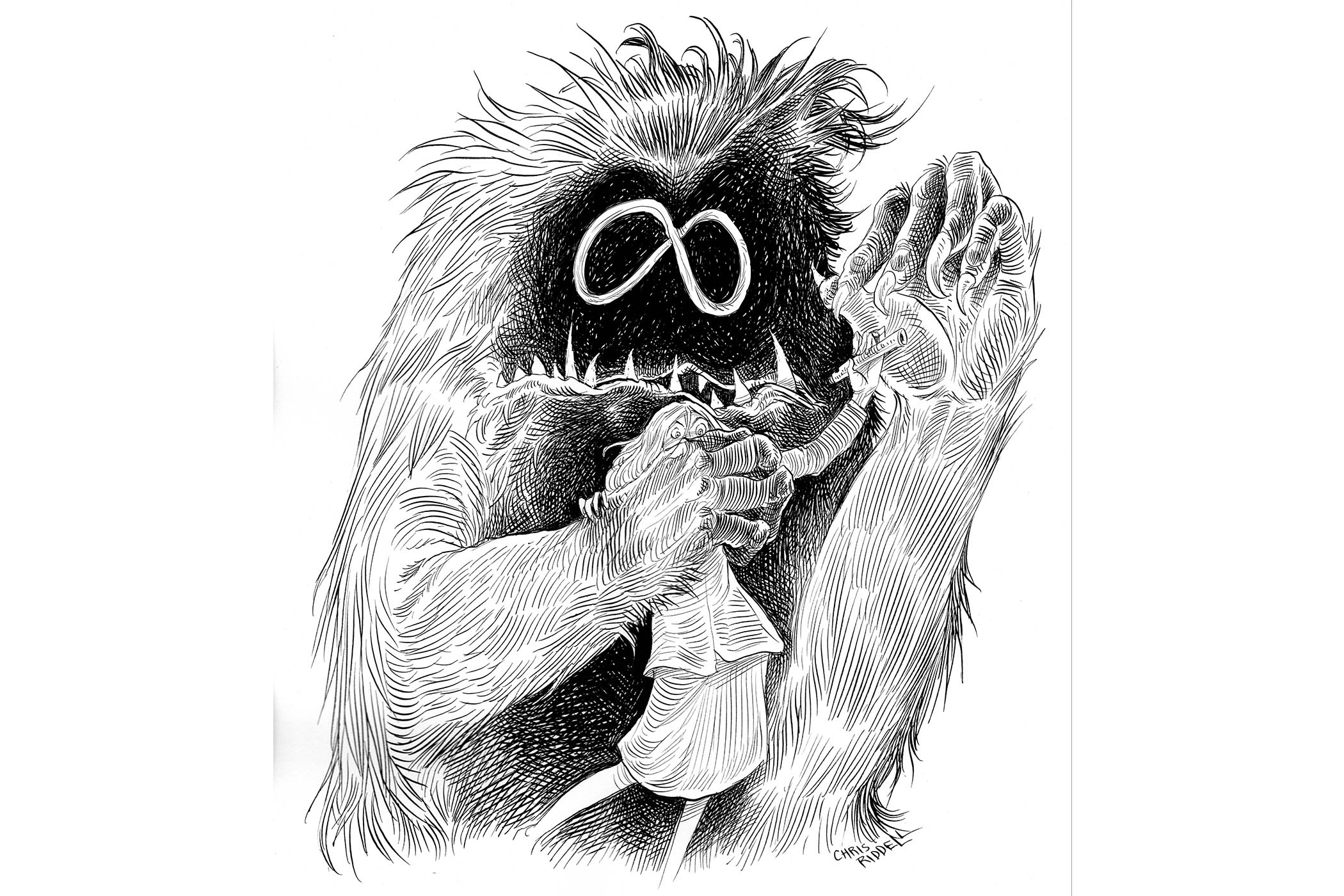

When the whistleblower Sarah Wynn-Williams appeared on stage at the Hay Festival in May, she did so in total silence. While her fellow panellists debated the reach of the technology giants, Wynn-Williams sat motionless, not so much as nodding, lest she breach the terms of a far-reaching legal order obtained by her former employer, Facebook, the company now known as Meta.
“How much power is too much power?” the session billing asked. The answer was in the room: representatives from Meta had travelled to rural Wales to document Wynn-Williams’s appearance and gather evidence that she had broken the order, which bars her from promoting her memoir, Careless People.
To David Davis, the Conservative MP and former cabinet minister, it is “extraordinarily heavy-handed for such a big and powerful company, and an extraordinary way to treat an ex-employee”. Yet according to US lawyers and campaigners, the aggressive pursuit of whistleblowers is fast becoming an industry norm, a shift they attribute to a Silicon Valley operating with new impunity under a second Trump administration.
In Careless People, Wynn-Williams documents her seven years at Facebook, where she rose to director of public policy, until she was fired in 2017. In the book she makes a series of allegations, including that she was sexually harassed by senior executives, chief among them her boss, Joel Kaplan, now Meta’s president of global affairs; that Mark Zuckerberg would have given the Chinese government access to user data to enter China; that Facebook failed to stop its platform inciting ethnic violence in Myanmar; and that the company tracked when teenage girls felt “worthless” in order to sell them advertising. Meta says the book is inaccurate and calls it “divorced from reality”. Still, it has become a bestseller, shifting about 150,000 copies in the UK alone.
In March 2025, after the book was announced by publishers Pan Macmillan and Flatiron Books, Meta moved to suppress it, invoking a non-disparagement clause Wynn-Williams had signed on leaving her job in 2017. Without her being present, an emergency arbitrator in the US granted Meta an “interim award” that barred her from making any “disparaging, critical or otherwise detrimental” comment about Meta – even if it is true – and from promoting the book. (Wynn-Williams alleges that her invitation to the hearing was knowingly sent by Meta to an email address that was no longer in use.) In essence, the award is a temporary gag order, designed to keep Wynn-Williams silent while a wider legal fight about her non-disparagement clause is ongoing. She faces a $50,000 fine for each breach of the original contract, enforceable internationally.
Now Meta alleges that Wynn-Williams’s silent appearance at Hay breached the interim award because the attention she drew amounted to promotion of the book. The company wants the arbitrator to fine her a further $1,500 for each alleged violation of the interim award – each perceived promotion of the book – plus costs and any income from the events, including book sales. The penalties, she believes, “would ruin me and my family”.
In a filing submitted in California last month Wynn-Williams asked a federal judge to scrap the interim award as an unconstitutional restraint on speech. The sworn declaration she submitted alongside this filing is, for now, the only place she has been able to describe her experience of the past 15 months. She writes that Meta’s “surveillance” affects “how I regard every public space I enter, every camera I pass, every person I meet”. The order’s reach, she says, extends to her private life – to what she says at home, with her own family. “I believe the purpose of these actions is to send me a message that [Meta] is watching me,” she writes.
Ravi Naik, her UK lawyer, told The Observer: “The world needs to know that Sarah hasn’t just gone away. She’s been suffering in and by silence – silence as sought and enforced by Meta. And now she’s fighting back.”
But there is not much else Naik can say because he too is constrained by the interim award, which stretches to Wynn-Williams’s legal representatives. In theory, it could bar him from so much as discussing his own previous lawsuits against Meta, which might be construed as disparaging the company, and trigger a fine against his client.
In 2022, Meta executives told shareholders that the company would “not require or encourage our personnel to remain silent about harassment or discrimination”. Four years on, “it’s extraordinary, frankly, that the American court, of all courts, would go in for suppression of free speech in this way”, says Davis, who likens Meta’s conduct to a “peculiar American variant” of the SLAPP – the strategic lawsuit against public participation, used to bury criticism under legal cost and threat. “If this case were registered in the UK, I would certainly be raising it in parliament,” he says.
Newsletters
Choose the newsletters you want to receive
View more
For information about how The Observer protects your data, read our Privacy Policy
Not everyone agrees. “What is it [Meta has] done wrong?” asks David Gold, a solicitor and Conservative peer. Wynn-Williams was paid $200,000 to sign the non-disparagement clause on top of a $580,000 severance payment. If that is the deal one accepts, Gold says, “it’s more than arguable one should stand by it… and in that sense, I do have sympathy with the company”. Wynn-Williams has argued in court filings that she signed under duress.
In 2021, Frances Haugen, a product manager on Facebook’s civic integrity team, walked out of the company with tens of thousands of pages of internal research and handed them to the US Securities and Exchange Commission and the Wall Street Journal. The documents showed that Facebook knew Instagram worsened the mental health of teenage girls; that its algorithms rewarded outrage; that it struggled to contain hate speech; and, crucially, that it kept much of this from the public. Haugen’s disclosures were, in the words of her lawyer Mary Inman, Facebook’s “big tobacco” moment. Facebook disputed Haugen’s account in public, but did not sue her, gag her or move to bankrupt her.
The treatment of Wynn-Williams, Inman says, is symbolic of “the new Meta, empowered by the Trump administration”. Meta donated $1m to Donald Trump’s inaugural fund ahead of his second term, and Zuckerberg was given prime seating at the swearing in. Days after the inauguration, Meta agreed to pay roughly $25m to settle a lawsuit with Trump over the suspension of his accounts following the Capitol attack on 6 January 2021. Of that money, some $22m was directed to his presidential library. Zuckerberg has since praised an administration that, he says, “prioritises American technology winning”.
“Why was Frances treated so differently than Sarah’s being treated?” says Inman. “I think part of it is the emboldened nature of feeling that … President Trump has [the firm’s] back.”
The fear of political blowback once restrained businesses from pursuing whistleblowers like Haugen, explains Jennifer Gibson, co-founder of Psst, which helps tech workers raise workplace concerns. But an administration that moved within weeks to sack Hampton Dellinger, the official running the federal whistleblower-protection agency, has signalled that retaliation now carries little cost, she says. “The message Silicon Valley seemed to take from that was: if the federal government is going after their own whistleblowers, we can go after ours too.”
This problem is not confined to Meta. According to The Information, internal teams at OpenAI have allegedly used a custom version of ChatGPT to work out which employees may have leaked information to the press. The instinct to watch employees and deter them from speaking out seems to be becoming a tech industry norm, Gibson and Inman say.
Inman says the Wynn-Williams lawsuit “sends a signal to other current employees at Meta: ‘If you speak out, we’re going to try and find you.’” Based on her work at the law firm Whistleblower Partners, she believes Meta staffers are now coming forward in smaller numbers, deterred by Wynn-Williams’s treatment and, often, by the “golden handcuffs” of future payouts linked to company shares.
Meta earns more in a year – some $200bn in 2025 – than the entire economies of Morocco or Kuwait, and the company is worth about $1.5tn, a valuation on a par with the GDP of Indonesia, a nation of more than 280 million people. Firms of that scale answer to their shareholders and, in principle, to regulators. But, Inman says, social media and AI remain largely unregulated, particularly in the US.
“Whistleblowers are frankly our first and last line of defence,” says Gibson, “because these companies are black boxes.” Among other measures, Gibson is calling for clear public-interest exemptions “on both sides of the Atlantic”, so non-disparagement and non-disclosure agreements cannot gag whistleblowers for life.
For Wynn-Williams, a negotiated settlement with Meta remains possible, though The Observer understands it is unlikely. Failing that, the fight will go through the courts: her challenge to the interim award could take several months to resolve, and the full case several years.
Zelda Perkins, founder of the Can’t Buy My Silence campaign and a former assistant to the disgraced film producer Harvey Weinstein, believes Wynn-Williams will prevail, if not in court, then in the verdict of history. Perkins became the first of Weinstein’s accusers to break a non-disclosure agreement she had signed in 1998 after a colleague alleged the producer had tried to rape her. She spoke out in 2017, and has been instrumental in driving a UK ban on NDAs that gag harassment victims. “I had to wait more than 20 years,” she says. “But right does win out in the end.”
In a statement, Meta spokesperson Andy Stone said: “This former employee is trying to use the legal process to sell books, which an arbitrator already ruled broke the agreement she signed with the company when she accepted a large severance payment years ago.”
Photograph by Win McNamee/Getty Images