
As well as being one of the biggest chemicals companies in the world, Ineos manufactures an off-road vehicle named after a London pub, holds stakes in the world’s most famous football club, sponsors a Tour de France cycling team and, until recently, owned the fashion brand Belstaff, famous for its waxed jackets.
The company, run by Sir Jim Ratcliffe, one of Britain’s wealthiest men, is a motley fleet of businesses sailing on a sea of debt that reached €12bn by the end of last year.
War in the Gulf, and the resulting surge in oil and gas prices, has dealt a further blow both to Ineos and to Europe’s struggling petrochemical industry. The latest shock raises doubts about the future of an industry that underpins the modern world, providing everything from paint and packaging to fertilisers and construction materials.
In recent weeks, Saudi petro-chemicals producer Sabic has sold its European business to a German private equity firm, while Danish business Vioneo switched the location of a new fossil fuel-free plastics plant from Antwerp to China. Exxon shut down a chemicals plant in Fife after failing to identify a potential buyer.
The Sabic deal was organised through vendor notes, a financing arrangement under which the seller is repaid if the business does well or is sold on successfully, minimising risk for the buyer. “The assets were basically sold for nothing,” said Richard Carter, a former UK managing director for the German chemicals giant BASF, and now a consultant. “It’s a clear sign things are dire for petrochemicals in Europe.”
Across Europe, including the UK, Norway and Switzerland, as well as EU countries, plants equivalent to 17m tonnes of chemical production were scheduled for closure last year, more than double the scale of closures in 2024.
Erwin Douma, a senior partner at the consultancy firm Roland Berger, said: “Companies are closing plants at a scale that we have not seen before, and it’s accelerating.
“The consensus is that this will not come back – in essence, something isn’t right, so typically when it’s closed, it's closed.”
Douma said the facilities being closed included “crackers” – the energy-intensive facilities that break down complex hydrocarbons into the basic products used across the chemical industry.
He said: “These are often part of highly integrated chemical clusters, which make us competitive in Europe. If you take elements out, it’s a kind of Jenga – at some point the whole system is at risk.”
Newsletters
Choose the newsletters you want to receive
View more
For information about how The Observer protects your data, read our Privacy Policy
The factors to blame include high energy and feedstock costs – in particular, the successive shocks of the wars in Ukraine and Iran – and Chinese competition. In addition are the costs of carbon pricing under the EU and UK’s emissions trading systems.
Manufacturing industries are partly shielded from carbon costs through free allowances, but these allowances are due to be phased out as a border tax is brought in on carbon-intensive imports.
Ineos said last year that it faced a £15m bill for emissions at its Grangemouth complex in 2024, and Ratcliffe warned climate measures were “killing manufacturing”.
However, analysts at the thinktank Bruegel maintain that , however, thatEurope’s lack of industrial competitiveness is not a result of carbon pricing but rather “of a broader failure to manage technological transformation”.
Ineos is a privately held business, founded and majority-owned by one man. Ratcliffe, a chemical engineer by training, runs what he has described as a “federation” of businesses, from chemicals to sports to automotive. S&P downgraded the company’s debt last month, taking into account weaker earnings for the business and poorer prospects of recovery for the petrochemical industry. Its owner has stirred political controversy too, apologising last month for causing offence after saying the UK has been “colonised” by immigrants.
In crisis, the conglomerate is sharpening its focus on its core business – selling Belstaff, plus a business making resins and coatings and, say reports last week, giving up naming rights to the Ineos Grenadiers cycling team. Ratcliffe’s company has also lobbied successfully for state support, securing a £75m government loan guarantee and £50m grant at Grangemouth last year, plus a €300m grant from the French government to decarbonise its site near Marseille. Meanwhile, it has broken ground on a new cracker in Antwerp that uses ethane, a byproduct of shale gas that is cheaper and generates lower emissions than naphtha, the traditional petrochemical industry feedstock.
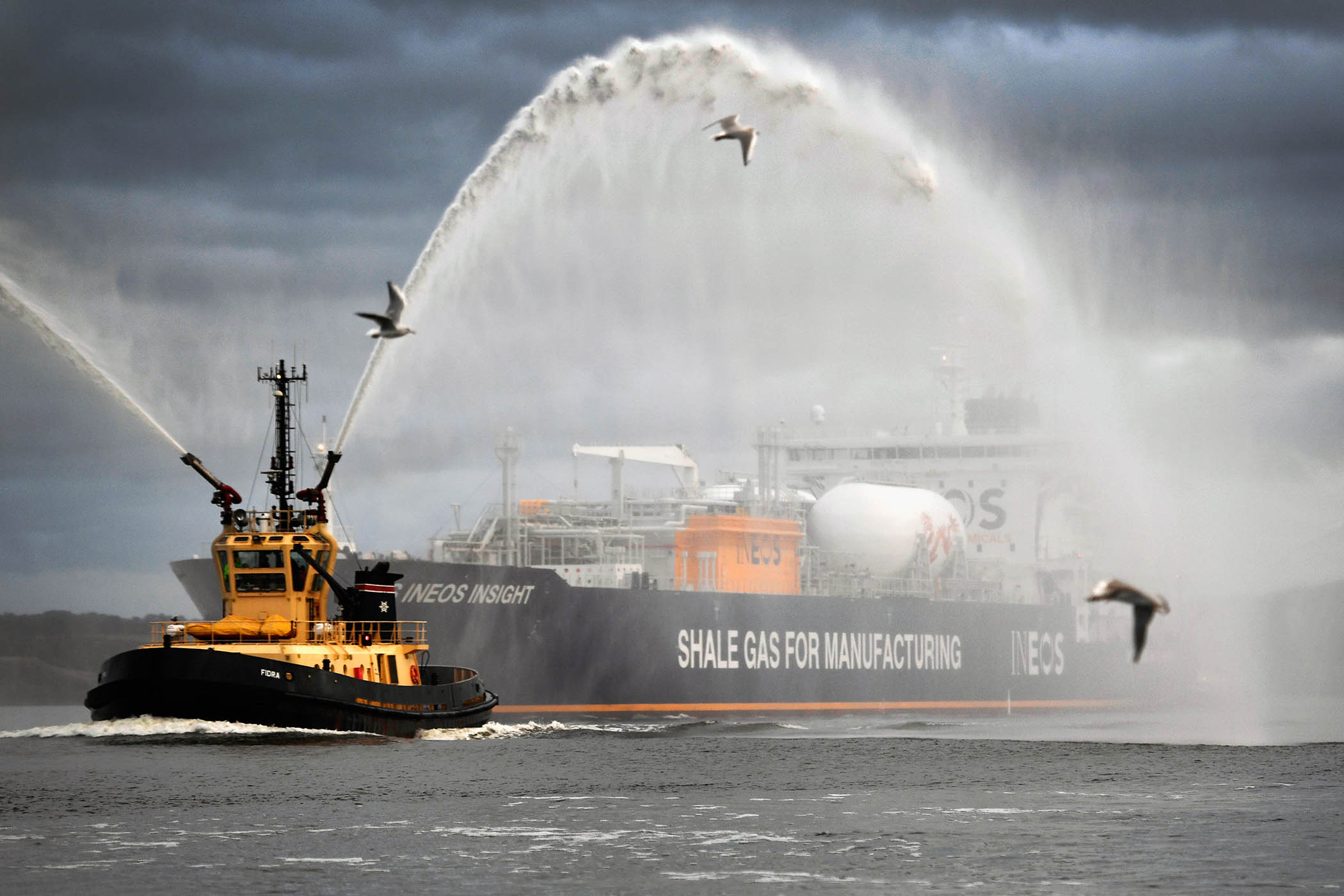
Ineos operates its own fleet of ships transporting ethane from the US to facilities in the UK and Norway.
The ownership of this fleet illustrates a shift to a global economy in which security of supply is taking on mounting importance. Asian petrochemical manufacturers are preparing to halt production as the supply of naphtha from the Middle East is disrupted.
“If you look at the war in the Middle East, there is now a scramble for hydrocarbons,” Carter said. “If you do not have your own vessels, [or] agreed freight rates – you are vulnerable.”
Photograph by Jeff J Mitchell/Getty Images