How do you approach a job application when the interview panel is made up of Vladimir Putin, Xi Jinping and Donald Trump?
That is the challenge facing María Fernanda Espinosa and four other candidates vying to become the next secretary general of the United Nations. To secure the role of the world’s top diplomat, they must win over the five permanent members (P5) of the UN security council – Russia, the US, China, Britain and France – who are on opposite sides of many crises from the war in Iran to Gaza and Ukraine.
That leaves only a narrow path to the top of an organisation that is itself facing a crisis of credibility – and liquidity – at a time of profound global upheaval.
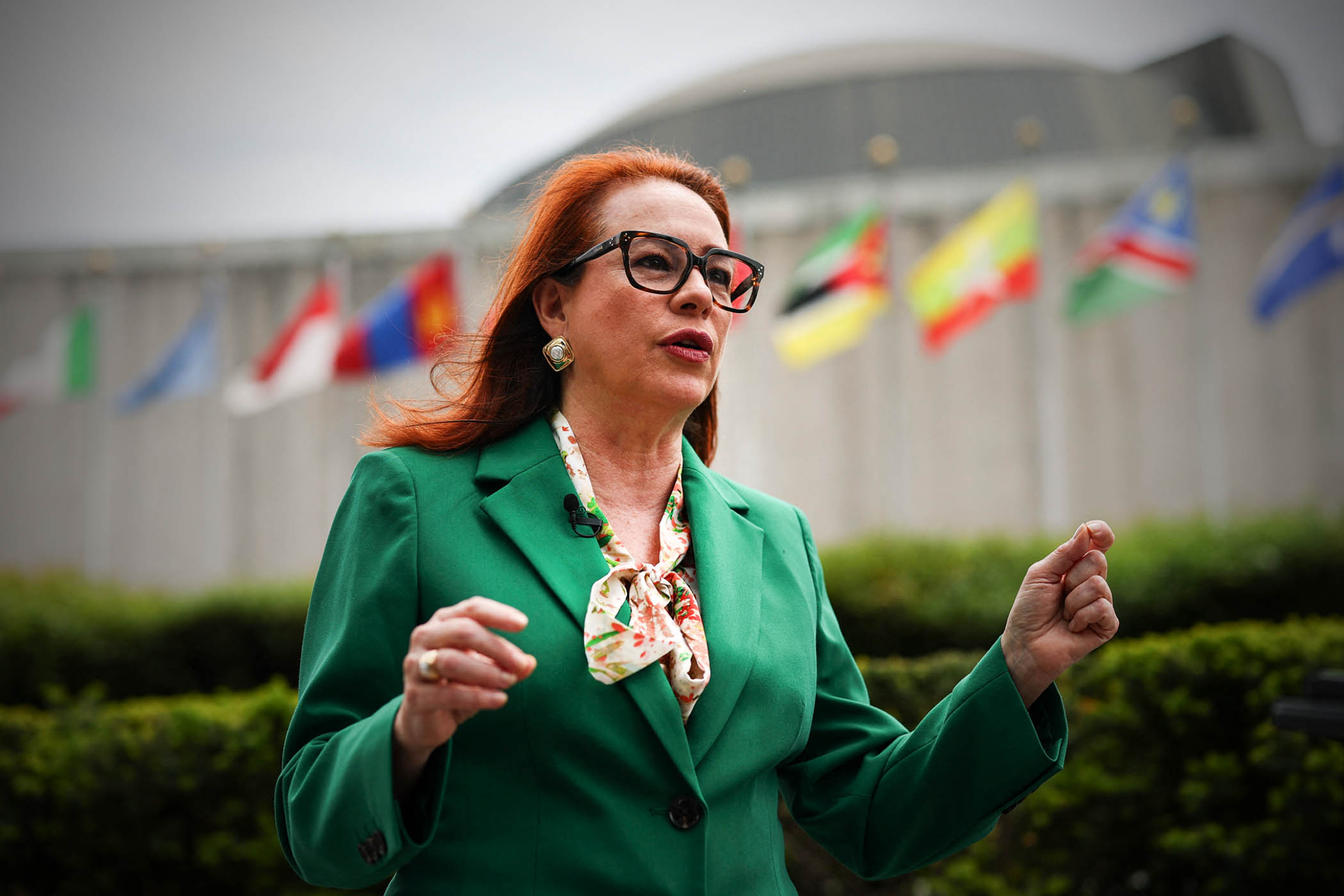
In an interview with The Observer days after declaring her candidacy, Espinosa, a poet and formerly Ecuador’s minister of foreign affairs, played down the challenge of navigating the competing interests of the big powers, reflecting the tightrope she must walk.
“This is not a campaign. This is not a popular vote,” she said. “It is a selection process. And you have to have the qualifications to be fit for purpose, to have clarity in your vision, to be very frank about what are the margins of your oxygen to operate, what are your qualities as a strong leader, as a transformative leader, and yet knowledgeable about how the system operates.”
The other candidates are Chile’s ex-president Michelle Bachelet; the head of the International Atomic Energy Agency, Rafael Grossi; former Senegalese president Macky Sall; and Rebeca Grynspan, former vice-president of Costa Rica.
Within the UN, however, diplomats are already considering what to do if the P5 can’t agree on a replacement for António Guterres by the end of the year, including the possibility of leaving the post temporarily vacant.
The contest comes at a critical juncture for the UN. Major powers are pressing the organisation to reform, cut costs and prove it is still relevant even as they increasingly undermine longstanding norms of international order. The UN’s largest contributor, the US, has slashed funding.
“There is a sense around the UN that this is almost an existential moment for the organisation,” said Richard Gowan, programme director of global issues and institutions at the International Crisis Group. “If we get a good energetic secretary general, there’s just a glimmer of hope that they might be able to navigate the storm.”
Guterres warned earlier this year that money could run out by July. At one of its headquarters in Geneva, the escalators are regularly switched off and the heating turned down to cut costs.
Newsletters
Choose the newsletters you want to receive
View more
For information about how The Observer protects your data, read our Privacy Policy
While budgets are shrinking, needs are only growing. More than 60 conflicts are raging across the globe and 117 million people are displaced. But for the UN to respond effectively it must urgently deal with its own problems.
“In the short term, the biggest challenge right now is the financial challenge,” said Espinosa, who was also president of the UN general assembly. “How to ensure that we have a predictable, sustainable, reliable budget for the UN to deliver its mandates.”
There is quite a lot of concern the big powers will opt for someone low-key who they think they can keep under control
There is quite a lot of concern the big powers will opt for someone low-key who they think they can keep under control
Richard Gowan, International Crisis Group
Under Guterres, the UN has been marginalised on wars in Ukraine, Gaza and Iran. Richard Kozul-Wright, who worked at the UN for 30 years, said Guterres had “failed to engage with what many people would associate with what the UN has to do, which was to be seriously engaged on conflict issues”. Another UN observer likened the current secretary general to a “deflated balloon”.
While the UN has drifted other organisations have emerged. Trump unveiled a Board of Peace seen as a copycat of the UN. Most of its members are monarchs or dictators.
UN insiders are deeply worried about the Board of Peace, but Espinosa said she didn’t see it as competition. “Perhaps we should see the Board of Peace as an initiative of a particular country trying to make up for some vacuum or gap that is felt to be left by the UN,” she said. “The UN has to be part of the solution. I see it [the Board of Peace] as complementary.”
At 61, Espinosa is the youngest of the candidates to declare so far.
Bachelet, who was head of UN Women, has encountered opposition from US Republican politicians who branded her “a pro-abortion zealot” and called on the White House to veto her candidacy. China previously condemned a report produced during her tenure as UN high commissioner for human rights that said the detention of Uyghurs and other Muslims in the country’s Xinjiang province may constitute crimes against humanity. As head of the UN’s nuclear watchdog, Grossi is involved in handling complex issues involving Iran’s nuclear programme and Russia’s occupation of a nuclear power plant in Ukraine.
Other candidates could still jump in. Typically they hold private meetings with each of the five permanent members to garner support. “The less the P5 are unified on any one candidate, the more opportunities it gives for others to try and fill that void,” said Daniel Forti, head of UN affairs at the International Crisis Group.
France and the UK have traditionally acted in close concert with the US, but the deterioration in transatlantic relations could change that.
There is no firm deadline for nominations, but the 15-member security council will begin informal voting in July. A recommendation is then made to the general assembly on which candidate to appoint.
A major question is whether the P5 even wants a secretary general with the dynamism needed to revitalise the UN. Despite their differences, they could unite against a candidate that threatens to stymie their agendas.
“There is quite a lot of concern among a lot of UN members that even if there are some really compelling candidates in the race then actually the big powers will opt for someone low-key who they think they can keep under control,” said Gowan. Suspicions are rife that the US, China and Russia may already have identified a candidate outside the pool of those who have declared.
Without major changes in leadership, the UN’s prospects are dim. “Given what the UN faces, continuity is the worst characteristic you could have,” said Kozul-Wright. “Business as usual will not save the UN.”
Photograph by Angela Weiss/ AFP via Getty Images