Photographs by Valeria Mongelli for The Observer
As he empties fragments of his thigh bone from a pot into his palm, Mohammed Yasin explains the symbolism of the four shards. At first, they were a keepsake from the doctor who operated on him, something for his children in case the bullet killed him.
Then they became proof of the Myanmar military’s genocidal campaign that nine years ago drove the family to south-east Bangladesh and to Cox’s Bazar, the world’s largest refugee settlement.
Sitting on a striped mat inside his woven bamboo shelter, the 40-year-old wears a heavy expression. Even that ordeal, and the aches that keep him awake, have been overtaken by something larger. “Every day I worry about kidnapping,” he says. “They come in black cars, sometimes rickshaws. They just take people. We don’t know who they are.”
Living on rations, and with a lame leg that keeps him from his bricklaying work, he cannot pay a ransom. He warns his children not to stray far from the shelter. “And never talk to strangers,” he says. “I can’t pay. So the kidnappers will either release or kill them.”
The Rohingya Muslims describe themselves as kosu patar pani – a rain droplet adrift on a taro leaf. For nearly a million people, tightly packed into this sprawling labyrinth of camps, there is nowhere to go.
‘They come in black cars, sometimes rickshaws. They just take people. We don’t know who they are’
‘They come in black cars, sometimes rickshaws. They just take people. We don’t know who they are’
Mohammed Yasin
For several weeks in late 2017, the Myanmar military attacked and burned to the ground hundreds of Rohingya villages, massacring women, men, and children, and committing rapes.
At least 6,700 Rohingya were killed that month, according to Médecins Sans Frontières. About 700,000 crossed into Bangladesh; others had fled earlier persecution, and more continue to arrive.
Almost a decade on, the Rohingya remain in limbo, denied citizenship on both sides of the border.
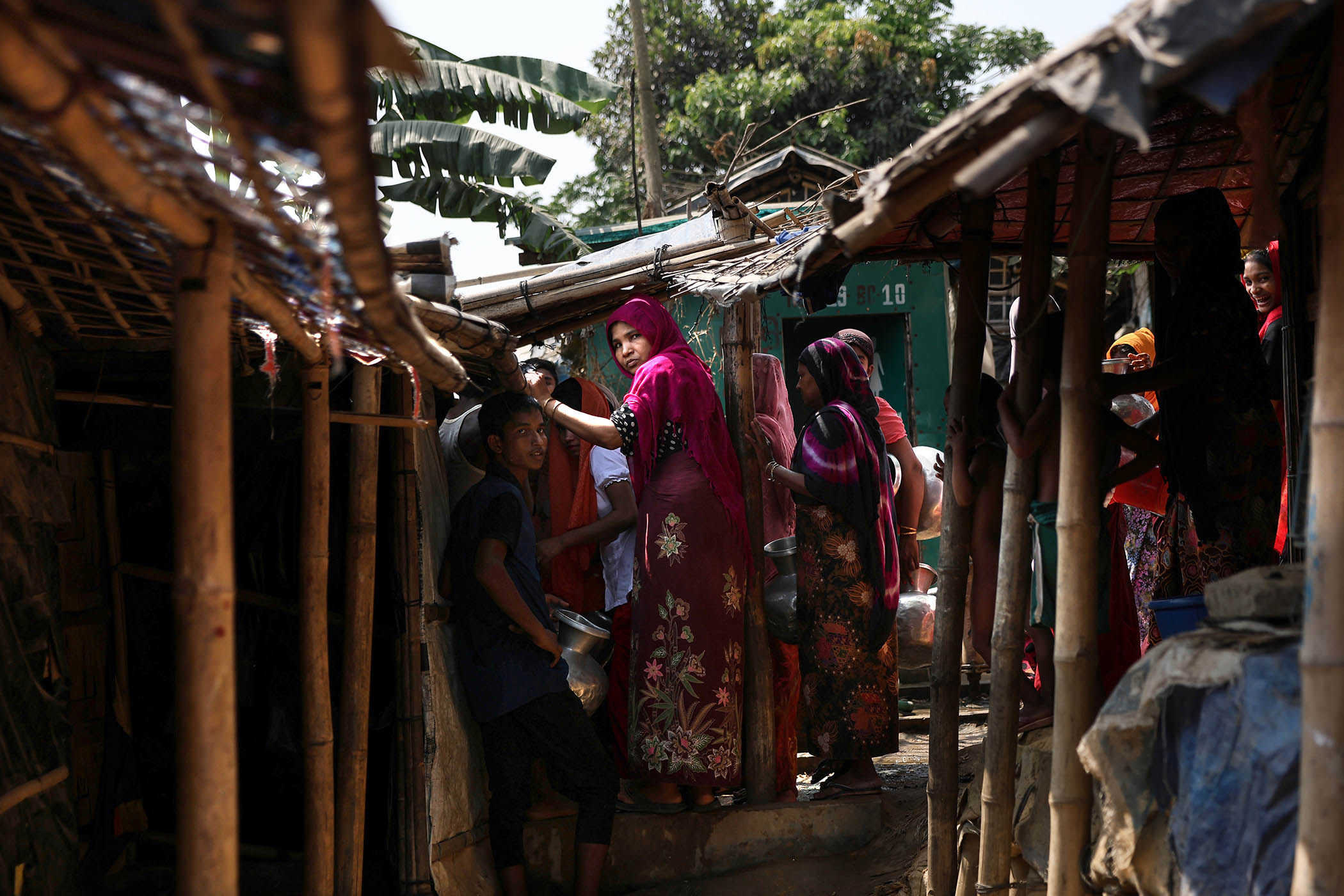
People queue to fill jars with water at a Rohingya refugee camp in Cox’s Bazar
As conditions deteriorate, more people are risking deadly 1,000-mile journeys on rickety boats to Malaysia or sinking into despair. Worsening shortages, including cuts to food rations, are fuelling tension and deepening the climate of fear.
Newsletters
Choose the newsletters you want to receive
View more
For information about how The Observer protects your data, read our Privacy Policy
Scarcity is also driving recruitment into militant groups and criminal gangs, who act with impunity, rights advocates say, while some refugees are being drawn – sometimes forcibly – into Myanmar’s civil war across the border.
Some of the gangs are local Bangladeshis, but others – to the refugees’ dismay – are Rohingya. Militant groups who cast themselves as liberators are targeting their own communities in cycles of killings, torture and abduction, often at night.
Yasin feels a lift when hearing the fiery rhetoric of militants vowing to fight for their return. He imagines himself as a mason again in his home village. “But then I look around,” he says. “They have no strategy.”
Like many here, his hopes are fading. “I don’t see a future where we return.”
On 27 August 2017, Yasin woke in his village of Maung Nu, Buthidaung township, to the staccato sound of Myanmar soldiers spraying gunfire. “Some children were shot,” he says. “People were running everywhere.”
A bullet cracked into his leg above the knee. He cried out for his wife to take the children before losing consciousness. Witnesses said soldiers loaded bodies, a hundred or more, from a residential compound in the village.
With the help of neighbours, his father carried him into the forest, where they hid for 10 days while their village burned. Later, they bore him on a chair stretcher to the coast, where an imam paid for his passage on a wooden boat to Bangladesh.
Min Aung Hlaing, the general who oversaw the campaign, called it “unfinished business”, tracing it to the second world war, when Rohingya who sided with retreating British forces clashed with Rakhine Buddhists aligned with Japan.
For Buddhist hardliners in Myanmar, the violence was a response to the spectre of Muslim insurrection and illegal “Bengali” immigration. Denied citizenship and driven from their land, Rohingya had placed their hopes in Myanmar’s then-civilian leader Aung San Suu Kyi to defend them. Instead, the Nobel laureate travelled to The Hague to defend the military against genocide allegations at the International Court of Justice (ICJ).
Her move was celebrated at home, while destroying her reputation abroad. Little more than a year later, in February 2021, Min Aung Hlaing staged a coup, detained Suu Kyi, dissolved her party and plunged the country into civil war.
In April this year Min Aung Hlaing was sworn in as president after an election widely dismissed as a sham. Suu Kyi has been moved from prison to a secure house in a military neighbourhood in the capital, Naypyidaw, remaining cut off from the outside world.
An ICJ ruling on the genocide case against Myanmar is expected later this year, but the court cannot compel arrest – its leverage is limited to sanctions and diplomatic pressure. The International Criminal Court is separately reviewing a 2024 request for an arrest warrant against Min Aung Hlaing on crimes against humanity.
Across Myanmar, dozens of ethnic armies and rebel forces fight the junta for their people’s land. In the camps, something crueller has emerged.
Rohingya militants no longer see the military that expelled them as their primary target. Their real enemy, they say, is the Arakan Army (AA), the ethnic Rakhine Buddhist force that wrested most of their homeland from the junta, and stands accused of its own abuses against Rohingya civilians.
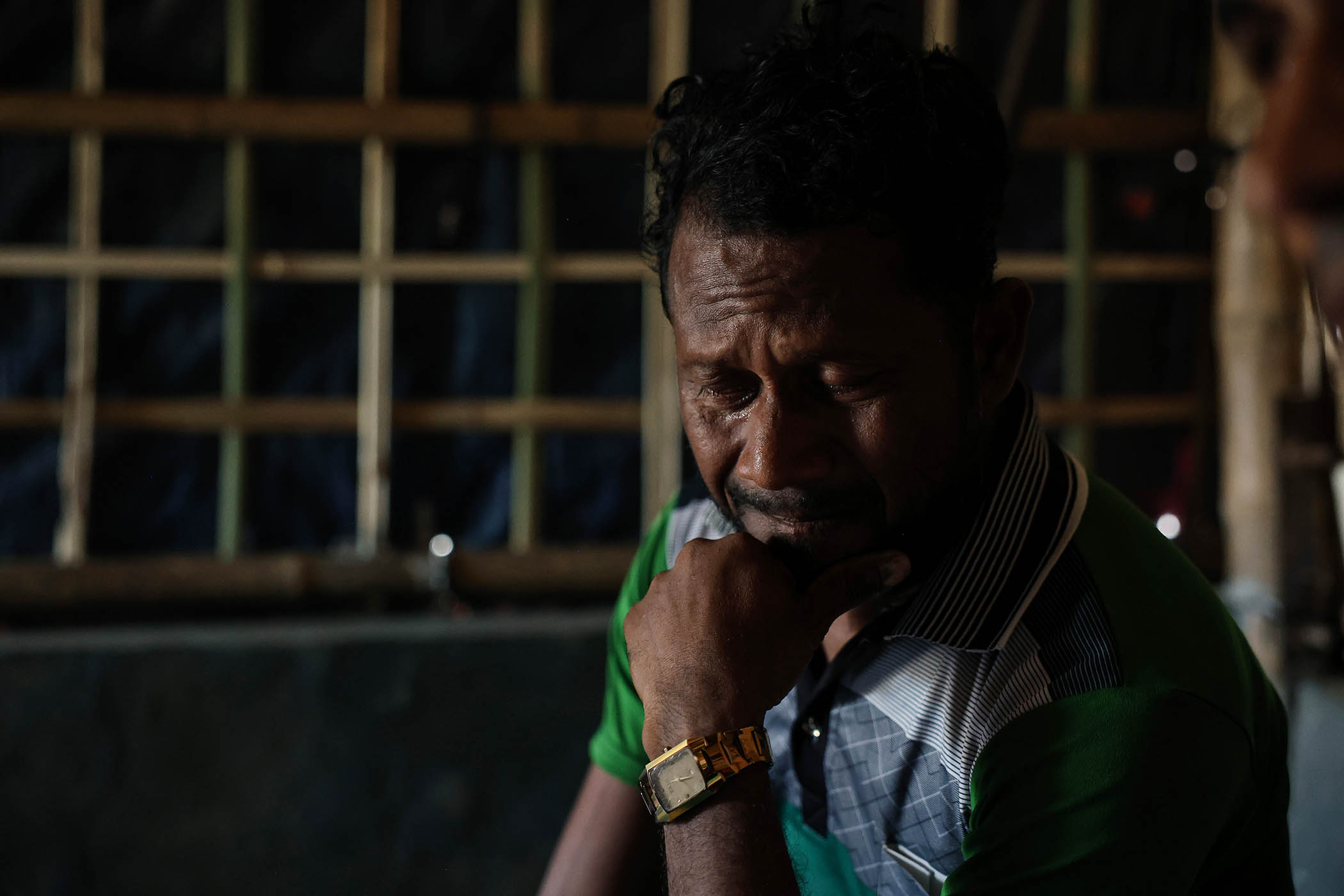
Mohammed Yasin, 40, reacts during an interview in his bamboo shelter at a Rohingya refugee camp in Cox’s Bazar
But even that picture mostly dissolves on closer inspection. Some militants stage occasional attacks against the AA; others have reportedly handed Rohingya captives to them as cannon fodder against the junta. Others still have worked alongside the same forces that drove them from their homes. Most clash in turf wars, extorting and kidnapping their own people. What binds this violent tangle is not liberation, but parochial lurches for power and money.
Mohammed Kassim understands this more than most. He sits in his shelter all day, jittery and haunted. On 16 January 2025, four men in black shirts sprayed the 48-year-old with a substance that blurred his vision. “I tried to fight them off,” he says. “But they were too strong.”
They beat him and threw him into a car, driving him to a hilly area near the Myanmar border. The kidnappers, who spoke Rohingya, demanded 600,000 taka – about £3,600 – an unreachable sum for refugee families. He was allowed to call his brother. When the family couldn’t pay, they beat him about the head.
“If I go outside now, the world spins,” he says.
Then they threw him into a pit. “Like a well. I couldn’t see over the edge, just the sky above,” he says. “It smelled like rot.”
In the gloom, he touched a large, severed hand. “The hair was long on it,” he says. “I saw a part of someone’s head, an ear, part of a finger.” He lost his voice from screaming. He was kept there for three days without food, pulled out only for beatings, he says. “I thought I would die. I had to go to the toilet where I sat.”
With a black plastic bag over his head, he was handed to what he believes were AA soldiers to fight the junta. He could not stand, let alone train for combat.
They accused him of faking his injuries and beat him. They forced him to eat pork, he says, and one tattooed his forearm with nonsensical Burmese script – he thinks it was the name they’d given him. Some Rohingya neighbours mock him for it, as permanent tattoos are considered haram, forbidden.
Seeing no use for him in his battered state, the soldiers returned him to the kidnappers. His family scraped together 200,000 taka and he was dropped in a forest. The whole ordeal lasted a week. He came out of it, he says, “like a crazy person”.
He now uses a crutch to stand, and a raised toilet seat – he can no longer squat. “I’m a burden now,” he says. “Before this, I helped people. Now I’m the one who needs help – to do anything.”
His brother refitted a stronger door, fearing the kidnappers would return at night. Any noise outside and, he says, “I think they are coming back for me.”
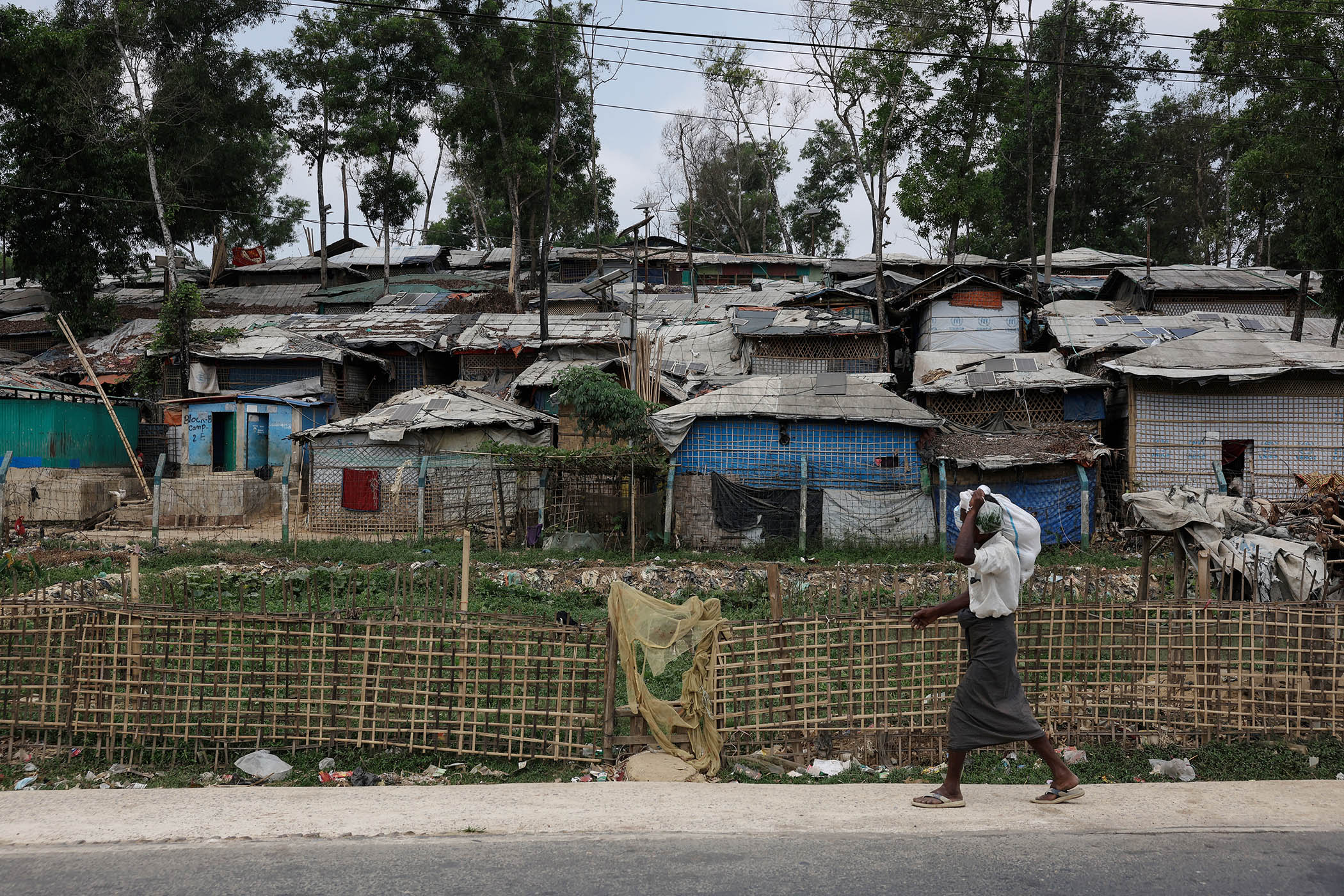
The camps sprawl across a narrow coastal strip a few miles from Cox’s Bazar, a busy beach town where Bangladeshi tourists promenade along one of the world’s longest unbroken stretches of sand. Just inland, a million people – described by some as living in an open-air prison – are packed into an area two and a half times the size of London’s Richmond Park.
Barred from legally working in Bangladesh, the refugees depend almost entirely on humanitarian aid. On 1 April, UN World Food Programme rations were cut, dropping for some from $12 to $7 per person per month. With the monsoon approaching, trash-choked waterways that children sift through for scraps of plastic to sell will flood and swamp homes, and alleyways will churn to mud.
Some slip out of the camps to fish, sell dried fish, drive taxis or work in shops or salt fields and the timber trade. The journey home is often when kidnappers can strike, especially after dark.
Those under threat are supposed to report to a block leader, who can escalate their case to a Bangladeshi government official. But refugees say block leaders, some of whom have been killed, are too intimidated to file complaints about armed individuals. Most threats go unaddressed.
The Bangladesh Armed Police Battalion, known as APBn, is responsible for camp security. A Human Rights Watch report found that APBn officers have extorted refugees and falsified evidence to detain innocent people. The agency denies the allegations. It did not respond to a request for comment.
They keep coming and saying, ‘give us your daughter’
They keep coming and saying, ‘give us your daughter’
Rozina
Bangladesh’s foreign ministry was offered in-person interviews over two weeks and given a further week to respond to written questions; a representative said they could not meet the timeframe.
The UN refugee agency (UNHCR) leads the humanitarian response at the camps, but camp security falls outside its mandate. Refugees can call a UNHCR emergency helpline or email the agency, though many report hearing nothing back.
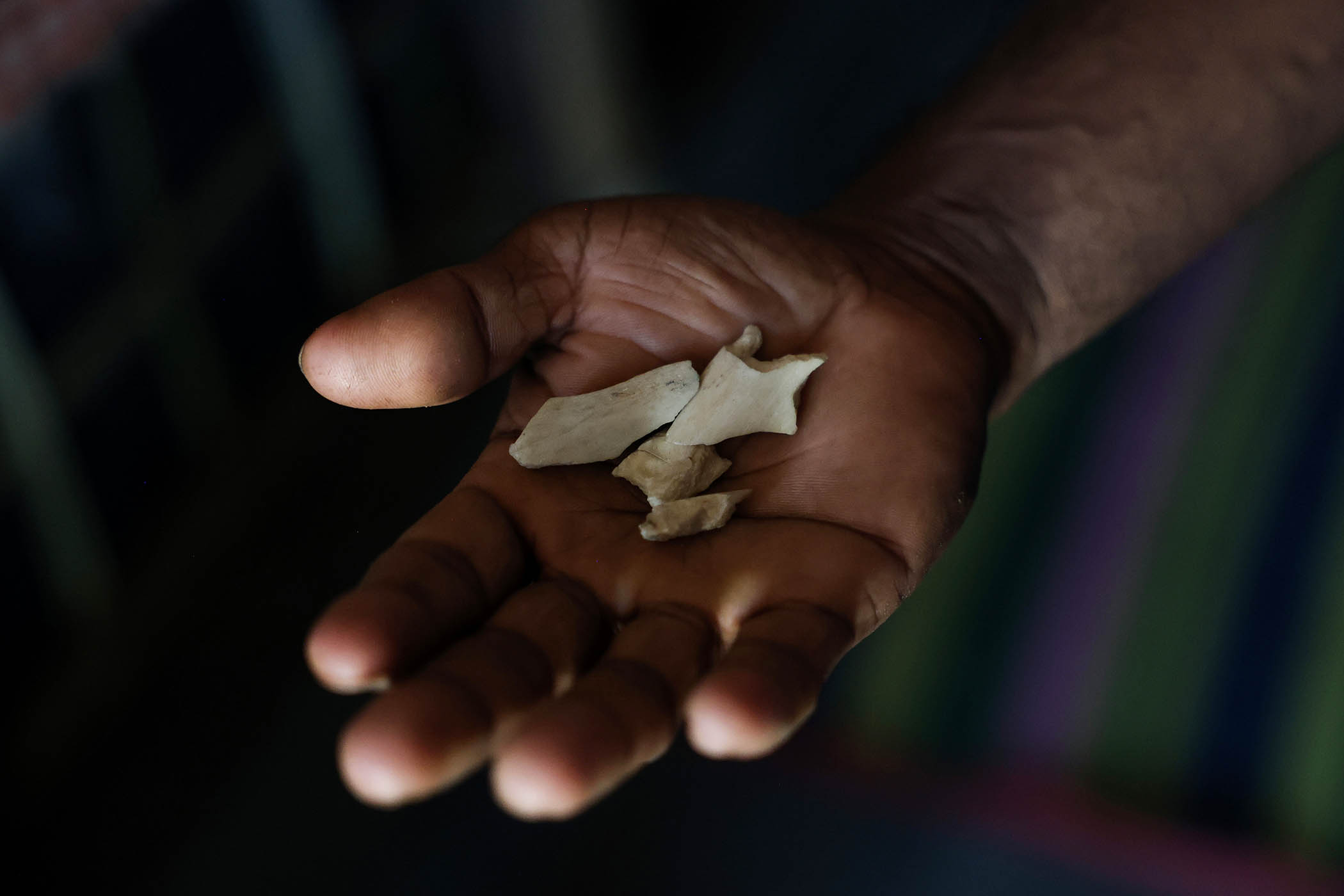
Mohammed Yasin, 40, holds fragments of his thigh bone in his bamboo shelter at a Rohingya refugee camp in Cox’s Bazar
Spokesperson Shari Nijman said the agency receives roughly 22,000 calls and 1,500 emails each month, triaged by a team of 10, with 49 in-person feedback points across the camps. UNHCR has cut nearly 30% of its staff in recent years as contributions have dried up, curtailing services across the board.
“In an environment of declining humanitarian assistance, we are acutely aware that we cannot fully meet the needs of refugees,” Nijman said.
The armed groups behind much of the violence in the camps have brutal records. The most prominent militant group, the Arakan Rohingya Salvation Army (Arsa), has been accused of killing prominent human rights defender Mohib Ullah in September 2021, and of a massacre of six men at a camp madrasa the following month. In October 2023, the group dismembered a 23-year-old Rohingya man. An Arsa leader has admitted to rights advocacy group Fortify Rights that his group has been involved in killings, rape, abductions, extortion and other abuses against refugees, though officially the group denies it.
Rozina (not her real name) is being harassed by men she believes belong to the Arakan Rohingya Army, a gang involved in trafficking crystal meth.
A year ago, masked men beat her husband to death because he refused to hand over their eldest daughter, now 17. She has since moved the girl to another camp. “They keep coming and saying, ‘give us your daughter,’” she says.
They have ransacked her shelter and stolen her jewellery. When her family reported the harassment to camp authorities, the men kidnapped her teenage son, holding him blindfolded for a day and a night.
“The criminals rule at night,” she says. “I’m here with the younger ones, in fear.”
For all the uncertainty, poverty and lawlessness, it is Rohingya children who bear the heaviest cost. More than half the camp population are under 18; some have grown up knowing nothing beyond the tarpaulin and dust.
They find happiness, playing barefoot football or flying kites made of plastic scraps, string wound around a bottle. But without serious change, many will probably live out their lives here.
Yasin knows this as well as anyone. As he returned fragments of his thigh bone to the pot, he said his dream of securing a better education for his children is slipping away.
He has the English alphabet written on his door – the key, he believes, to something better for them, whether a job with an NGO or a path out of the camps.
Small children peer through the door, and his son watches from behind a curtain partition, as Yasin breaks down in tears. “Their future is in the dark,” he says.
Additional reporting by Ro Min Swe and Ro Zeen Kyi