
To hear more about this story, listen to Ada and Rory’s investigation on The Slow Newscast here.
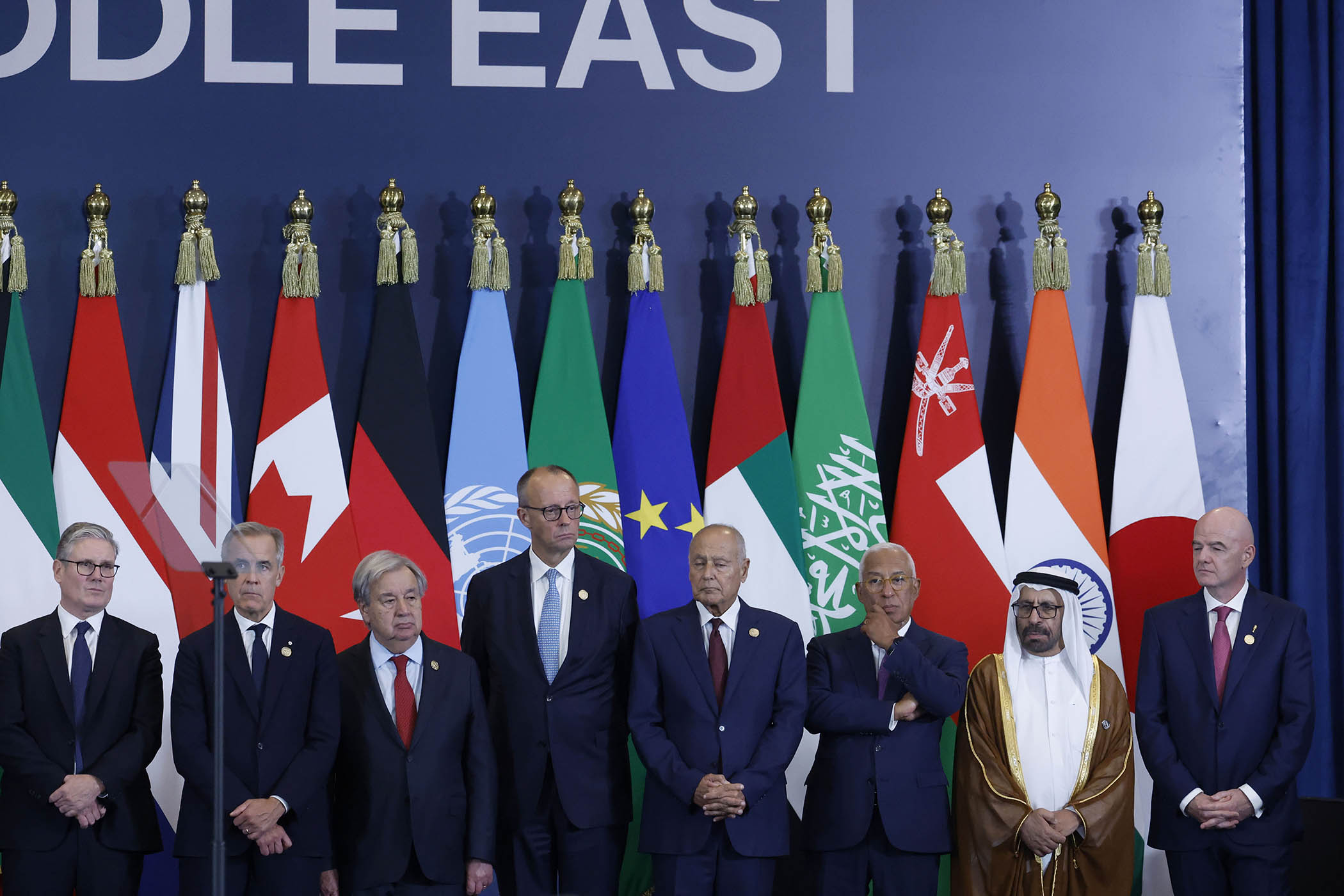
Out in the Egyptian desert, the world’s leaders were waiting and waiting. They had been summoned to the resort town of Sharm El Sheikh at short notice over the weekend of 11 October: presidents and prime ministers and at least two kings, gathered together at the behest of US President Donald Trump to discuss his plan to end the war in Gaza.
That morning, they had been swept out of their hotels to the vast conference centre where the summit would take place, a convoy of power-brokers and police officers and security details, snaking across the sand. The roads were lined with images of Trump and his Egyptian counterpart and co-host, Abdel Fattah el-Sisi.
Once they arrived, however, they found themselves at an unexpected loose end. Trump had been delayed: he had been in Israel, making a speech to the Knesset and was still travelling. Nothing could start without the master of ceremonies. Keir Starmer held a bilateral meeting with Recep Tayyip Erdoğan, the Turkish president. They were soon joined by Emmanuel Macron. Others popped in, too, to pass the time.
Only one invitee appeared to have been kept fully abreast of Trump’s schedule.
Gianni Infantino’s arrival in Egypt, on a private jet owned by the state of Qatar, dovetailed much more neatly with Trump’s. Soon, he was posing for photos alongside both the US president – both giving a thumbs up – and El-Sisi.
He was present in the “family photo” too, the image of all 30 or so delegates at the talks – standing behind Viktor Orbán, the Hungarian prime minister, and Pedro Sánchez, the Spanish premier.
Many of those in attendance found his presence surprising. Infantino, after all, is not a president, or a prime minister, or a king. He was the only guest who does not have an explicitly political role. (The EU, the UN and the Arab League are not nation states, but were all represented, too.)
Figuring out exactly how to categorise the 55-year-old Swiss-Italian lawyer is trickier than it sounds. Technically, as president of Fifa, global football’s governing body, he is a sports administrator. His prominence is such, however, that Kirsty Coventry – the low-profile head of the International Olympic Committee – feels a less apposite parallel than the Pope.
It is not as absurd as it sounds. Neither is a head of state; neither is an expressly political figure. But both do represent religions that exert an outsize influence over the lives of their hundreds of millions of followers – and there is a non-zero chance that Infantino’s is the more popular.
Newsletters
Choose the newsletters you want to receive
View more
For information about how The Observer protects your data, read our Privacy Policy
That brings with it the kind of power that allowed Infantino not only to attend the Gaza summit, but to feel perfectly at home on that stage; he would later say that the role football might play in any reconstruction of the Gaza Strip actually made it imperative he was present. It has afforded him a prominence that has permitted him to build a rapport with the man who invited him to the summit that many of the other leaders present would envy.
Infantino was, it turned out, in Sharm El Sheikh at the instigation of Trump himself, yet another manifestation of an unlikely friendship that seems to encapsulate how both modern politics, and modern football, work.
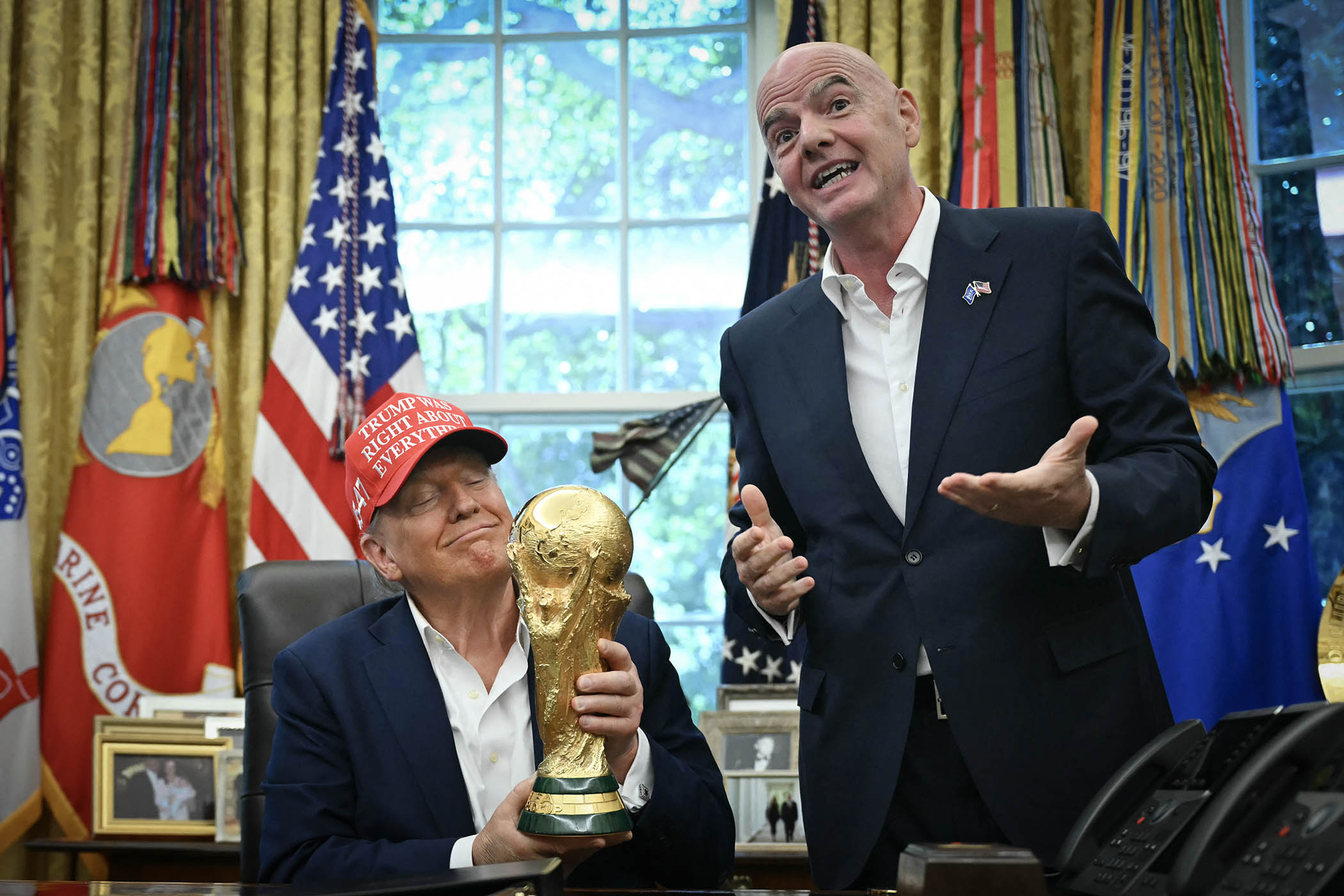
Donald Trump holds the World Cup trophy next to Fifa president Gianni Infantino in the Oval Office of the White House.
In the 15 years in which he worked for Uefa, the organisation that sits at the top of European football, Infantino was never a regular participant in the regular staff games that took place near its headquarters in the Swiss city of Nyon. Those who played frequently recall their colleague donning his boots only a handful of times.
That was, in many ways, in line with their assessment of his character. It is difficult, at this remove, for his former colleagues to separate their memories of him then from their impressions of him now; the story always takes on a different timbre when you know the ending.
Speaking to several people who worked closely with him at Uefa though, the picture that emerges is fairly consistent. Infantino joined in 2000, initially taking up a sort of junior executive role in the association’s doubtless thrilling legal affairs and club licensing department. He quickly won a reputation for his diligence and his depth of knowledge.
He was not, one source said, an especially loud presence, but he commanded respect through his grasp of the subject matter. He “always made sure he was better briefed than anyone else,” they said, “even when it was not necessarily his specialism.” He worked hard, keeping long hours. He rarely seemed to sleep, former colleagues joked.
He had an ability to make himself useful to his bosses. He was, one of them said, especially adept at “building and maintaining his network”. In some cases, the praise is grudging, tempered by what would come later, but that serves only to make it feel more sincere.
“People do what they’re good at,” one former colleague said. “And Gianni is good at sports politics. He has come from the ground up. He knows that world like the back of his hand.” By the glacial standards of Uefa, he rose quickly through the ranks: he was deputy secretary general by 2007, and then secretary general a couple of years later.
Still, his decision in 2016 to stand for election as Fifa president – officially the most powerful position in world football, although perhaps not always the most prominent – seemed, from the outside, more than a little fanciful.
What little public image he had at that stage had been formed in his brief appearances at draws for Uefa’s various competitions. Infantino was a smiling, largely indistinguishable technocrat. He was a good man for telling you which group Real Madrid would be in. He could explain the permutations of the last 16. He knew how to corral a few former players to pluck balls from a transparent vessel. He seemed an unlikely candidate to run the world’s biggest sport.
In the byzantine world he inhabited though, that was precisely his appeal. In 2015, Fifa’s longstanding president, Sepp Blatter, had been banned from the sport for eight years following the exposure of quite staggering corruption at the organisation.
A US Department of Justice investigation had uncovered what appeared to be a culture awash in kickbacks and outright bribery. The details are many and varied, but the best is that one former Fifa executive had the use of two Manhattan apartments, one of which he used solely for his cats. Blatter always fiercely denied any wrongdoing, but he was toppled nonetheless. Fifa says it has since introduced a series of new processes and structures, including a whistleblower helpline, and is now a completely new organisation.
Even by Infantino’s standards, he has grown exceptionally close to Trump. The Fifa president was present, in a prominent seat, at Trump’s second inauguration.
Even by Infantino’s standards, he has grown exceptionally close to Trump. The Fifa president was present, in a prominent seat, at Trump’s second inauguration.
The scandal was, coincidentally, perfect for a candidate like Infantino. Fifa not only needed someone untainted by the sins of the past, but someone almost, well, bland: a safe pair of hands, someone to steady the ship, someone to keep things quiet. Infantino’s colleagues suspected deep down that he had always wanted the job. His ambition might have been quiet, but it was not entirely silent. Now even they could see he fitted the bill.
His pitch was simple. He talked about both “restoring” Fifa and “creating a new era”. He vowed that the money the organisation generated – more than three quarters of which can be traced to the revenue created every four years by the men’s World Cup – would not go to the office of the president, but to the then 209 member federations.
He stressed he was, at heart, just a simple football fan, a boy who had grown up supporting Inter Milan. It worked. Infantino had grown up in the same Swiss canton, Valais, as Blatter. In February 2016, he replaced him as permanent president of Fifa.
His childlike love for football would become a hallmark of his presidency. He makes time, on many of the trips he takes to visit his electorate, for a game of football; they regularly feature appearances from the cast of what he terms “Fifa legends”, a status bestowed on a fairly arbitrary selection of recently retired greats.
It’s in those moments Infantino seems most in his element, in which his love for the game seems most pure, most childlike. Former colleagues find it amusing. Infantino is more than happy to play football, it seems. It just depends who’s on his team.
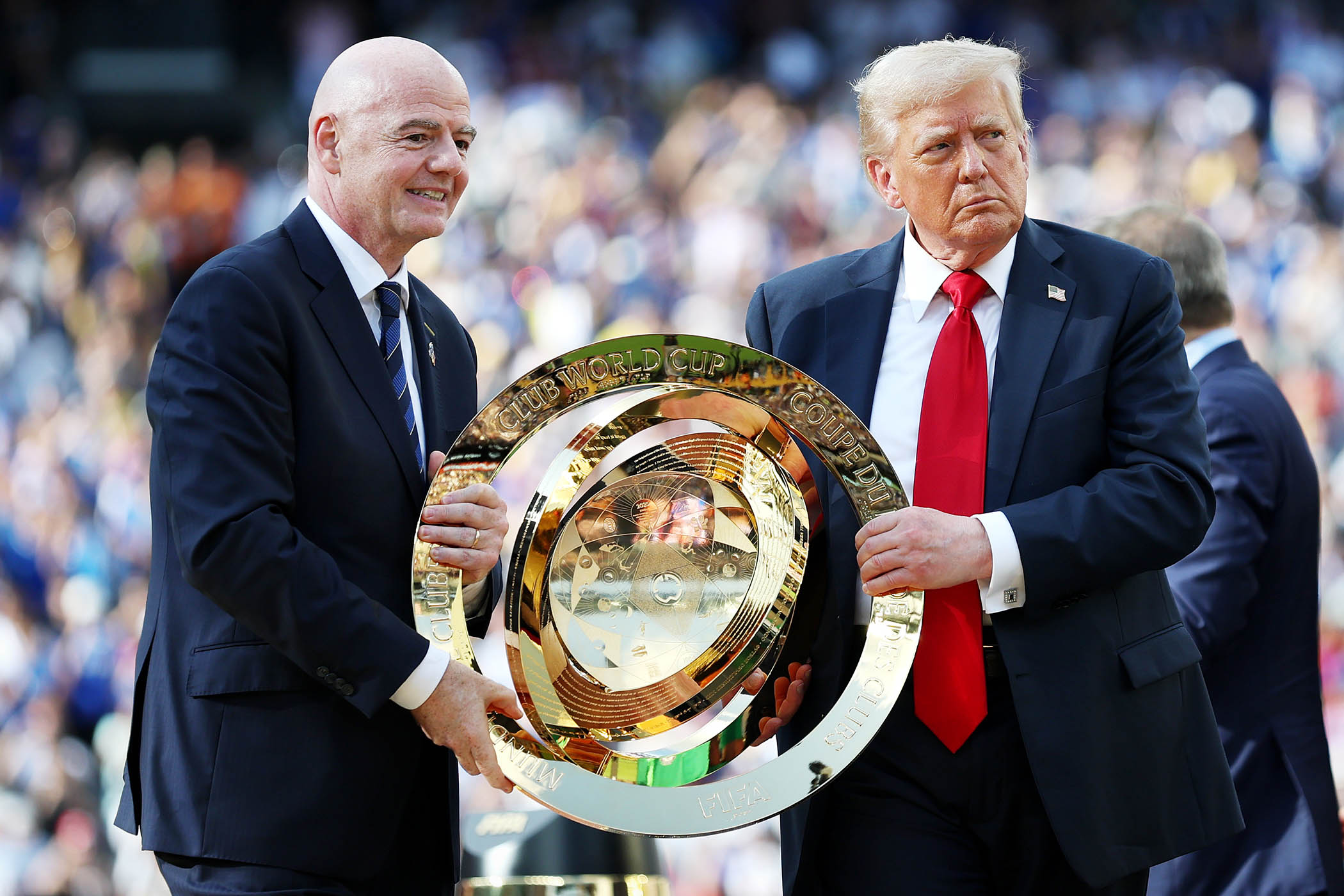
Gianni Infantino and Donald Trump hold the Fifa Club World Cup trophy at the final between Chelsea and Paris Saint-Germain at the MetLife Stadium in July. The US president later kept it.
The security services had closed the highway leading from New York to the marshland of New Jersey. Drones and helicopters hovered overhead. On the ground, both the TSA – America’s ever-welcoming airport officials – and the FBI forensically searched the bags of everyone hoping to enter MetLife Stadium for the final of last summer’s Club World Cup, a newfangled tournament designed as a forerunner to next year’s men’s World Cup.
The reason for the enhanced measures took his seat in an executive box a few minutes before kick-off, looking out at the arena, an emperor surveying his games. In the sweltering July heat, a haze had descended on the vast, sweeping bowl of MetLife. It was not possible to make out President Trump’s features. The 80,000 fans in the crowd could not have missed his big red tie.
In the nine years since his election to Fifa’s highest office, Infantino has reliably sought to build close relationships with the ruling classes of whichever nation is due to host the World Cup. Vladimir Putin would award him an Order of Friendship Medal after Russia held the tournament in 2018. He forged such strong bonds with Qatar, hosts in 2022, that he moved there.
Those tournaments were marked by widespread criticism of both countries’ human rights records. Infantino defended both to the hilt. He has been quick to establish a connection with Mohammed Bin Salman, Saudi Arabia’s crown prince and de facto ruler, too. Saudi Arabia won the right to host the 2034 World Cup effectively uncontested.
All of this, those around Infantino would say, is nothing more than realpolitik. Fifa needs the World Cup to run smoothly. That is much more likely if the people in power in the host nation are well disposed to the tournament’s frontman. (They do not say that this is particularly important when Fifa is dealing with autocracies, as it did in 2018 and 2022, something one now disgraced executive at the organisation once said was preferable.)
They would cast his relationship with Trump much the same way. The US, along with Canada and Mexico, will hold the next edition of the tournament next summer. It is both logical and desirable that Infantino should forge a close bond with the president, although he has shown much less interest in courting either Mark Carney or Claudia Sheinbaum, the leaders of the other host nations.
“To host an event of the magnitude of the FIFA World Cup it is absolutely essential to establish a fruitful relationship with the governmental authorities of the host countries,” FIFA said in a statement to The Observer, stressing that the organisation’s statutes demand its president “maintains and develops good relations” with its member nations. “The President must maintain good relationships with leaders of host countries to ensure a successful event for all.”
Even by Infantino’s standards, though, he has grown exceptionally close to Trump. The Fifa president was present, in a prominent seat, at Trump’s second inauguration. He has visited him at both the Oval Office and Mar-a-Lago, occasionally dragging slightly bemused footballers with him: players for the Italian side Juventus watched on, with Infantino, while Trump raged against Iran at the White House in June. Infantino has suggested that Trump will not just make America great again, but “also the entire world”.
Fifa this year announced that it would open up a New York office – in addition to its seats in Miami, Doha and Zurich – in Trump Tower. When Trump took a liking to the Club World Cup trophy, designed by the jeweller Tiffany, he was told he could keep it. The version Chelsea lifted after winning the tournament was a replica.
Originally, Fifa had seemed to want to hold Friday’s draw for the World Cup – a glitzy, overblown event in which teams find out who they will face in the tournament – in Las Vegas. Much of the logistical groundwork had been done when its plans unexpectedly changed: instead, reportedly at Trump’s insistence, it was held at Washington’s Kennedy Center. Trump, Carney and Sheinbaum all appeared on stage.
But only one of them took home the inaugural Fifa Peace Prize, an award announced last month, days after Trump was overlooked for the more prestigious Nobel version. Infantino handed the US president a gaudy trophy and a medal, one to “wear everywhere you go”, in gratitude for being a “leader who cares about people”. Trump received the award graciously, explaining that he had saved the lives of 10 million people.
The flattery, clearly, has worked. The reciprocity of their relationship is fairly transparent: Infantino burnishes Trump’s ego, Trump allows Infantino to cosplay as a statesman. The depth of it, however, is a little harder to fathom. Trump is not a football fan. His enthusiasm for the World Cup, beyond the projection of power to a global audience in the billions, is not deep-rooted. His affection for Infantino, though, appears to be.
Last month, Trump gave a speech at the America Business Forum in Miami. It was, in theory, a difficult time. The US government was in shutdown. The Republicans had suffered various electoral setbacks, including the election of Zohran Mamdani as mayor of New York.
Nevertheless, Trump was characteristically bullish, espousing the strength of the economy to a star-studded audience: Javier Milei, the embattled Argentine president; Jamie Dimon, the chief executive of JP Morgan. Jeff Bezos spoke the next day. But it was the sight of one person in particular that excited Trump the most.
“Gianni, my boy,” he said on stage. “I didn’t know he was going to be here. He’s big stuff.”
Photographs by Chip Somodevilla, Andrew Caballero-Reynolds, Michael Regan/Getty