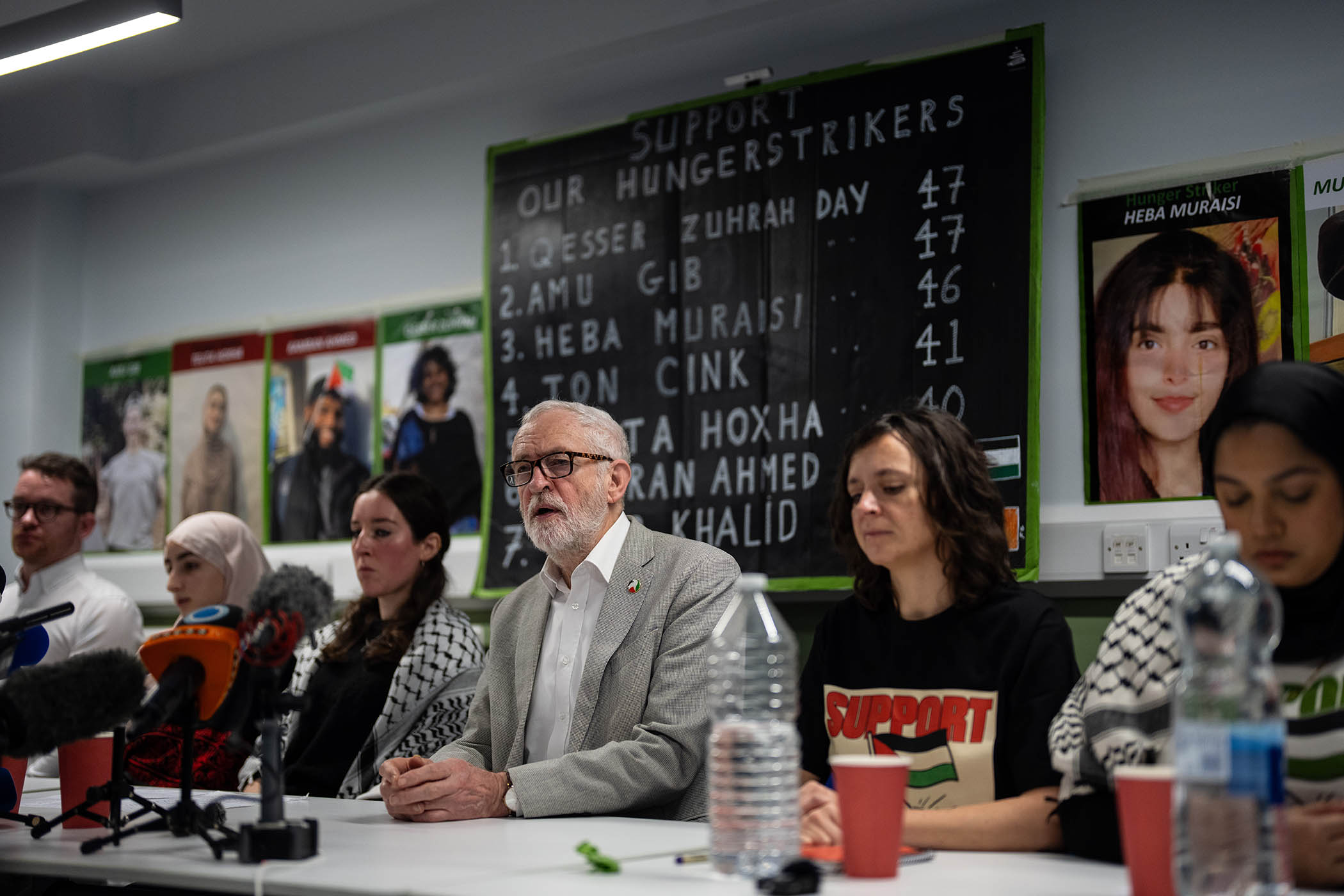



Today, four prisoners in jails across England – down from eight a few weeks ago – are refusing food while they wait to go on trial for offences allegedly carried out in the name of Palestine Action. “Our demands [for ending the hunger strike] are simple,” one of them, Amu Gib, wrote last week. They include shutting down weapons factories in the UK that supply arms to Israel and ending the proscription of Palestine Action for being “concerned in terrorism”.
If the list of demands looks difficult to negotiate to the government on the receiving end of it, Jeremy Corbyn and other supporters of the hunger strikers have signposted a shortcut: arrange a meeting between their lawyers and a government minister and the protesters will start eating and drinking. The Ministry of Justice response in a statement to The Observer was noticeably blunt and unequivocal: “Ministers will not meet with them.” Corbyn described that posture as a “complete and utter disgrace”.
The impression is of two groups looking through opposite ends of an ethical telescope: Palestine Action activists and their supporters squinting through the eyepiece and seeing in their hunger strike a large, looming, principled challenge to the government; the government peering through the big lens and seeing a problem that is familiar and actually rather straightforward. If that is indeed the impression, based on conversations The Observer has had this week, it does not seem inaccurate.
Why does the government’s stance seem so inflexible? For the moment it is based on principle more than risk (the risk of someone dying), and the principles of how to deal with prisoners refusing food are well established. Prisons have to work with the prisoner to understand what lies behind the decision not to eat and take their wishes seriously. But no one can be obliged to start eating again and, perhaps above all, this is about prison management, not political meddling. Ministers are to stay well away.
Two hundred prisoners go on hunger strike in an average year, although not often as publicly as the Palestine Action activists. But the sense of something routine is underpinned by a practical question. To put it simply, if a minister wanted to do something to stop the hunger strikes, what could she or he actually do?
The days of force-feeding are over. A hundred years and more ago, suffragette hunger strikers had to endure tubes rammed down their throats or up their noses and a “soup”, usually of milk and eggs, poured into their stomachs after a court judgement emphasised the sanctity of life and placed a duty on prison officials to preserve it. But those days came definitively to an end with a ruling in 1995 that is the legal basis for the MoJ’s position today. The home secretary v Robb established the principle that mentally competent prisoners are within their rights to decide not to eat. As a result, the MoJ’s Prison Safety Policy Framework accepts that food refusal is not a form of self-harm and, consequently, it would be illegal for a justice secretary to attempt to force anyone to eat.
In the style of Yes Minister, a civil servant might advise a minister that the alternative to an illegal approach to ending the hunger strikes would be an unconstitutional one. In the government’s view, the proposal for a meeting with the protesters’ lawyers sits squarely in that category. In a statement given to The Observer this week, the prisons minister, Lord Timpson, said: “We have a justice system that is based on the separation of powers, and the independent judiciary is the cornerstone of our system. It would be entirely unconstitutional and inappropriate for ministers to intervene in ongoing legal cases.”
As the days go by there is still the potential for risk to become the wild card. At the moment, the government’s nerves are being steadied by the fact that other Palestine Action hunger strikers have abandoned their protests as their health has deteriorated.
But the case of the last prisoner probably to die on hunger strike in England underlines the impossibility of neat calculations about the effect of refusing food on human health. “Probably” because the MoJ declined to tell The Observer who he was – we would have to submit a freedom of information request to extract that information from the vaults, and the MoJ might oppose it because it could be “distressing” to the prisoner’s family.
The news archives are less squeamish. It is widely reported that the last prisoner to die in England after refusing food was Barry Horne, who had been convicted of terrorist offences connected to animal rights. He died in 2001 after a 15-day hunger strike, but the medics seemed to agree that the real damage had been done by a much longer one – more than 60 days – in 1998, from which he never fully recovered. Profound starvation is a deeply unpredictable condition.
Newsletters
Choose the newsletters you want to receive
View more
For information about how The Observer protects your data, read our Privacy Policy
Photograph by Carl Court/Getty Images