




Tommo Holbrook’s Instagram page is a taught, glistening gallery of modern masculinity – all tanned, vascular muscles and gym-floor selfies. Holbrook appears confident in the videos he makes for his 14,200 followers, describing his brand of self-help as “helping lads get wam and shredded”. This means, Holbrook explains, he is here to tell men how to put on muscle, and shed as much body fat as they can.
But Holbrook’s fitness regime extends beyond the more traditional protein shakes and deadlifts. In his videos, he lists the precise combinations and doses of unregulated chemicals he injects into his stomach weekly to maintain his physique. After a terrible experience with steroids, which gave him gyno – the beginning of breasts – he’s sworn off them completely. He prefers peptides. His current regime is retatrutide, a powerful appetite-suppressant peptide in the same class as Ozempic and Wegovy, and GHK-Cu, a copper peptide that he credits with thickening his hair and smoothing his skin.
Holbrook is an online fitness coach, training clients across the world, but a portion of his income comes from affiliate links for a peptide company. When someone makes a purchase through his Instagram, he earns a percentage-based commission. On his Instagram page is a link to a WhatsApp group where 600 people discuss, recommend and buy things such as the Wolverine Stack, a combination of two synthetic peptides, BPC-157 and TB-500, named after the Marvel character famous for his rapid regeneration.
There are many influencers like Holbrook – advertising and facilitating access to these drugs. But here’s the catch: retatrutide, or reta, should not be available in the UK in any form. The GLP1 agonist is still undergoing clinical trials and is not cleared by any medical regulators for use.
Holbrook’s digital storefront represents an unprecedented public health risk: a vast, subterranean boom in unregulated peptide use, driven by a blend of social media-fuelled body dysmorphia, and a cultural obsession with “self-optimisation”. There are millions of people in the UK like Holbrook, injecting powders and potions – often from Chinese factories – into their bodies with the aim of looking younger, hotter and leaner.
Peptides, short chains of amino acids that function as chemical messengers or hormones, have been rebranded as the ultimate “magic juice”. Celebrities including Jennifer Aniston praise “peptide plumping” facials, while lifestyle gurus advocate for them as standard wellness tools. But the velocity of this market’s expansion has completely outpaced the state’s regulatory powers. Needle use, once a thick boundary line separating ordinary fitness enthusiasts from hardcore anabolic steroid users or drug addicts, has been completely normalized: a study by University College London showed that approximately 1.6 million adults in the UK used an injected GLP-1 peptide in 2025. It is now just a routine step in a contemporary beauty and wellness regime.
The pressure, particularly on young men, to optimise their looks and bodies has spawned an entire internet subculture. “Looksmaxxing” originated in the darker, more nihilistic corners of the online “manosphere” and incel message boards and explicitly treats human appearance as a commodity that must be maximized at all costs. Its extreme figureheads include characters such as Clavicular – an American online personality who put himself on synthetic testosterone at age 14 and claimed to have performed his own cosmetic bone surgery using a household hammer to alter his facial structure.
Clavicular claims to have introduced America to peptides. Today, his particular brand of reckless, high-stakes physical optimization has seeped out from the fringes of the online manosphere to colonise new demographics, cutting across lines of both age and gender. Holbrook both understands and facilitates this hunger. A relatively small influencer from Loughborough, he is one of many cashing in on an illicit industry, just a few clicks away from mainstream social media.
*
Holbrook is 27. He grew up in Loughborough, and he’s been training in gyms since he was 15, ever since a classmate casually told him he was ‘“getting fat” while they were changing in the school PE dressing room. That single comment ignited a decade-long obsession with physical culture, in the course of which he has been swept up in a profound and disturbing evolution in how young British men view their bodies.
Newsletters
Choose the newsletters you want to receive
View more
For information about how The Observer protects your data, read our Privacy Policy
While Holbrook distances himself from the self-harming fringes of looksmaxxing, he acknowledges that its underlying philosophy has penetrated mainstream British teenage culture. Speaking on a video call, he explained: “When I first started out as a 15-year-old, lads would get fat, they’d bulk up to put on muscle. They didn’t care how they looked. Now I speak to these young lads starting out, and everyone wants to be lean. Everyone wants to have abs. Everyone wants to have that jawline. When I go on a night out to a rave, the 18, 19-year-old lads have got veneers, some have hair transplants, some have had work done, some have fillers. When I was 18, if lads did that, you’d make fun of them. But looks are a massive thing now and the main reason is social media.”
The desire for instant results often overrides any fear of long-term medical consequences. Holbrook openly admits that he continues to inject substances despite knowing the health risks. When he began using retatrutide, he experienced an immediate, total suppression of appetite. “Within an hour, I stopped thinking about food entirely. I had to physically remind myself to eat.”
For Holbrook, the perceived benefits – the instant fat loss, the preservation of his hairline and the glowing skin – outweigh the dangers of injecting chemicals manufactured in unregulated overseas labs. His audience agrees. His follower demographic is no longer just a small subculture of competitive bodybuilders. It has expanded to encompass ordinary people from all walks of life. Holbrook’s private chatrooms feature British clients ranging “from 18 to 80”, he says. “Older women trying to drop dress sizes, even the middle-aged pub geezers with massive beer bellies are wanting to take this stuff to lose weight without dieting. It’s honestly insane.”
The mainstreaming of peptide culture can be traced directly to the global frenzy surrounding licensed GLP-1 receptor agonists such as semaglutide, the active compound in Ozempic and Wegovy. When Hollywood stars and tech billionaires began praising the drugs as miracle cures for obesity, it triggered a massive supply shortage in legitimate UK pharmacies. Desperate consumers quickly turned to the internet, creating a highly lucrative black market.

Boxes of weight-loss drugs seized in a warehouse raid by Northamptonshire police last year
The Chinese factories supplying illicit semaglutide were already supplying bodybuilders and “gymbros” with tanning peptide melanotan II (MT2), the muscle-repairing Wolverine Stack, ipamorelin to increase muscle mass and a smorgasbord of other drugs. Peter Magic, founder of the Czech Republic-based Janoshik Analytical lab, which tests peptides and steroids sent by worried buyers for purity, says social media influencers and Facebook groups spread the word. In the past year his lab has grown to a staff of more than 40 and he’s mainly getting samples from middle aged buyers’ clubs in the Midwestern US and UK regional cities. “One in 50 clients used to be female before. Now I feel like there’s more of them than there is of males,” he says.
The scale of this illicit economy is staggering. The Medicines and Healthcare products Regulatory Agency (MHRA) recently carried out a series of co-ordinated raids across the UK, seizing £45m worth of illegal, counterfeit, or diverted versions of slimming peptides boxed and branded Alluvi. The MHRA estimates that this massive haul represents a mere 10% of the British black market in peptides.
The MHRA’s enforcement powers extend only to substances that are officially classified as licensed medicines. Dozens of other popular peptides occupy a regulatory grey zone. Compounds such as MT2, GHK-Cu and the Wolverine Stack fall through the cracks of British law.
Under current legislation, it is legal to manufacture, sell, and market these peptides in the UK provided they are explicitly designated for “laboratory research purposes only”. It is only illegal to market them for human consumption. Because they are not explicitly classified as controlled illegal substances by the Advisory Council on the Misuse of Drugs (ACMD), possession of these injectables is not a criminal offence.
This legal loophole has allowed underground networks to operate in plain sight, using pseudo-scientific disclaimers to shield themselves from prosecution while selling raw hormones directly to the public. Medical professionals view this lack of regulatory oversight with mounting horror.
“The growth of the availability of these things on the grey market is massively outstripping the pace of regulatory change,” warns Dr Ben Coyle, a general practitioner based in Leicester who also operates a registered aesthetic clinic. “The horse has completely bolted on this one.”
Coyle says consumers are misunderstanding human biology when experimenting with these substances. The copper peptide, GHK-Cu, which Holbrook takes for his skin and hair, is a common and regulated ingredient of face serums that promise to plump the skin. But it’s being sold on the black market in injectable form under the assumption that active ingredients will penetrate deeper and be more effective. But Coyle explains this is a fallacy: “You put soap on your skin, but you wouldn’t put soap into your skin through an injectable device.”
The sophistication of this black market was delivered directly to Dr Coyle’s clinic in the form of an unprompted, silver Jiffy bag. Inside was a sleek, professionally printed box containing a pre-dosed injection pen device and a packet of sterile needles. Emblazoned in silver capital letters across the box was the word RETATRUTIDE, beneath the brand name ALLUVI.
Following the raids on Alluvi’s two warehouses in October and March, investigators identified a crypto entrepreneur named Fasial Tariq as the owner of the premises, linking him to the company. The units were registered to Wholesale Supplements Limited. Tariq is listed as that company’s director.
To investigate the Alluvi operation, The Observer took the boxes provided by Coyle to a specialist mass spectrometry laboratory at University College London. Mass spectrometry is an analytical chemistry technique used to identify a substance’s precise chemical composition and molecular structure.
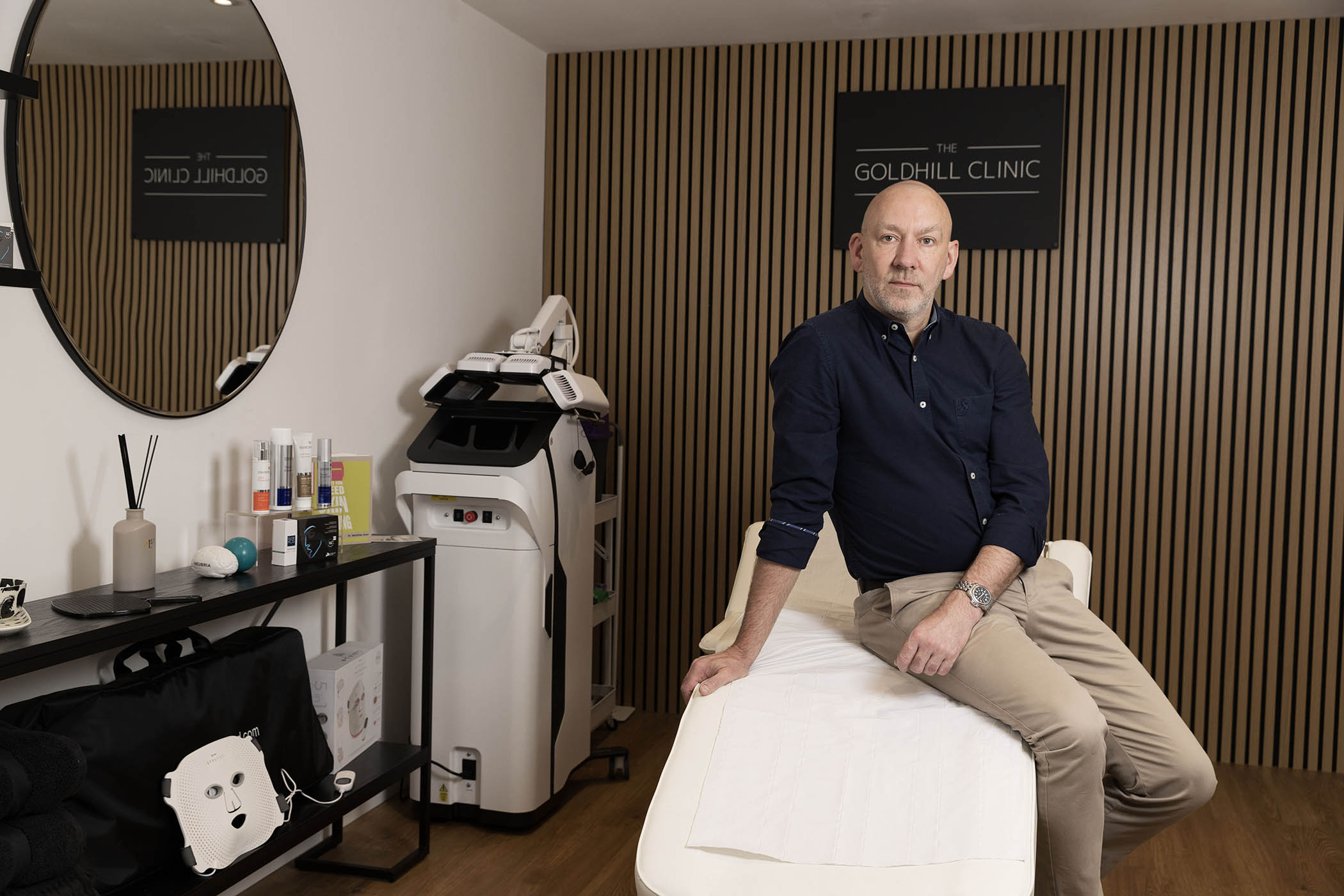
Dr Ben Coyle says peptide experimentation misunderstands human biology.
The results from the UCL lab were startling: the liquid inside the counterfeit pens did, in fact, contain the bonafide, active retatrutide peptide sequence.
This finding shows that the enterprises behind brands like Alluvi are not just kitchen-table scammers filling vials with sugar water or blue dye. They are running sophisticated, multi-million-pound pharmaceutical operations. They have successfully established illicit supply lines to source raw, authentic research-grade peptide powders, using advanced machinery to formulate them into working injection pens.
But the fact that the compound is chemically authentic does not make it safe for use. These illicit facilities operate outside human prescription frameworks, with zero quality control or regulatory oversight. Because these synthetic peptides are manufactured cheaply using bacterial proteins, even a batch advertised at 99% purity contains a 1% remainder of bacterial protein toxicity.
There is also no guarantee that these pens are being blended, filled, or stored in sterile conditions, introducing a risk of blood-borne infections, localised tissue necrosis and systemic sepsis.
The Alluvi operation markets its goods directly to consumers via encrypted messaging channels. The main Alluvi group on one app acts as a bustling digital trading floor where more than 3,500 members swap unverified medical advice. Users routinely post about experiencing alarming side effects, such as “weird pins and needles sensations down the arms and hands” or feeling intensely “spaced out” for hours after injecting doses of black-market retatrutide. When members post panicked messages tracking sudden, severe hair loss caused by their rapid metabolic fat-loss cycles, they are casually advised by fellow users to buy another unapproved Alluvi peptide, like Glow GHK-Cu, to fix it.
At the helm of the group chat is “Sophie”, a representative of Alluvi, who members contact directly to purchase the drugs. When The Observer contacted this number with a request for retatrutide, we were simply asked for an address and payment method, with no questions about medical history or age verification.
The instruction leaflets tucked inside the Alluvi boxes feature anatomical diagrams showing exactly how to insert a needle into a user’s stomach, thighs, or arms, alongside detailed human dosing schedules. At the very bottom of the page sit six tiny words: For research and development use only.
The human cost of this lack of regulation is not theoretical. In May 2025, Karen McGonigal, a 53-year-old woman from Salford, visited a local beauty salon. Having struggled with her weight and being unable to secure a licensed weight-loss prescription through her overstretched NHS GP, she was informed that the coveted “skinny jab” was available over the counter at the salon for only £20 a dose.
Her family believes she was injected with an illicit, black-market batch marketed as semaglutide. Four days later, Karen was rushed to an emergency ward, her face turning purple as her vital organs collapsed. She died two days later, the first documented British fatality publicly linked to the booming illicit weight-loss trade. A police investigation is underway.
If encrypted messaging groups function as the market floor for this trade, fitness influencers are the shop front. To understand how ordinary people are guided into these networks, one only has to look at the interface between Holbrook’s public Instagram profile and his private business operations.
On his main page, Holbrook posts high-energy videos discussing his physique and the peptides he uses. Nestled in his bio is a link that redirects users away from Instagram’s monitored ecosystem and into a private WhatsApp group chat. The chat is an endless stream of text messages discussing injection frequencies, needle gauges, and personal testimonials.
It is within this unmonitored digital space that the money changes hands. Followers can chat directly with Holbrook, receive informal advice on which compounds match their physical goals, and buy unregulated substances like MT2 directly through him using his affiliate links.
Holbrook defends the arrangement by arguing that he acts as a harm-reduction filter, preventing young men buying lethal substances from unknown scammers. He highlights his own bad experiences to demonstrate his candour, noting that MT2 makes him feel profoundly nauseous. “Within a minute of taking it, I feel sick. I have intense face flushing... your freckles go dark and new moles appear.”
Holbrook and Alluvi are examples of a paradigm shift: by normalising the injection of unapproved, research-grade synthetic hormones, we are participating in an unprecedented, uncontrolled national chemical experiment.
Thank you for reading. Tell us what you think by writing to letters@observer.co.uk
Photograph by Fairfax Media, MHRA, Gary Calton/The Observer