
I came across Counterpoints Arts a couple of summers ago, invited to serve as a judge (with Elif Shafak and Dina Nayeri) on a new writing prize the organisation had established with the Footnote Press, the Southbank Centre and Dartington Estate.
The narrative nonfiction prize was open to any writer who identified as being from a refugee or migrant background. I checked out the organisation, was impressed by the staff and trustees, the organisation’s core beliefs, and the personal resonances (a migrant great-grandfather, from Russia; a Nazi-refugee mother from Vienna, saved by Miss Elsie Tilney, a missionary from Norwich; a refugee mother-in-law, from the Spanish civil war).
Art can inspire social change, as Counterpoints asserts. Migrants and refugees make valuable contributions to our cultural and social lives. They traverse a two-way street that enriches their localities.
This last point has been especially resonant over this holiday period, for me, as I have been writing an Introduction to Faber & Faber’s forthcoming reissue of Inherit the Truth (1996), the remarkable memoir by musician Anita Lasker-Wallfisch. She arrived in Britain in 1946, a talented young German Jewish cellist who spent time at Auschwitz, where she played in the women’s orchestra, and then Bergen-Belsen, from where she was liberated in April 1945.
In one passage she recounts how, at the end of November 1945, as she and her sister Renate hoped to join another sister, Marianne, in Britain, the Westminster parliament legislated to allow displaced persons to join family members in England, but only if they could prove they were not yet 21 and had no relatives elsewhere. Anita was 20, but her sister was 22, they didn’t want to be separated.
“Old combatants like us are not so easily deterred by such details,” she writes, so they found a way around the problem. “It took fifty Naafi cigarettes to have our dates of birth altered at the Registry Office in Belsen.” With a couple of years shaved off their ages, the sisters made a new life in Britain.
What a life and a contribution it has been. The indomitable, forthright Lasker-Wallfisch has played a remarkable role in British arts, as a founder of the English Chamber Orchestra (patron: King Charles III, who recently visited her at home to mark her 100th birthday), performing with Benjamin Britten and other luminaries at Aldeburgh and elsewhere around the country, whose children and grandchildren have made their own vital contribution to British cultural life.
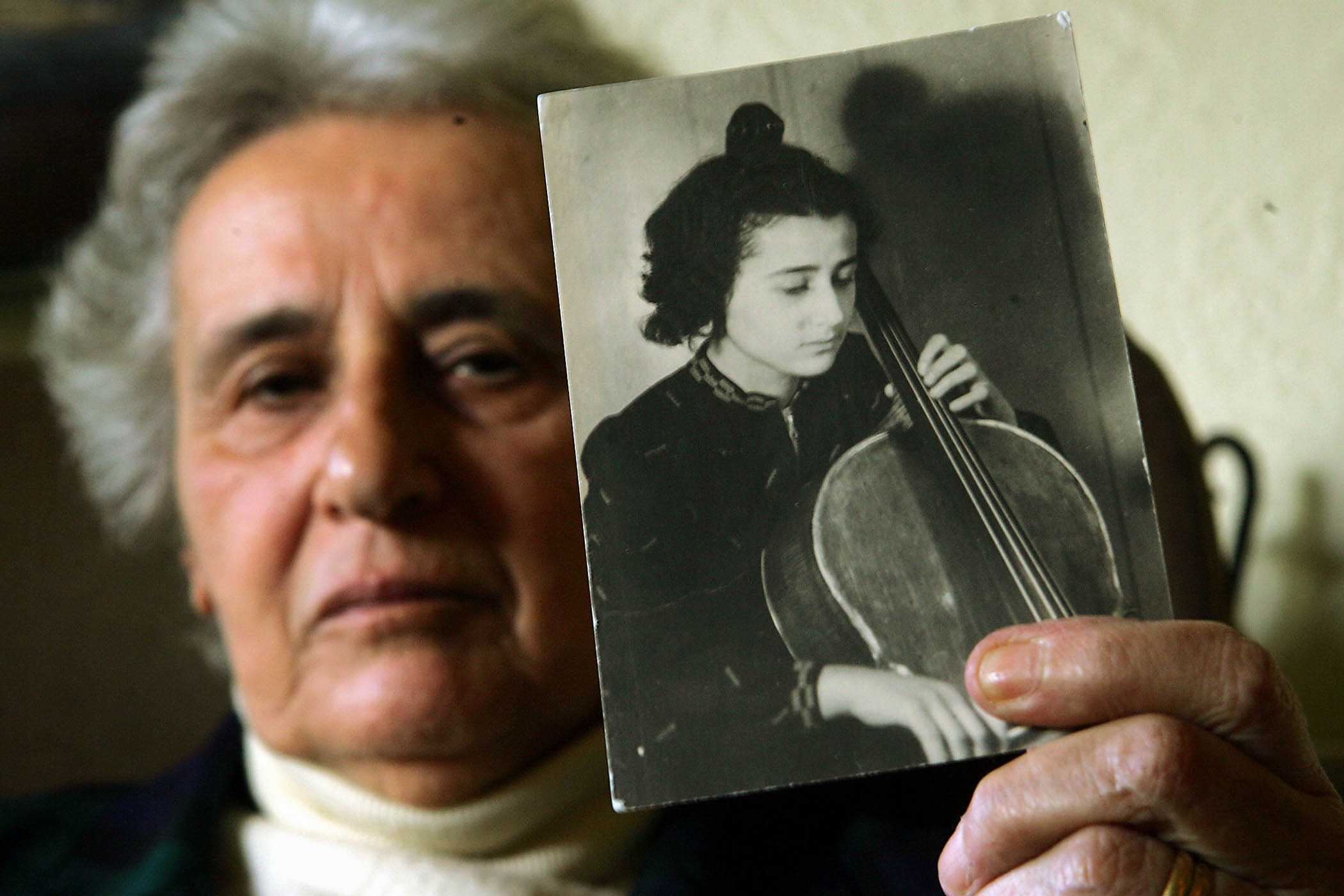
Holocaust survivor Anita Lasker-Wallfisch holds up a portrait of herself playing the cello taken in Berlin before she was transported to Auschwitz
“Can you imagine what would have happened to me today?’” she asked me with a knowing smile, and a raised eyebrow, when I visited her last week at home in Kensal Rise, north London.
I could indeed. I knew of the German project to grant refuge to 1,100 young Yazidi women and children appallingly abused by Isis followers, and was painfully aware there was no equivalent UK programme. This was around the time that Alf Dubs failed to secure entry for up to 3,000 young refugees, settling instead for a far more limited scheme that has since been ended.
‘Can you imagine what would have happened to me today?’
‘Can you imagine what would have happened to me today?’
Anita Lasker-Wallfisch, German Jewish refugee
I know too, from my own worlds of law and universities, that migrants and refugees from across the world have enriched teaching, scholarship and justice. So it is with sport. I have come to know a young man from Sudan, who recently took refuge in Britain, from the horrors of Darfur. He is mad keen on football, and a fine player, so I invited him to an Arsenal men’s game, a first for him, a Carabao Cup match against Brighton & Hove Albion.
Newsletters
Choose the newsletters you want to receive
View more
For information about how The Observer protects your data, read our Privacy Policy
He was particularly thrilled at the prospect of seeing Bukayo Saka in action. Saka, of African heritage, was born here, after his mother and father Adenike and Yomi, a chartered accountant and a businessman respectively, arrived from Nigeria as economic migrants.
The young Saka is a player of sublime artistry and grace, combining power and intelligence with a magical character and smile. He has truly enriched our local community, and modern British cultural life, and we should be thankful to his parents and this country for allowing his contribution to flourish.
My young friend was a bit disappointed that Saka didn’t start the game. However, in the 70th minute his face lit up as Saka prepared to enter the match as a substitute. A vast roar of welcome and love engulfed the Emirates Stadium. Did it touch my young friend from Darfur, as it touched me? It seemed to me that it did, and with it the wonderful dawning that he too could be welcomed.
Elif, Dina and I duly judged Counterpoints nonfiction prize, with much joy. All the more so with what followed: the winner – Crossing, by Sabrin Hasbun – and the two runners up – Himmler’s Curtains, by Simon Weisz, and Dead Iranian Girl, by Roxana Shirazi – have all found publishers.
Counterpoints’ initiative reflects the reality of the two-way street. It was a privilege to be a part of the project, to support a fine organisation, one vital for our times.
To donate to Counterpoints, please click here.
Philippe Sands will give the Alf Dubs Lecture 2026 on 5 February at Battersea Arts Centre, London; alfdubslecture.org.uk
Photographs: Adrian Dennis; Jim Watson/AFP