
Portraits by Katherine Anne Rose for The Observer
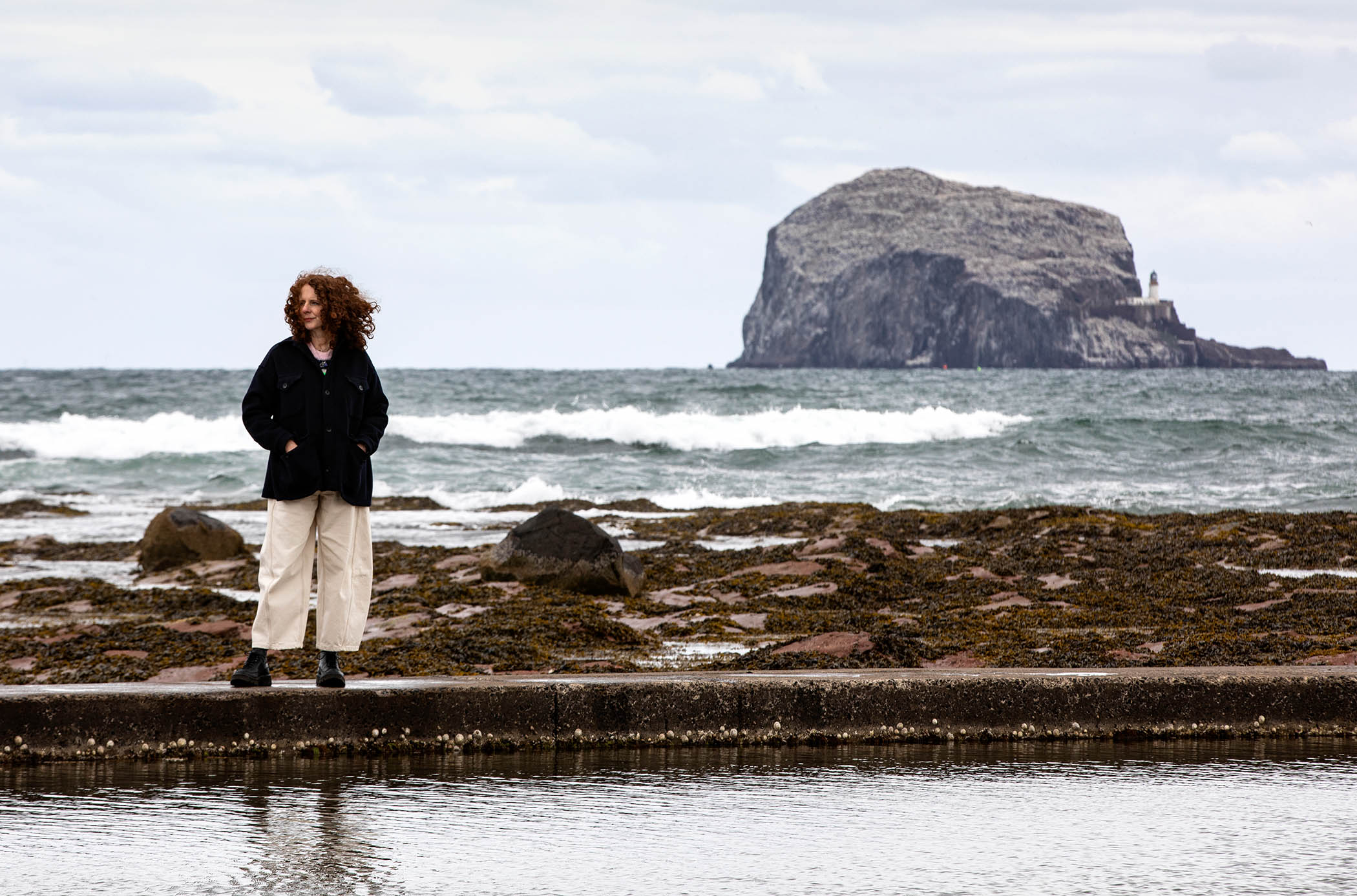
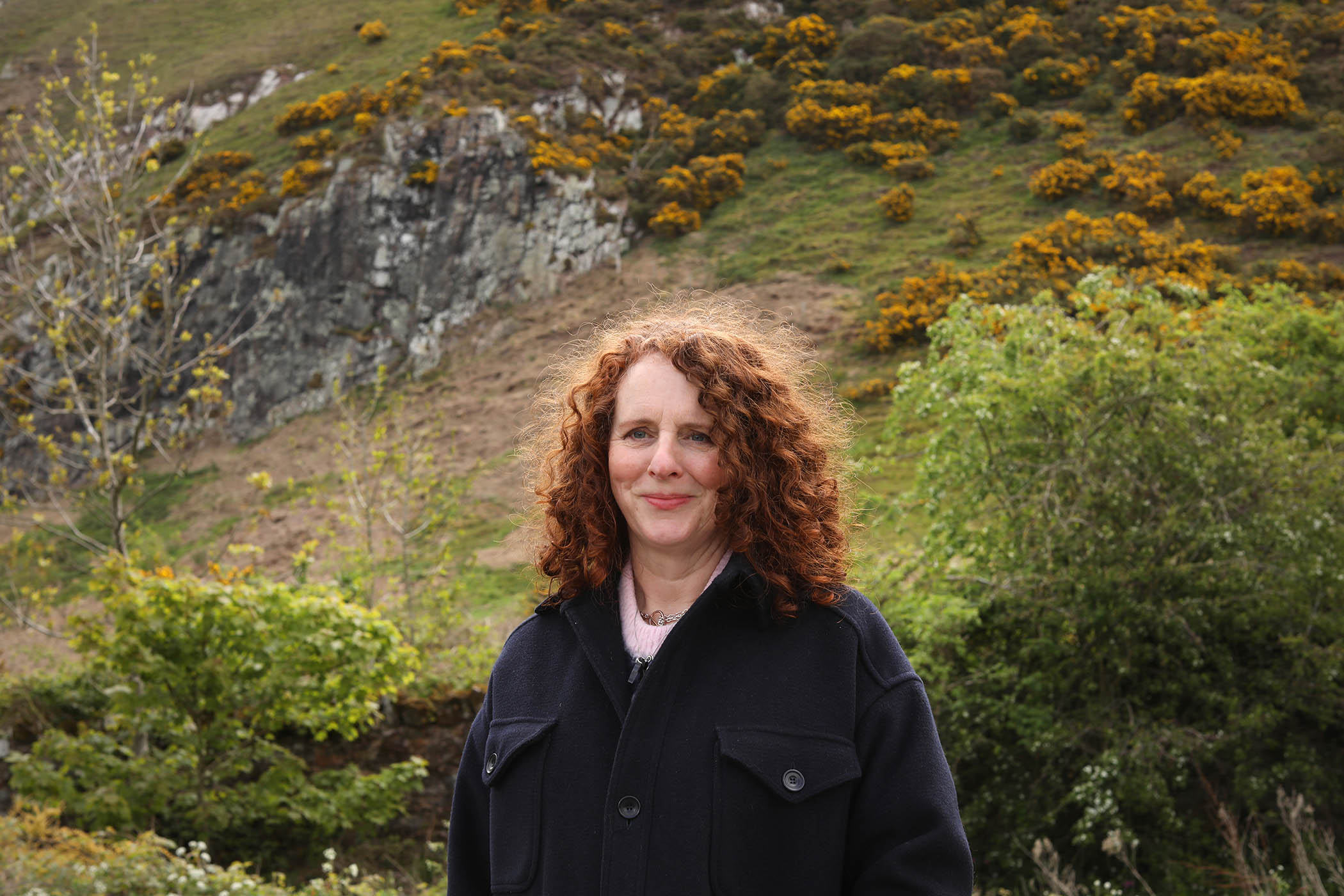
‘The first bit isn’t so lovely, then we’ll go through the bottom, and it’ll be beautiful!” Maggie O’Farrell and I are standing in a car park in the shadow of North Berwick Law, a volcanic plug – the hardened remains of lava that didn’t quite make it out of a volcano 340m years ago. She is setting out the route in the East Lothian landscape that will spit us out on to the seafront as The Observer photographer snaps her, noting that the magical light is giving the impression that O’Farrell is wearing a halo above her mass of auburn curls. “That always happens,” she deadpans.
We have decided against the half-hour climb up the mound, for fear of our chat being reduced to wheezy breathing. Instead, we are preparing for a less demanding amble that will give a flavour of the town where she moved with her parents from Wales, aged 13, and which her folks still call home. She came up here last night from Edinburgh, 30 minutes south by train, where she lives with her husband, the writer William Sutcliffe, and their three children.
As we turn our heads to admire the gorse cheering up the mound – O’Farrell notes it has made it the same bright yellow as the photographer’s groovy nail varnish – we have a sense that something is moving towards us. Spoiler alert: it’s not a stream of lava. A vehicle hoves into view.
“I’m going to get run over by an Asda van,” she shouts, scooting out of danger. “That would be a way to go.”
We don’t want to give O’Farrell, who wrote I Am, I Am, I Am, a wonderful, if alarming, book about her 17 brushes with death, fodder for a sequel.
This mortality test leads us to consider how long it’s been since we first met: in 2000, we reckon, when she had just published her debut novel, After You’d Gone, set in North Berwick, and was still working on the arts desk of the Independent. “My God, we were children,” says O’Farrell, now 54.
Since then she’s had 11 books published, won shelves of awards. Hamnet, her novel about Shakespeare’s son, was adapted for the screen: directed by Chloé Zhao and starring Paul Mescal and Jessie Buckley as Mr and Mrs Shakespeare, it picked up an Oscar for Buckley along with a slew of nominations.
Her 2022 novel, The Marriage Portrait, which is set in Renaissance Italy and imagines the grim court life of the 15-year-old Lucrezia de Medici, will be filmed by the French director Audrey Diwan. She thinks Olivia Lynes, 14 – Judith in Hamnet – would make a great Lucrezia. And O’Farrell’s latest book, Land, out next week and the reason for our walk, has already been optioned for the screen by Liza Marshall, the producer of Hamnet. She’s determined to write that script herself.
In an appropriately cinematic reminder of how far she’s come, we walk past O’Farrell’s old high school, a collection of functional 1930s buildings with a colourful box thrown up more recently. Her comprehensive in south Wales had 2,000 children and this “seemed tiny” at just 600 or so when she first arrived here (her father, an economist, got a job in Edinburgh). It took her a while to find her feet.
Newsletters
Choose the newsletters you want to receive
View more
For information about how The Observer protects your data, read our Privacy Policy
Just now, when for the first time in 35 years she walked from her parents’ house to the school to meet me, it took her back.
“I had this weird, Pavlovian, ‘Oh God, I’m gonna be late. I’m gonna get a slip!’” she laughs. I had her down as a good ’un.
“Well, I think I was quite studious, but I was quite naughty at the same time,” she says, remembering the squash lessons she bunked. Unsurprisingly, she was happier in the school library, studying English and geography – she thanks a geography teacher at the back of Land.
Talking of which, it’s her most ambitious book yet, I think, and one of her most personal. Set in 1865, on a peninsula on the west coast of Ireland more than a decade after the Great Famine, the novel tells the story of Tomás and Liam, his 10-year-old son, who together help plot the first Ordnance Survey maps. It’s a little reminiscent of Translations, Brian Friel’s play, in its consideration of colonialism, the death of the Irish language and the effects of the acquisition of English (Friel also imagined an OS surveyor).
But O’Farrell shakes things up by introducing a ghostly element which takes us back to neolithic times where we meet Brith, a beautiful young girl who is marked by her elders for sacrifice, and her loyal hound.
Their worlds meet when Tomás stumbles upon a sacred well which somehow compels him to defy the redcoats, the backbone of the army in the British colonies, and chart the land the Irish way.
Tomás was inspired by O’Farrell’s paternal great-great-grandfather and Liam by his son. She says: “Every family has its myths. One of the things that we were told as children is that one of our antecedents drew the first maps of Ireland. In my head he was just a kind of one-man band that did the whole thing.”
Like Liam in the story, her great-grandfather abandoned mapmaking to join the Jesuits but then turned his back on the order – social death in Ireland back then – to return to charting the land.
O’Farrell was born in Coleraine in County Londonderry in Northern Ireland but had a peripatetic childhood because of her father’s academic career and still visits Ireland with her family whenever she can. During her own summers there – in Dublin, Galway and Donegal – she would find herself looking out of the window and thinking: “How could one person draw the whole area?”
“More recently, I wondered how much truth there is in the story, because all myths, all myths, have a seed of truth at the very least,” she says, adding of her great-great-grandfather: “And so I went searching for him. It was actually very hard to find him.”
If you were Irish and working for the OS in the mid-19th century, you weren’t allowed to sign your name to your work. There could have been many maps, field books and surveying notes that were his, but it was hard to know. She eventually found his signature in the ledgers in the national archives in Dublin, “in payments and certain memorandums that all the labourers, as they were called, needed to sign”.
The signature did not read “Tomás” but another name. Following discussions with “my many, many cousins”, O’Farrell explains, she decided “to leave him, the real him, in peace”. In fact none of the names in the book are those of real people.
“I just feel they didn’t ask,” she sighs, as we trudge down a path. Nor is the land she describes with such passion a particular spot. “It’s a fictitious peninsula made up of many different places that I have been to and imagined.”
The detective work didn’t end in the archives. In her parents’ house there’s a map, drawn by her great-grandfather. “It’s been there for years. It’s incredibly beautiful — it’s of a kind of imaginary place. And in the upper corner, there’s a tiny little medallion, which is about the size of an old postage stamp.” For some reason a few years ago she took a magnifying glass to it and saw a picture of her great-great-grandfather in the medallion.
‘There’s one thing about having an interesting biographical story, but it’s quite another to make it into a novel’
‘There’s one thing about having an interesting biographical story, but it’s quite another to make it into a novel’
Maggie O’Farrell
In the image, he is standing behind a redcoat who is looking through a theodolite – an instrument used for measuring angles between points. His son is holding a measuring chain, as Liam does in the novel to assist his father. O’Farrell says: “I thought: he’s been hiding in plain sight for all these years.”
She has long been intrigued by father-son relationships and it was enough to “instantly electrify” her. But, still, it wasn’t one of those books that wrote itself, if they ever do. For a long time she just couldn’t see how to make it work.
“There’s one thing about having an interesting biographical story, but it’s quite another to make it into a novel,” she says. Then two years ago she was on a train from Belfast to Dublin, staring out of the window, and the first line came into her head: “My father was ever a man of few words.”
She stops walking and turns to face me – “I could suddenly see the whole journey. I wrote 12 pages of notes, planned it all,” she says. Talk about your muse taking you.
We continue on our way. That happened with Hamnet too, I say. An obsession forged at school which… percolated. “Yeah,” she says. “But I think each book arrives very differently.”
We come across a shiny metal gate (“it’s new; fancy”) and stop to open it. We are walking into a lawned, manicured park with a children’s playground.
“So this is the Lodge Grounds,” she says and explains how she would come here for “games”— but the grass was a lot higher then and if you lagged behind the group you could disappear in the vegetation and “wait for it all to be over”.
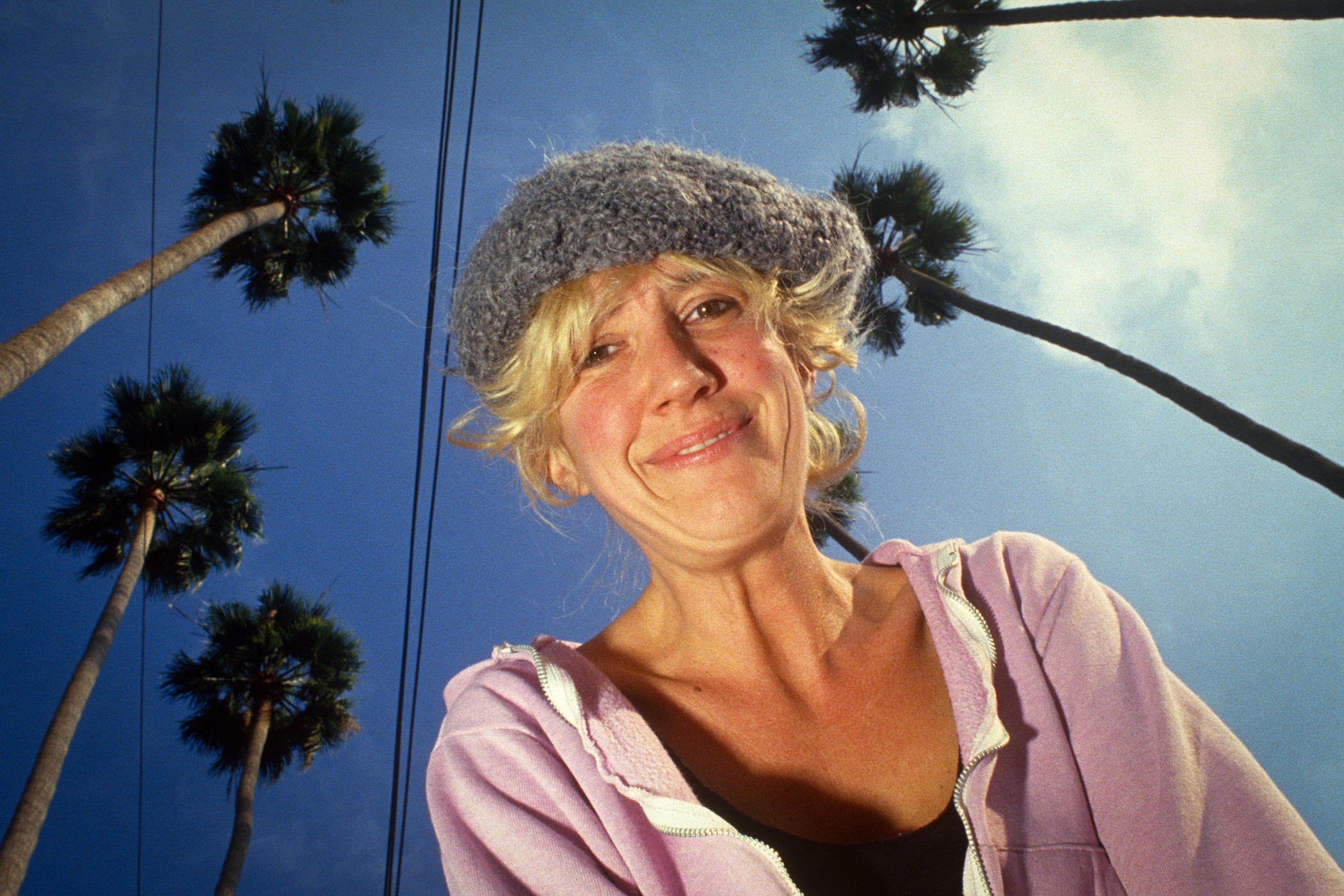
Her ankle is giving her gyp, so we sit for a moment. “Very foolishly I got a permanent anklet and it interferes with my boots,” she sighs, easing the sides of the leather. She got the ankle bracelet, which can’t easily be taken off, while in California on her Oscars jaunt. I raise half an eyebrow.
“I know, how childish am I? I thought: when in Venice Beach… but I stand by it,” she laughs, although standing is clearly a problem.
We get moving again, and as we start to smell the sea, we discuss other, holier, bodies of water. In Land there is a sacred well – toibreacha – which is almost a character in its own right. We talk about how Ireland probably has the best preserved pre-Christian or Celtic mythology in Europe, because the Romans never invaded. So taken is she with the connection between paganism and Christianity that she took her son (“he’s always up for a quest!”) on a holy well tour of Ireland four years ago – it probably beats U2. She took her secateurs, because most of them are so overgrown. Turns out her well-fancying started young.
“There’s actually a photo of me aged about two,” O’Farrell, says. “You know how people in the 1970s never took any photos? You had maybe one or two a year? And there’s one of us all, and I’m leaning right over, into the well, looking down into it.”
The neolithic strand in Land was fed by regular visits to the bronze and iron age bog bodies at the National Museum of Ireland in Dublin. “There you see yourself, not as someone who’s occupying your life. You’re just a blink of an eye, really, in the whole course of history,” she says. When she was on Desert Island Discs in 2021 she was asked which luxury she required – she asked for that museum.
‘In the Roman empire, mapping became a form of possession, a form of power: I’ve mapped it. It’s mine’
‘In the Roman empire, mapping became a form of possession, a form of power: I’ve mapped it. It’s mine’
Maggie O’Farrell
Talk turns from how we’d cope without the maps on our phones to one of the oldest known maps. Carved in stone on the wall of a cave in Bedolina in the Italian Alps, dated to the iron age, it shows all the fields and houses around. Later, during the Roman empire, mapping took on a different focus. “It’s a form of possession. It’s a form of power. ‘I’ve mapped it. It’s mine’,” O’Farrell says.
We turn a corner. “The sea!” I cry, with the zeal of the terminally landlocked. We look past the Victorian villas, where more volcanic plugs – Fidra, Craigleith and the Lamb – rise from the surf.
By now we are on the beach with seaweed under our feet and, urgh – watch the dead seagull! She looks to Craigleith and says she doesn’t know if it’s true, but Robert Louis Stevenson is said to have had a summer house on this street here, she gestures, pointing inland, “and people say that the dimensions and geography of Craigleith is exactly the same as Treasure Island”. Our timbers shiver.
Like children, we walk along the narrow wall of the boating pond, fed by seawater; a swimmer waves at us. O’Farrell strikes me as a happy writer, I say, not one of the tortured ones.
“Well, you’re catching me on a good day,” she laughs. “No, I do really love it. I don’t really understand when people talk about how terrible it is. Just go and do something else, then. I mean, it’s not easy. You don’t choose to be a writer for an easy path.”
She says that what has surprised her is how much there is to learn: “You write one book or two books, and you think, ‘OK, I know how to write books!’ But, actually, what you know is how to write those books. You don’t necessarily know how to write your next book, because it’s different, and it needs to be different.”
How the heck did she focus during the six-month Oscar campaign? “It’s quite nice to have the writing,” she says. “I mean, it’s incredibly exciting, surreal and strange.” And then she talks me through awards day…
“So you start getting ready about 9am,” she says. “A very nice man called Otto from Berlin did my hair and makeup.” Chaos almost reigned when he dared to suggest he brush her hair. “I warned him, ‘It will backfire horribly,’” she recalls. She chose not to have a stylist, instead wearing a fuchsia gown – and a fascinator by the Irish designer Margaret O’Connor. “I think I would have found it very odd as I have been dressing myself since I was about five,” she says.
They got in the car at noon to join the queues of limousines, navigate sniffer dogs and security checks and arrived on the red carpet at 2pm with the ceremony starting at 4pm.
Did you get hungry? “Someone had warned us, so we did have a picnic,” she says. Her agent of many years accompanied her. “So there we were eating bagels in the car, in the queue, in our finery.” Once inside it took a while for her “civilian” brain to assimilate. “I heard someone behind me talking and I did think, ‘Someone sounds exactly like George Clooney.’ Then I thought, ‘Oh, that’s because it is George Clooney.’”
We come to Andrew’s Old Kirk, a chapel, possibly dating back to the seventh century, thought to have been created by monks from Lindisfarne. Nearby, the art deco lido where O’Farrell swam in her teens has been concreted over. “That’s where the high dive board was,” she says, mournfully, before pointing out the hotel, the Blenheim, along the coast, where she was once a waitress.
We’re at the end of the route and, as we prepare to leave, we look ahead. I remember her telling me years ago that between books she likes to “fill the well”. Meaning, she reads, visits galleries, watches movies, loads up. “Yes, it’s like the land,” she says, “you’ve got to let yourself lie fallow for a bit.” In fact she has started thinking about a new novel but it’s early days and she is “superstitious” about discussing it, worried exposure will “drain it”.
Quick, cover it in brambles, I think, and let her magic run its course.
Maggie O’Farrell’s new novel, Land, is published on 2 June by Tinder Press