Photograph by Tom Pilston
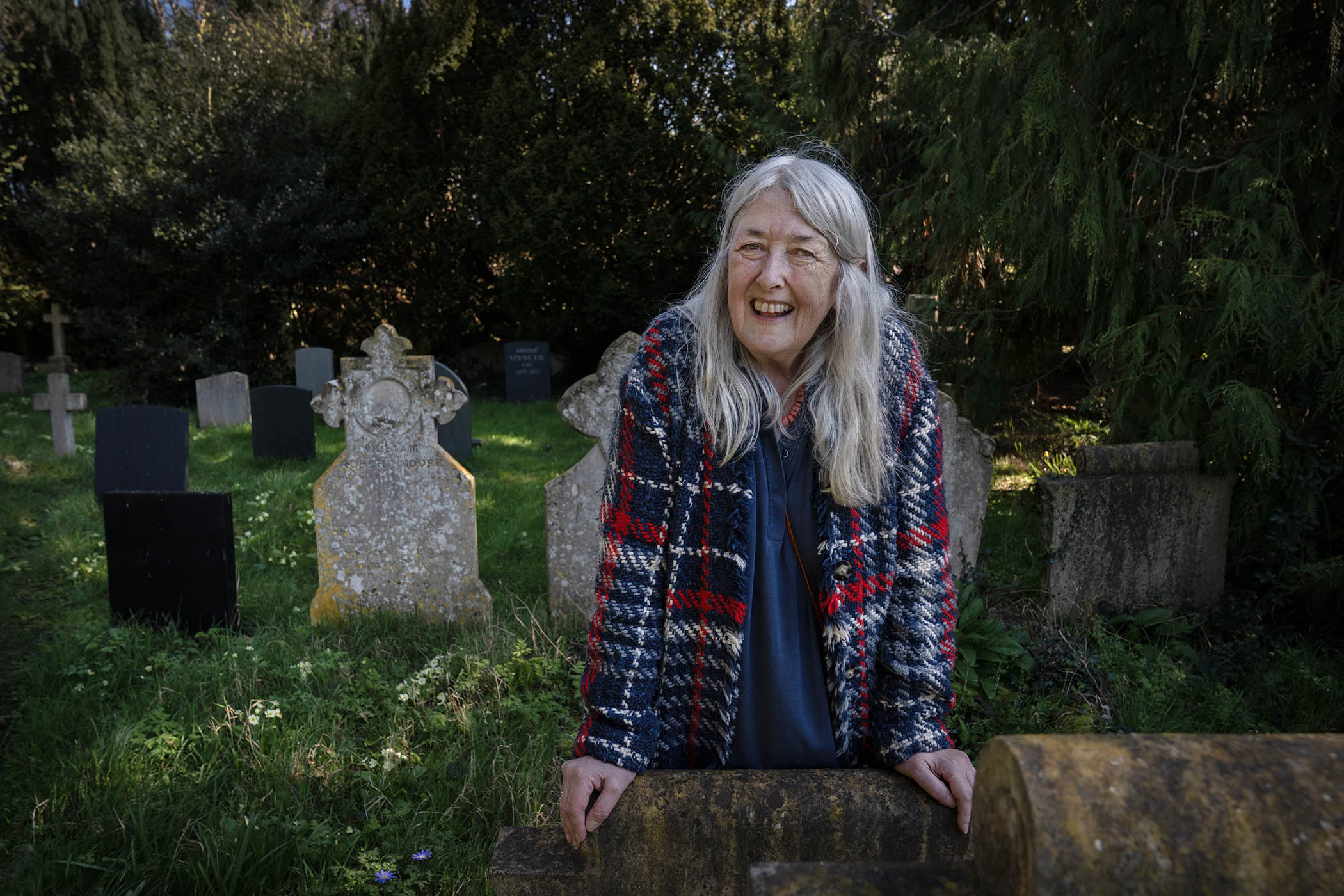
Mary Beard is suffering from “granny knee” but her shoes, covered in brightly coloured cartoons, and glittery socks are not the kind of sensible footwear normally associated with 71-year-old academics. The Cambridge classics professor has always managed to combine the ancient and the modern. She is as happy reading Vogue as Virgil and brings her subject to life by making classics as much about gossip and graffiti as gladiators and grammar. One student described a tutorial in which Beard reclined on the sofa, put up her feet and began: “So, Cicero. Bit of a twat wasn’t he?” It is her irreverence that has turned Beard into a “rock star scholar” and national treasure.
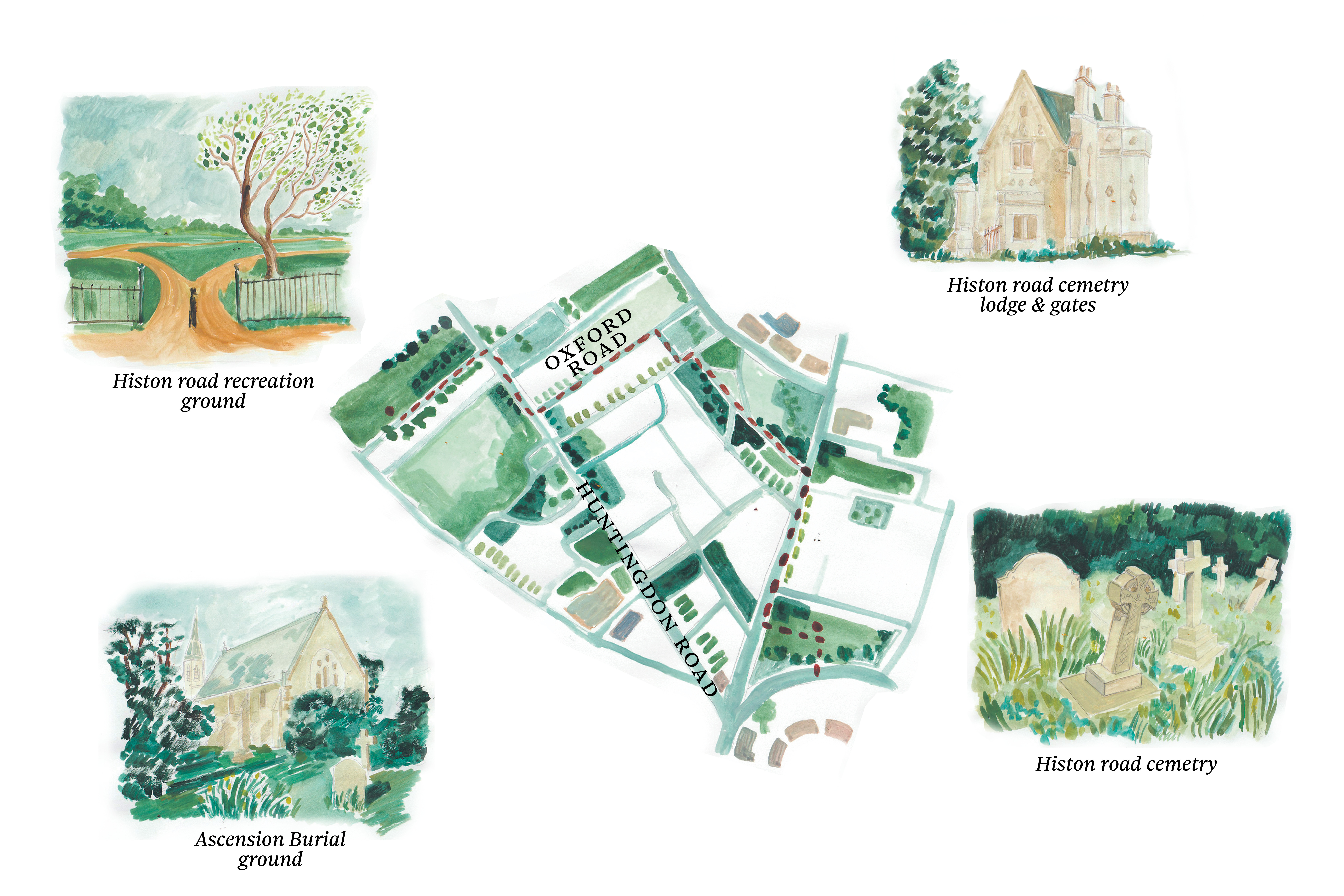
We meet outside the Histon Road cemetery on the outskirts of Cambridge. Our walk will take us between two graveyards, which somehow seems appropriate. “They are about nostalgia and remembrance, and a total leveller because that’s where we’re all going to be one day,” Beard says. “But they are also places where the past meets the present.”
As we set off, weaving through the tombstones, cyclists whiz past us. The dreaming spires of the university town are nowhere to be seen. “I think of that as lovely but a bit like the office,” she explains. There are marble obelisks, angels, Roman wreaths and urns amid the daisies and daffodils. The graves are full of the merchants and traders of historic Cambridge. “These are the wheeler dealers. There was a big department store called Eaden Lilley and look, here are the family vaults of the Eadens and the Lilleys.”
Even surrounded by death, Beard manages to bring history to life. “It’s the mixture that remembrance brings that’s really exciting, the way the past is always with us but never with us,” she says, gesturing to the tombstones. “You can’t ever know whether you can understand it, or whether you’re distant from it, or whether it’s familiar. You can’t decide whether there is a wonderful self-confidence about the people who put these up, or whether they’re just dead and gone.”
We sit down on a bench opposite a group of 11am drinkers. Beard has a new book out called Talking Classics in which she argues that the “shock of the old” is the extent to which it illuminates the new. Classics, she writes, “prompts you to rethink the present”.
Donald Trump and Peter Mandelson seem like characters straight out of ancient Rome, while Boris Johnson wows his audiences by reciting the Iliad in the original Greek. But Beard insists it is less about individual comparisons than recurring themes. “What I bridle at is the idea that somebody can say – so what emperor is Donald Trump most like? That’s a good party game. But if you think it’s told you anything about Trump, or it’s told you anything about Nero, dream on. What Rome is good at is giving you some lessons in the structures of power.”
‘Democracy has always been something you have to fight for’
‘Democracy has always been something you have to fight for’
She points to the US president’s flip-flopping over tariffs. “People were saying he could never make his mind up. He always seemed to be vacillating. What a comparison with antiquity suggests is that vacillation is in fact an extremely important weapon in the armoury of power.” There is a good example of Caligula doing something similar in the first century. “He says, ‘Right, I’m going to go and conquer Britain.’ He gets the army together, gets to the Channel, it’s going to be a great military victory. And then Caligula says, ‘Sorry, I’ve changed my mind. Let’s just collect some seashells and go back home.’ Historians look at that story and say, ‘That shows how barking he is.’ What it actually shows is that he has the power to say, I’ve changed my mind.”
It is just like Trump’s sabre-rattling over Greenland, she suggests. “The autocrat partly shows their power by making you fall in with their new plans.” There were also echoes of the ancient world when the president launched a military strike on Venezuela.
“That version of international power rests on the idea that ‘you’re going to do what I say’. Trump has no desire to take over Venezuela, but it’s an absolute classic case of the earliest phase of Roman imperialism, when what they wanted was for people to do what they were told.”
Newsletters
Choose the newsletters you want to receive
View more
For information about how The Observer protects your data, read our Privacy Policy
Nigel Farage and Zack Polanski have their classical doppelgangers too. “You can trace the populist playbook back to the Roman world,” Beard says. “What you see in the figure of Julius Caesar, who is a populist dictator, is that he manages to bypass the traditional methods of hierarchical communication. He was writing down what he had done in Gaul, and it was read out on street corners. That was his version of social media. The populist talks to the people direct.” And, like Polanski and Farage, “what Julius Caesar said is ‘the establishment don’t understand’”.
The classical world had its version of spin. “One of the things that is important in antiquity is that words matter and there’s a very high premium put on persuasion. Of course, they got anxious about that too because they would say, but what if a really good orator can persuade you to do things that are wrong? There was always a question about how far winning the argument was playing on the underbelly of emotion.”
Often, though, the lessons are not the obvious ones. “We tend to think of fifth-century BC Athenian democracy as somehow very virtuous. We treat it as an ancestor under whose shadow we should be proud to stand,” Beard says. “In fact it is relatively short-lived, and it’s violent, and there are coups and assassinations. For me, if there’s a lesson it’s that democracy has always been something you have to fight for. It’s fragile, it’s work in progress and if you don’t stand up for it, you won’t have it.”
Does she think we are at the “end of empire” stage for the west, where the seeds of destruction have already been sown just as they were in ancient Rome? “It’s too early to say, though I think the question is right,” she replies. “Historians who are worth their salt don’t say, ‘Oh, we’ve been here before, and look at the downfall of the Roman Empire in the west and the same thing is going on.’ Those are not very interesting arguments. But why studying other periods of history is great is that it makes you look at yourself from a different perspective. It makes you ask different questions. It’s helping you see yourself externally.”
As we continue through the graveyard, Beard describes talking to a group of teenagers about free speech. “They thought it was a modern problem and that free speech had become an issue with the advent of social media. When I said Socrates was put to death on free speech grounds, they were fascinated. And as they started to debate the Socratic problem, not Twitter and JK Rowling, there was a freedom to the argument. They didn’t have a stake in it. Socrates was long dead. Nobody was going to come and have a pile-on.”
Beard grew up in Shropshire. Her mother was a primary school teacher, her father an architect, and her love of history was born when she visited the British Museum for the first time at the age of five. A curator opened a glass case and showed her a piece of 4,000-year-old bread. “I never forgot it. It was that sense of wonderment at being eyeball to eyeball with an ordinary bit of the past.” As a child she joined archaeological digs in her school holidays and then got a place at Newnham College, Cambridge, to read classics. When she returned as a fellow in 1984, she was the only female lecturer in the classics faculty. “It was very much a monoculture and that doesn’t feel the same now.”
Having taught for more than 40 years, Beard worries that students have now become so obsessed with grades that they have no time for intellectual curiosity. “Being at university is about thinking harder than you ever thought before and it’s about making mistakes.” She remembers weeping as an undergraduate “because my head hurt” and she admits she may have made some of her students cry. “I’m not suggesting that we sat there and suddenly I said, ‘You are so stupid,’ and they burst into tears. But if you are pushing people to the edge of what they can do, tears are a natural reaction to that. It’s tough love.”
We leave the cemetery and walk on through terraced streets, lined with trees full of blossom. Beard says it infuriates her when politicians denounce humanities degrees as a waste of time and money. “That’s just stupid. The skills that humanities subjects offer you seem to me to be absolutely essential for civic democratic debate.”
Like many female public figures, Beard gets appalling abuse online. “I tend to reply. You get to sniff out the real nasties from those that are using very nasty words, but may not be so nasty.” She once wrote a job reference for one of her trolls. “He was just a silly student whose anger had taken the form of misogyny.”
We turn into a park, where children are playing on the swings. A few years ago a male reviewer described Beard as too ugly for television because, with her long grey hair, she refused to conform to his ideal of a female presenter. Sexism isn’t as rife “but it hasn’t been eradicated”, she says.
“They still say, ‘Look at those teeth, what a witch.’ The combination of age and gender is absolutely devastating. I think you can get away with being an old man and you can get away with being a young woman, but being an old woman is a devastating combo.”
She worries that the #MeToo movement has failed to change the culture in any significant way. “Do we live in a world in which that kind of behaviour has become less acceptable and more called out? Probably we do, but there’s still an awful lot of it.”
This is personal for Beard. As a young graduate student, she was raped on a train to Rome. “I was carrying all my stuff for about three or four months and I had carefully divided my thesis between different cases for safety. I was naively, but understandably, quite anxious to practise my Italian. So I was sitting in the cafe waiting for the train, and I talked to this guy. He went off and got me a ticket and, surprise, surprise, also had a ticket for the same compartment. I was knackered. I had to get the train and I couldn’t afford to lose any bit of my luggage. I was strangely imprisoned by my thesis.” By the time they got to the sleeper compartment, she says, “there wasn’t any doubt about what was going to happen”. She somehow detached herself from the situation. “You just want it to be over as quickly as possible. Your mind doesn’t connect.”
Afterwards, she says, she was “angry more than upset”. She thinks her historian’s brain kicked in to help her cope. “I hadn’t ended up traumatised in any long-term way, or not that I could recognise,” she says. “I came to make sense of it to myself. I’d retold the story in different ways and there was a kaleidoscope of different stories which kind of transcended the idea that it was simply … the exercise of male power over a vulnerable woman.
“I came to wonder about his narrative. Maybe he was married. He was an architect who was designing a building outside Naples. I thought, ‘When he got home that night what did he say? What was his story?’ You have funny ways of apportioning blame. I remember thinking that if the grant-awarding body had been more generous, I would have flown to Rome and this wouldn’t have happened.”
There was “not a complexity of moral judgement but a complexity in the narrative of it”, Beard says. “‘Coping’ is probably the wrong word. It was a way of explaining and making sense of and in some ways facing up to it.”
We cross Huntingdon Road and turn down a path towards the Ascension Parish Burial Ground. This graveyard is more overgrown than the other one and full of Cambridge academics, including three Nobel prize-winners. Beard leads me around, excitedly pointing out the philosophers Ludwig Wittgenstein and GE Moore and the anthropologist JG Frazer. It is a beautiful and peaceful spot, lichen-covered headstones all leaning elegantly at slightly different angles next to the former chapel.
As we turn to leave, I ask whether she wants to be buried or cremated. “I don’t know,” she replies. “But if you could be buried somewhere like this for eternity, that would be lovely.” And with that the queen of classics wanders off to continue illuminating the present through the past.