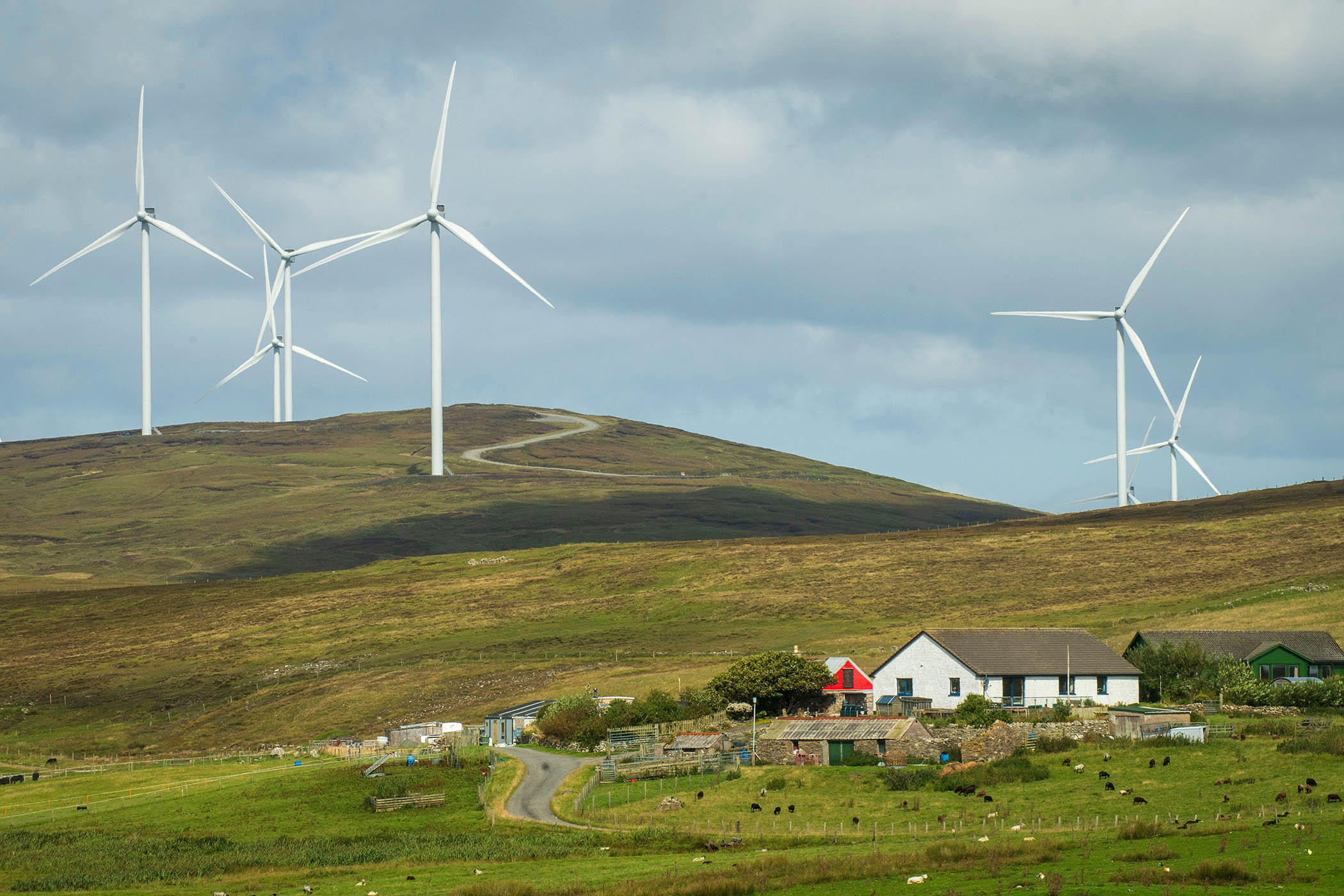


Last Wednesday afternoon, winds of 45mph swept across Shetland, Scotland’s northernmost isles, but the huge turbines that loom over a vast swathe of the dramatic landscape were at a standstill.
Residents say it is a common sight for the 103 turbines at the Viking windfarm to be idle in strong winds. They describe the project as a “white elephant”.
The reason for the shutdown of the 155-metre-high turbines – about 508ft, or three times the height of Nelson’s Column – is a lack of capacity on the grid to transmit the power to where demand is greatest, often in the south of England. The Viking windfarm’s operator, SSE Renewables, is paid up to £10m a year to turn off the turbines.
The Observer revealed last week how more than £270m has been paid out since the start of the Iran war to shut down windfarms in Britain, and also to pay for gas power plants and other sources to replace the lost energy.
“I can see from my house when the wind turbines are standing still,” said Frank Hay, chair of the Sustainable Shetland community group, who lives in a bay in the hamlet of Weisdale on Mainland, Shetland’s principal island. “I’ve seen them shut down as much as a week at a time.”
“It is disgraceful. SSE knew full well they would be paid, whether the wind turbines operated or not.”
Windfarm operators have agreements with the electricity network to provide a transmission service. When the flow of electricity has to be constrained because of bottlenecks in the network, the operators are entitled to compensation, known as “constraint” payments.
Last year, the Viking windfarm at Shetland was paid £9.86m not to generate power. The turbines were shut down about 65% of the time they could have been operating, according to industry data. The windfarm started operating in September 2024 and is connected to the Scottish mainland and the UK electricity grid by a 160-mile (almost 260km) subsea cable.
The 11,706 households in Shetland pay some of the highest energy bills in Britain, but not even they are benefiting from the plentiful energy from the Viking windfarm. The £580m project can power 500,000 homes – or a medium-sized city – but the local grid in Shetland has still not been connected.
Instead, the islanders largely rely on a diesel-fired power station at Lerwick, Shetland’s capital, and a gas-fired power station at Sullom Voe in the north of Mainland. Roxane Permar, an artist who lives on the island of Burra, said: “People have been horrified that this project has been earning money for doing nothing. There has been an industrialisation of Shetland and there’s been very little benefit for the community. These turbines have desecrated the landscape and are now raking in money when they are not being used. It seems absolutely pointless.”
It is disgraceful. SSE knew full well they would be paid, whether the wind turbines operated or not
It is disgraceful. SSE knew full well they would be paid, whether the wind turbines operated or not
Frank Hay, Sustainable Shetland
The construction of the Viking windfarm was opposed by many islanders because of the excavation of peat for construction leading to large releases of carbon dioxide;, the potential impact on breeding birds such as the whimbrel, a large wading species; and the scale of the project. Many of the islanders involved supported renewable energy, but considered the Viking windfarm was too large for Shetland. While SSE was paid to shut down the turbines at Viking windfarm on Wednesday, gas-fired power plants were being paid to help replace the lost energy. The payments are made by the National Energy System Operator, a public corporation owned by the government, which manages the electricity network.
The Seabank power station beside the Severn estuary, co-owned by SSE, was paid £1.6m in constraint payments on Wednesday to help replace the lost wind energy. Keadby 2 in North Lincolnshire, operated by SSE, was paid £1.3m.
Figures collated for The Observer by the electricity data analysis website Kilowatts.io reveal that 42 plants have been paid £1.42bn from 1 January 2025 to 17 April 2026 to help replace lost energy from wind turbines taken off the grid because of a lack of capacity.
Some of the biggest beneficiaries over the period were the Grain power station in north Kent, which was paid £162m to replace lost wind because of a lack of grid capacity; Marchwood power station near Southampton, which was paid £134m; and Seabank, which was paid £129m.
Over the same period, more than £455m has been paid to windfarms in constraint payments to stop the turbines. The Viking windfarm in Shetland has collected £13.5m in constraint payments over the period. These payments are ultimately paid for by consumers in their energy bills.
Ben Watts, a software developer specialising in the energy industry and founder of Kilowatts.io, said Viking was completed ahead of schedule, but more infrastructure is needed for its full benefits to be realised. “We agreed to let schemes connect to the grid before we have sufficient transmission capacity from north to south,” he said. Some energy experts have proposed regional pricing of electricity to create higher demand where there is excess generation, but this has been rejected by the government. It announced a scheme this month, however, to offer homes and businesses free or cheaper electricity at a time of excess supply. Renewable energy generated a record amount of electricity in the UK last year.
Greg Jackson, founder and chief executive of Octopus Energy, said: “Last year, the UK paid £1.5bn to turn off British wind – and we’re heading for as much as £8bn by 2030. The problem isn’t renewables; it’s the exploitation of an out-of-date regulation and policy. We need to fix this by reforming the market through zonal pricing.”
SSE Renewables is aiming to complete the required infrastructure later this year to ensure that Shetland’s homes can be powered by the Viking windfarm. It also wants to see the national electricity grid upgraded to ensure more power from the windfarm can be transmitted across Britain to where it is required.
A spokesperson for SSE said: “The UK has built renewable generation where the resources are strongest. It’s important we continue to upgrade the grid to remove bottlenecks so we can harness more of that energy, more of the time.”
A spokesperson for the Department for Energy Security and Net Zero said: “We are reversing decades of underinvestment to upgrade and build out the grid, which will [to] minimise constraint costs, meet the capacity needed to deliver clean power by 2030 and help bring down bills for households for good.”
Photograph by Dave Donaldson/Alamy
Newsletters
Choose the newsletters you want to receive
View more
For information about how The Observer protects your data, read our Privacy Policy