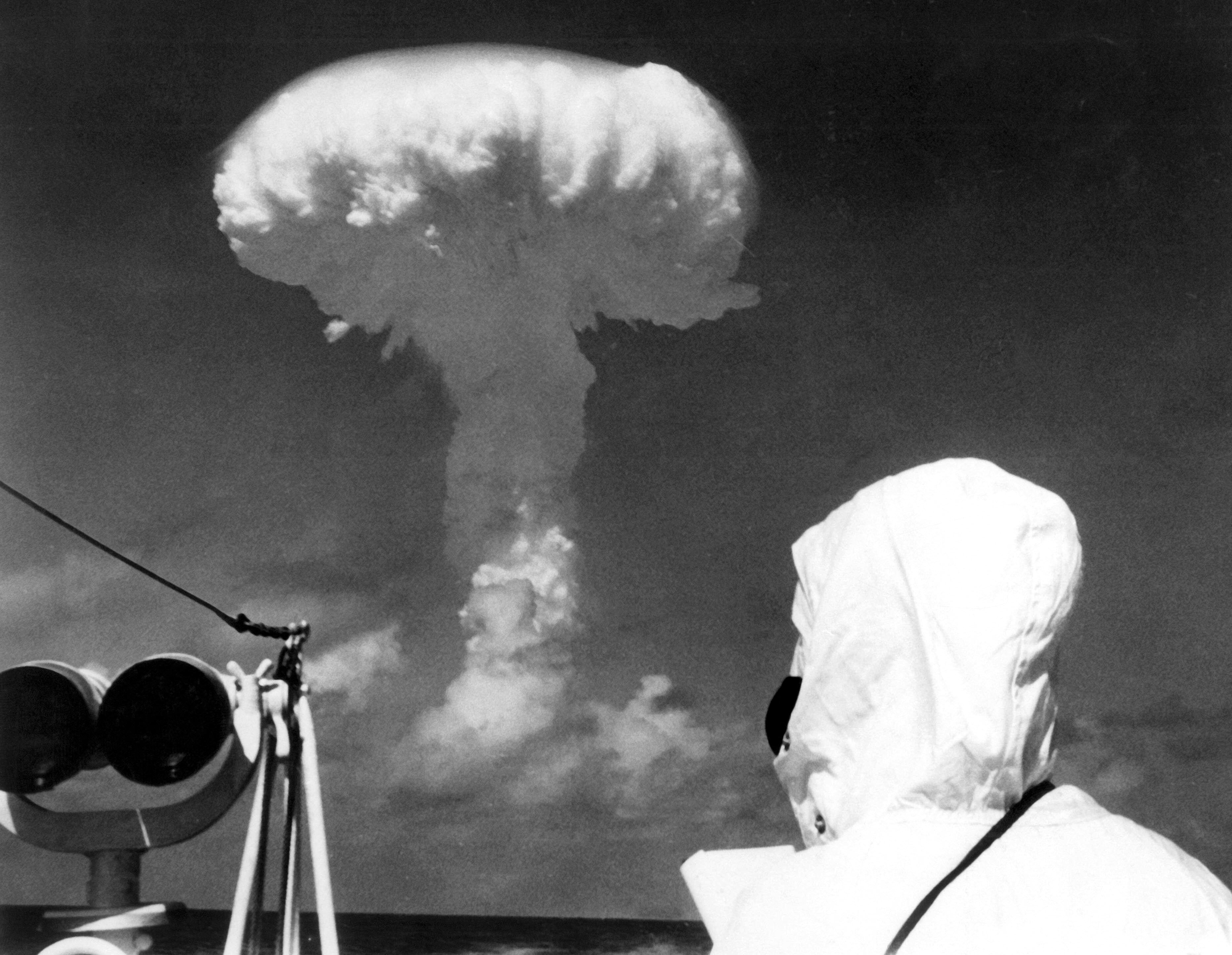


In November 1957, thousands of servicemen on Christmas Island in the South Pacific watched the testing of Britain’s first megaton thermonuclear bomb. Witnesses compared it to seeing the end of the world.
Many viewed the explosion on the island while wearing shorts and short-sleeved shirts, with sunglasses handed out to protect their eyes. Veterans claim they were exposed to needless risk and were the victims of gross negligence.
Large numbers later suffered blood disorders and cancers, which they believed were caused by exposure to radioactive fallout. Most were denied war pensions because of ill-health.
By contrast, those involved in the US nuclear testing programme, including the Manhattan Project led by J Robert Oppenheimer, benefited from a $2.6bn no-fault compensation fund. France agreed in 2008 that it would pay compensation to nuclear test veterans who suffered illness linked to radiation exposure.
British veterans now hope the release of thousands of previously classified documents from the Merlin files into the National Archives will help support their near-70-year battle for justice.
Some of these newly released documents analysed by The Observer detail risks of radioactive fallout, health monitoring of military personnel and orders for blood samples to be taken from servicemen that could be used for evidence in any subsequent claims for damages.
Andy Burnham, a potential leadership candidate for the Labour party if he wins the Makerfield byelection next month, last year described secrecy around the tests as “a criminal coverup on an industrial scale”.
John Morris, 87, from Rochdale, Greater Manchester, was 18 when he joined other servicemen stationed on Christmas Island for the Grapple X test. The bomb was about 85 times more powerful than the first successful nuclear test in New Mexico in July 1945, which features in the 2023 film Oppenheimer.
“Nobody can dispute there was a lack of care when you sit 20 miles [32km] from a nuclear explosion with a pair of shorts and a shirt on,” said Morris. “There were birds falling from the sky on fire. There were men who started to run away, but where could they run to? I saw a fireball that was like melting rock.”
Morris said he suffered a blood disorder diagnosed in his 20s that he considered was linked to the testing and also has a bone marrow deficiency. He believes the sudden death of his first child, Steven, at four months old in 1962 was the result of his exposure to radiation.
Newsletters
Choose the newsletters you want to receive
View more
For information about how The Observer protects your data, read our Privacy Policy
Morris added that, during his national service on Christmas Island, medical staff took regular blood samples. He was told the blood records did not exist when he sought evidence to pursue a legal action against the Ministry of Defence (MoD). He was refused a war pension.
About 22,000 British military personnel from all three forces took part in 45 large-scale nuclear weapons tests in Australia and the South Pacific between 1952 and 1967. A dossier of 28,000 documents on the testing programme was collated in the face of veterans’ unsuccessful legal action for compensation.
In May 2024, the government published 151 documents involving blood records after a decades-long campaign by the Mirror newspaper for justice for the nuclear test veterans. All the other documents in the Merlin files are now being transferred in batches into the National Archives.
Susie Boniface, the investigative journalist who has been covering the campaign since 2002, said: “The Merlin files should never have been classified.” Boniface is now working with a team at Liverpool University to study the documents.
In 2001, a government briefing for the media suggested blood samples were not taken from servicemen because it was considered there was no medical reason. The confidential Merlin memos, however, reveal orders for regular blood in July 1958 after the death from leukaemia of a young serviceman who had been stationed on Christmas Island.
There was also a May 1952 defence memo stating all personnel exposed to radioactive sources should be blood-tested. Many veterans believe these blood files were deliberately withheld, which has been denied by the MoD.
Defence officials insist most servicemen who witnessed the nuclear tests were not exposed to dangerous levels of radiation. A long-term epidemiological study conducted by the former National Radiological Protection Board is reported to have found no valid evidence to link participation in the tests to ill-health.
An internal 2014 document from the former Atomic Weapons Establishment, released earlier this year, reported higher background radiation after the nuclear test on Christmas Island witnessed by Morris than previously acknowledged. The internal draft report stated the data in the Merlin files could “potentially overturn” previously accepted information provided by the government in judicial proceedings.
Alan Owen of Labrats, the group campaigning for justice for the nuclear test veterans, said: “For the first time [in the 2014 report] we have scientists telling us that the information that they’ve relied on for years is incorrect.”
The Labour MP Rebecca Long-Bailey, who has campaigned for the nuclear test veterans, said: “There must be a comprehensive review of all past legal cases and pension decisions that were made on the basis of incomplete or inaccurate evidence. Most importantly, there absolutely must be a fair and just compensation scheme for nuclear testing veterans and their families.”
While in opposition, the defence secretary, John Healey, said he supported the veterans’ campaign for compensation, highlighting the fact the UK was the only nuclear test country without a scheme. To date, no scheme has been announced and there are now only about 1,400 nuclear test veterans still alive.
There is a continuing government inquiry into what blood samples were taken from the servicemen and what happened to the files. It is due to report later this year.
An MoD spokesperson said: “A long-term study found that nuclear test veterans are no more likely to have cancer or die early than similar military personnel. Ministers have commissioned officials to look into unresolved questions regarding medical records. This work will enable us understand what information the department holds in relation to the medical testing of service personnel who took part in the UK nuclear weapons tests.”
Officials say nuclear test veterans in the UK can seek compensation and pension benefits through the war pensions scheme.
______________________________
Merlin database explainer
By Susan Boniface
For most of the past 70 years the contents of the Merlin database have been a closely guarded secret. I stumbled on it after investigating the claims of British nuclear test veterans for the past two decades.
At least 40,000 British and Commonwealth troops, as well as civilians, scientists and indigenous people, took part in 45 nuclear blasts and nearly 600 radioactive experiments between 1952 and 1967. In 2022, I found evidence that their claim to have been government guinea pigs was true: a 1958 memo between weapon scientists, discussing “gross irregularity” in the blood tests of a squadron leader who flew through mushroom clouds after some of the bombs in Australia and the Pacific.
I traced the memo to the Atomic Weapons Establishment (AWE), which builds and maintains nuclear warheads. It claimed to have no other blood tests, but in a freedom of information response it admitted it had “more than 150” documents that mentioned blood on a database codenamed Merlin.
Further digging revealed Merlin was a “stand-alone, read-only system” holding 28,330 technical and scientific documents classified “Secret Atomic”, and even AWE staff had to pass strict vetting to access it.
It was built in 2007 for a negligence lawsuit brought by 1,011 veterans and widows. The court instructed Ministry of Defence lawyers to gather everything relevant to injury, risk and knowledge of biological harms, and share it with the claimants. But veterans’ lawyers had no meaningful access, and had to submit keywords and wait for security checks.
In 2023, after parliamentary pressure, the 150 blood documents were published. They were packed with medical data, blood test results, official discussions, analysis and even MoD-drafted “lines to take” for ministers in 2001, claiming blood tests never happened.
Ministers have ordered AWE to come clean, and Merlin is now being released in full.
Photograph by Alamy