Sadiq Khan is accompanied by two bodyguards when we meet for our walk along the River Wandle in Tooting. He is the first Muslim mayor of London and the first elected representative of Britain’s capital city who needs round-the-clock security.
“It’s not great, is it?” he says. “I said ‘no’ for a long time. Then they told me my team and my family were potentially at risk when they’re out and about with me if I’ve got no protection, so I thought I was being selfish by saying no.”
The police officers try to keep their distance. “When I go for a run or I’m on the bike, they follow behind me,” Khan says. “You get used to it after a while but it’s a bit weird to go to the cinema with your wife and there’s two blokes behind you. It’s not nice. Neither Ken [Livingstone] nor Boris [Johnson] needed protection.”
‘When your wife is scared, when your kids are scared, it has an impact’
‘When your wife is scared, when your kids are scared, it has an impact’
The mayor receives death threats and racist abuse every day. Last year there were 23,661 mentions of Khan alongside Islamophobic keywords on social media, representing hundreds of messages a week. The scale of the physical risk to him is now so great that he is only allowed to leave his home under armed guard. “I discovered a long time ago, when I was seven or eight, not to cower in front of bullies, but of course it’s frightening,” he says.
“When you’ve got experts telling you that they’re concerned about your personal safety so you need to have armed protection, of course it’s a source of concern. No matter how stoic you are, when your wife is scared, when your kids are scared, when your mum is scared, it has an impact on you. You think, hold on a second, all I want to do is be a public servant.” He worries that other people like him will be put off going into politics. “I’m petrified, frankly, that if you’re a minority, if you’re a Muslim, you may think twice, thrice, four times about standing for public office,” he says.
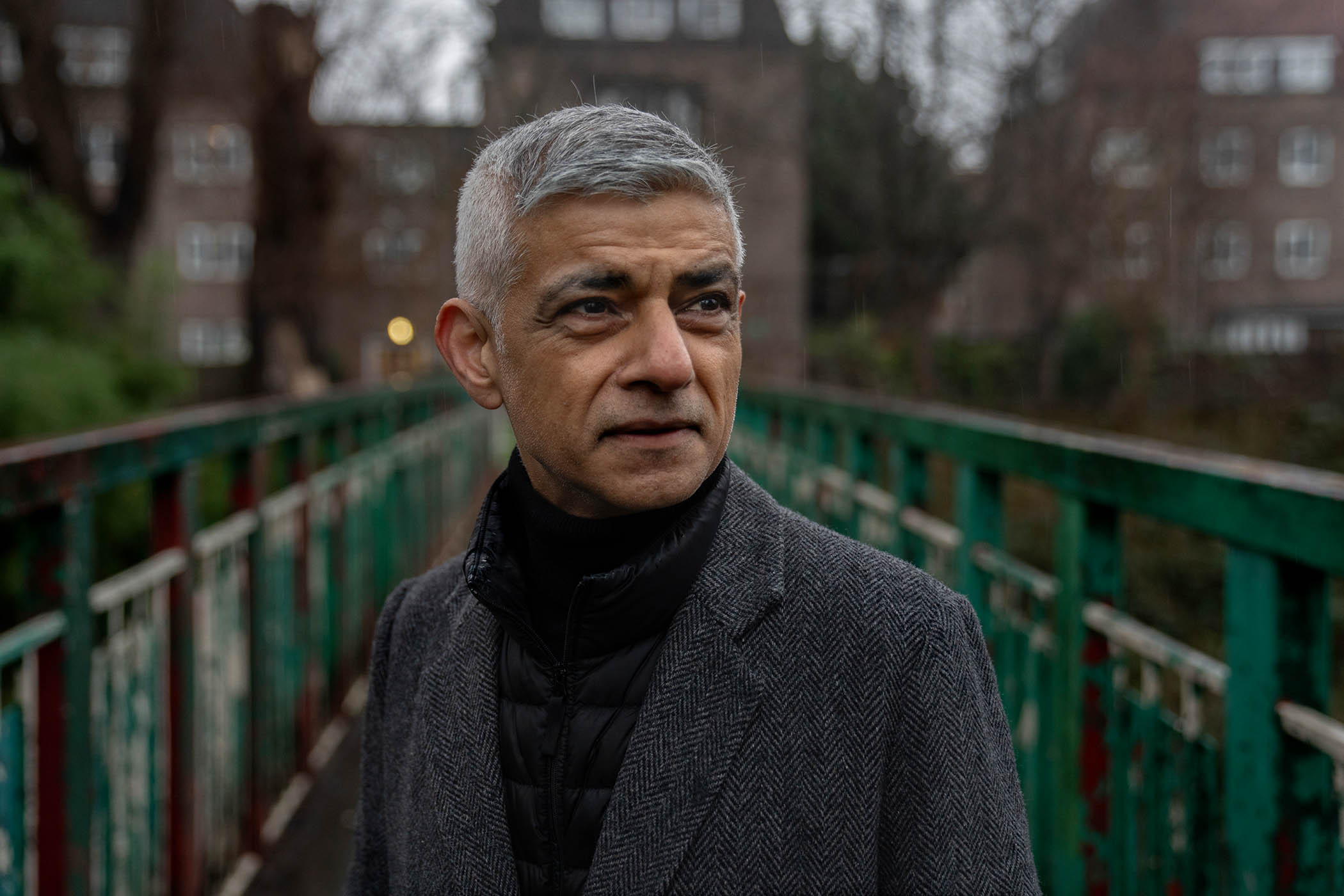
We meet around the corner from the Earlsfield Amateur Boxing Club, where Khan and his brothers used to go after school. Our walk will take us past the Henry Prince estate, where the mayor grew up, and along the 44 bus route that his father drove every day. “This is my hood,” he says, pointing to the adventure playground where he swung on the tyres when he was young. “All politics is personal.”
Khan, 55, was MP for Tooting for 11 years before becoming mayor in 2016. As we trudge through muddy puddles in the drizzle, he says this part of south London has been transformed since he was a child. In the 1970s the river was full of abandoned supermarket trolleys. Now the water has been cleaned up, a Gail’s bakery has opened on the high street and the local hardware store sells Farrow & Ball paint.
“I think the word people would use is ‘gentrification’. When I was growing up I never saw anybody go to work in a suit. I’d see people going to work with a uniform – the bus driver, the train driver, the factory worker. The first time I ever saw an Asian man in a suit was when I got to secondary school and met the headteacher, Mr Bokhari. I thought, wow. The word ‘aspiration’ is overused but I really do believe in the power of role models.”
The son of Pakistani immigrants, Khan is the fifth of eight children, seven of them boys, and is fluent in Urdu. He did well at school and became a lawyer, but says he experienced racism from an early age. “When I was growing up, it wasn’t uncommon to hear the P-word to describe people like me, or the N-word to describe people who were black, or the Y-word to describe people who were Jewish. That went to the periphery.
“What’s happened over the last 10 years is the stuff that was on the periphery has become normalised. The sort of hate we’re talking about – racism, Islamophobia, antisemitism – had disappeared, and it’s come back. People like Donald Trump have given permission for this stuff to be back in the mainstream. People think there’s no consequence to inciting hatred online.”
Newsletters
Choose the newsletters you want to receive
View more
For information about how The Observer protects your data, read our Privacy Policy
Londoners “are generally lovely” when he meets them in person around the city, but “people online seem to suddenly become incredibly brave at being rude”, he says. “Since Elon Musk has taken over X/Twitter it’s become a lot worse.” The thing he finds “very troubling” is the way in which discrimination has evolved over the past 40 years. “When I was growing up it was the colour of my skin. Now it’s the religion I belong to,” he says. “You’ve got a school of thought now that believes there’s a clash of civilisations – that it’s not compatible to be a westerner and a proud Muslim.”
He sees the impact on those around him. “I meet women who have chosen to wear the hijab and are scared to do so because they’re worried about being spat on. I meet men with beards who are petrified of keeping the beard because they’re identifiable as a Muslim. Ramadan is coming up and people are really worried about going to the mosque at night time because of the rise of Islamophobia. If you’re a Muslim, you’re the recipient of increased anti-Muslim hatred.”
Throughout history, there has always been a minority at the bottom of the pile, he says. “It used to be Jewish people, it used to be Irish people, it used be black people, and now it’s Muslim people.”
He points to the White House national security strategy, which warns of “civilisational erasure” in Europe as a result of mass migration. “Think about that. Imagine if you’re not mixing with Muslims you might believe that rubbish; you might believe we are erasing Judeo-Christian civilisation. It’s a problem because what it does is spread animus and hatred,” he says. “I’m afraid Muslims are the new proxy in the culture war. As a Muslim, why am I the pawn? It is incredibly unfair.”
Trump has described Khan as a “stone cold loser” and a “horrible, vicious, disgusting mayor”. Last year he used a speech at the UN to claim London was being steered towards “sharia law”. The mayor is baffled by the president’s obsession with him. “I do appear to be living rent-free inside his head and it’s hard to explain why that is,” he says.
There are, however, consequences both for him personally and for the city he represents. “You can draw a graph from President Trump’s election [in 2016] showing the amount of racial abuse that I have received. You can see spikes. When President Trump was no longer president, it went down, and when President Trump was re-elected, it went up again.” The idea of there being civilisational erasure or sharia law in London “plays into the stereotypes”, he adds. “If you’re someone whose only source of news is the social media of President Trump or his acolytes, you may mistakenly believe that because of my faith and my name, I’m bringing sharia law to London. Londoners know, of course, that’s nonsense, but there are more and more people who amplify those messages and start believing it.”
Khan thinks there is a reason why Trump and his vice-president, JD Vance, seem so determined to pick on him. “London is a beacon for diversity, for pluralism, and that’s what they hate. It goes against what they’re espousing because if they’re right we should be a disaster as a city. But we’re doing incredibly well and that’s why they talk us down.
“London’s success and the fact that I’m the mayor is the antithesis of what they believe in, which is that you can’t be a progressive, liberal, Londoner of Islamic faith.” He has been in touch with Zohran Mamdani, the Muslim New York mayor, by text to compare notes. What infuriates him even more is the fact that British politicians, including Nigel Farage and Robert Jenrick, are so quick to denounce “lawless London” too. “It’s the Gerald Ratner school of politics but we’re not talking about cheap jewellery – we’re talking about a capital city. I can’t think of anything more unpatriotic.”
Speaking of patriots, the mayor thinks ministers, and the public, should be more grateful to the billionaire philanthropists who support London’s cultural institutions. “Our ecosystem benefits from having the wealthy here,” he says. “When money is tight, our brilliant museums and galleries need philanthropic support. There are people who are incredibly wealthy who want to give back. We shouldn’t denigrate that. We shouldn’t assume everyone is culture-washing. Sometimes they have the best of intentions.”
He worries that changes to the tax system are encouraging the super-rich to flee. “I think the Treasury is recalibrating,” he says. “Even the biggest cheerleaders of the Treasury would say they’ve not got everything right in the first year.”
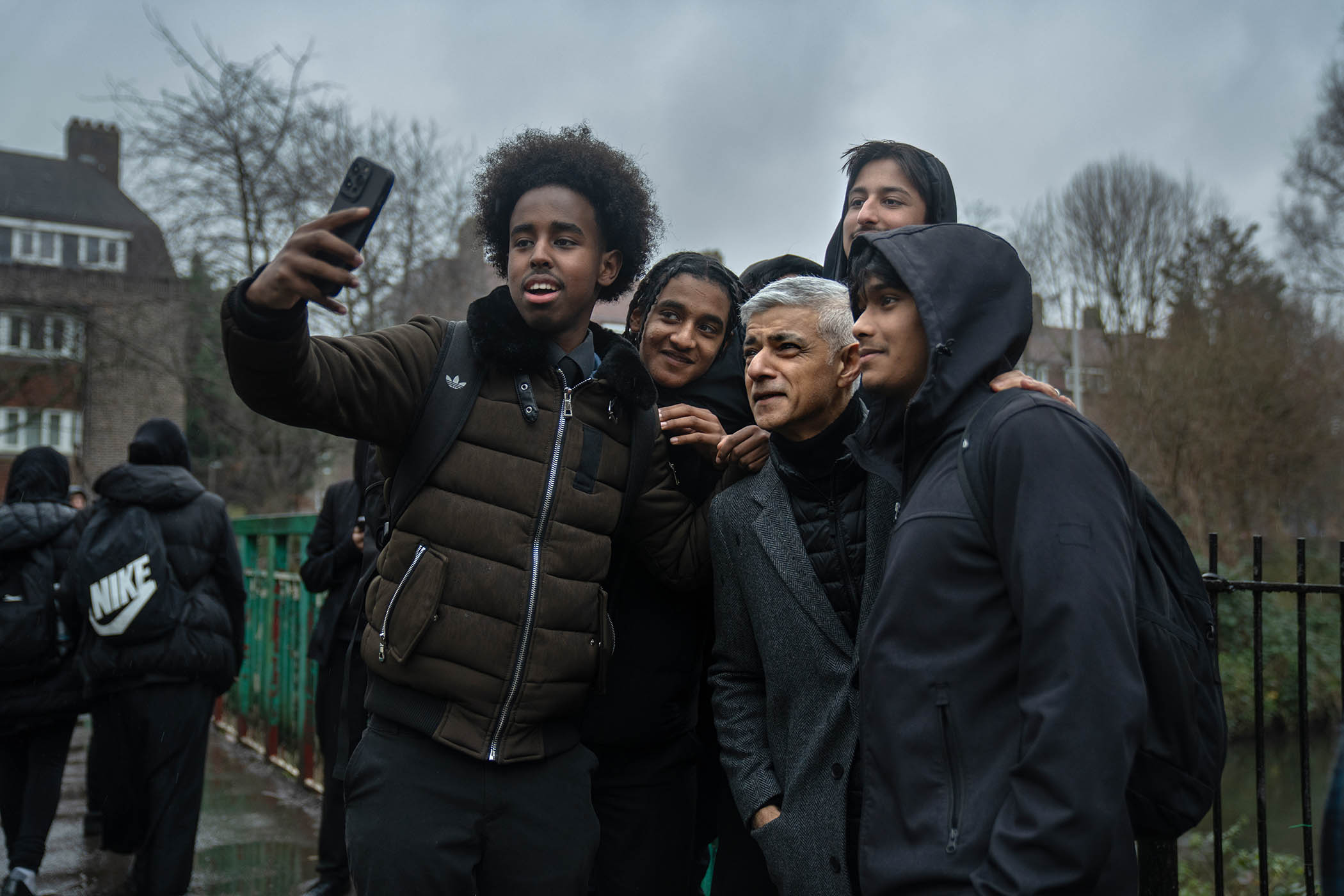
We have reached the bridge across the river that leads to the Henry Prince estate. Teenagers returning home from school ask for selfies with the mayor. Khan may be a celebrity in London but he represents a party that is tanking in the polls and led by a deeply unpopular prime minister. The forthcoming local elections are likely to be dire for Labour in the capital. “I think we will, in London, lose seats to the other parties,” the mayor admits. “We’ve got a threat from Reform, the Greens, Lib Dems and independents.” But he thinks it would be a mistake to chase after Farage. “We’ve got to play to our strengths – social justice, economic competence. We know what our north star is. The same rules apply whether you’re in politics or you’re running a business or whether, of course, you worry about competition, but you shouldn’t allow that to dictate how you behave.”
Although the mood in the Commons is sulphurous, Khan insists it would be a mistake to oust Starmer for Labour MPs to oust their leader. “Football is a 90-minute game. You wouldn’t dream of saying in the 35th minute because you’re 2-0 down – we’ll take all the players off and sack the manager.”
As we turn on to Garratt Lane, the 44 bus pounds past us in the rain. Khan makes clear he has concerns about the home secretary Shabana Mahmood’s proposals to force immigrants to wait decades for the right to settle permanently in this country. “If you’re saying to people, you need to be here for 20 years before you’ve got a stake in the country, it may mean you’re not committed to learning the language. How can you put down roots?”
The mayor also thinks the prime minister should be more ambitious about rebuilding links with the European Union European Union. “Brexit was the biggest act of economic self-harm any country’s ever done. My ultimate goal is for us to rejoin and I think it will happen in my lifetime,” he says. “I definitely want us to be part of a customs union. I’m somebody who’s an advocate for us being part of a single market. I think we can negotiate more now, because of how geopolitics has changed, than we could in 2016 or 2019. Europe needs us and we need Europe.”
We reach the Lockdown Bakehouse and order coffee and tea to warm up. It is time to confront the leadership question. Starmer is in serious trouble after the latest revelations about Peter Mandelson, who was appointed UK ambassador to the US despite his friendship with the convicted paedophile Jeffrey Epstein.
“The whole Mandelson saga is a case study in ‘there’s one rule for the elites and the establishment and there’s another rule for the rest of us’,” Khan says. “It also shows the arrogance of the man. The only person who knew what was in those files was Peter Mandelson. It beggars belief that knowing what he knew about his relationship with Epstein he still put himself forward to be the ambassador to the US.”
Does he think it raises questions about Starmer’s judgment? “My starting point is the victims and survivors,” he replies. “Everyone’s talking, understandably, about market-sensitive information being leaked for personal gain, but if you’re the victim of paedophilia, if you’re the victim of rape, you will say, ‘Hold on a second, what about me?’” Nor will he point the finger at Morgan McSweeney, the prime minister’s chief of staff. “A lot of people had drunk the Peter Mandelson Kool-Aid,” he says.
Photograph by Tom Pilston