

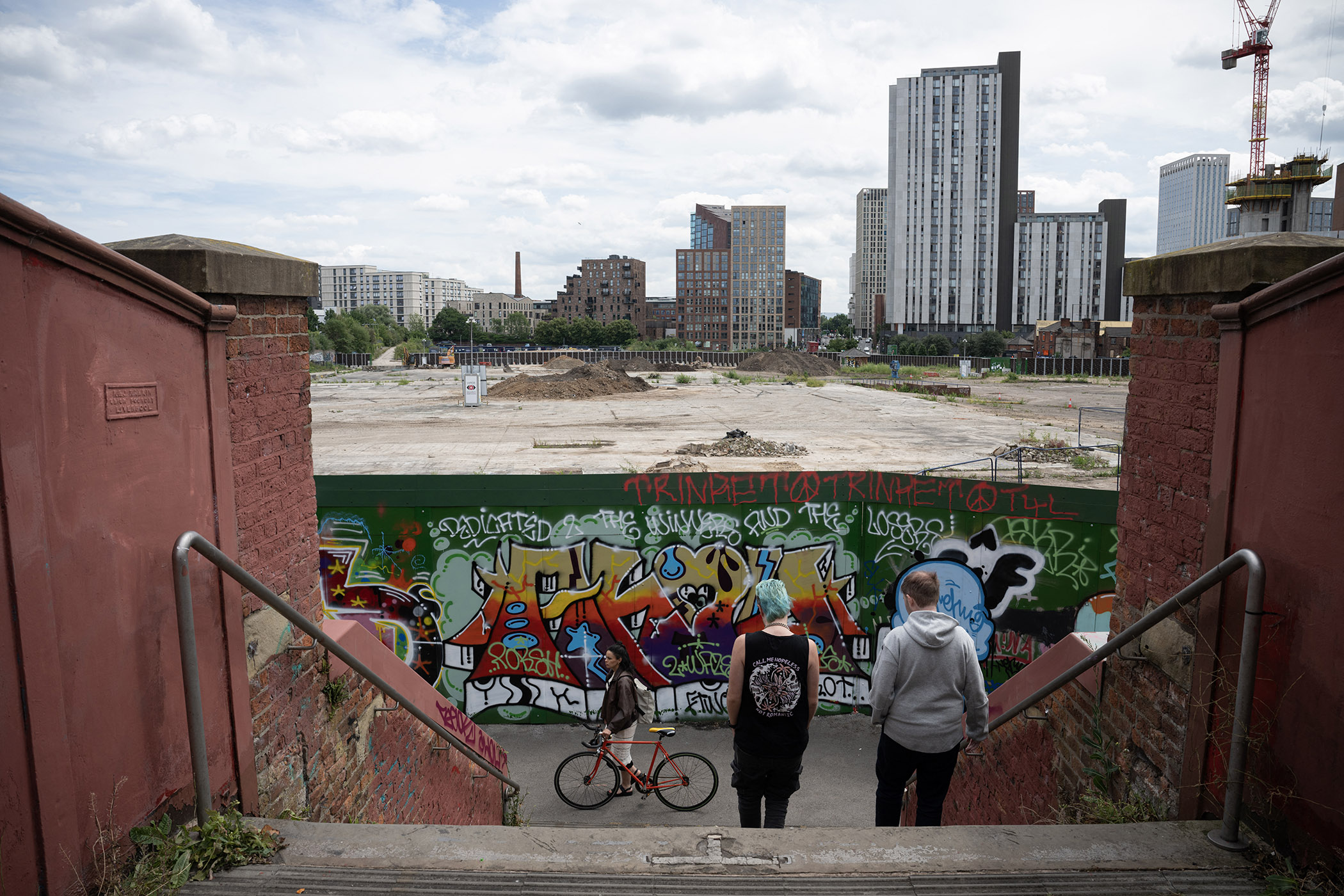

Pupils at North Chadderton school in Oldham, Greater Manchester, were among the first in the country to be given the option to take a new baccalaureate qualification as a vocational alternative to university.
At 14, as they prepare to choose their GCSEs, students log on to a website that offers them seven possible career paths. These comprise construction, engineering, education and early years, health and social care, business, technology and the creative industries. There is a list of the local jobs they could apply for if they had the right qualifications, and the salary they would earn.
Once pupils have picked a route, the Greater Manchester Baccalaureate (MBacc) system then recommends which subjects they should take and helps connect them with local employers to arrange work placements. Businesses involved in the scheme also visit the school to explain more about the careers on offer. Students then receive a certificate at 16.
Amanda Marsh, assistant director of North Chadderton school, said the programme gives a “clear line of sight” to the workplace for pupils who often otherwise struggle to see the point of education. Almost half of the relevant cohort have signed up and there is no single pupil leaving the school at 16 this year who is not in education, employment or training (Neet).
Across Oldham, one of the most deprived parts of Greater Manchester, about 3% of young people typically drop out at that age. North Chadderton is the only school with 0% dropouts. “We’ve given these students so many opportunities through the MBacc over the last 18 months,” Marsh said. “They’ve been motivated to go and get a college course. Quite a few have got apprenticeships. The experiences that the students are having are giving them aspiration. It’s giving them a purpose.”
For employers, the MBacc is a valuable way of attracting a wider range of young people. Gary Briggs, director of training and skills at the arts organisation Factory International, which is part of the scheme, said the creative industries have traditionally relied on recruiting graduates. “A lot of young people are unaware of the breadth and scale of the opportunities in culture. The MBacc as a mechanism for joining the dots and bringing everything together is really important. It recognises the importance of diversity of routes in. You get different perspectives.”
The MBacc programme, which was introduced by Andy Burnham when he was Greater Manchester mayor, is now almost certain to be rolled out around the country. In his speech last week, the probable next prime minister promised a “complete rethink” of education. “The days of a school system configured entirely around the university route will be brought to an end,” he said.
During the Makerfield byelection campaign, Burnham told The Observer that the emphasis on academic over vocational education was “a huge theme for me in relation to where the country took the wrong path”.
He said: “We overpromoted university, and having an education system that is almost solely focused around that has been to the detriment of lots of young people in this constituency. We need an education system that is about parity between academic and technical. The MBacc has been a real success.”
Schools, he added, are too much like “exam factories” and “the pressure is felt by the kids and the teachers”.
Newsletters
Choose the newsletters you want to receive
View more
For information about how The Observer protects your data, read our Privacy Policy

The baccalaureate programme fits with Burnham’s promise to devolve more power over skills policy to mayors because it relies on local leaders to work with employers to identify the career opportunities. Already, a similar scheme is being introduced by Helen Godwin, the Labour mayor of the West of England. The “West Bacc” will be developed over the next 18 months in partnership with employers, schools, colleges and young people.
Burnham could also introduce a survey of children’s mental health in all schools, based on the #BeeWell programme, launched in Manchester in 2019. Last year, more than 57,000 young people from 161 schools completed the survey, which measures the wellbeing of pupils.
As mayor, Burnham expressed his concern about the number of children being excluded from school. “It’s become too easy for a headteacher to exclude,” he said last year. “They’re under pressure from Ofsted and there’s a vested interest sometimes to exclude quickly. Actually, it might be ADHD [attention deficit hyperactivity disorder] or some undiagnosed neurodiversity: there are lots of reasons why a young person’s behaviour might be difficult.
“It’s too easy for them just to push them out. For me, the pupil referral units have become a symptom of a school system that is geared to the interests of some kids rather than all kids.”
With more than 1 million 16- to 24-year-olds classified as Neet, senior Labour figures are hoping that Burnham will be bolder than Keir Starmer on education reform. The former cabinet minister Alan Milburn, who is now working on the recommendations for his Neets review, said it was time for a “radical shake-up” of education.
“School standards are non-negotiable and the curriculum has obviously got to teach knowledge,” he said. “But the question we’ve got to ask ourselves is: is there a way of schools teaching in such a way that every child is able to fulfill their potential and aspiration and find the thing that they are good at? At the moment, the straitjacket of the curriculum and assessment system means that a very big proportion are only ever going to fail, and that can’t be right.”
The former education secretary David Blunkett called for Burnham to put a “rocket booster” under the proposals in the government’s curriculum and assessment review that was published last year. More effort should be made to “engage business”, Lord Blunkett said. “You can use the local context to bring alive the curriculum in particular areas across the country so that young people all the way through can see that what they’re doing is going to have a beneficial outcome.”
Reforming the curriculum and assessment system would be in line with Labour’s manifesto. Starmer promised to introduce change but the government review proposed only modest reforms. Its author, Becky Francis, advocated “evolution, not revolution”.
There are growing concerns among employers and trades unions that schools are failing to give young people the skills they need in the jobs market. An Opinium poll for The Observer last year found that only a fifth of the public believe the education system prepares children well for life or work.
Education, which should be the engine of social mobility, is also entrenching class divides. Analysis by the Education Policy Institute, published last week, found that persistently disadvantaged pupils – those who spend at least 80% of their school lives on free school meals – are typically 22 months behind their wealthier peers by the time they take their GCSEs.
They have a 25% chance of not progressing towards a qualification equivalent to at least one GCSE, or an apprenticeship. The average grade of a persistently disadvantaged pupil is 3.3 in GCSE English and maths.
Pepe Di’Iasio, general secretary of the Association of School and College Leaders, urged Burnam to go further in reforming exams. “We are the most tested nation in the world. I would like us to be bolder,” he said. “I don’t think we need to have the numbers of hours sat in heatwave-ridden sports halls over the summer period.
“This summer, we can predict right now that there will be a third of students who are destined not to get standard passes in their GCSEs. They feel like failures.”
Photographs by Andrew Fox for The Observer