Portraits by Gary Calton for The Observer
Andy Burnham is stopped by a voter as we stroll through the Three Sisters nature reserve in Makerfield. “My son’s a massive fan of yours but I’m in two minds,” the man tells him. “I’ve always voted Labour but I’m not sure now. We do need a prime minister like yourself. The problem is Keir Starmer.”
Burnham listens, nodding empathetically. “I’m not coming here saying Labour’s great. I’m saying Labour’s not been good enough and it needs to change to get back to a party that listens to people,” he replies. “The London set have run it for too long.”
There in a nutshell is the battle being fought in this extraordinary and consequential byelection. It’s “vote Labour to oust its leader”. If Burnham becomes the MP for Makerfield next month he will challenge the prime minister and is the overwhelming favourite to win a Labour leadership contest. He could be in Downing Street by the summer, running a government based on what he calls “business-friendly socialism”. Burnham tells me that if he does get to No 10 he will give 15% of his salary to homelessness charities, as he has always done as mayor of Greater Manchester. “It’s about deeds not words, leading by example in terms of building more of a give-back culture in society.”
First, though, Burnham has to win in Makerfield, where “Vote Reform” posters dominate the windows and union jacks flutter outside redbrick terraced houses. “I’ve never been under any illusion that it’s a hard fight,” he says. “I think politics in Britain needs to change. The culture of it is rotten in many ways and it isn’t connecting with people. The country needs lifting out of the negativity that is in danger of overwhelming us all.”
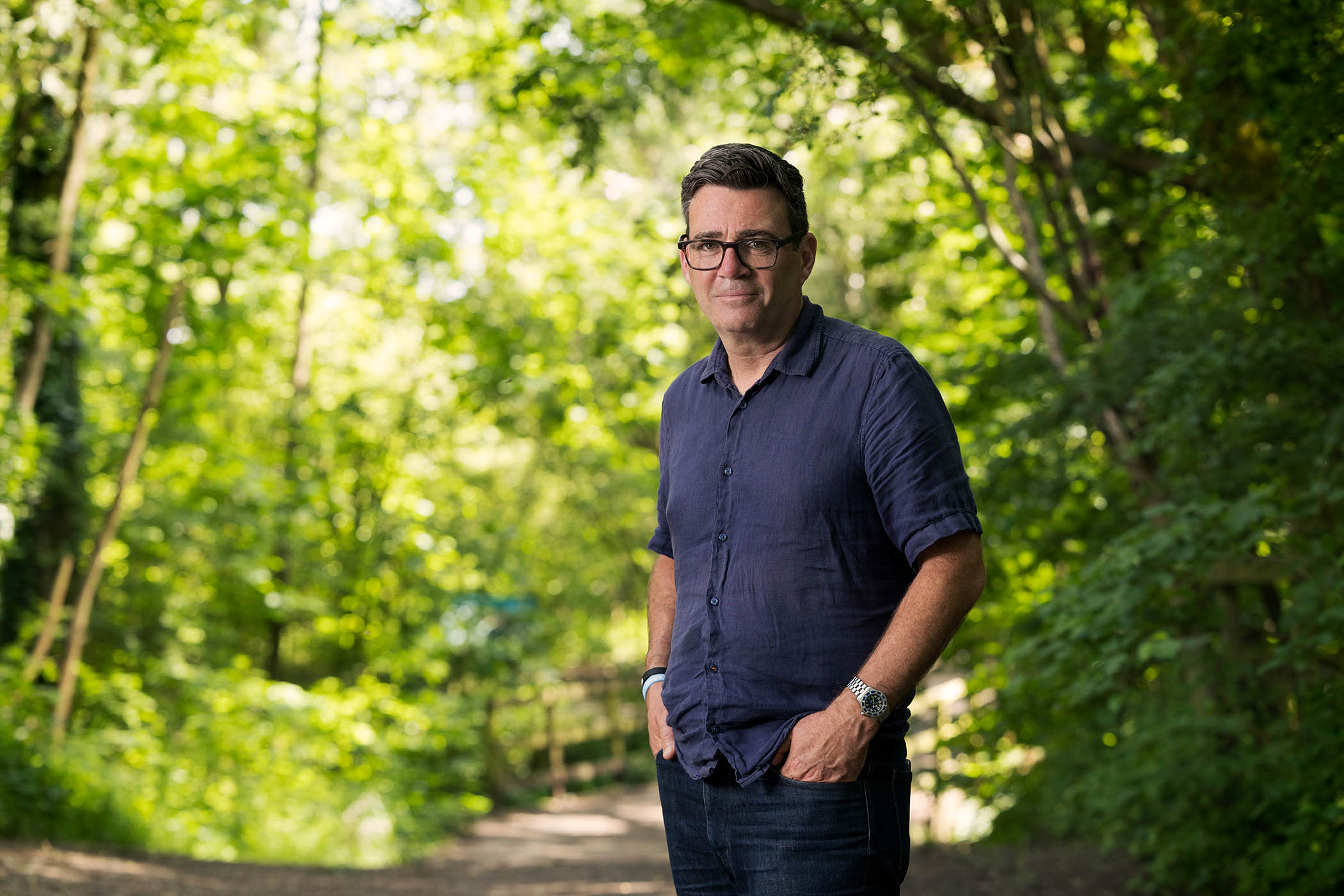
We meet at the Hindley community sports and social club in Wigan. It is a scorching day and Burnham, 56, has a pint of lime and soda in front of him when I arrive. Once when asked to choose his favourite biscuit, he opted for “chips and beer” rather than a digestive or a Jammie Dodger. “I’ve never lived that down. It’s like my running shorts in this campaign – there are things that once they’re seen they can’t be unseen,” he says. He is wearing a navy linen shirt and dark blue jeans. He happily chooses Oasis over Blur and football over rugby but says: “I’m both guacamole and mushy peas.”
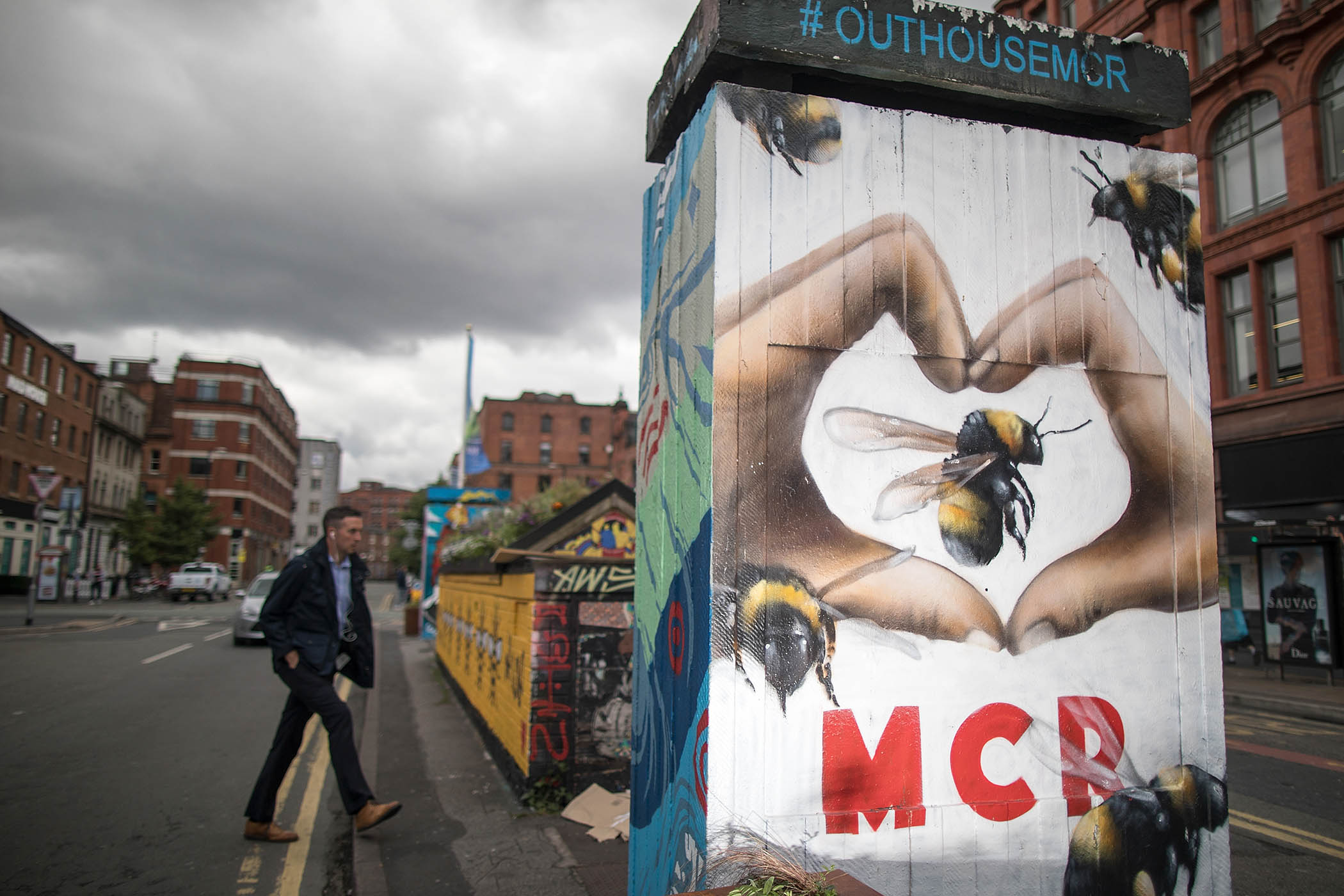
Manchester’s northern quarter
Burnham is promising to put Labour “solidly on the side of working-class people”. His party’s members are overwhelmingly wealthy, liberal graduates but the mayor thinks Labour has been too focused on Hampstead and not enough on Hull. “Chasing middle England and middle-class voters and saying that’s the only thing that matters and we’ll all fight on that ground” is one of the signs that “politics has lost its way”, he says.
“To me, that just leaves millions of people adrift.” There is, he warns, a sense that Westminster “looks past” places like Makerfield. “People aren’t daft – they feel that, and it’s been going on for a long time. The sentiment you hear a lot is ‘Labour left us, we didn’t leave Labour’.”
This week Tony Blair warned his party against going to the left, but Burnham thinks the former prime minister misunderstands the economic causes of populism. “He doesn’t mention inequality once,” he says. “If you don’t get how that’s driving politics now, if you are not rooting your analysis in the fact that people are unable to live and that things that were taken for granted are no longer affordable, then you are not understanding what’s going on… People don’t think the centre has delivered for them in terms of their lives, therefore they’ve gone further to the extremes.”
Our walk will take us through the nature reserve, which was created out of coalmining spoil tips. It is a short drive from the pub and walking distance from Burnham’s home. “We discovered it in the pandemic,” he says as we head to the reservoir. “Those days are really etched in my mind. I would often go round Three Sisters just to process it.”
It was the Covid-19 crisis that turned the mayor into the “King of the North”, standing up for Manchester in his anorak. If he gets back to parliament after almost a decade away from Westminster, he wants to carry on being a voice for the region in which he grew up and now represents. “Some people laugh that I’m a professional northerner. That’s fair enough, but I’m proud of where I come from.” He insists, though, that he will not ignore similarly forgotten places in the south, west or east. “Everyone else feels something of the same. The country isn’t balanced in terms of the way we invest and the way opportunity is spread.”
Newsletters
Choose the newsletters you want to receive
View more
For information about how The Observer protects your data, read our Privacy Policy
Burnham says he wants a “positive, inclusive unifying” approach, with “more collaboration”. Would he work with Zack Polanski in a “progressive alliance” with the Greens? “I would try and work with all political parties,” he says. “Enduring change tends to come when it’s more than your own tribe subscribing to it. I feel really strongly that British politics has got to get back to a search for common ground.”
He is convinced that introducing proportional representation at Westminster is now essential to “change the political culture” and restore trust in democracy. When he stood for the Greater Manchester mayoralty, which was fought under a supplementary vote system, he realised that he had to knock on every door to try to secure second preferences. “It made every vote count,” he says. “I don’t see how first past the post and the point-scoring that’s inherent with it lifts Britain out of the doom loop it’s in.” He thinks electoral reform would reassure “my friends the bond markets” by encouraging long-term political stability and cooperation between parties. There would, in his view, need to be a public mandate through a referendum or general election. “I would prefer a manifesto commitment,” he says.
“My dad, when I came into politics, said: ‘Never commit to a referendum on anything.’ I look back and think how wise he was.” Electoral reform is also supported by the Liberal Democrats, the Greens and Reform UK. “I think its time has come.”
The swans and geese are bobbing peacefully on the lake when we arrive at the nature reserve. Things weren’t so calm when Burnham announced he was planning to run in Makerfield – it pushed the cost of government borrowing to its highest level in decades. He tried to calm things down by saying he would stick to Rachel Reeves’s fiscal rules and tax pledges, but there is nervousness after his suggestion last year that Britain was “in hock” to the bond markets.
“People took that phrase and thought I would just ignore them and spend, spend, spend. That wasn’t what I was saying at all. What I was saying was that if you go back to the mid-1980s onwards, a wave of rightwing policies of deindustrialisation, privatisation, austerity and Brexit have combined to leave us in that position where we don’t have enough control, we can’t protect people from the cost-of-living pressures that they experience. Often people are living day to day, hand to mouth, and all of that has left the country on the edge.”
To some critics, Burnham is a dangerous leftwing radical; to others he is “continuity Keir”, who has stymied his hopes of delivering change by boxing himself in on tax and borrowing. He prefers not to be pigeonholed. “It’s knowing where you need to take a more left solution and where you want to be pro-business,” he says. “I’m saying something very different to what the Labour party has said for a long time – it’s a new politics to build a new economy.”
The path leads around the water and into the dappled shade of the forest.
Burnham wants a more active, interventionist state, including public ownership of essential services. His model is the Bee Network, the integrated transport system that he introduced in Manchester. “The contracts are a third cheaper than the tenders we used to have under deregulation. The bus operators made double-figure profits out of Greater Manchester for 40 years and now they don’t.”
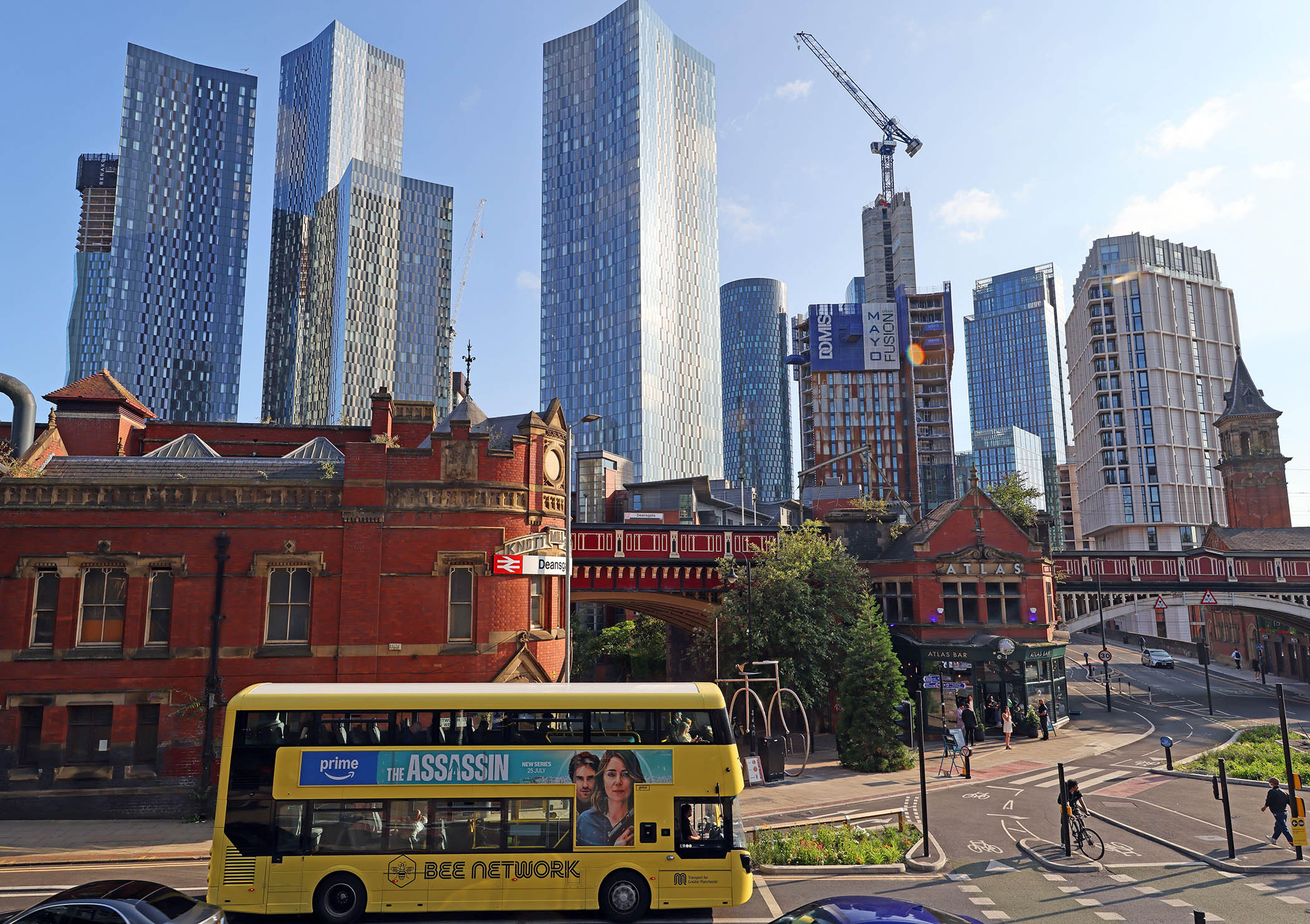
Burnham introduced the Bee Network in Manchester in 2022
He thinks there are similar efficiency gains to be made by taking water, energy, social housing and transport back under public control. He points out that Greater Manchester spends £75m a year on temporary accommodation because there are not enough council homes.
“The public housing stock has shrunk by about 1.5m homes since the mid-1980s and the effect of that is that the benefits system chases rents in the unregulated private rented sector,” he says. “When we gave up control of the basics, we gave up control of a large part of the economy and we lost control over public spending.” Taking privatised utilities into public ownership would be expensive. “You don’t have to do it all at one time and that allows you to manage the cost.”
Burnham has previously called for a 50p top rate of income tax. Now he says: “I think we need to tread carefully and carry people with us, not necessarily going straight to new areas of division and conflict.” But he insists he wants “a fairer taxation system [that] incentivises the right things”. He supports a land value tax – charging an annual levy to developers who sit on land without building – and a revaluation of council tax rates as part of sweeping reforms to property taxation that would also look at stamp duty. “At the moment a mansion in Marylebone pays less than a two-bedroom terraced house in Makerfield,” he says. “The way national government treats local government is absolutely scandalous. You’ve got a threadbare local state and a bloated national state.”
Social care should, he argues, be free at the point of use – like the NHS – possibly funded by a levy on people’s estates. “My dad sadly has Alzheimer’s and the system is really broken. When he was at home with my mum, the carers were told if there was ever a problem, just ring 999. Me and my brothers had to go to A&E a few times and say please don’t admit him.” He points out that the health service is spending almost £2bn a year looking after people in hospital who are medically fit to go home but cannot be discharged because there is no social care. “I don’t believe the NHS can carry on and be at a level we’d want it to be at without fixing social care. We can’t just ignore these massive fundamentals that are wrong with the country.”
As we pass a “hedgehog hide” in the woods, I ask whether he has concerns about the home secretary Shabana Mahmood’s immigration reforms. “There has to be a sense of control if people don’t feel that there’s a problem,” he says, but he clearly worries about the plans to make refugee status temporary and retrospectively apply changes to the settled status rules. “We need to pause on those consultations and make sure we get the balance right.”
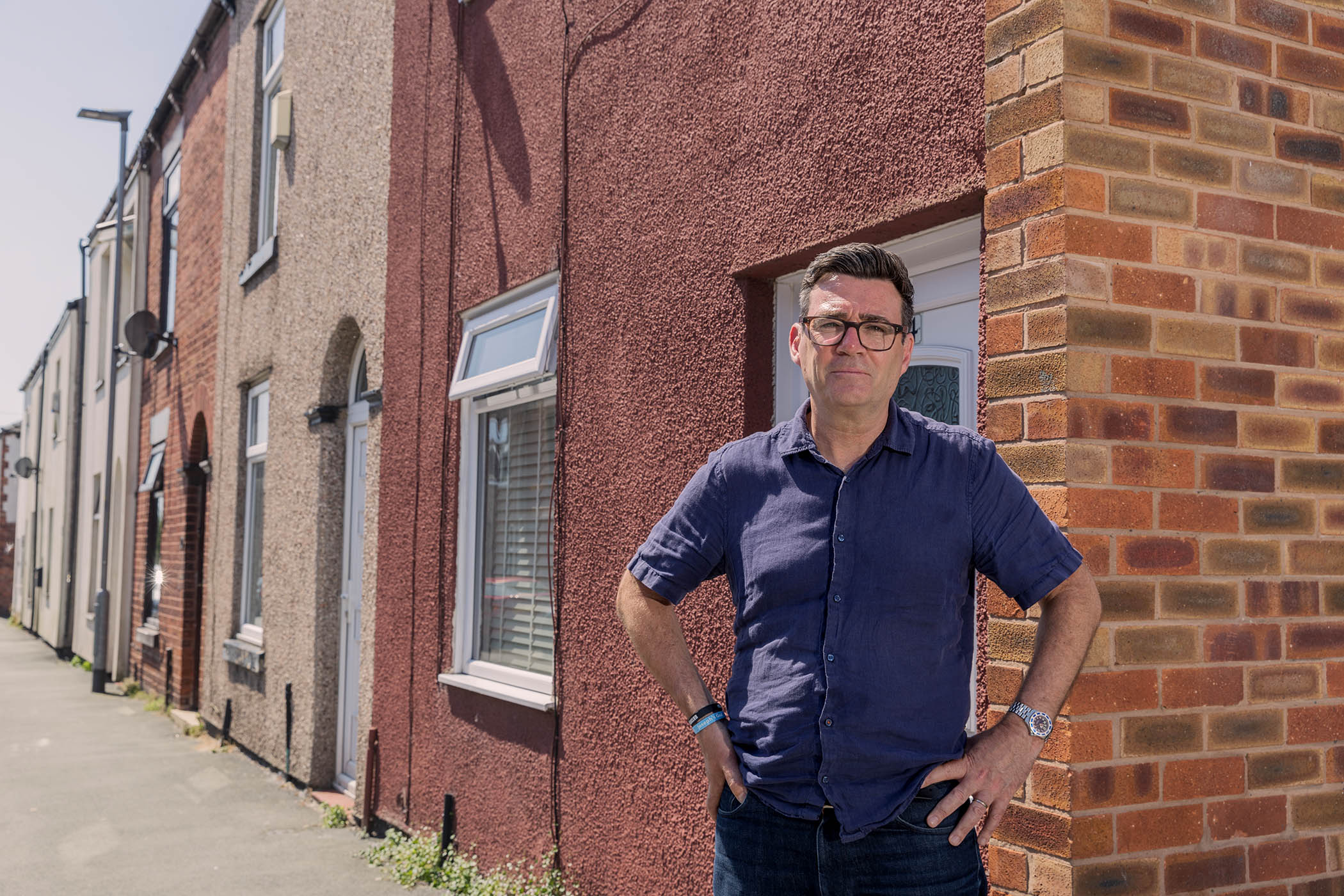
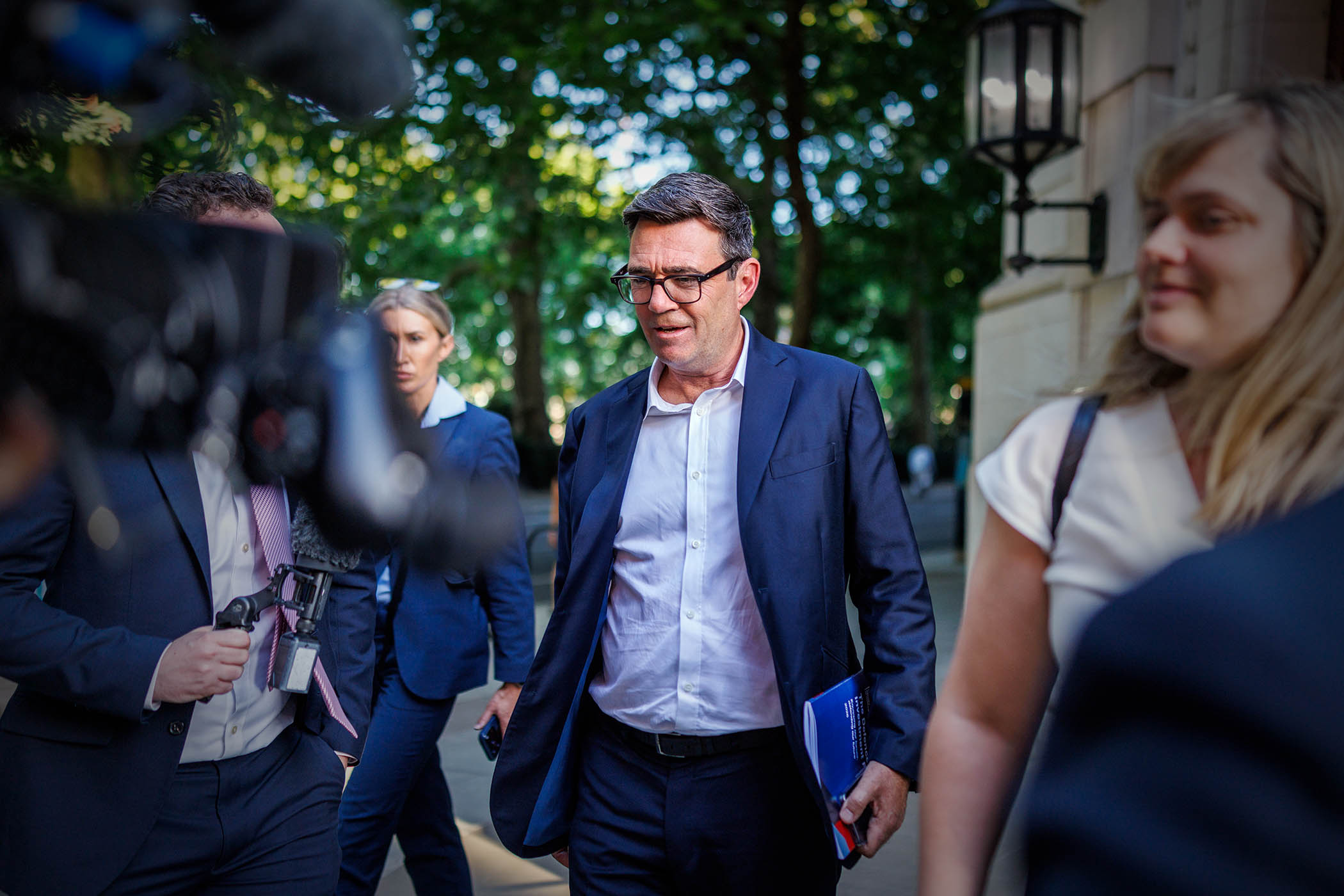
Burnham near the Hindley social club
Burnham believes education needs to be transformed. Schools “are too much like exam factories,” he says. “We overpromoted university and that has been to the detriment of lots of young people in this constituency. We need an education system that is about parity between academic and technical education.” Would he support a ban on social media for under-16s? “I’ve definitely come to the view that it’s really harmful and if not a full ban, something has got to change.” Elon Musk has thrown his weight behind Rupert Lowe’s rightwing Restore Britain party. “I think what they [giant tech] have created is dangerous. They’re monetising hate.”
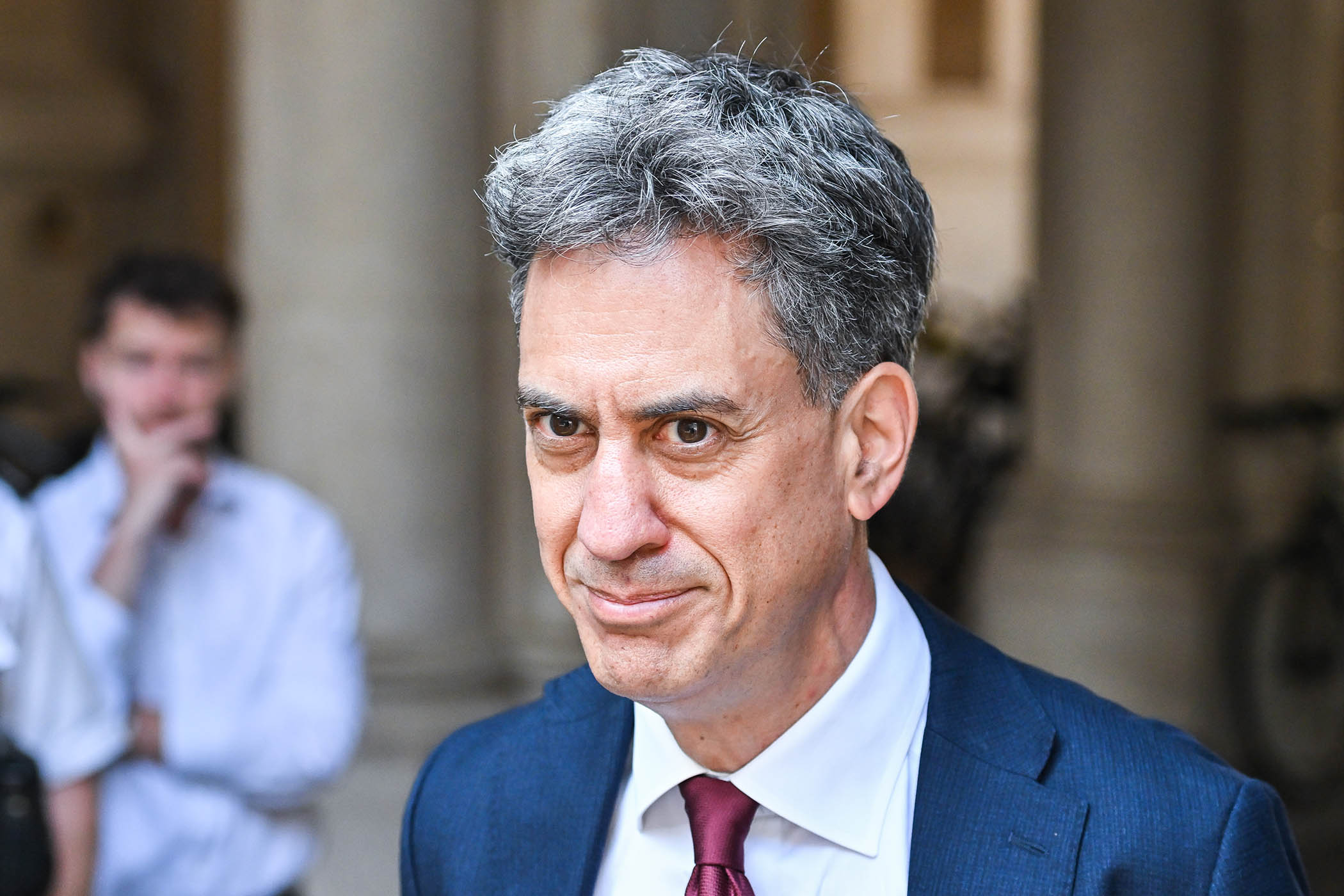
Ed Miliband once divided businesses into “predators” and “producers”. Does Burnham agree? “Our version of it in Greater Manchester is ‘good growth’,” he says. “We had a big campaign around promoting the real living wage and I remember a representative from Ikea standing up in front of the meeting and saying: ‘Paying the real living wage has saved us money. We’ve cut our sickness rates, we’ve cut our recruitment costs, people are staying with us for longer, productivity is higher.’ There’s a business case for good employment.” He thinks “social value” should be a factor in public procurement and has refused to give contracts to the controversial data company Palantir. “I have concerns about that model.”
There is a joke doing the rounds at Westminster: “A Blairite, a Brownite and a Corbynite go into a bar. The barman says, ‘What will you have, Andy?’” Burnham has a reputation as a political chameleon who has served under three Labour leaders of very different political persuasions. “I’m a team player,” he says, “but they then make that a source of ridicule. It shows how overly factional the Labour party is because they make a joke about that.”
I’ve known Burnham for almost 30 years. We first met when he was a special adviser and I was a junior political reporter. We have spoken regularly ever since. In many ways he is just the same affable, approachable person, even if his politics have evolved. But as mayor he seems happier and more fulfilled than he ever did in government. The job suits his ability to connect with people and articulate the public mood. “I left Westminster for a reason,” he says. “I’ve been a lot more comfortable in myself and what I believe and what I’m about.”
As we walk back to the car, I ask why he wants to return to parliament and put all that at risk. He says his wife, Marie-France van Heel, is “battle-hardened”. Still, she must be dreading the scrutiny of her hair and outfits. He hates the yah-boo culture of the House of Commons and the tribalism of Westminster. He has retained his popularity as mayor by being a political outsider, and he is standing in the byelection as an insurgent. But if he becomes prime minister he will be the incumbent who is held responsible for everything that goes wrong.
“I’ve always said at some point I will probably go back, because I don’t feel Makerfield and Greater Manchester can be where I want them to be without big changes at a national level,” he says. “So if I go back, I’m keeping the insurgent approach. It needs a lot of change, and I’m going back with that spirit.”
For more from The Observer’s politics team, sign up to receive Rachel Sylvester on Politics – a new weekly newsletter in which our political editor shares her exclusive insight into what’s happening in Westminster, Whitehall and beyond
Additional photographs by Christopher Furlong/Getty Images, Tony Smith/Alamy