Photograph by Karen Robinson for The Observer
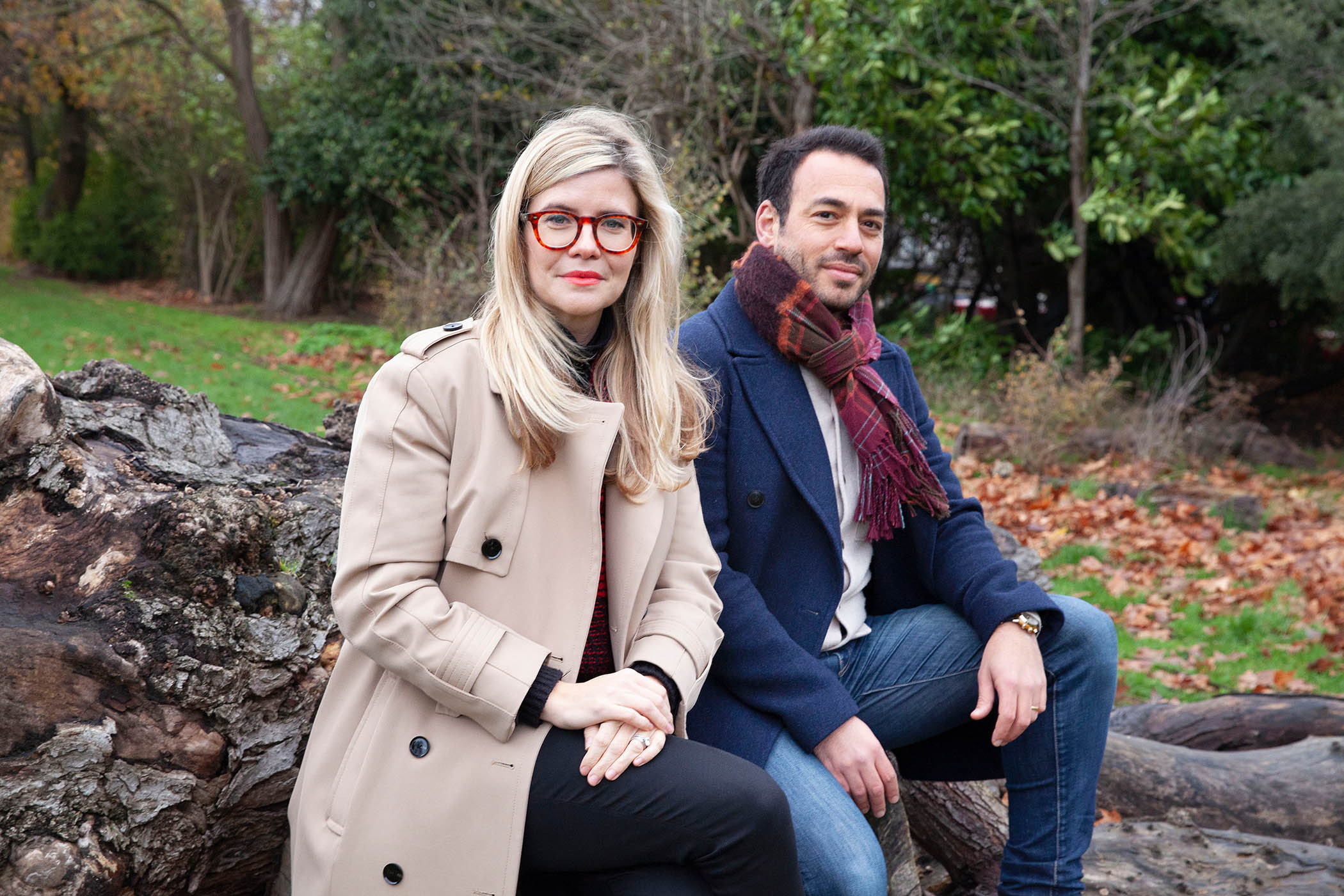
To stroll through Herne Hill and Brockwell Park in south-east London with Emma Barnett and Jeremy Weil is to see a seemingly ordinary London district anew: and for the two of them, that’s the whole point.
“When we moved here, before we had kids, we only ever turned left out of our house to go to Brixton, for lovely food and cocktails and whatever else was going on,” Barnett says. “Or we’d get on the Tube, and it was just 12 minutes to Soho, which is where I was living my life then.” But first one longed-for baby, and then another – and then Covid – opened up a whole new world.
On a drizzly autumn afternoon, Barnett and Weil are taking time out from their staggeringly busy lives to wander through the place they not only love, but which planted the seed of their company, Colour Your Streets. It’s a range of colouring books, 175 and counting, each filled with a selection of local landmarks to colour in, closely focused on the places we call home – from Barnsley to Basingstoke, Eastbourne to Exeter, and London boroughs that take in the whole A-Z.
This is all pretty good going, especially when you consider Barnett’s side hustle as a presenter of Radio 4’s flagship Today programme. At 40, her career in the media has run on a relentlessly upward trajectory. She was the Telegraph’s first digital editor and launched the paper’s Wonder Women section, but she really made her name in broadcasting, from Hit List on 5Live to taking over the BBC’s Woman’s Hour on the show’s 75th anniversary in 2021.
She moved to Today in May last year. Meanwhile, she’s written two books, Period: It’s About Bloody Time and Maternity Service: A Love Letter to Mothers from the Front Line of Maternity Leave. She’s now also the host of a BBC podcast, Ready to Talk, which features long, open conversations with the likes of comedian Chris McCausland, and Georgia Barrington, born without a womb, whose friend Daisy Hope helped her to have a baby.
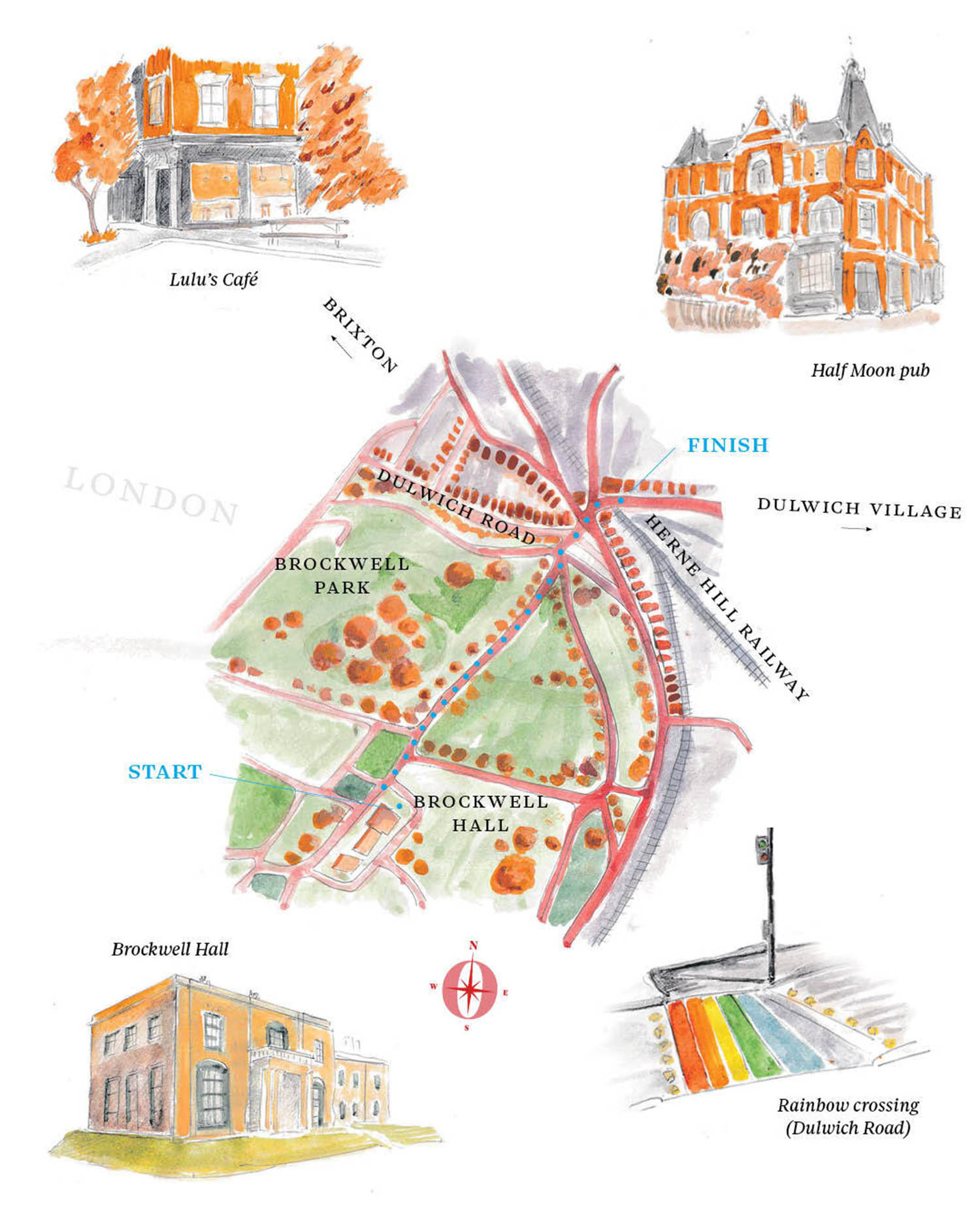
I meet them at Herne Hill station, whose facade appears, along with local landmarks such as the SE24 sign next to the railway bridge and the Brockwell Lido, in the first colouring book they made. They’d planned to take me to Lulu’s by the station for a coffee, but alas the trendy south London cafe is closed, so we get into our stride instead, heading towards Brockwell Park via the rainbow street crossing, which also appears in the book. All our lives changed in lockdown, and it was the endless walks with a pushchair and a coffee that first inspired their colouring project. “I feel very passionate about having screen-free options, especially as a family,” Barnett says.
That family too was hard-won. Barnett has been open about her struggle to conceive. The couple’s children, now seven and two, were born thanks to IVF, and she has been candid about her experiences with the pain of endometriosis and adenomyosis – in which cells from the lining of the womb start growing where they shouldn’t. “It’s a formidable foe to have inside your body,” she says.
But it doesn’t slow her down. “I’m very, very passionate about sightseeing, and finding new areas to visit,” she says as we head into the park. It was that passion that led to the project’s expansion. That very, very passionate nature can appear to make her husband take a bit of a back seat as we talk: she steps in for him forthrightly. “You’re bad at saying good things about yourself!” she admonishes, grinning. “But Jeremy is a natural-born creative and entrepreneur.”
‘I called my friend from our date and said, “I’ve met the one.” I was only 20’
‘I called my friend from our date and said, “I’ve met the one.” I was only 20’
Emma Barnett
The pair have been together for two decades, since meeting when they were both students at the University of Nottingham. “We’ve now crossed that boundary where we’ve been together for longer than we weren’t,” Weil says. “It’s almost impossible for me to remember life before Emma.”
Newsletters
Choose the newsletters you want to receive
View more
For information about how The Observer protects your data, read our Privacy Policy
I ask if they both knew right away that they’d met “the one”.
“He didn’t, I did,” Barnett says with a cheeky briskness. “And there’s proof of it, because I called my friend from our date and said, ‘I’ve met him’. I was only 20!”
Weil was born in Brooklyn but there’s no trace of the Big Apple in his voice. After university he went to business school. He worked for Deloitte before becoming chief product officer at the Economist Intelligence Unit, but now his product-based smarts are focused on Colour Your Streets. “I didn’t know how big a thing colouring was when we started,” he says. “We’ve been amazed by the breadth of it.”
Colouring really caught on after 2015, when Johanna Basford’s Secret Garden and Enchanted Forest books, with their intricate lines, swamped the bestseller charts. But don’t think this is a new phenomenon: people have been colouring in since the first days of the printing press.
The couple’s company provides more than just quality family time: there’s outreach too. “We’re about to do a major initiative with Magic Breakfast, who provide school meals,” Weil says. “We’re working with a number of schools in the local area: while [the children] have breakfast there can be a focused activity. We do things like put together kit bags for A&E departments.
“We always try and take part in anything like that that we can.”
On this December day, the sky is lowering and rain begins to patter down: Weil’s umbrella can’t quite keep it off Barnett’s distinctive spectacles, so we head up the hill to Brockwell Hall – yes, it’s also in the book – which was recently transformed from a crumbling pile into a community hub thanks to a national lottery grant. Neither Barnett nor Weil had yet visited the restoration: we can report it’s a delightful place, with tasty teas and beautiful paintings by Henry Strachey (1863-1940) originally commissioned for the county council.
‘BBC colleagues feel under attack, but they should feel proud of their work’
‘BBC colleagues feel under attack, but they should feel proud of their work’
Emma Barnett
Barnett says part of her love for London comes from still feeling like a tourist. She grew up in a Jewish family in Broughton Park, Salford; she is an only child. Fiercely driven from an early age (she was known as “Commitment Carol” at school because she signed up for absolutely everything), after Nottingham she did a journalism postgrad in Cardiff.
If there’s a guardedness about her when we speak, I’m not surprised. She’s used to being on the other side of the microphone, for one; and she’s had her fair share of slings and arrows. When she was in her early 20s her father was convicted of running brothels in Manchester; he served two and a half years in prison, and her mother received a suspended sentence for money laundering.
She is unfazed when I ask her what it’s been like to slot herself into an institution like the Today programme. Despite some reports of friction between herself and her fellow presenters, her reply is smooth: “I feel I was asked to do it as me, and that hasn’t changed. At no point have I been told not to be who I am.”
She appreciates the way her podcast gives her a chance to stretch her legs and speak to listeners (“I really love listeners, and I love connecting to them and talking to them,” she says) in a more nuanced way. In news interviews her strengths, of reflection and effective listening, are apparent in her conversations with, say, Nazanin Zaghari-Ratcliffe after she was released from an Iranian prison in 2022; or Caroline Darian, the daughter of Dominique and Gisèle Pelicot.
But she has not always had an easy ride. An interview with Jeremy Corbyn on Woman’s Hour in 2017 in which she came after him for figures on childcare costs – which he could not produce – resulted in so much online abuse that Corbyn himself came to her defence. Some of that abuse was antisemitic: again, Barnett will tough that out. “I’ve never wanted to lose the joy in being a Jew,” she says. She’s stopped looking at posts on X.
Barnett says she’s more comfortable about being publicly Jewish than her husband is, but then she lives her life much more in the public eye. Yet he too tries to shrug off the ever more visible prejudice. (A report commissioned in July by the Board of Deputies of British Jews described an “onslaught of antisemitism” since the 7 October Hamas attack on Israel, and some Jewish organisations in Europe have described rises of more than 400% in antisemitic incidents.) “Obviously it matters that people are antisemitic, that people have hatred,” Weil says. “But you just have to live your life, manage your life, and try to cut out that voice.”
A dog snuffles under our table in Brockwell Hall; the comforting surroundings are at odds with the tenor of our talk. Barnett conducted the first broadcast interview with Yoni Finlay, who survived the horrific October attack at Heaton Park synagogue in Crumpsall, Manchester, on the morning of Yom Kippur. Jihad al-Shamie drove his car at worshippers standing outside and attacked others with a knife before attempting to storm the building. Finlay was shot, accidentally, by police as they tried to subdue Shamie.
This horror had a particular resonance for Barnett – Heaton Park was the shul she attended growing up. “I’d wanted to walk down the aisle there when I was a little girl,” she says. “But to be honest, I go into journalism mode. I want to do the best job by Yoni, and I want to take him through the story properly.”
Despite her discipline, the story shocked her. “I hadn’t quite taken in that the bullet fired by the police is thought to have gone through the attacker’s body, ultimately taking him down through the synagogue door, which Yoni was barricading with another man, Adrian Daulby. It went through Yoni’s body, the attacker’s body, and into Adrian Daulby behind.”
Daulby, 53, was killed, along with Melvin Cravitz, 66. “I was also very struck by his telling me that this was his first personal experience of antisemitism,” Barnett says, a little wonder in her voice. “So his very first experience of antisemitism is of a knife-wielding attacker on the steps of synagogue on the holiest day of the Jewish calendar.” The repetition attests to her sorrow and astonishment.
Journalism mode, however, offers useful armour for many situations. She won’t be drawn when I ask what it’s like to work at the BBC at a time when the institution seems particularly embattled. Its head of news, Deborah Turness, and director general, Tim Davie, recently stepped down after Michael Prescott, formerly an external adviser to the BBC’s editorial guidelines and standards committee, delivered a long memo outlining claims of bias at the organisation – and then there’s the president of the US threatening to sue the Beeb for a billion dollars over the way a section of his 6 January 2021 speech was edited in a Panorama documentary.
“Of course, when people leave an organisation that changes things, it’s very dramatic,” Barnett allows, but tells me that her position as a presenter puts her in a fairly unusual position. “I’m not in the building a lot of the time when other people are in” – her alarm wakes her at 3.21am to get in for Today – “and if I’m in the building, I’m usually in a live broadcast studio.”
She doesn’t feel she can say what the mood is, generally: “I don’t think I’m representative.” But absolutely, “people have felt very much under duress. They felt under attack. They also should feel very proud of a lot of the work they do.” The BBC, she points out, is in a unique position: being the subject of scrutiny while it also scrutinises itself. “The story of the BBC is also one we have to cover, so I do feel removed from it, almost by definition.”
It’s a long way from colouring books – no wonder both she and Weil want to engage with something away from the rigours and controversies of the news. We’re all glad too to get a breath of air again as we finish our tea. It’s nearly dark now, the tree-lined path in Brockwell Park that is one of their favourite family spots hides in the gloaming, but they both assure me of its canopied beauty in summer.
We would have stopped for a swift half in The Half Moon, a gingerbread Grade II-listed pub that beckons invitingly, but childcare duties call for the pair. It’s clear how content they are in each other’s company. “He makes me laugh,” Barnett says simply. They stride off arm in arm, walking past their beloved landmarks toward home.
Illustration by Ellie Wintour