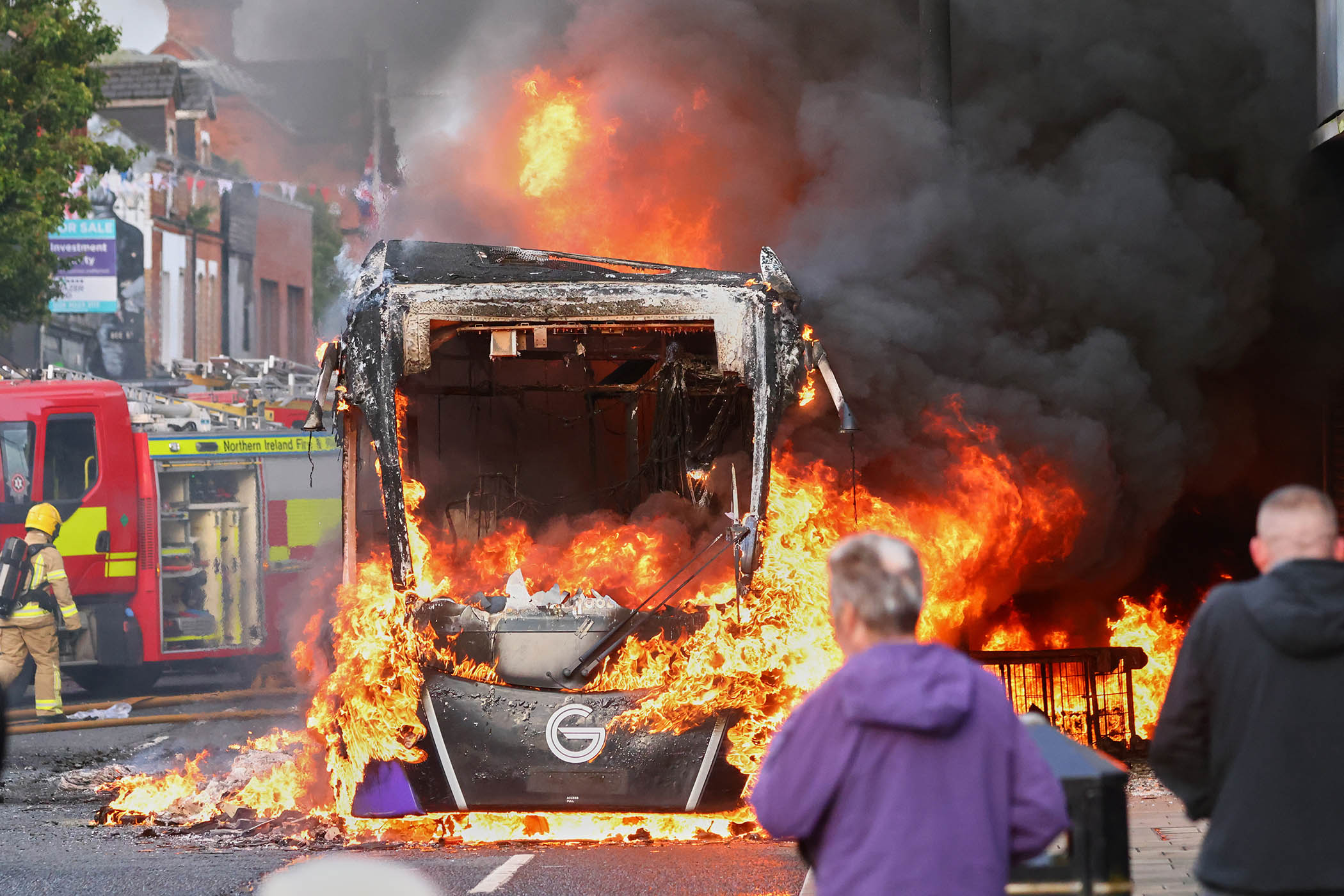

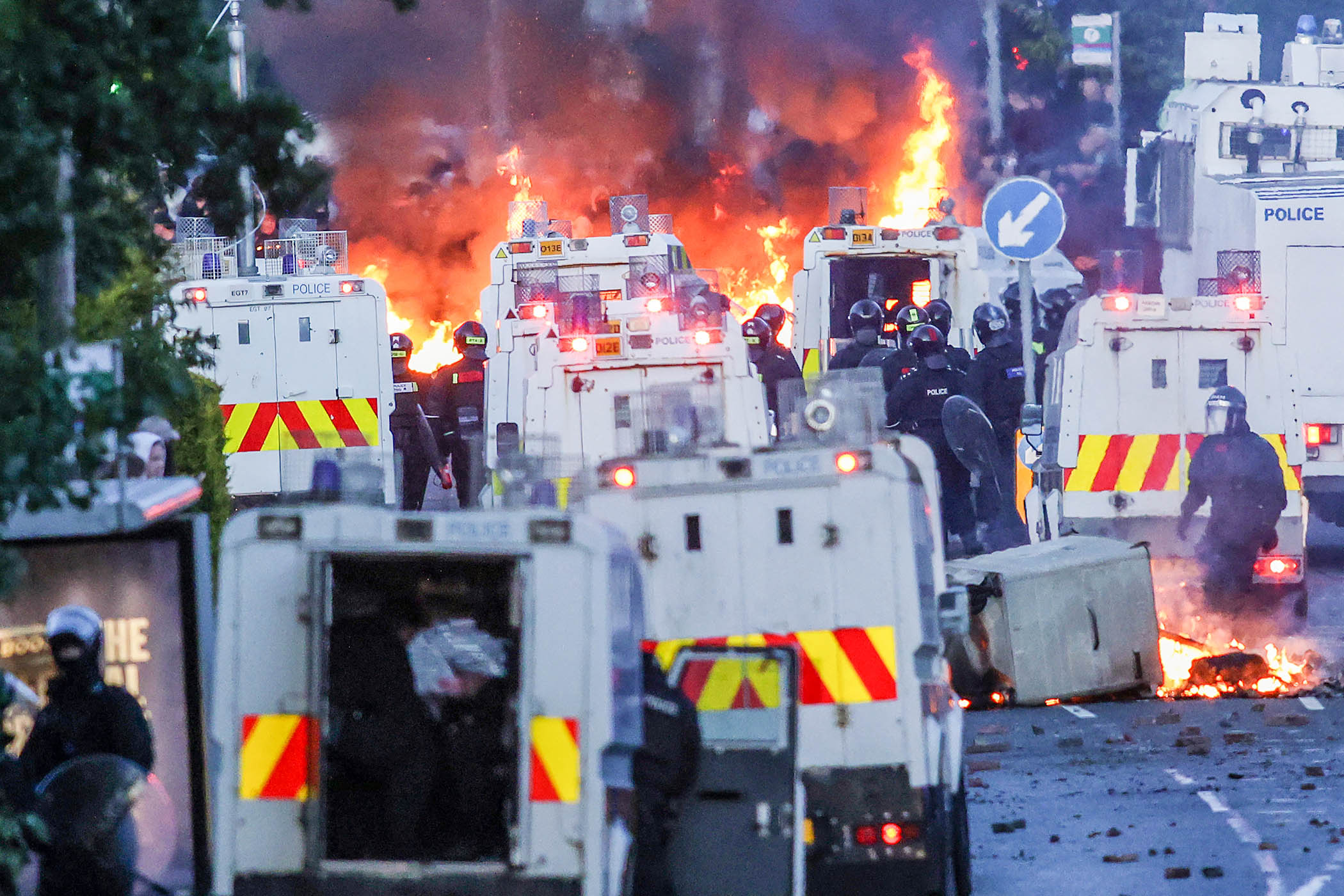
There were no protests happening in Belfast last week. What Belfast saw last week were not protests but an outbreak of racist riots. Crowds of young men wearing balaclavas gathered across the city burning cars, buses, houses. To check the ethnicity of motorists, some of these men set up checkpoints in interface areas – which divide Catholic and Protestant neighbourhoods – one of which is at the end of the street where I grew up.
The city came to a standstill, the centre a ghost town with shops closed and workers sent home. A Ugandan nurse escaped her home with only her passport and work uniform, her letters from her children destroyed inside. All public transport was cancelled after rioters set fire to a Glider bus, of which there are about 30, each costing the taxpayer more than £700,000. Graffiti appeared around Belfast reading “KKK” and “whites only”, featuring swastikas and target signs. Houses were burned, in what has been described as a pogrom.
Chris Donnelly, principal of St John the Baptist primary school in west Belfast, published an open letter on behalf of the school community, reporting emptier classrooms because the parents of minority-ethnic children were too frightened to send them to school. “It’s a very worrying time, to be honest,” he told The Observer.
He said another local principal was making up a food parcel to be delivered to a pupil’s family in a predominantly loyalist area. They were the only family of colour living on the street, and the parents were too afraid to leave the house. “It’s truly sickening to see,” Donnelly said. “This is now an established pattern on an annual basis here, and there is no sign that the wider climate is changing for the better.”
Elements within the British right have said last week’s riots in Belfast, which followed a knife attack for which a Sudanese man has been charged with attempted murder, were the same as riots in Southampton or Epping. In the US, a Fox News host claimed the rioters just wanted to be Irish and “wanted Ireland back”, misunderstanding that the rioters themselves would be horrified by this characterisation. What most mainstream news coverage of the unrest in Belfast this week has missed is that violence erupted almost exclusively in loyalist areas of the city. As an X account called Ulster News put it, the violence in Belfast was “not committed by anyone who would consider themselves Irish”, because Republicans “are leftists & support mass migration”. Loyalist paramilitaries have denied orchestrating the riots but are also refusing to stop them.
“Loyalists are always angry,” says Gemma McSherry, a writer from Newtownards. “This type of violence is grounded in loyalism and has been happening in Northern Ireland for generations. Violence in these communities is seen as entertainment, and the PSNI [Police Service of Northern Ireland] do virtually nothing to prevent it, so these loyalist leaders and organisers know they have a mandate to do as they please.” McSherry draws a through-line from deprivation in loyalist estates, like the one where she spent much of her childhood, and a kind of recreational outpouring of violence. “What we are seeing here is the coming together of generations of violence combined with new means of recruiting – social media, far-right rhetoric, misinformation. But the target remains the same: young boys who want to feel like big men because their futures, or lack thereof, have been set in stone since before they were born,” she says.
“I think we need to remember that the ‘far right’, as we’re now calling it online, has always existed in this form in Northern Ireland.”
This sometimes ignored, highly local context makes things difficult for those looking to exploit Belfast’s violence for political gain by characterising it as genuine anger, or anything approaching real concern, over immigration. In March 2026, only 2,379 people were receiving asylum support across the entirety of Northern Ireland – just under 2.5% of the total UK figure. Of all 10,468 people arrested in Northern Ireland in 2024/25, 92% were white and 5.7% were from a minority-ethnic background.
The far-right narrative, whipped up by figures such as Elon Musk and Tommy Robinson, who have no understanding of Northern Ireland’s context, say Belfast is becoming more violent because of immigration. This, too, is a narrative complicated by the fact that violent crime is embedded into the fabric of Northern Ireland, even outside the context of the Troubles. Thirty women have been murdered since 2020 – beaten, burned, run over. In one case a woman was attacked with a crossbow. Recent PSNI figures reveal there have been more than 100 attempted murders involving stabbings in Northern Ireland over the past five years. None of these violent crimes has resulted in unrest.
But violence against those perceived to be “alien” is not new to Belfast. It happened when the city was even less ethnically diverse than it is today. In 2001 Catholic schoolgirls from Holy Cross primary school were attacked by loyalist mobs while walking to school through a segregated area. In 1969 loyalists burned almost all of the houses inhabited by Catholics on Bombay Street, and left 1,500 people homeless. From 1920 to 1922 loyalists burned Catholics and leftwing Protestants out of their neighbourhoods, leaving 23,000 people homeless, in what became known locally as the Belfast Pogroms.
Newsletters
Choose the newsletters you want to receive
View more
For information about how The Observer protects your data, read our Privacy Policy
There has been no Cobra meeting in response to last week’s violence – no vigil, no visit from Keir Starmer or any other high-ranking British politician. Journalists dispatched to working-class communities will leave, and the far-right internet personalities will move on, too. Local communities have been left with the task of rebuilding trust and protecting their neighbours. Gerry Carroll, a legislative assembly member for the People Before Profit party, has been out in some of those communities with antiracism organisations,reaching out to immigrant neighbours. “Obviously, people are extremely anxious,” he says.
“Unfortunately, this kind of rhetoric has been bubbling for the past few years, in particular among the far right and certain loyalist organisations promoting really rancid, fascistic views. It’s been building for a while.” He points out that although police were warned months ago about far-right organisations targeting addresses in Belfast, they took no action to prevent the disorder of the last few nights, which was “reminiscent of 1969 for many people”. Instead, community groups and youth clubs have been arranging transport and helping with supplies. “It’s an incredibly brave thing to do, but this is something the state should have been doing,” Carroll says. “It’s these people who are on the frontline preventing the disorder, not the PSNI. That’s an incredible testament to the spirit of people in this city.”
On Thursday night the streets of Belfast were relatively quiet, but with marching season just around the corner, nobody is under any illusion that trouble will dissipate entirely. “There’s a real concern that come summer, come July, things will heat up again,” Carroll says. “And it will become unbearable for our migrant and minority population.”
Photograph by Peter Morrison/AP Photo