
A manifesto for childhood
An extract from A British Childhood: How Our Children Live Now by Frank Cottrell-Boyce
I can’t tell you exactly when British childhood changed. But I can tell you where and when I noticed. I was in a primary school in Liverpool a few years ago, towards the end of the summer term. When I arrived, a pair of impeccably polite year 6 reading ambassadors gave me a guided tour that ended at the head’s office. The head then gave me a list of warnings about my day at the school – the kids were excited, possibly overexcited. There was an autistic boy who could sometimes be disruptive. There was a girl who was hard of hearing, so would I mind wearing a device around my neck that connected with her hearing aid? One of the children had lost a parent in tragic circumstances, so… maybe don’t talk about death and destruction.
Briefings like this remind me that children who, in my day, would have been pushed to the side, or bullied, are now given more respect and seen as individuals with lives beyond the classroom. They make me feel that, in many ways, their world has got better. And then the head spoke again. “Oh. And maybe don’t go on about the summer holidays. They hate them.” Say again? “They don’t like the summer holidays.”
I’d often been warned about making too much of Christmas. A lot of the kids will not be getting presents, and some of the children celebrate Eid or Hanukah rather than Christmas. I also, of course, knew that, for lots of kids, summer did not mean holidays. From my teens until well into my 20s, I’d worked on summer play schemes. My own kids, too, worked on summer camps for Barnardo’s or Edmund Rice.
I said that I knew summer could be difficult for busy parents juggling childcare and jobs. “Yeah. It’s not that. It’s that they miss school.” They miss school? “School is where our kids feel secure. It’s where they’re fed. It’s their happy place. They don’t like the summer.” I’ve heard this on many school visits since. I’ve heard it so many times, in fact, that no one needs to say it any more.
Summer is the stage on which our adventures played out. Summer is freedom’s playlist. Here Comes the Sun. Here Comes the Summer. School’s Out. Summer in the City. School is prison. Or so I had always thought.
Is this partly why Harry Potter, Percy Jackson and Amari and the Night Brothers are so beloved? Because they present school as a refuge, a place of nurture? How had I not noticed that until now?
Summer is a story that we’ve told for centuries. Is that story over?
______________________________
‘It’s like the future isn’t on the agenda at all’
Interview by Tim Adams
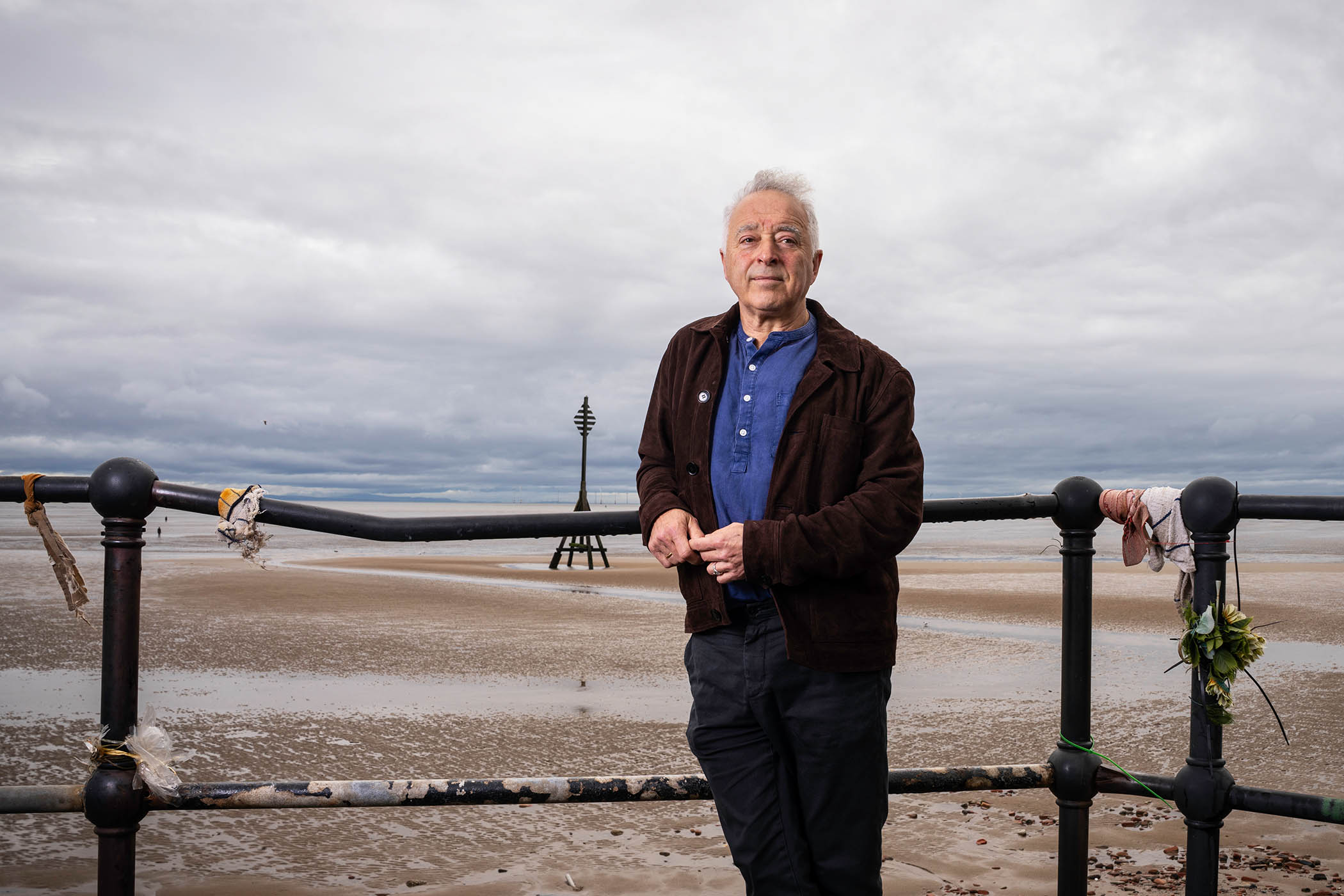
Like a figure from a nursery rhyme, Frank Cottrell-Boyce has seven children and seven grandchildren, three of them born this year. His passion for infant development, therefore, explored in his urgent and heartfelt new book, A British Childhood: How Our Children Live Now, always feels close to home. There is a wonderful moment early on in that book when all his hunches and instincts about the intangible things he has devoted his life to – family and storytelling and human connection – are given rigorous scientific grounding.
It comes when he visits the University of East London’s baby development lab and meets Sam Wass, director of the Institute for the Science of Early Years and Youth. The professor works in a place of “monitors and computers but also babies and toys”. Cottrell-Boyce has gone to the lab to find out exactly what happens in a baby’s brain when it is read to by a parent.
“Think about it,” Wass says of the wide-eyed, newborn subjects of his study. “A few days or weeks ago, you were an aquatic creature, and now, all of a sudden, you are in east London. Where do you even begin to make sense of that?” One crucial place, his research suggests, is during the hours in which a beloved voice takes that infant brain through a familiar set of sounds and images, turning the pages of a book, one by one.
“Life comes at the baby at incredible velocity, but when Mum reads a picture book, it all slows down,” Wass says. When he wires up a baby and her mother to a brain scanner at story time, Cottrell-Boyce can observe that marvellous fact on a monitor in real time.
“I watched the baby’s ‘messy brain’ tune in to the calmer more relaxed brain activity of her mother,” Cottrell-Boyce writes. “The mother’s voice was a signal shining out over her baby’s storm-tossed brainwaves, bringing her into a safer harbour.” The pathways laid down in those habitual minutes and hours of security and shared wonder can last a lifetime, the research suggests. They give the child’s brain the tools and structures to start making sense of the world – the wheels on the bus go round and round – a gift that never leaves them. Cottrell-Boyce writes beautifully of parents “night by night building a new destiny for their children” just by whispering the same rhymes, singing the same songs.

Frank Cottrell-Boyce has written a dozen novels for children
When we speak in person, Cottrell-Boyce describes to me the “absolutely transcendental” nature of that moment in the lab. “Baby neuroscience is itself in its infancy,” he says. “It’s hard to measure baby reactions, so it’s a remarkable thing to see.” It has, he says, made his recent months with three new grandchildren even more thrilling. “Just looking at them through that lens. I mean, that’s the really happy side of it.”
As he sets out in his book, there are – sadly – plenty of other less happy facts that have emerged in studies of child development in recent years. The most heartbreaking one, in some ways, is the fact that more than half of children are not read to daily by a parent or carer, a proportion that has fallen from 69% in 2013; 28% now arrive at school “unable to handle a book”.
“[Those children] had no idea how books worked,” Cottrell-Boyce says. “They were trying to swipe pages or tap on illustrations.” Sociologists have a term for the difference between those children who come to reception year having been read to and those who have not. They call it “the million word gap”. “If you first encounter a book when snuggled up on a couch or in a bed with someone you love,” Cottrell-Boyce writes, “you have a massive advantage over children whose first encounter with a book is in school – where they are being asked to decode it.”
Cottrell-Boyce – the author of a dozen novels for children as well as film scripts as different as 24 Hour Party People and The Railway Man – has long been a campaigner on these issues. His two years as Waterstones children’s laureate end next month. He has used that time to do all he can to try to get politicians and parents to wake up to that reading divide and begin to reverse it. His new book is made up of field notes – “mostly written on trains and in Premier Inns” – from those two years during which, along with BookTrust, the charity that appointed him to the laureate role, he has led the campaign called Reading Rights.
It has been a profoundly eye-opening odyssey, he says. What he has witnessed up close, and across the country, is a cohort of children who have been undone in different ways by the triple shocks of the last decade or more: austerity and Covid, and the addictive habits of social media.
As he sets out in that introductory passage of his book quoted above, those shocks have led in the majority of cases to a radically changed reality for many British children – one that he would hardly recognise from his own childhood in Liverpool. The stretched resources of schools have become the only reliable structure in a life that is less outdoorsy, less playful, less creative, and in which time-poor and resource-poor parents in desperation outsource care to “smart” screens, where all sorts of grownup dangers lurk.
Those children had no idea how books worked. They were trying to swipe pages or tap on illustrations
Those children had no idea how books worked. They were trying to swipe pages or tap on illustrations
If he has a catch-all word for how we have, as a society, tended to treat that generation of children now at school it is simply “carelessness”. “We’ve let them flip into that digital world without question. It was the same with austerity: we allowed all kinds of buildings and safe spaces to close that really affected children, without there ever being any proper national debate about the fact that shutting libraries and Sure Starts and youth clubs was always going to affect children first and foremost.” The carelessness, he suggests, lies in every older generation feeling that their problems are more important than anyone else’s.
Some of the anecdotal evidence he has gained from teachers about the effects of these changes, particularly post-Covid, should give all of us pause. One teacher highlighted the new reluctance of young children to sing; others lament the fact that they have become social workers and toilet trainers, and clothes washers and dental hygienists and breakfast makers. Many of these problems – this carelessness – is down to the grind of what Cottrell-Boyce calls “all the hyphenated poverties that have appeared in the past 10 years or so”: food-poverty, hygiene-poverty, housing-poverty.
“The most invisible of these is probably furniture-poverty,” he says. He has been volunteering with the charity Time for Bed, which donates beds to homes that can’t afford them. It is all very well for him to go around preaching the virtues of reading to children, he suggests: but how do you explain the importance of a bedtime story to a family who don’t have a bed? (Time for Bed gave out 582 bed bundles just in Merseyside last year.)
All these problems have been exacerbated, he suggests, by the way that unregulated social media has invaded every aspect of our lives. “There’s all kinds of research about what the digital world does to us,” Cottrell-Boyce says. “But the big thing it does is make us preoccupied. Everybody claims to be multitasking, but that’s nonsense. The digital world pulls us out of the present – which is where children need us to be.”
When I ask him how he has managed to avoid those distractions himself, he holds up an old brick of a mobile phone, one with no apps beyond a torch.
He welcomes the Online Safety Act and the steps that the government is belatedly taking to try to hold the tech billionaires responsible for the unchecked flood of unsuitable content that invades childhood imaginations. He partly agrees with the campaigner Jonathan Haidt that the mental health crisis in children and teenagers is a result of their being “overprotected in the real world and underprotected online, or not protected at all online”. But the fact is, Cottrell-Boyce suggests, as a generation: '“I don’t think they’ve been well looked after in the real world either.” He likes to quote the comment that Alexei Sayle made on the political argument for austerity: a policy based on the idea that “the global financial crash of 2008 was caused by there being too many libraries in Wolverhampton”.
If all this sounds like a handbook of despair, there are many natural reading highs in Cottrell-Boyce’s book and in his worldview. He is after all the man who scripted two of the great cultural moments of our lives: the 2012 Olympic opening ceremony and the Queen’s tea party with Paddington (and what’s not to love, for example, about a man who can make a convincing argument that John Lennon was consciously channelling the “Outlaw” spirit of Just William).
Cottrell-Boyce’s father was an English teacher; one of his earliest memories is leaving the two-bedroom flat just off the Dock Road in Liverpool that he shared with his mum and dad, his “formidable gran” and his brother, and being taken to the local library. He can remember the warmth and the smell of entering the world of Where the Wild Things Are there – and he still finds those epiphanies everywhere in the schools and community groups and institutions he visits.
He tells the story of a young man in Liverpool prison in Walton who described the novelty of being read a story as “the only time I ever felt alert without being in danger” – a quote to make grown men cry. At moments such as this, and when he sees those teachers who never give up “looking for that thing that makes a child’s eyes sparkle”, he – and his readers – may be tempted to believe that “the world might just be saved with a copy of The Very Hungry Caterpillar and a Pritt stick.”
Newsletters
Choose the newsletters you want to receive
View more
For information about how The Observer protects your data, read our Privacy Policy
Cottrell-Boyce’s dealings with often well-meaning government tend to bring him back to earth. His lobbying experience for these issues, he says, “is very much like dealing with Hollywood studios: you find someone who loves your movie and your script, and the next time you look, they have gone, and you’ve got to sell your story to someone else”.
When we speak, he’s just come back from appearing at a Department for Education cross-party inquiry into the collapse in figures for adults reading for pleasure. “It’s fixable,” he suggests, but he’s not holding out that much hope for top-down interventions.
Reading his book – and hearing about the litany of inspiring local, site-specific initiatives that, given resources, may keep successive childhood imaginations alive – you sense a great gap in our politics. It’s the absence of a manifesto that would start with a promise to give all our children not only the right to read, but the right to draw, to learn an instrument, to have safe spaces to play and explore – and which would recognise how those rights are rooted in the more fundamental rights to a decent, stable home and food on the table, and protection from harm, and a good story at night. Then the discussion about how best to get there could begin.
The author is impressed by the commitment of many politicians, but when he looks at the Labour leadership wrangle – and the Makerfield byelection – he suggests: “It’s like the future isn’t on the agenda at all. I’ve kept saying this for the last couple of years, but for me, the future has got names. The future has got all these names. And they are the names of our children, and our children’s children, and when you’re watching them grow up, you’re watching the future get closer. The velocity of it is astonishing. How are we not talking about it?”
A British Childhood: How Our Children Live Now is published by Picador (£14.99). Order a copy from The Observer Shop for £13.49 (10% off RRP). Delivery charges may apply
Portraits by Antonio Olmos for The Observer