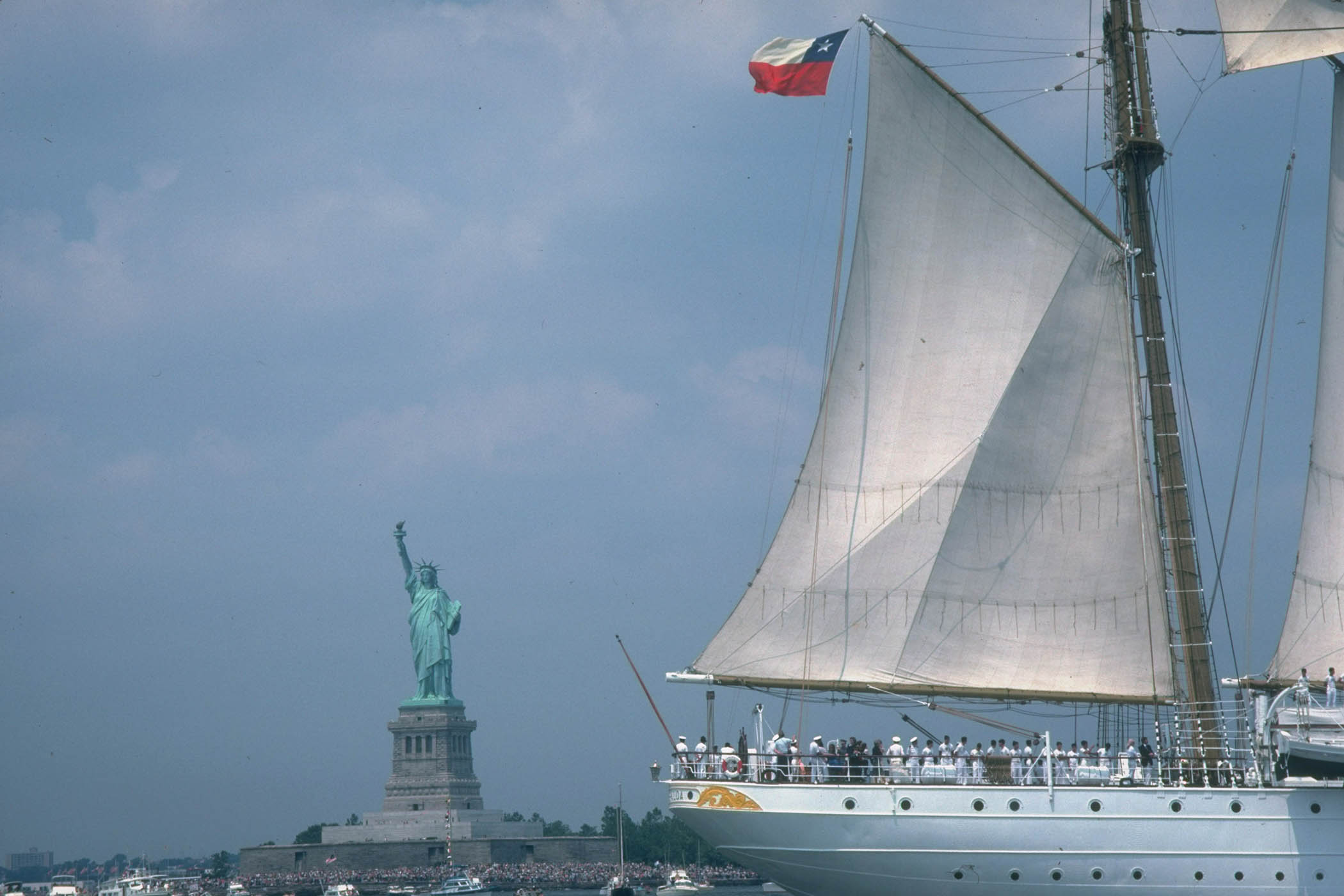

The summer of 1976: America’s bicentennial. It was everywhere, the celebration, the red, white and blue: and even at the age of eight I was aware of how vast, how universal, the party was. From the windows of my parents’ apartment on the far west of Manhattan island, we could see all the way down to the harbour, and all the way across to the Jersey shore – a perfect vantage point from which to see the tall ships as they processed up the Hudson to mark the Fourth of July.
Fifty years have passed: America marks another milestone birthday today. It is not partisan to say that the way the two events have been commemorated could not have been more different. The first was largely unifying, a demonstration that even a country in trouble – post-Vietnam, in the midst of an oil crisis – could come together; this year’s events are a damp squib, ruthlessly politicised so that genuine acts of commemoration look like resistance.
Operation Sail in 1976 was the brainchild of Frank Braynard, who had once been programme director at the South Street Seaport Museum. By the time the summer of the bicentennial rolled around, Braynard had been planning the event for nearly three years, scouring the seven seas for the great square-riggers that had, by then, been turned into training vessels. Sagres from Portugal, a three-masted barque with a red Maltese cross on its sails; the Christian Radich from Norway with its 38metre main mast; Ara Libertad from Argentina, carrying 2,650 sq metres of sail; not to mention the US Coast Guard’s Eagle and – Braynard’s great prize – Amerigo Vespucci, the Italian 101metre steel frigate.
“I fought to get her for eight months,” he told the New York Times. “She’s one of the greatest ships in the world.”
Plenty of people thought Operation Sail would be a flop, or worse. With 5 million people and 20,000 pleasure craft expected in the harbour – on top of the 200 “tall ships” themselves – logistics were a nightmare. And aside from a downbeat vibe on the national stage in the 1970s, New York City itself was in big trouble. Just the year before, New York officially went broke. Firehouses were shuttered, teachers went on strike and garbage piled up in the streets. I remember the garbage. I remember Central Park as run down, all browning grass and busted-up playgrounds. Periodically, along the broad and glittering river, arsonists would torch the old wooden piers that poked out into the water, turning them into twisted black skeletons: Pier 50 in 1973, the West 11th Street pier a few years later. Federal assistance was requested but none was forthcoming: President Gerald Ford, a Republican, had very little tolerance for what he and his administration saw as the city’s profligacy: “Ford to City: Drop Dead” ran the famous headline in the New York Daily News. Who was in the mood to party?
And yet there was a party, and the sense of excitement was real. My parents and I didn’t join the crowds thronged down by the river’s edge because we didn’t have to: the great ships with their bellied sails – “Quick! take the wings of the morning, or the sails of a ship, and fly to the uttermost parts of the earth” wrote Herman Melville in White-Jacket – seemed to be en promenade right under our noses as they cruised upriver from the Verrazzano‐Narrows Bridge to the Spuyten Duyvil in the Bronx. Something else I remember: my own excitement, my parents’ excitement. At eight, I had no inkling of the afflictions of the country – I was very fortunate in that regard – but I knew optimism and joy, and I remember how those qualities permeated the day, and how we wondered at the beauty of the vessels processing upriver, history brought to life.
So imagine my surprise when, just a week or so ago, I discovered that – wouldn’t you know? – the tall ships were coming back to New York. Yes, the Ara Libertad, the Sagres, the Amerigo Vespucci too, all headed back to the Hudson for Sail4th: 250, “the greatest celebration in our nation’s history,” according to the website. Perhaps throngs will crowd the shores of New York and New Jersey, despite the searing heat. But when I talk to my friends in New York, I’m not convinced. A deeply plugged-in journalist pal had no idea the event was on the cards; I asked another friend, equally well-connected to the city’s goings-on, whether there was a swelling sense of excitement around Sail4th: 250. “If the Knicks aren’t involved, then no,” he told me bluntly.
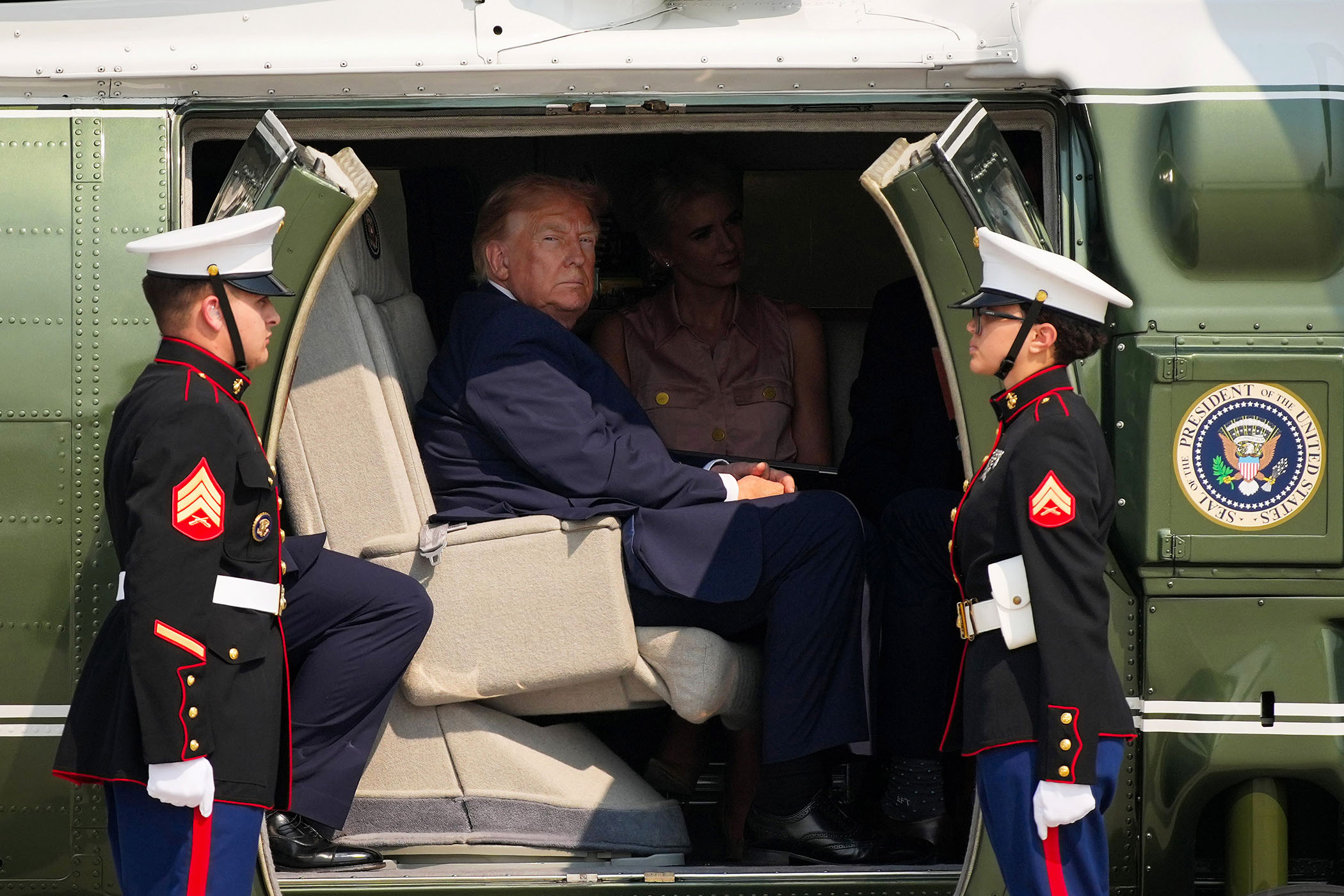
At a kickoff event at the end of last month, the president barely mentioned the country or its history
At a kickoff event at the end of last month, the president barely mentioned the country or its history
No doubt many factors contribute to the muting of anticipation around an event such as this. A changed media landscape, for one, in which many more distractions (Taylor Swift’s wedding, anyone?) clamour for attention. But more significant is that the United States has become a personalist regime. Its leader, the 47th president of the United States, seeks not to celebrate his country, or the future of American democracy, but himself.
Let’s ignore, for the time being, the UFC Freedom 250 – the ultimate fighting championship held in the White House grounds on his 80th birthday, which transformed the Ellipse from a graceful lawn into a churned-up expanse of barren dirt; the disastrous and costly efforts to turn the Lincoln Memorial Reflecting Pool a shade of Mar-a-Lago blue; let’s even ignore the gold-lettered plaques on the walkway linking the West Wing to the White House residence, on which President Trump summarised each of the 47 US presidencies: his commentary rife with lies and slander.

Better just to consider the Great American State Fair being held on the National Mall to celebrate the nation’s semiquincentennial. In the run-up to what was supposed to be a national celebration, invited musical acts – including Young MC, Martina McBride and the Commodores – withdrew. You know you’re in trouble when Milli Vanilli won’t play. A number of the nation’s great states declined to represent themselves. At a kickoff event at the end of last month, the president barely mentioned the country or its history, instead harping on about his usual obsessions: mass deportations, tough border enforcement, the elimination of diversity, equity and inclusion programmes across the government. Reports from the Mall indicate that there is hardly anyone in attendance. Even Fox News can’t pretend otherwise.
Newsletters
Choose the newsletters you want to receive
View more
For information about how The Observer protects your data, read our Privacy Policy
It’s not just that I haven’t seen much coverage of the tall ships returning to New York: it has been widely noted that while 1976 provoked a bonanza of bipartisan nostalgia and patriotically themed episodes of sitcoms (Maude and The Bob Newhart Show, I’m looking at you) there’s a kind of yawning silence this time around, leaving Larry David – with Life, Larry and the Pursuit of Unhappiness, a seven-part historical parody – to fill the gap with his dyspeptic humour.
I was sorry I wasn’t in New York to see the Knicks take the championship last month. Like so many of my countrymen, I don’t give a damn, this year, about the Fourth of July. But as a kid – that eight-year-old who watched those gorgeous ships sail on by – I learned in school that things don’t end well for tyrants, and I’ll remember that, too.
Erica Wagner’s latest novel, Wash, is published by Salt
Photograph by Beatriz Schiller/Getty Images