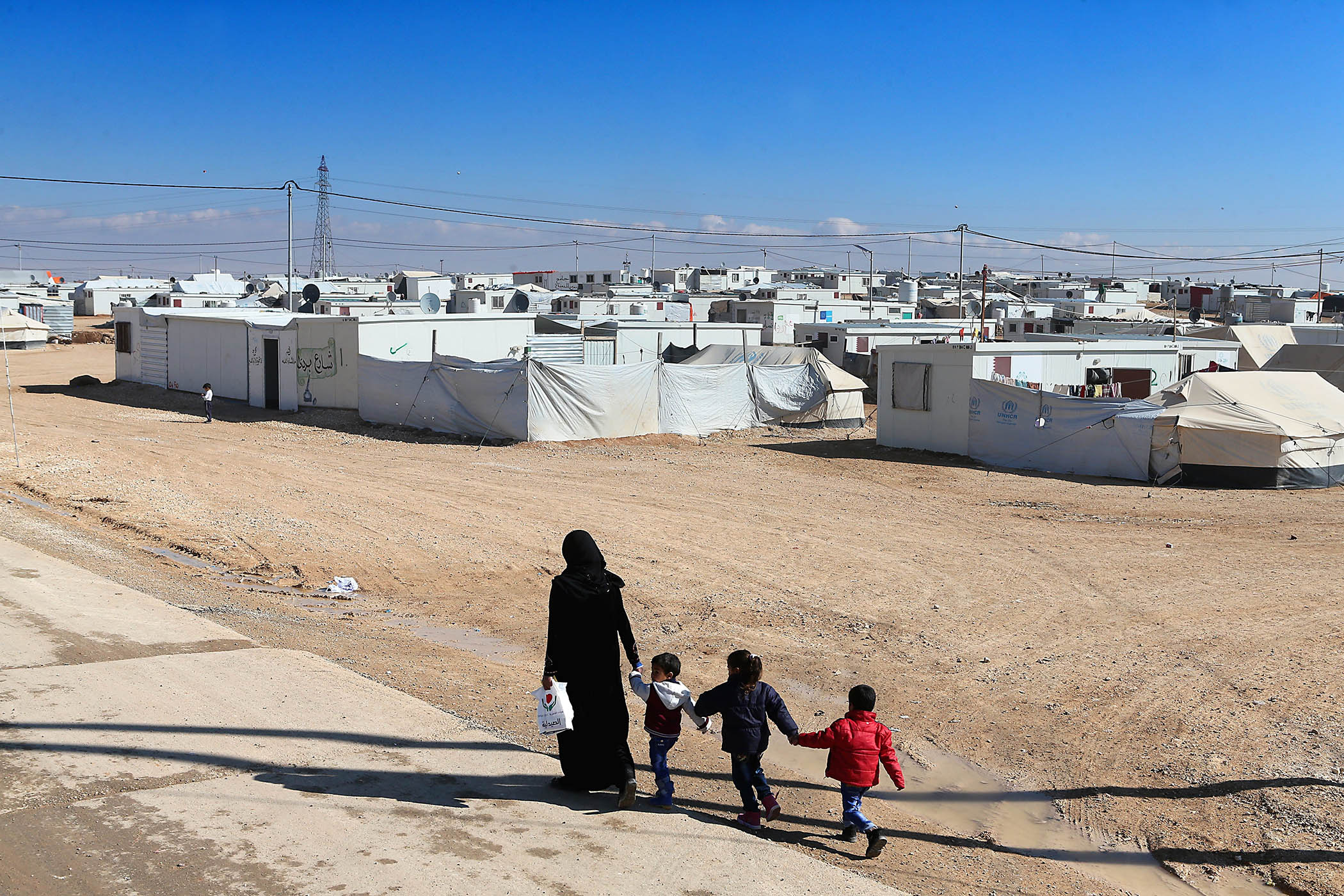



I set off to Jordan in August 2012 in my role as Britain’s international development secretary with the words of anxious British officials ringing in my ears as an impending disaster loomed in Syria.
Over the border from Syria and into Jordan, Syrian refugees were pouring into the small camp at Zaatari, some of whom had been shot at for target practice by Syrian soldiers.
I was horrified by the stories I heard and impressed by the young Australian UN official who was tasked with setting up the camp on behalf of the international community. Britain was determined to help relieve this impending humanitarian crisis and Zaatari is now one of the biggest refugee camps in the world. When I returned as the British deputy foreign secretary 10 years later, the camp resembled a city with permanent structures.
By then the Assad regime had butchered its way ahead, causing literally half of its citizens to flee their homes, with more than 5 million in camps such as Zaatari, more than 5 million internally displaced in Syria, and 1 million heading towards Europe and across the Mediterranean. Meanwhile, the Assad regime – supported by Russians and Iranians – massacred anyone who was perceived as unsupportive. Chemical weapons were used against its own people.
Eventually the regime collapsed and the Assads along with their Russian and Iranian comrades fled the country.
Over the years, much has been unearthed about the extent of the horrors and their chief architects. What is less well known is the complicity of the first lady, Asma al-Assad, who was at the centre of Syrian power.
As revealed by The Observer last week, the first lady was instrumental in the regime’s atrocities. Even more alarming was that she did so under the guise of being a humanitarian actor.
This brings us to the question of accountability. It is universally accepted in the west that President Assad must be brought to justice for egregious crimes against humanity. However, because Syria was never a signatory to the international criminal court (ICC), the world shrugged its shoulders at the fact that it had no jurisdiction over Syrian perpetrators.
In contrast, Mrs Assad is a British national and eligible for prosecution before the ICC or indeed a British court (under universal jurisdiction laws). In fact, the Metropolitan police’s war crimes unit compiled a dossier of Mrs Assad’s alleged crimes and submitted it to the Crown Prosecution Service, only to have it thrown out on the basis that she is unlikely to set foot in the UK again.
That is no reason for a prosecutorial authority to reject it. It is an incredibly cynical and short-sighted position to take. Unfortunately, the UK doesn’t have a great record on prosecuting war criminals. With the exception of one Nazi criminal who, under Mrs Thatcher’s edict, the UK pursued vigorously; other prosecutable international crimes have disappeared under the radar.
Newsletters
Choose the newsletters you want to receive
View more
For information about how The Observer protects your data, read our Privacy Policy
Over the past 10 years I have campaigned vigorously but ineffectively to bring alleged Rwandan war criminals to justice for their role in the 1994 genocide against the Tutsis. Sadly, there has been precious little movement in the UK since 2015.
When it comes to Mrs Assad, we have the legal means and ways to do it if we deem it a priority. We would be using extradition treaties, lobbying the ICC, and exploring every avenue to ensure that justice is served.
There is no real political will to force the authorities’ hands – no Mrs Thatcher breathing down their necks
There is no real political will to force the authorities’ hands – no Mrs Thatcher breathing down their necks
The problem for the UK is not legal or structural – it is political will.
Over the past 20 years, the war crimes unit has been degraded and understaffed. There is no real political will to force the authorities’ hands – no Mrs Thatcher breathing down their necks.
That is the paradox. Political determination these days is defined by public opinion. If in doubt, ask yourself this: if the prime minister of Israel was of British background, what would be the public’s response? I guarantee there would be a forceful clamour to criminalise him at any cost, even though Israel’s actions do not come close to the brutality of the Syrian regime.
Mrs Assad operated at the heart of an evil junta hell bent on control and oppression which it pursued relentlessly and with no mercy. She was complicit. If we don’t have the will to hold her to account, we may as well pack in our alleged commitment to international justice.
We must face up to the fact that we are failing in our basic and profoundly important responsibilities, and if we want that to change, we need to inject far greater vigour and planning on this issue. Victims of war crimes deserve nothing less.
Andrew Mitchell was secretary of state for international development from 2010-2012, and later deputy foreign secretary. He has served as MP for Sutton Coldfield since 2001
What are your thoughts on this? Send us a letter to letters@observer.co.uk
Photograph by Mika Schmidt/AP