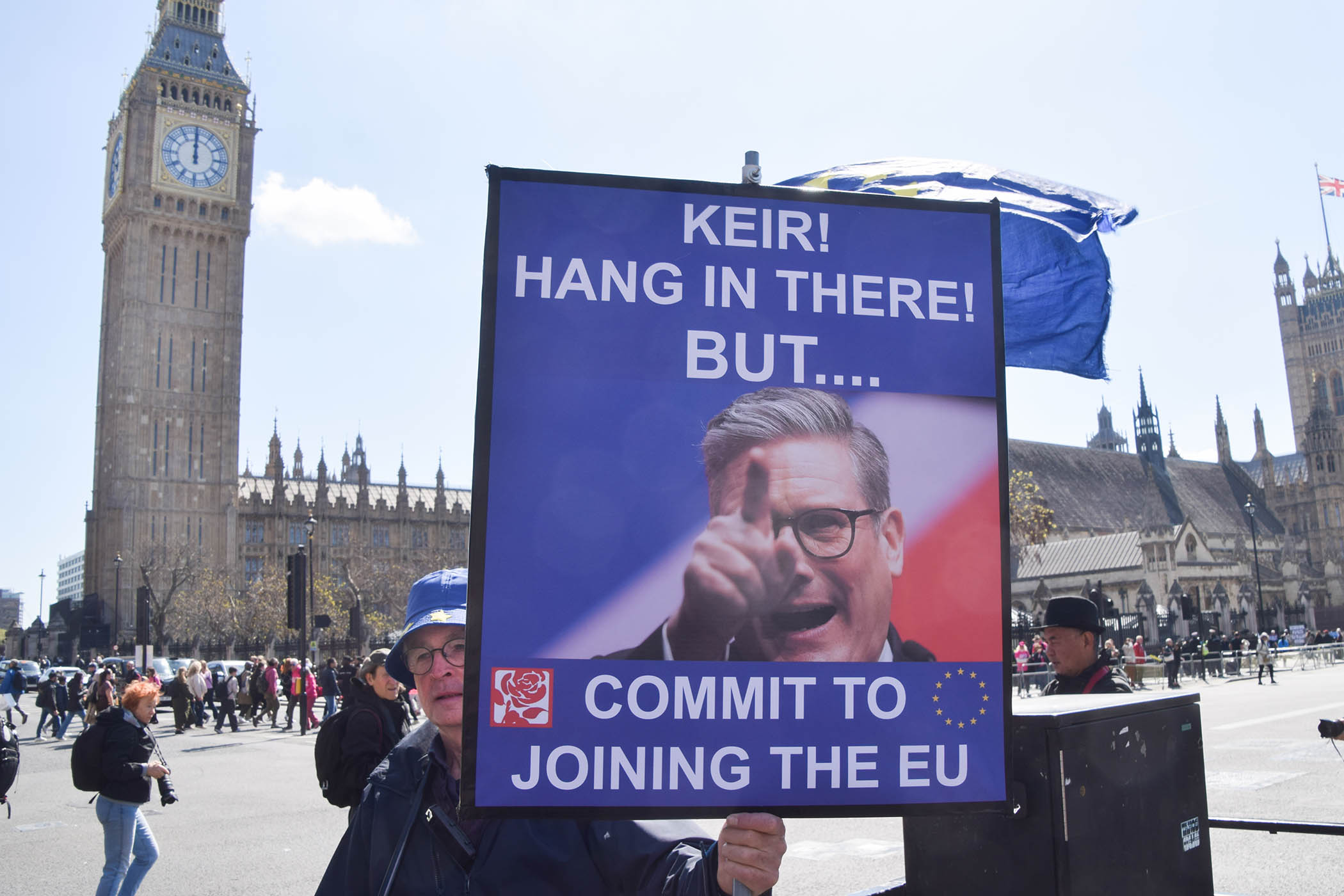


For the first five years after he entered politics, Keir Starmer spoke about little else except Brexit. For the next five, as he became Labour leader and then prime minister, he did his utmost to avoid the subject. Over the past one, however, he has gradually – then suddenly – begun to talk about it again.
Last summer he agreed plans for incremental improvements in our relationship with Europe. In his September party conference speech, Starmer used the “B-word” four times. By January, the prime minister was saying that better alignment with the EU’s single market rules would be “in the national interest”. Last month, after Rachel Reeves cited forecasts that Brexit will shrink the size of the economy by 8% – equivalent to a £224bn every year – he finally acknowledged the “deep damage” it had done to our country.
The chancellor has done much to shift the government’s direction on Europe over the past six months towards steadily, if stealthily, reintegrating different sectors of the economy with the single market. Along with everyone else, however, she knows going further will require clarity about Britain’s preferred destination. And perhaps this will become apparent after this week’s elections, when the prime minister will use a speech on security to say that strengthening ties with allies in Europe are essential if we are to withstand the global storms being unleashed from across the Atlantic.
Even so, all this may be judged too little – or too late – when public opinion is moving very fast. A YouGov poll last month showed four-fifths of those who voted Labour in 2024 would now back rejoining the EU, with barely one in 10 opposed. Such statistics have not gone unnoticed in Downing Street, where it is now acknowledged far more former Labour voters are backing the Greens, who have already come out for a full reversal of Brexit, than defecting to Reform UK.
The prospect of this week’s elections casting the prime minister’s future deeper into darkness makes a LabourList/Survation survey this weekend, particularly noteworthy. It suggests 87% of Labour members support re-entry into the EU, and you do not need to be a master strategist to realise the impact that can have on any leadership contest. And yet the most obvious candidates to replace Starmer have remained strangely silent on Europe.
‘The move would galvanise a demoralised Labour and revitalise the economy’
‘The move would galvanise a demoralised Labour and revitalise the economy’
Wes Streeting hinted about negotiating a new customs union in an interview with this newspaper last year. But such is the pace of change, that seems timid compared with former Labour leader Neil Kinnock’s full-throated call for Britain to rejoin the EU. Andy Burnham has vaguely said he would like the UK to rejoin “at some point” in his lifetime but, along with Angela Rayner and Ed Miliband, he largely avoided the epic battle over a second referendum between 2018 and 2019 that once did much to burnish Starmer’s credentials as a future leader.
It means this is a subject on which Downing Street’s current occupant is still better qualified than anyone else to make his own. Not only was he the shadow Brexit secretary who picked apart Theresa May’s deal, Starmer has the recent experience of trying to negotiate better terms himself. But this has seen his European values, rooted in the collective security of institutions such as Nato or the human rights treaty that emerged from the ashes of the second world war, grinding against the self-interest of member states, especially France.
Efforts to join the EU’s new £130bn rearmament fund were frustrated by Emmanuel Macron insisting on an astronomical “pay-to-play” membership fee for the UK. It has proved similarly difficult to get even small agreements on improving trade. Some in Brussels think the UK should be punished for Brexit, others resist any “cherry-picking” of the single market if Britain continues to refuse freedom of movement, while still more say they are not interested in making deals when Nigel Farage could get elected and rip them up again.
Such obstacles help explain the continued caution. Labour aides say public backing for re-entry is “paper-thin” and would disintegrate when it became clear there was neither an easy route back nor much enthusiasm for it in Europe. The prime minister remains wary of crossing the pro-Brexit “red lines” he imposed on himself while in opposition, and though these do not prevent Labour going further in its next manifesto, many would quail at the prospect of fighting a general election as a de facto referendum on Europe. Indeed, the LabourList members’ poll shows support for rejoining falling sharply in such circumstances, then dipping further if it meant joining the eurozone.
Yet the advantages of a bold move on Europe loom larger than ever. It would galvanise a demoralised Labour party, and revitalise the economy, as well as speak clearly to the perils of this time. And time, of course, is a commodity that may be in short supply for both Starmer and his government.
Newsletters
Choose the newsletters you want to receive
View more
For information about how The Observer protects your data, read our Privacy Policy
Photograph by ZUMAPRESS.com / Avalon