
Related articles:
A pair of cardboard butterfly wings. An outfit worn by tennis champion Billie Jean King. A statue of Lady Liberty carrying a basket of tomatoes. These are a few of the offending objects on display at the National Museum of American History (NMAH), according to a report released by the White House on 4 July, the 250th anniversary of US independence.
The 162-page report, entitled Saving America’s Story, is the Trump administration’s latest and most aggressive assault on the Smithsonian Institution, a consortium that includes NMAH, 20 other national museums, 21 libraries and the Washington zoo. It accuses Smithsonian leadership of “extreme political activism” for mounting exhibits which situate American triumphs alongside American injustices. The authors of the report are particularly vexed by museum didactics which mention that figures such as Benjamin Franklin and Alexander Hamilton owned slaves. In such texts, they complain, “‘complexity’ is always code for slavery” – betraying a patriotism so brittle that it can only withstand a toothless, simplified narrative.
Alongside demands for a fawning celebration of America the Beautiful, the report has many rightwing talking points. One section accuses NMAH of putting “sexually suggestive material in front of children”, such as videos of contestants lip-syncing on RuPaul’s Drag Race. Tennis champion King’s sartorial sins aren’t elaborated – does her skirt offend because it once belonged to a lesbian?
The Organization of American Historians, which represents more than 7,000 of the nation’s most distinguished academics, promptly condemned the paper. “Reports of this ilk reveal less about the museums they target than about the anxieties of their authors,” it said in a statement. “They reveal the White House’s fear that an accurate and complete telling of American history that includes hard lessons alongside proud ones will somehow puncture a nostalgic and fragile self-image of American exceptionalism.”
The White House report is also a blueprint for how the most reactionary figures in the Trump administration hope to rewrite America’s story in its 250th year. Congress appoints the Smithsonian’s board of regents, chaired by the chief justice of the Supreme Court, and apportions its funding – more than $1bn last year. But in a thinly veiled threat, the report notes that its revenue goes into an account managed by the Treasury Department – an agency under Trump’s control – and that most museum staff are federal employees, so the president can fire them.
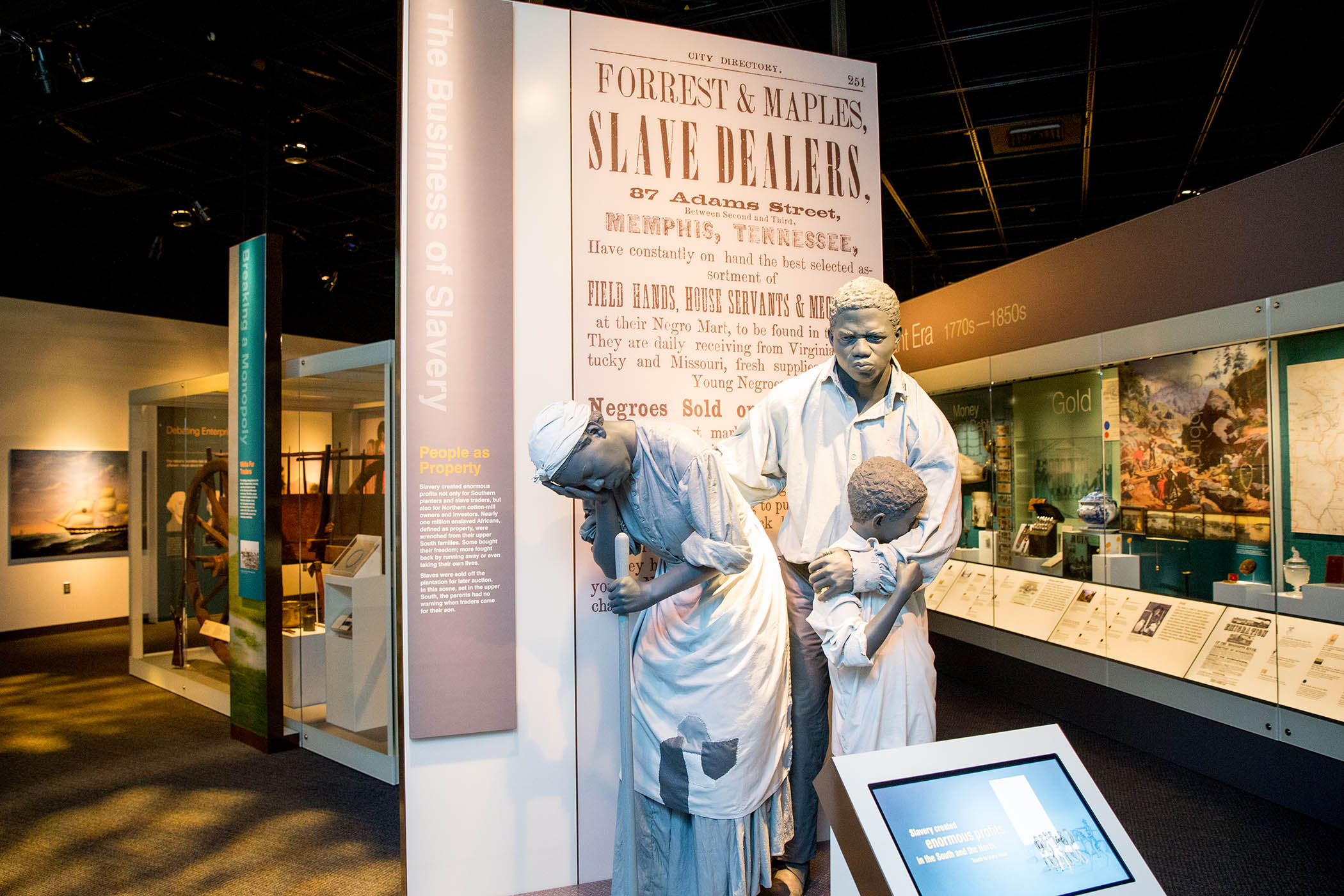
The American Enterprise exhibit at the Smithsonian’s National Museum of American History on the National Mall
The report appears to bear the influence of two men: Vince Haley, chair of the Domestic Policy Council, and Russell Vought, director of the Office of Management and Budget. Both aides have a fiercely ideological streak and a background at rightwing thinktanks – the American Enterprise Institute and Heritage Foundation, respectively – which have drafted some of the administration’s most controversial policies. Both contributed to Project 2025, the unofficial manifesto of Trump’s second term, which calls federal arts and humanities organisations agents of “cultural Marxism”. Haley is overseeing the construction of a 250ft triumphal arch at the end of the Washington DC’s National Mall; Vought, whom the White House characterised as “the reaper” in an AI-generated video it shared to X last year, has taken a scythe to the federal bureaucracy.
In December both men wrote to Lonnie Bunch, the Smithsonian secretary, demanding detailed exhibition plans for this year. Although the institution is not required to provide such information, Bunch mostly obliged. Nevertheless, Trump has made it clear that he wants the secretary gone. Pressure from the president is often effective: after Trump declared he’d sacked Kim Sajet, the head of the National Portrait Gallery, she resigned. Now Anthea Hartig is in the firing line: the director of the NMAH is mentioned more than 70 times in the report and characterised as a “radical” leftwing activist.
Bunch and Hartig are historians with credentials. They will know that this report doesn’t make the grade. By insisting the Smithsonian tell a “general narrative” of America, it forgets that history lives and breathes when it is contested. The report’s preamble quotes definitions of the Smithsonian from the 1950s, invoking the red scares of the McCarthy era, when criticism of the US was cast as a communist plot. In lieu of tough love, this White House lays down the party line.
Related articles:
No account of history is neutral. A national museum is by definition an ideological enterprise. At stake is whether the US can be a place for competing ideas – a democratic nation of different cultures and belief systems striving to form a more perfect union – or the preserve of Donald Trump’s yes men.
Photographs by River Zhang/AP, Andrew Harnik/AP
Newsletters
Choose the newsletters you want to receive
View more
For information about how The Observer protects your data, read our Privacy Policy