

I had a tutor at college who used to put pretentious undergraduates in their place by telling them: “If you can’t be clever enough to be sensible then you’re not really clever at all.” She was one of the most brilliant scholars of her generation, an Anglo-Saxon specialist with an interest in Old Norse, and she had no time for nonsense. If a student produced a deconstructionist analysis of Beowulf or suggested that the “O” in Ophelia represented a vagina, she would raise a disapproving eyebrow. It may have been clever but it certainly wasn’t sensible.
I’ve always thought this was an excellent prism through which to look at politics. There are so many people at Westminster who are clever, spouting theories about “neo-endogenous growth theory” or the shifting of the “Overton window”, but there are far fewer who are sensible. The poll tax, Brexit or scrapping the winter fuel allowance were all ideas that sounded good at a thinktank seminar but did not survive contact with reality. Political strategists are so often caught up in trying to outwit their opponents that they lose touch with the electorate; civil servants are frequently brainy but lacking in common sense.
Roy Jenkins once said Tony Blair had a second-class intellect and a first-class temperament. He meant it as a compliment. Gordon Brown was far cleverer but he was, in the words of one New Labour adviser, “psychologically flawed”. Good leaders need wisdom as well as brains, emotional intelligence as well as intellectual clout. In French, “sensible” means “sensitive” and that is part of what I mean when I use the word: politicians must have a heart as well as a head to succeed. Leadership is tested under pressure and so judgement – a gut instinct about people and policies – is the most important quality for a prime minister.
That is why the row over the appointment of Peter Mandelson as British ambassador to Washington matters. Forget the procedural drama in the committee corridor, the furore over who said what to whom about security vetting or the politically motivated Commons vote over a sleaze inquiry. It is entirely possible that everyone is telling the truth, or a version of it, and there is no reason to think that Keir Starmer knowingly misled parliament.
The real issue is far simpler. The prime minister appointed to one of the country’s most important diplomatic postings a man who had twice been fired from the cabinet for dodgy connections, and continued to have a relationship with Jeffrey Epstein after the financier had gone to jail for child sex offences. He did not have to see the outcome of the developed vetting process, or understand the full extent of the connections with a convicted paedophile, to know that Mandelson was trouble. Indeed, had he bothered to consult Philip Barton, the head of the diplomatic service at the time, before making his decision, he would have been warned not to send the one-time “sinister minister” to the US. It looked “clever” in the SW1 bubble but it was not “sensible”.
Starmer then compounded the misjudgement by firing Olly Robbins, the respected head of the foreign office – who it seems increasingly clear had followed the proper process for security vetting – in an attempt to control one day’s news cycle. That second error has had a devastating impact on the relationship between ministers and the civil service, undermining the government’s ability to deliver on its policies. Those around Starmer frequently lament that “the prime minister won’t make a decision” but when he does too often he gets it wrong.
As a former director of public prosecutions, the Labour leader has all the intellectual qualifications for the job but he lacks the more emotional skills required to succeed in No 10. It’s partly a curious lack of confidence – he thinks he does not “do politics” and so sub-contracts the big judgement calls to others. He worries about showing what he truly believes in case his views do not pass the focus group test, which leads to U-turns and creates a vacuum.
These bigger flaws, highlighted but not created by the Mandelson affair, explain the Labour leadership crisis. A reshuffle would make no difference and might actually inflame the situation by adding to the sense that Starmer throws people under the bus to save his own skin. “He’s just absolutely hopeless,” says one Labour veteran. “There’s no point talking about changing people and all this nonsense. If he doesn’t know what he wants to carry forward it won’t work. He blames everybody except himself. The problem is lack of purpose.”
In his evidence to the foreign affairs select committee, Morgan McSweeney said he had resigned as chief of staff because “responsibility should rest with those who make serious mistakes” but he also made clear that the decision to appoint Mandelson was ultimately Starmer’s. “Sometimes as an adviser you give advice and a prime minister goes with you and that’s what happened this time,” he told the MPs. “There were other times where I would say, ‘I think we should go in this direction,’ and the PM would say ‘No, I’ve got a different view.’”
It was as close as he could get to pointing the finger.
Nobody knows what will happen after 7 May, when Labour is expected to get smashed in the local, Scottish and Welsh elections. It will all depend on the scale of the disaster and the mood on the Labour benches. Political authority is an emotional thing, not a rational one. “I’ve always assumed the cabinet wouldn’t have it in them partly because they all want to be prime minister,” one Labour grandee says. “But I do now wonder whether something will happen after the local elections. They should do it as responsible people because we’re not delivering for the country. I instinctively think there’s a bit of a shift.”
One way or another, time is running out for Starmer.
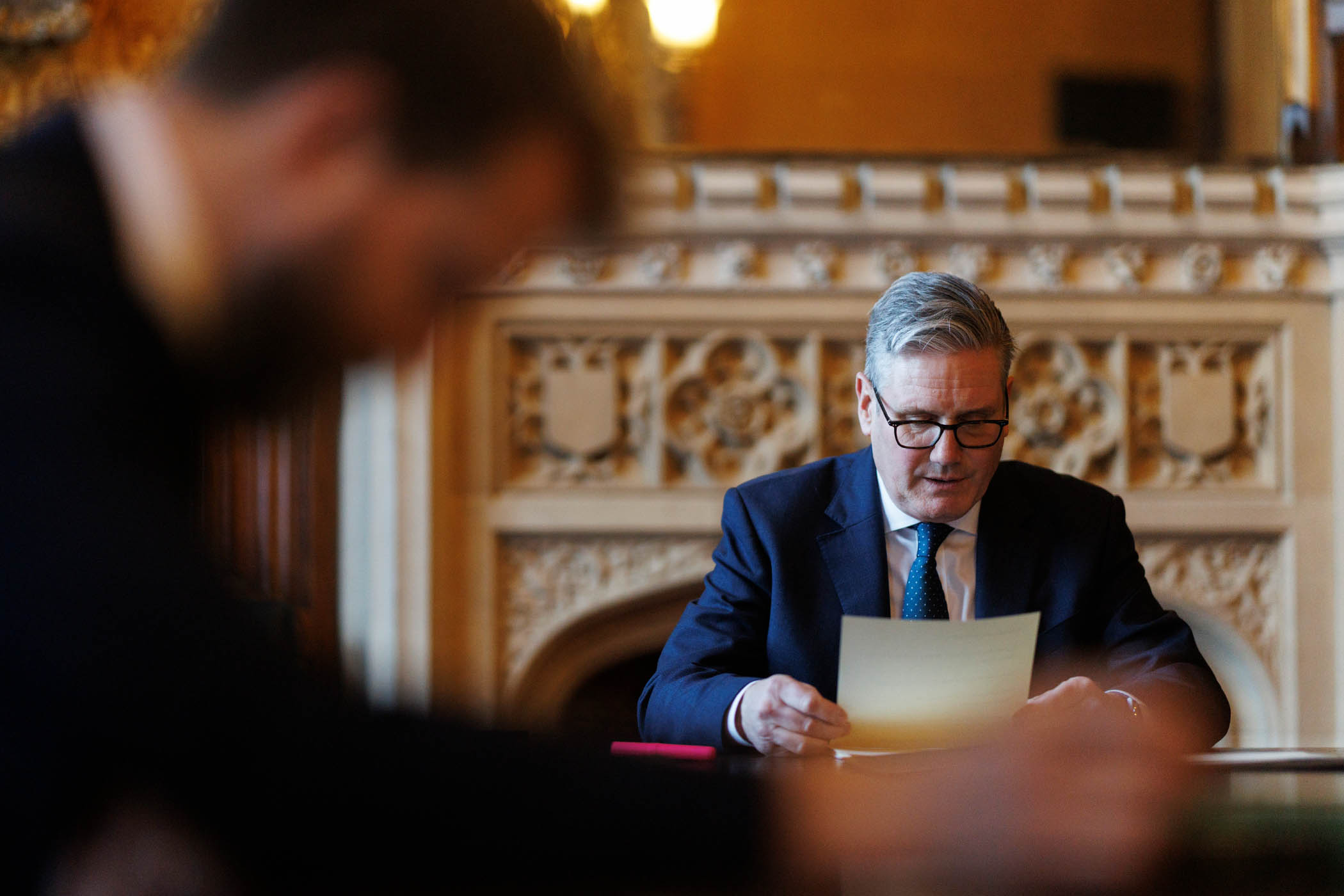
Photograph by Simon Dawson / No 10 Downing Street
Newsletters
Choose the newsletters you want to receive
View more
For information about how The Observer protects your data, read our Privacy Policy