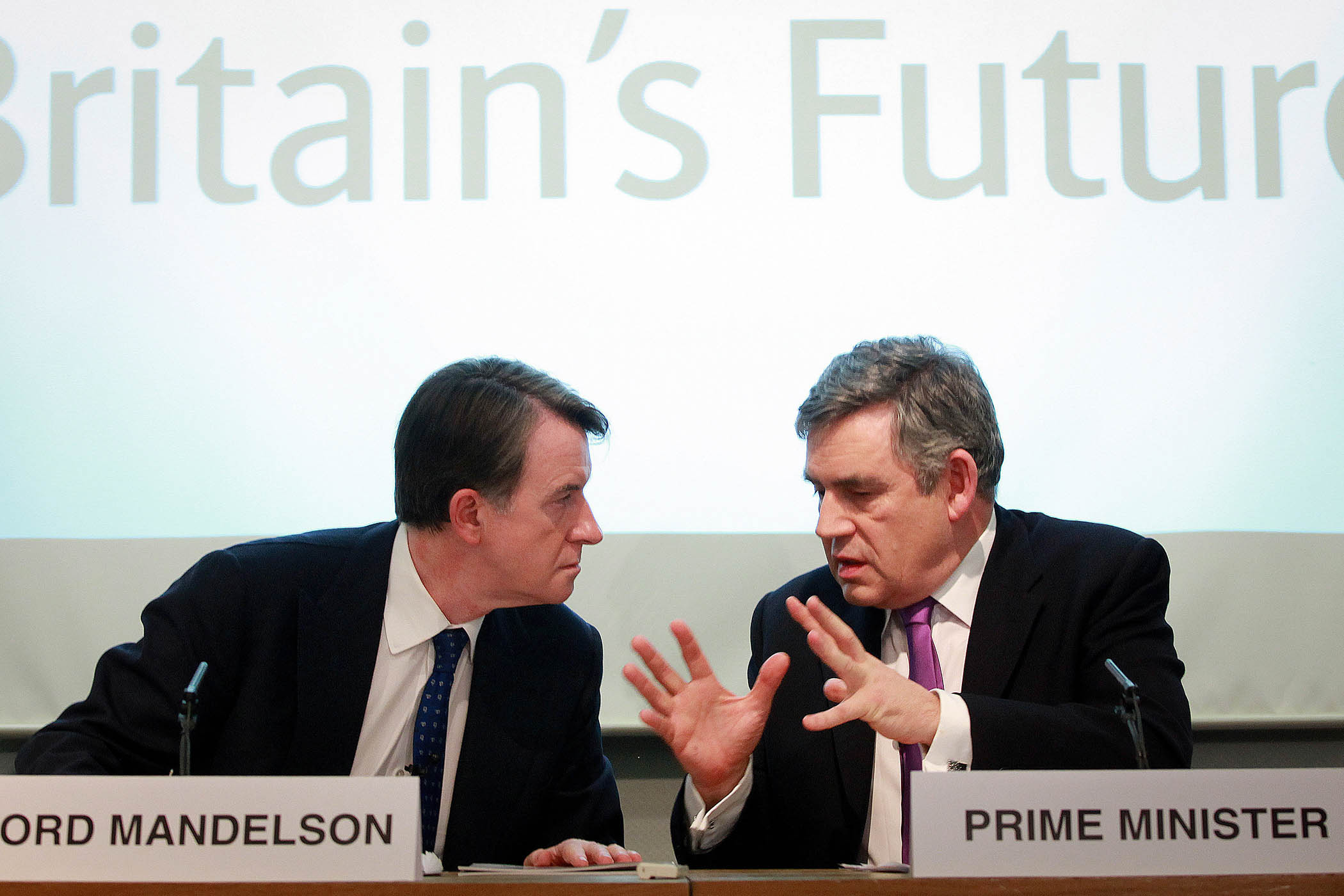



Revelations from the Epstein files indicate that while serving as business secretary in Gordon Brown’s government, Peter Mandelson was urging the repeal of a surtax on bankers’ bonuses. Mandelson told his friend Jeffrey Epstein by email that he was “trying hard” to change the government’s position on the bonus policy.
He did so to the advantage of a coterie of Wall Street investment bankers, who had rashly taken advantage of deregulation to bring the 2008 financial crisis upon us. At the same time as they were being bailed out by public money – and Brown was, in economist Paul Krugman’s famous tribute, “saving the world” – these bankers were objecting to higher taxes on their bonuses. It was, of course, a moot point whether they should have been paying themselves bonuses at all.
Moreover, there – apparently – was our business secretary leaking via Epstein that the eurozone was about to receive a €500bn bailout; surely highly market-sensitive inside information. I wonder how much the recipients made by piling into the euro, knowing it was about to go up. Mandelson has maintained he did not act criminally or for financial gain but this is a huge scandal, and surely merits a public inquiry.
Brown has expressed regret that he ever made Mandelson business secretary in 2008. But one reason Mandelson gained the position was his expertise on Europe – he had been a trade commissioner in Brussels. It’s now becoming clear where his real priorities lay.
Mandelson leaked via Epstein that the eurozone was about to receive a €500bn bailout: surely highly market-sensitive information. This scandal surely merits a public inquiry
Mandelson leaked via Epstein that the eurozone was about to receive a €500bn bailout: surely highly market-sensitive information. This scandal surely merits a public inquiry
And what about this current government’s priorities? After championing Remain and Rejoin, then abandoning their European principles in favour of “red lines” – no re-entering the customs union or the single market – our rulers seem finally to have accepted that our economic future depends on a closer relationship with the single market.
The chancellor had been strangely silent in public amid the cacophony of speculation surrounding Keir Starmer’s position. But last week, speaking at the London School of Economics at an event arranged by the Brussels-based Bruegel thinktank, Rachel Reeves said: “There are three big economic blocs: US, China and Europe. We will always seek every opportunity to grow our economy and these trading relationships but, ultimately, only one of these is on our doorstep, and so the biggest prize is closer integration with Europe.”
We have, of course, never left Europe. But in that strange episode in 2016, about 38% of eligible voters elected to leave the European Union, and that was enough to trigger what Nick Thomas-Symonds, the constitution and European Union relations minister, recently described as “a Brexit that has been utterly miserable and anti-growth”.
Drawing on his conversations with leading exporters, he went on: “Far from delivering freedom, the Conservative deal made UK businesses surrender to invasive bureaucracy.” Shortly before Reeves came out from behind the red wall, Starmer even brought himself to say: “If it is in our national interest to have even closer alignment with the single market, then we should consider that.” Consider? I hear a lawyer speaking, but, to use the latest fashionable cliché, “the direction of travel is clear” – and about time.
The chancellor is to be commended for finally getting the message about the single market: moving closer is good for growth.
But by welcoming the decision by the Bank of England last year to lower capital requirements for high street banks for the first time since the crisis, Reeves risks jeopardising that growth. We have been there before. Deregulation undoubtedly contributed to the banking crisis of 2007-2009. Mandelson’s digressions have offered a timely reminder of what happens when politicians and financiers get too close.
Newsletters
Choose the newsletters you want to receive
View more
For information about how The Observer protects your data, read our Privacy Policy
Photograph by David Bebber/WPAPool/Getty Images