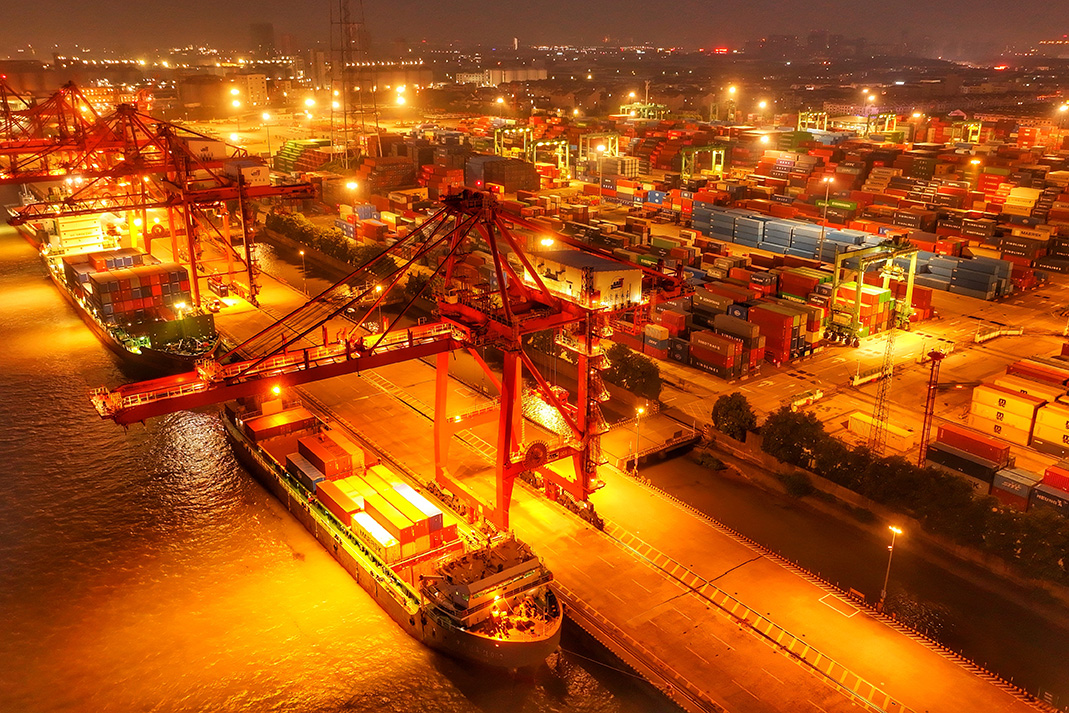



Fleets of ghost container ships are leaving European ports, filled with little but air as they head home to China. There, in the mega container ports of Shanghai and Shenzhen, they will reload with electric batteries for cars, motorbikes and cycles, electric cars, solar panels, chemicals, furniture and much more, before turning back for Europe.
But the Brussels establishment and politicians across Europe are waking up to an emerging trade relationship that borders on the abusive.
French president Emmanuel Macron describes the mounting volumes of China’s exports as a “steam roller”, while the European Commission’s strategy chief, Stéphane Séjourné, says Europe cannot be “the victim of a predatory strategy that is destroying our industry”. Its president, Ursula von der Leyen, urges a “major crackdown” on subsidised Chinese imports. An imminent European response seems inevitable – as does a retaliatory tit-for-tat reaction from China.
The scope for a climbdown is limited. China now accounts for 30% of world industrial production but only 13% of global consumption. That awesome productive power, reflected in the avalanche of exports, is driven by the Communist party’s desperate recognition that its survival as the authoritarian ruler of China depends on providing hundreds of millions of jobs and rising living standards.
Otherwise the risk is of unmanageable protest, even revolution, from below; Xi Jinping knows he is unloved. Hence the state throws its entire weight behind building and subsidising industry, in particular everything to do with sustainability, where China saw the economic opportunity early. China’s consumers cannot buy all the output – so it is shipped to Europe and the US.
The goods are attractively cheap, well below their economic cost, and often combined with state-of-the-art technology. For example, the latest BYD electric car will flash charge in five minutes with a range of 800 miles, and is still – notwithstanding tariffs – the cheapest in its class in the European market. Existing EU EV tariffs can be shrugged off as pin pricks. Condemned by its warped political economy to over-produce and over-export, China’s trade surplus last year was an astounding $1.1tn dollars, with the EU contributing a third. And it’s growing.
On some estimates the EU is losing 500 manufacturing jobs a day to China, with Germany haemorrhaging an estimated 10,000 a month. In the US the loss of blue-collar jobs to China was directly correlated with the growth of the Trump vote. Yet when Donald Trump as president angrily raised tariffs to 125% last year, China countered with a 145% tariff on US exports plus limits on China’s exports of rare earths. The state controls 90% of global production of these elements used in everything from electric windows to robotics and wind turbines.
The view is growing that trade is a two-way means for mutual betterment; not one country exporting its political and social problems to others
The view is growing that trade is a two-way means for mutual betterment; not one country exporting its political and social problems to others
Trump backed down. The average US tariff on Chinese exports is now 22%, and in China last month he declared Xi his friend.
The EU is wary of taking on this aggressive Goliath, but it has little choice. The rise of populism in the west is often explained in part by a reaction to globalisation; but globalisation’s name is China. An important LSE paper 10 years ago showed how closely correlated the Brexit leave vote was with the extent of Chinese imports displacing manufacturing jobs. In Germany the same effect is discernible today with the rise of its quasi Nazi party, the populist right AfD, now topping German opinion polls.
Already the EU has been stepping up its response. Two years ago there were a mere seven anti-dumping cases against China; this year there are over 50 in train – but each takes 18 months to investigate. Plainly higher tariffs are another option. Or there is the EU’s 2026 Industrial Accelerator Act with its new “made in Europe” requirement: the final assembly of any good must be 70% done in Europe while 50% of critical technologies have to be sourced in the EU. Under consideration is that Chinese companies should source 30% of all component supply in Europe; now it should be implemented.
Newsletters
Choose the newsletters you want to receive
View more
For information about how The Observer protects your data, read our Privacy Policy
Lastly, the EU is to copy the US and permit evidence of industrial overcapacity – rather than the demanding need to prove “injury” – when setting quotas on excess imports. The EU treads carefully, wary that China will hit back hard as it did with the US, including limits on its exports of rare earths. But the view is growing that trade is a two-way means for mutual betterment; not one country exporting its political and social problems to others.
Meanwhile the UK looks on. We ran a £50bn trade deficit in goods last year with China, as we watched containers arrive in Felixstowe, London Gateway, Southampton and Liverpool before leaving similarly largely empty. Every shipment weakens our industrial base and helps consolidate the passions of Nigel Farage’s electoral support.
Only this week China’s state council signalled its growing intent to build fortress China; it has already made it tough for foreign companies to move any supply chain out of China – now Chinese investment overseas is to be screened. The omens are clear. The free trade globalising world in which Brexit Britain would ‘buccaneer’ is disappearing. A new world of Fortress US, Fortress China and Fortress Europe is emerging – with Britain squeezed on the outside.
This looming disaster is what makes British debates about Europe look like exercises in toytown politics. Too many recoil from spelling out that becoming part of the European bloc is a geopolitical necessity. It is too divisive, so we must make the best of a bad job – as echoed in last week’s Observer by the widely admired Anthony Seldon, foreshadowing The Brexit Effect.
Really? So there can be no end to economic self-harm, collective impoverishment and geo-political marginalisation? We want to buy BYD cars, certainly, but there must be mutual benefit. The ghost container ships carry a message that must be voiced, heard and acted on.
Thank you for reading. Tell us what you think by writing to letters@observer.co.uk
Photograph by Getty Images