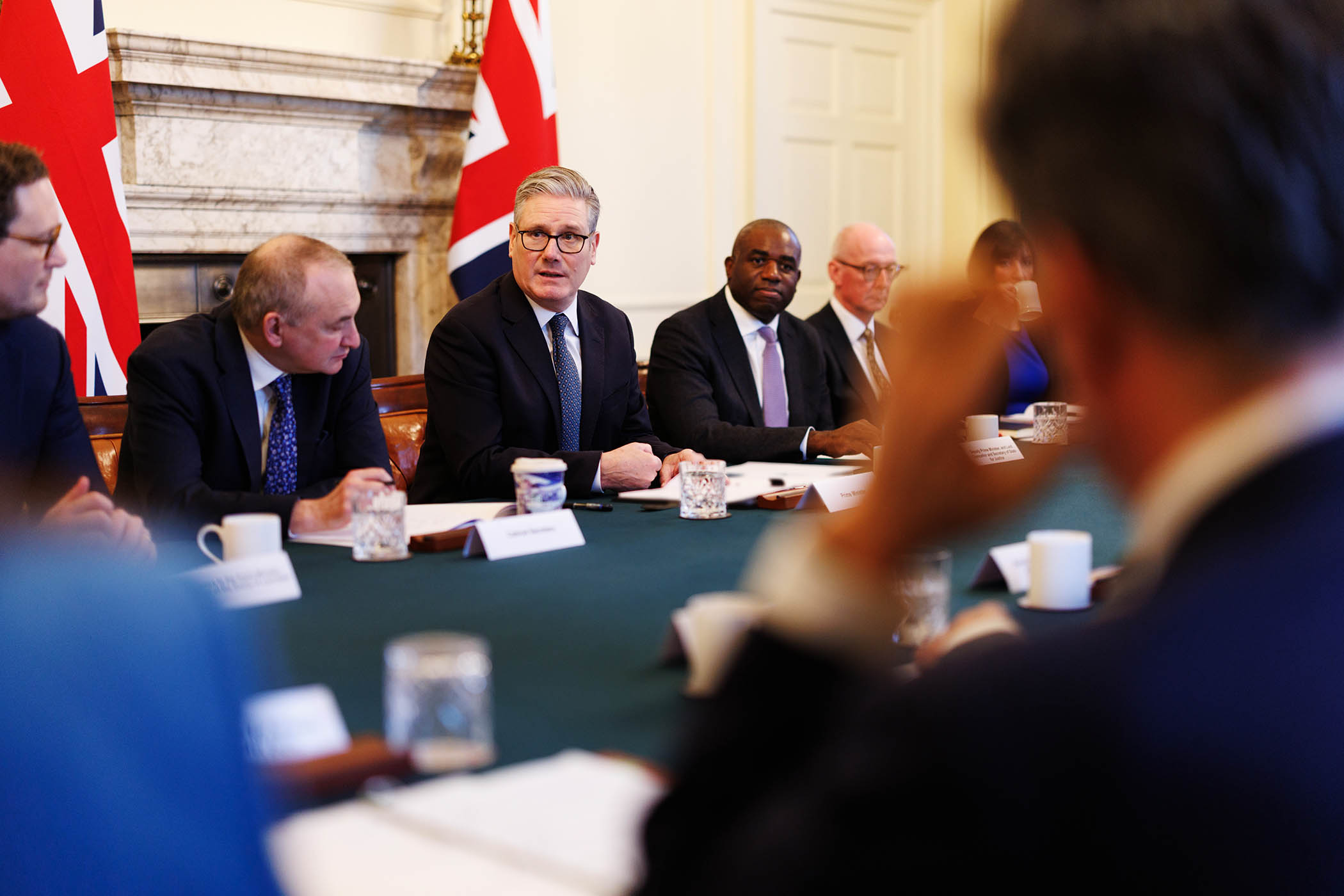
Keir Starmer is being urged by exasperated ministers to introduce a more consultative form of cabinet government if he is to save his premiership.
The chaotic build up to and fall out from the budget has infuriated members of the cabinet who believe Labour’s reputation is being harmed because they are being excluded from the decision-making process.
Traditionally, the prime minister is regarded as “first among equals” in the cabinet, with major decisions taken by the senior group of ministers. In the Tony Blair era, elected politicians were involved more informally through discussions in the prime minister’s study in what became known as “sofa” government.
Now, senior ministers have warned that the government is suffering because the prime minister is too reliant on a small coterie of advisers in No 10. One secretary of state said: “The problem is we have neither cabinet government nor sofa government.” Another minister described the Downing Street operation as “completely dysfunctional”.
Ministers are frustrated that there was no substantive cabinet discussion about the major measures announced last Wednesday, even though the prime minister and the chancellor were contemplating a manifesto-busting rise in income tax rates.
Cabinet members also feel they were not given the full picture about the state of the public finances before the budget because the chancellor repeatedly highlighted the downgrade in productivity forecasts. In fact, the Office for Budget Responsibility (OBR) had informed her that the downgrade had been offset by higher than expected tax receipts because of inflation and higher wages.
Every week, Rachel Reeves came to the cabinet and said, “It’s all very difficult,” one minister said. “There was no debate about whether or not to raise income tax. People occasionally raised the two-child limit but again there was no discussion.”
The budget board, the joint No 10 and Treasury committee set up to shape the financial statement, included only one member of the cabinet – Darren Jones, the chief secretary to the prime minister. The final decisions – including the last minute U-turn on income tax – were taken by Starmer, Reeves and their closest advisers in frantic meetings behind closed doors in Downing Street.
Downing Street said budget decisions were usually taken without prior cabinet debate but ministers believe there is a damaging pattern
Downing Street said budget decisions were usually taken without prior cabinet debate but ministers believe there is a damaging pattern
Asked by the BBC today why ministers were not told about the OBR’s better than expected forecast ahead of the budget, Reeves said: “You would never expect the prime minister and chancellor to go through all the detailed numbers. The cabinet are briefed on the morning of the Budget on the Budget numbers.”Downing Street sources said budget decisions were usually taken without prior cabinet debate but ministers believe there is a damaging pattern. When the historic decision was taken to recognise the state of Palestine in September, cabinet ministers were informed in advance of the public announcement. There was a discussion but one source said it was “meaningless” because the debate did not inform the policy.
Several senior ministers raised concerns about the conditionality of the plan, which meant Israel could theoretically avoid recognition by meeting certain requirements. However, even as the cabinet meeting was going on the news came through that MPs and junior ministers were being briefed on the government position which had still not formally been agreed. “The cabinet is a sham,” one source said.
Newsletters
Choose the newsletters you want to receive
View more
For information about how The Observer protects your data, read our Privacy Policy
Today, the prime minister insisted the chancellor did not mislead the public by overstating problems with the public finances. “There was a point at which we did think we’d have to breach the manifesto in order to achieve what we wanted to achieve,” he said. “Later on, it became possible to do it without the manifesto breach.” The chancellor has also rejected claims that she lied.
The prime minister is determined to revisit reform of a welfare system that has ‘trapped people in poverty’
The prime minister is determined to revisit reform of a welfare system that has ‘trapped people in poverty’
In his speech, Starmer described the budget as a “moment of personal pride”. He promised a “productivity revolution” in the UK to fix an economy “scarred by austerity, by Brexit.” There would be changes in the nuclear industry to remove “unnecessary red tape” and “fundamentally misguided environmental regulations,” he said.
The prime minister also said he was determined to revisit reform of a welfare system that has “trapped people in poverty” and kept young people out of work. He said he was “confident” that the UK could “beat the [economic] forecasts.”
However, the calls for more consultation are a further sign that Starmer’s authority is fading around the cabinet table after a torrid few weeks at the top of government.
The sense of frustration was fuelled by a memo from the prime minister, telling cabinet ministers that the government’s so-called “mission boards”, the Whitehall bodies set up after the election to implement Labour’s core priorities, would no longer be cabinet committees. Instead, they will become “delivery-focused forums benefitting from external and industry expertise”, according to the note that was circulated two weeks ago. Some ministers believe it is another indication that they are being bypassed.
While no leadership plot is imminent, even previously loyal cabinet ministers are beginning to take seriously the idea that Starmer may not survive. “A dam has burst,” one said. “He’s like the tech guy turning up, trying to fix the computer but the prime minister should be more like the architect creating a blueprint for the country,” one minister said. “People want to be led they want to know what direction the government is going so they can follow, but that’s not happening.”
Photograph by Simon Dawson / No 10 Downing Street