Illustration by Andy Bunday
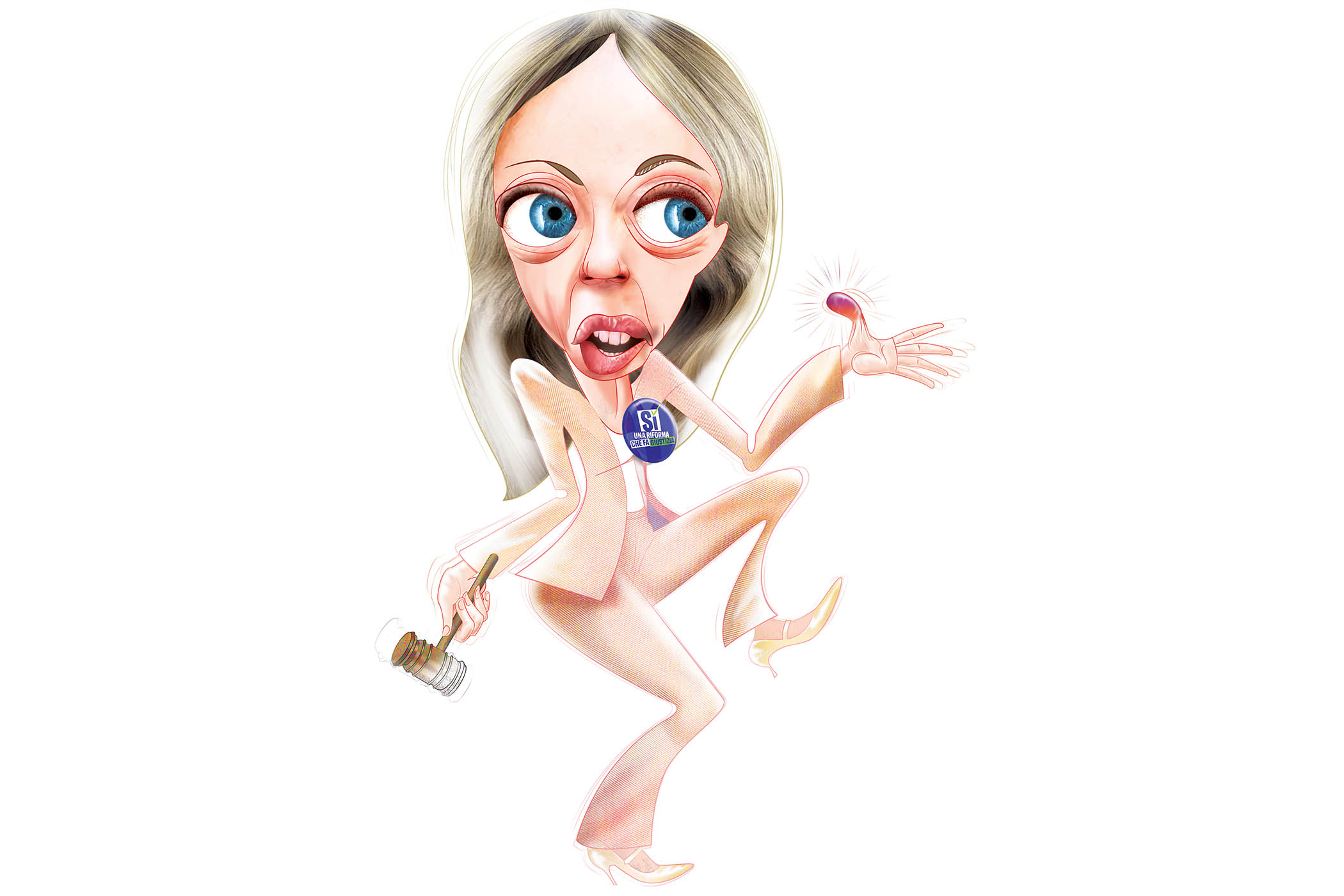
Italy’s prime minister, Giorgia Meloni, was once thought politically unstoppable. Her defeat in last week’s high-risk referendum, in which voters rejected her proposed judicial reforms, marks the first clear misstep of her premiership.
While it is a significant setback, the loss is unlikely to dent her dominance of Italian politics for long. In September, Meloni, who leads the far-right, anti-immigration Brothers of Italy party in coalition with the centre-right and the anti-immigration League, will surpass the late Silvio Berlusconi’s record for the longest continuous term in office in Italy since the second world war.
In hindsight the referendum was an unnecessary gamble. Yet she forged ahead, appearing to overestimate both public appetite for reform and her ability to carry it. What began as a technical overhaul of judicial governance was recast by opponents as an attempt to place the courts under political control. Bad blood between politicians and prosecutors dates back to sweeping corruption investigations in the 1990s; Berlusconi claimed decades of persecution by a leftwing judiciary, culminating in his “bunga bunga” trial.
Unable to hide her emotions behind a poker face, her eyerolls and side-eye have become memes
Unable to hide her emotions behind a poker face, her eyerolls and side-eye have become memes
Meloni’s government has clashed repeatedly with judges, including over the trial of her firebrand deputy, Matteo Salvini, for holding immigrants on board an NGO rescue vessel. She attacked the courts for blocking elements of her security agenda, including offshore migrant processing in Albania. But many voters appear to have used the referendum to register a broader unease about institutions, the economy, and political power itself.
It has weakened her. The former PM Matteo Renzi predicted she would become “a lame duck”, having lost her “magic touch”. A long-divided opposition senses an opening.
Yet the political picture is more complicated than the result suggests. As the pollster Lorenzo Pregliasco of Youtrend notes, a referendum “no” vote does not necessarily translate into support for the opposition. “Voting against something has a symbolic value,” he says, “and can be more appealing than voting for a party or a programme.” The opposition, despite its momentum, still lacks unity, a shared platform and a clear leader.
To mistake this moment for the beginning of Meloni’s decline would be to misunderstand what kind of politician she is. Allies describe her as a once-in-a-generation figure: disciplined, instinctive and unusually durable. She leads the most cohesive rightwing bloc Italy has seen in decades, with no serious internal rivals and consistently strong polling.
Since taking office, she has combined ideological clarity with pragmatic positioning, reassuring international partners while maintaining a hard line on migration and national sovereignty. She has also understood the importance of credibility abroad. By aligning firmly with Nato, supporting Ukraine and respecting EU budget constraints, she has secured the trust of Brussels and Washington, while reshaping her brand of nationalism into something more acceptable to mainstream European politics. European policy has moved into line with her, rather than the other way round. Even moderates such as Keir Starmer have come round to her way of thinking on immigration.
She bonded with Rishi Sunak on the grounds of them being trailblazing leaders (Sunak as a British-Asian, Meloni as a woman). US President Joe Biden greeted her with the song Georgia on My Mind and kissed her head. Albania’s socialist prime minister, Edi Rama, bent down on one knee in apparent adoration, after agreeing to host offshore migrant centres.
Newsletters
Choose the newsletters you want to receive
View more
For information about how The Observer protects your data, read our Privacy Policy
At home, her appeal is based on her donna next door persona. The child of a single mother who wrote romance novels and a cocaine-trafficking father, she was raised in a working-class neighbourhood of Rome, and has long presented herself as an underdog who worked her way up. Before entering full-time politics, she cleaned houses, managed a club cloakroom and sold records at a market.
A fiery speech at a rally in 2019, beginning “I am Giorgia, I am a woman, I am a mother, I am Italian, I am a Christian”, remixed by opponents, went viral, translating into a win for her. While her look has evolved from black jackets to white or cream power suits (Armani for key occasions), she still speaks with a strong Roman accent, sometimes in dialect, and cultivates a direct, informal style that has attracted derision from Italy’s elitist political class. She told one press conference she was “desperate” for the toilet, and at a Nato event offered that her high heels were “killing me”.
Apparently unable to hide her emotions behind a poker face, her eyerolls and side-eye have become memes, often stealing the show. Her biographer and longtime ally Italo Bocchino says Italians’ perception of her as “authentic, a woman of the people, someone who has suffered and lived in very difficult conditions” has been central to her success.
Her rise was long in the making. She entered politics at 15, joining the youth wing of the Italian Social Movement, a post-fascist party so marginal that there was little expectation that any of its members would enter government. “Those who joined did so for belief, not for career,” recalls the journalist Francesco Boezi. “They had no real prospect of power.”
That background has shaped her strengths and limitations. Within her party, she commands intense loyalty, built over decades of shared experience. But it has also fostered a tight inner circle and a distrust of outsiders. “There is a very restricted group around her,” says a former MP and activist. “They have always felt under attack and trust very few people. It’s almost a reflex.”
Meloni’s work ethic is relentless. Nicola Procaccini, a close friend and MEP, describes her as suffering from “the night-before-the-exam syndrome, every night”: obsessively preparing for meetings, and sleeping little, compensating with “microsleeps” between engagements.
This combination of ideological conviction, personal discipline and an ability to connect with voters helps explain why a single misstep is unlikely to dislodge her.
Still, the political risks ahead are real. Italy faces mounting economic pressures, including the prospect of EU action over its deficit, and slowing growth as post-pandemic support winds down. Rising energy costs leave the government less room for manoeuvre. Some analysts argue that she may be tempted to call early elections before the economic situation deteriorates further.
Opposition leaders from the centre-left Democratic party and the populist left Five Star Movement, as well as smaller radical left parties, buoyed by the referendum, are attempting to seize the momentum, calling for primaries. But divisions remain on issues such as weapons for Ukraine, and they lack a unifying leader.
Even in the event of defeat, few expect Meloni to disappear. At 48, she is young by Italian politics standards, and her dominance of the right gives her a platform few of her predecessors enjoyed. Bocchino compares her to Berlusconi: a figure who could shape the political landscape for decades.
Yet that durability comes at a cost. Friends describe a life with little room for anything beyond politics. One consequence has been the breakdown of her relationship with the father of her child, the TV host Andrea Giambruno, who was caught making lewd comments to juniors off camera. Meloni has defended her right to bring their nine-year-old daughter on work visits to China and events such as the G20 summit.
Those close to her insist she is not attached to power. “She thinks about life after politics,” says Procaccini, “more time with her family. We have often joked about doing a radio show together.” Another ally suggests that, on leaving office, she might even feel relief.
Meloni has made a mistake that reshapes the immediate political landscape. But the qualities that carried her to power – discipline, belief and an unusual connection with voters – remain intact. The question is not whether she survives this moment but how long she is willing to continue paying the price that survival demands.
Giorgia Meloni
Born 1977
Alma mater Istituto tecnico professionale di Stato Amerigo Vespucci
Work Prime minister of Italy
Family one daughter