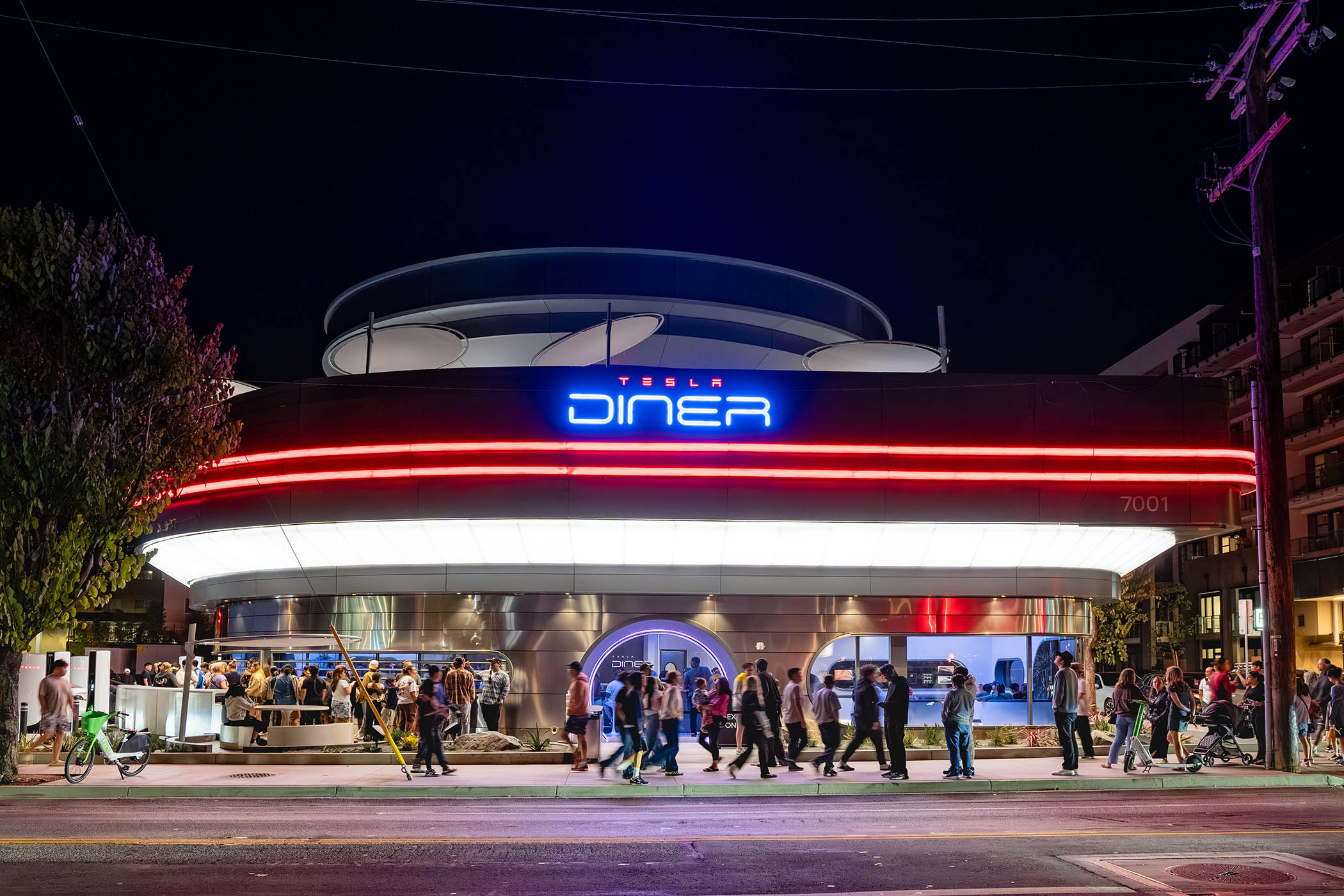
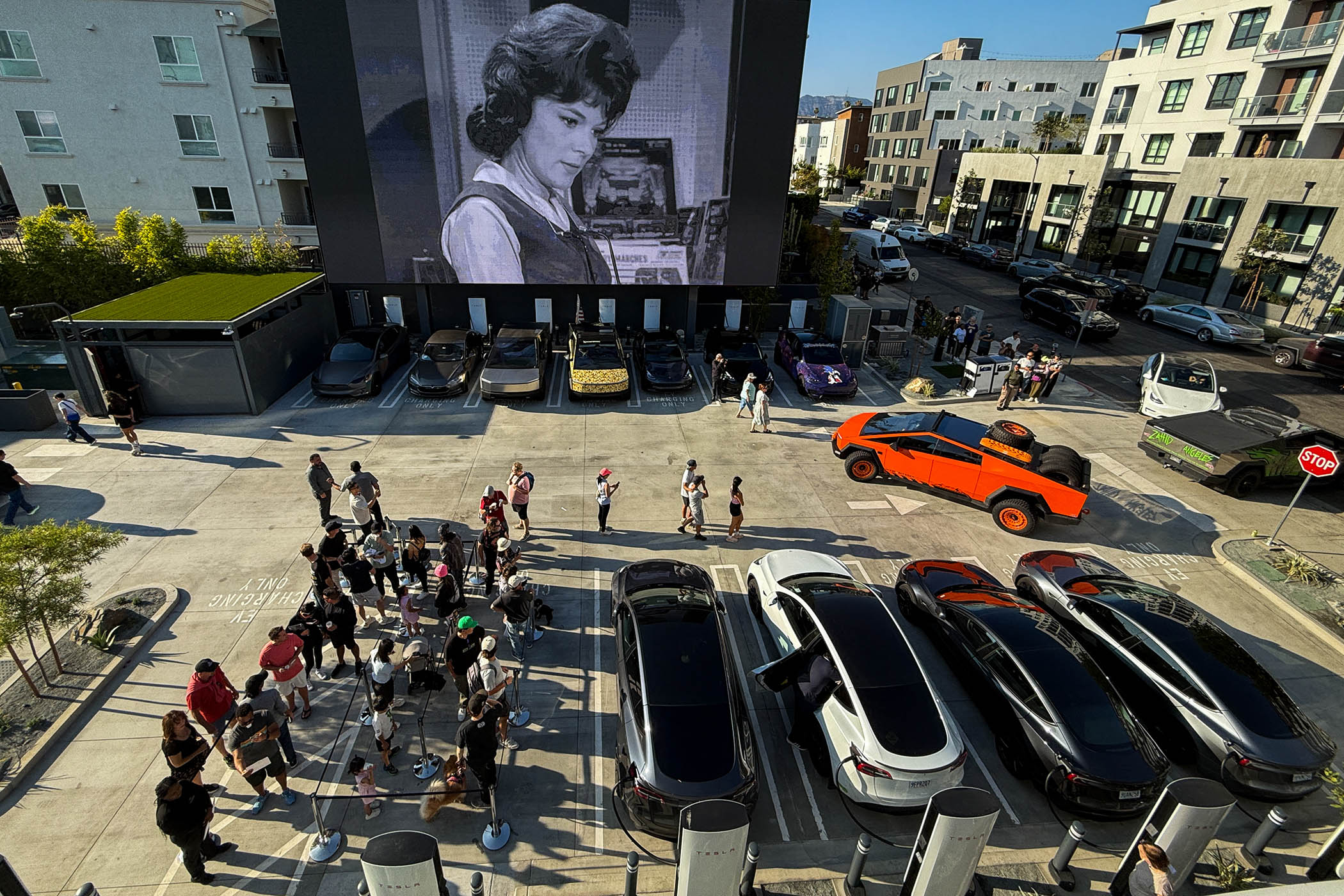
The carpark of the Tesla Diner is mostly full in the middle of a Tuesday afternoon, but not many people seem to be eating. They’re there for juice – the vast quantities of electricity being sucked up by their model Ys and Cybertrucks. That’s what Elon Musk’s 24-hour greasy spoon is really for.
Los Angeles has more Tesla drivers than any other city, accounting for 10% of the company’s global fleet, but it has precious few public charging stations. It takes 15 minutes to an hour to get to full battery capacity, so an episode of the 1960s cartoon TV series The Jetsons plays from two enormous drive-in theatre screens.
Jane Jetson is showing off her flashy – and literally flashing – new dress, a “Pierre Martian original”, when I pull up on my bicycle. The diner resembles a cartoon spaceship, round and chrome and gleaming.
It’s an outlandish sight along this stretch of Santa Monica Boulevard, a scruffy strip of auto body shops that in my childhood was better known as a place where sex workers plied their trade. But in a city where architectural whimsy manifests in buildings shaped like giant bowler hats or binoculars, Musk’s flying saucer isn’t all that unusual. Drivers zoom on by.
Inside, though, the diner is like a hellish airport lounge, all curved white resin and deep blue lighting. The hot dogs and the milkshakes look as if they’ve been extruded from the same machine. The menu also features a Giga Burger, a Falcon Wing Fried Chicken Sandwich and a “Chill Mode” Grilled Cheese, though the vaguely threatening prototype for Tesla’s Optimus robot, installed behind glass beside the all-gender restroom, nearly puts me off my lunch. Musk has been openly hostile towards trans people – including his own daughter – but his restaurant is required under LA law to designate its single occupancy toilet “all-gender”.
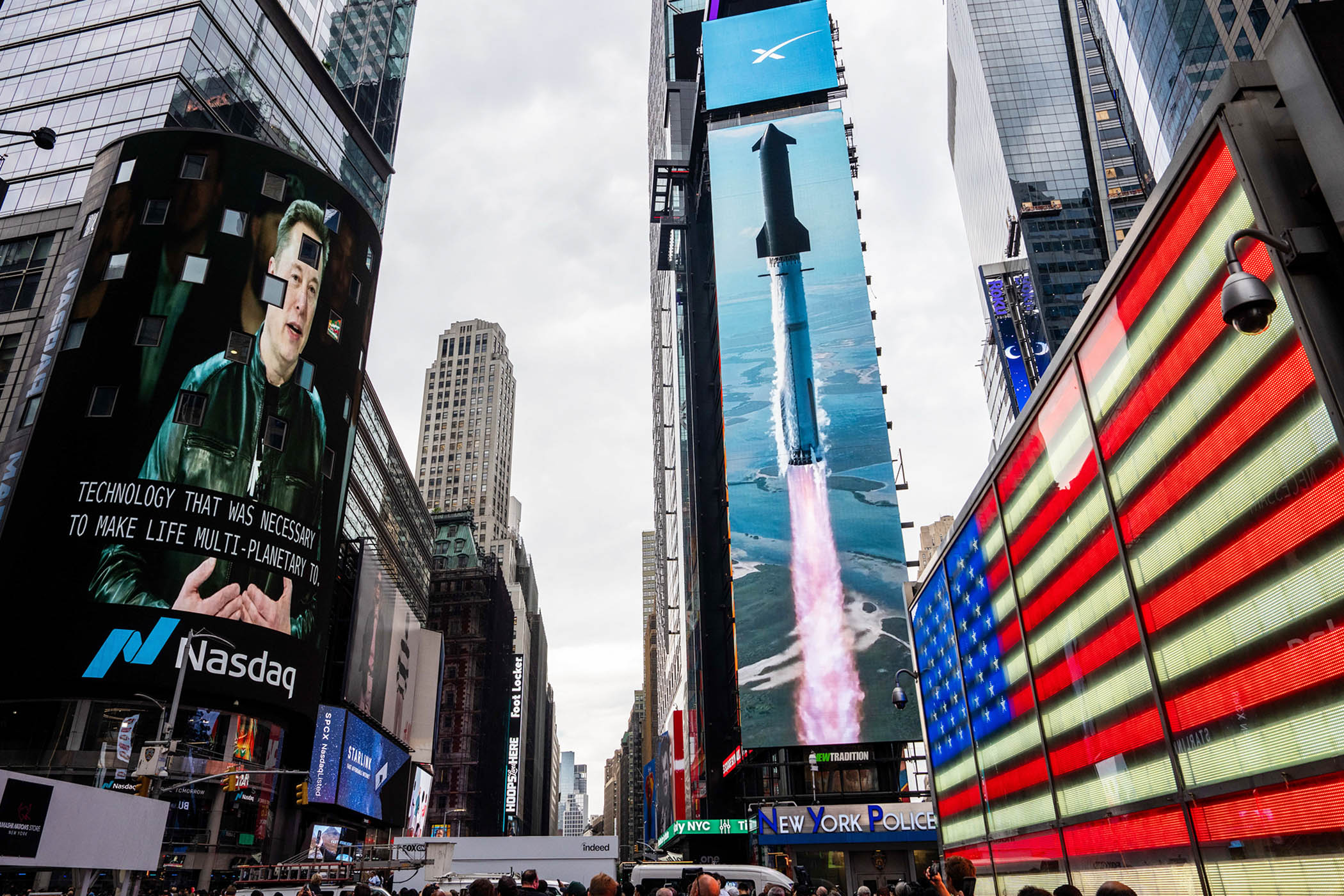
A message on the wall nearby reads: “Our mission is to build an amazing world of abundance.” Musk, for his part, seems more concerned with enriching himself at the expense of everybody else. The world’s wealthiest man has mastered tax-avoidance strategies while securing $22bn in government contracts for SpaceX so that he can leave this amazing world behind. Last year his Doge minions wreaked havoc on US welfare agencies. When the Tesla Diner opened in July, the queues snaked around the block, but lately they’ve all but disappeared. Perhaps liberal Angelenos have had their fill.
The language of SpaceX and Tesla is steeped in geeky, sci-fi nostalgia. Optimus is a reference to the Transformers robot, while the Falcon rocket is named after Hans Solo’s ship in Star Wars. The Tesla Diner is equally retro: Los Angeles was the birthplace of the Space Age long before Musk ever left South Africa. It’s the home of the Jet Propulsion Laboratory and military aircraft manufacturers from Raytheon to Lockheed Martin. Aerospace, LA’s largest industry up until the end of the last century, inspired the homegrown Googie style of architecture, which raised Jetsons-like structures from Norms Restaurant to the LAX Theme Building.
I grew up in Los Angeles before moving away more than a decade ago, but on this trip back, I no longer recognize the future the city is trying to sell me. On the sidewalks I’m often the only pedestrian, vastly outnumbered by tiny delivery robots that resemble mini-fridges with wheels. Their big, baleful eyes are digitally programmed to blink, and human names – Juan, Ingrid, Satochi – flash on their forehead screens. My partner’s dad recently sent me a video of one of these bots in Leeds; it’s only a matter of time before they start slowing down pedestrians on London’s Oxford Street.
Driverless Waymo taxis, meanwhile, now rule LA’s roads: you can’t go far without seeing one of their round LiDAR sensors spinning like a child’s propeller hat. With Waymo claiming around 22% of the rideshare market in San Francisco, the recent appearance of the teched-out cars in London spells doom for the capital’s cabbies.
A few miles west of the Tesla Diner, I pass a delivery robot outside the Tail o’ the Pup, a historic hot dog stand deliciously shaped like an enormous weiner in a bun. “Melinda is on delivery” flashes across the robot’s screen. As I approach the corner, Melinda follows nervously behind before making a surprise request: “Press the crosswalk button for me?” I hesitate (think of the jobs!). Couldn’t she at least say please? But in the end I relent. It isn’t Melinda’s fault she doesn’t have arms. I press the button and the signal changes. “Thank you,” she says, and glides away.
Photographs by AaronP/GC Images, Patrick T Fallon / AFP via Getty Images
Newsletters
Choose the newsletters you want to receive
View more
For information about how The Observer protects your data, read our Privacy Policy