


In the first half-hour of Donald Trump’s second term, while he was still being inaugurated, a handful of young men hired by Elon Musk gained access to information on millions of federal workers. Soon afterwards, each of these workers received an email, the gist of which was: quit or risk being fired.
Musk’s “department of government efficiency” (Doge) was a disaster. It scrapped whole departments, trashed more than a million years of public service experience, caused thousands of deaths in Africa by ending the distribution of life-saving medicines, and probably cost public money rather than saving the $2tn in “waste” that Musk had promised.
But it was the apotheosis of Muskism. The real point of Doge wasn’t to save money but to centralise all forms of US government data and subject it to the rigours of the private sector and AI. As a case study in moving fast and breaking things, it was extreme in its purity. As an exercise in co-opting the state, it was unmatched in its ambition. That is a big part of the argument of this book, at any rate.
Quinn Slobodian, a historian, and Ben Tarnoff, a journalist, have constructed a credo in Musk’s name and written an extended essay about it. Their Muskism has four tent poles, of which co-opting the state is one. The distinction between co-opting and replacing is important – think Tesla, dependent for much of its revenues on electric vehicle (EV) subsidies, and SpaceX, whose biggest client by far is the US government.
Another tent pole is Musk’s preference for hardware over soft. Electric cars and reusable rockets may look now as if they were always destined to take off, but they didn’t when Musk bet on them in the noughties. His fondness for bending metal was conspicuously retro then, when most of his Silicon Valley peers were looking for new ways to invest their dotcom gains without actually making anything.
Tent pole three is the melding of tech and human, which Musk is trying to do literally by stitching computer interfaces into human brains at Neuralink, one of his less commercially successful companies; and figuratively by encouraging our species to get used to the idea of living and working with humanoid robots.
Tent pole four is a concept – the superset: the sum of all information and the pursuit of the control of it. For Musk, a short description of the superset is the internet. A longer one is “a theory of power masquerading as a description of a technological process”, Slobodian and Tarnoff write. “If everything became digitised, then authority would rest with those who controlled the code. Whoever owned the superset would have dominion over its subsets.” And it’s pretty clear that Musk in his 2026 skin thinks he has dominion over more than a few subsets.
Two examples stick out from the book. One involves Starlink, his most extraordinary technical accomplishment, the satellite-based broadband internet service used by both sides for battlefield communications in Russia’s war on Ukraine. This led Poland’s foreign minister, the formidable Radek Sikorski, to accuse Musk of making money off war crimes by helping to target Russian drones. To which Musk responded in a transnational kind of way: “Be quiet, small man.”
Also in the subset category: European migration policy. Musk has become one of the louder amplifiers of the Maga line that mass non-white immigration threatens European civilisation. He supports hard-right, anti-immigrant politicians across the continent, including Eva Vlaardingerbroek of the Netherlands and her campaign for mass deportation – or “remigration” – of non-white migrants. When Vlaardingerbroek posted online about an assault by a Moroccan youth last year in Milan, Musk responded: “REMIGRATION NOW.” Before that, in front of a global audience at a Trump inauguration celebration, he had performed what looked uncannily like a Nazi salute, not once but twice.
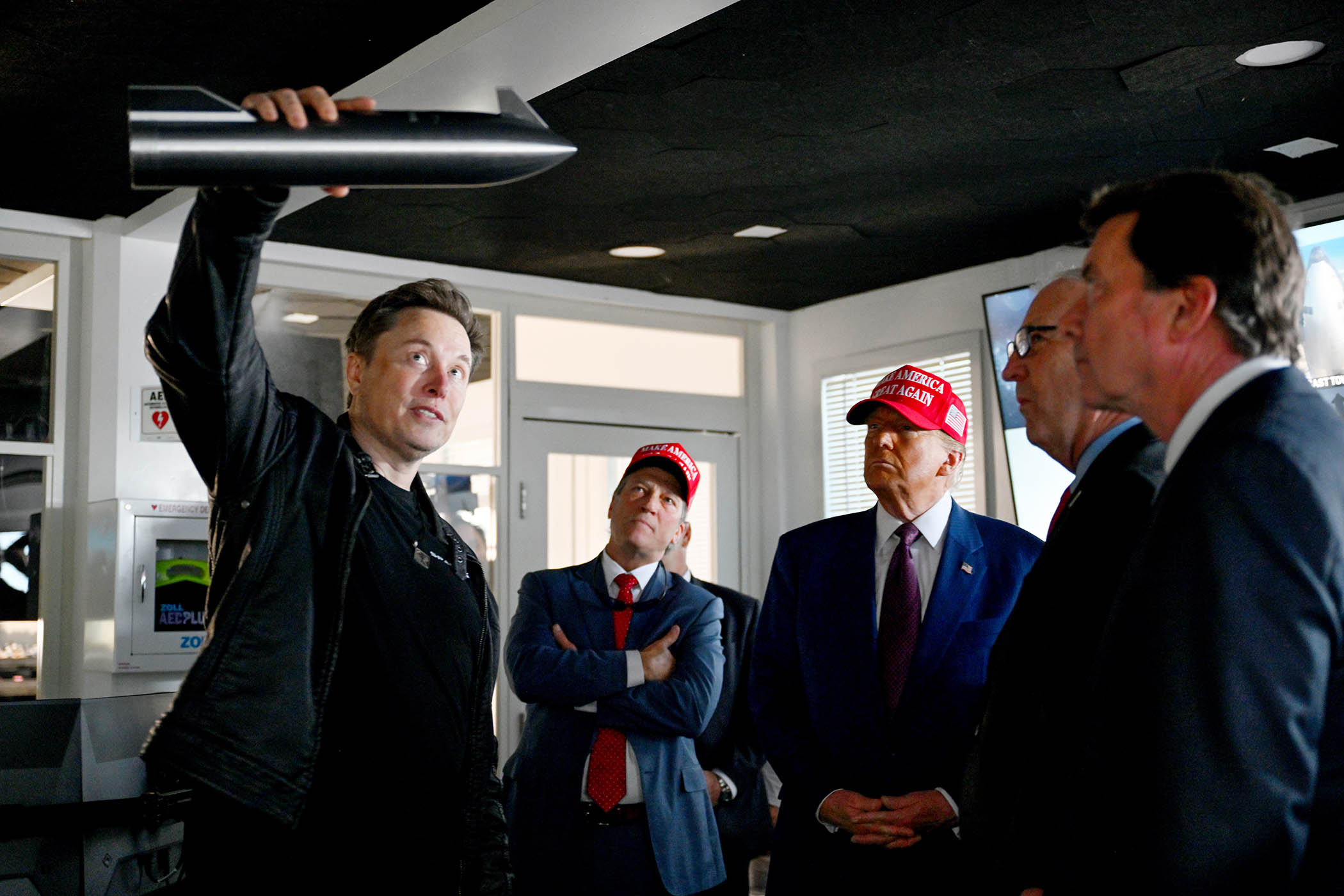
Musk’s hope is that Starship will fulfil his boyhood dream of starting the colonisation of Mars for the preservation of the human species as it despoils its home planet
Musk’s hope is that Starship will fulfil his boyhood dream of starting the colonisation of Mars for the preservation of the human species as it despoils its home planet
Does it all add up to an “ism”? Does this book work as “a guide for the perplexed” as its subtitle promises? Even readers familiar with the biographies by Ashlee Vance and Walter Isaacson should find it thoughtful and illuminating, at least in parts. It connects the Musk story to his South African youth and apartheid – which Slobodian and Tarnoff call a “reactionary technocracy” – and the idea of harnessing Henry Ford’s thinking on mass production in the service of a pampered white elite. It reminds you there were plenty of reasons for Musk’s lurch to the right during Covid, including a general – and mutual – disenchantment with the Biden administration, which bizarrely failed to invite him to a White House summit for EV makers in 2021, even though Tesla made two-thirds of EVs sold in America at the time. And it reframes the decade of cheap money after the 2008 crash as a huge public subsidy for entrepreneurs like Musk.
Newsletters
Choose the newsletters you want to receive
View more
For information about how The Observer protects your data, read our Privacy Policy
But sometimes the book is too clever by half. There’s a big chapter on “sovereignty as a service”, for instance, which doesn’t convince. Its central idea, based on the Starlink example, is that “sovereignty, going forward, will be infrastructural before it is territorial – defined by access to bandwidth, compute, launch cadence and orbital real estate as much as by borders and bureaucracies”. But sovereignty as a service is a contradiction in terms. It sounds cool but it’s not a thing. A nation state that outsources essential functions to a service provider isn’t buying sovereignty as a service. It’s buying a service and losing sovereignty. Maybe this is the point Slobodian and Tarnoff are trying to make, but they’re not making it.
A bigger gripe, and perhaps an unfair one, is that the authors try too hard to make sense of late-phase mad Musk. They write seriously about Muskism as “cyborg conservatism”; about Musk’s fear that the “woke mind virus” will interfere with his dreams of making Homo sapiens a multiplanetary species; about Musk’s evocation on Joe Rogan’s podcast of a “super oppressive woke nanny AI that is omnipotent” and might “execute you if you misgender someone”.
It’s well known that the most personal reason for his switch from palatable if geekish discourse on tech to rancid interventions in global culture wars and hard-right politics is his failure to come to terms with his daughter Vivian coming out as trans in 2020. But even that is arguably a distraction from something simpler and more in-your-face (especially if you still use X) – namely the slow crack-up of a narcissistic bazillionaire of limited emotional bandwidth surrounded by sycophants, overfond of ketamine and increasingly convinced of his infallibility on every subject his addled mind turns to in the long night hours on his private jet, even as Tesla sales slump and the giant rocket he once hoped would take humans to Mars keeps blowing up.
That rocket, known as Starship, has failed on five of 11 test flights. Yet Nasa is depending on it to ferry its next lunar astronauts – the first in more than 50 years – to the surface of the moon as soon as 2028. Musk’s hope is that it will then fulfil his boyhood dream of starting the colonisation of Mars for the preservation of the human species as it despoils its home planet.
It is, presumably, quite stressful being Elon Musk. That human element is missing from this book. But you can’t have everything in what is essentially an elegantly crafted thought experiment. Muskism closes with a bleak vision of an imagined future, circa 2035, of a schoolgirl on a dying planet where data centres have first call on energy and Starships blast off 20 times a day for other worlds. It’s not too far-fetched. The richest man on earth is already reshaping it in his image.
Muskism: A Guide for the Perplexed by Quinn Slobodian & Ben Tarnoff is published by Allen Lane (£25). Order a copy from The Observer Shop for £22.50. Delivery charges may apply
Photography by Getty Images