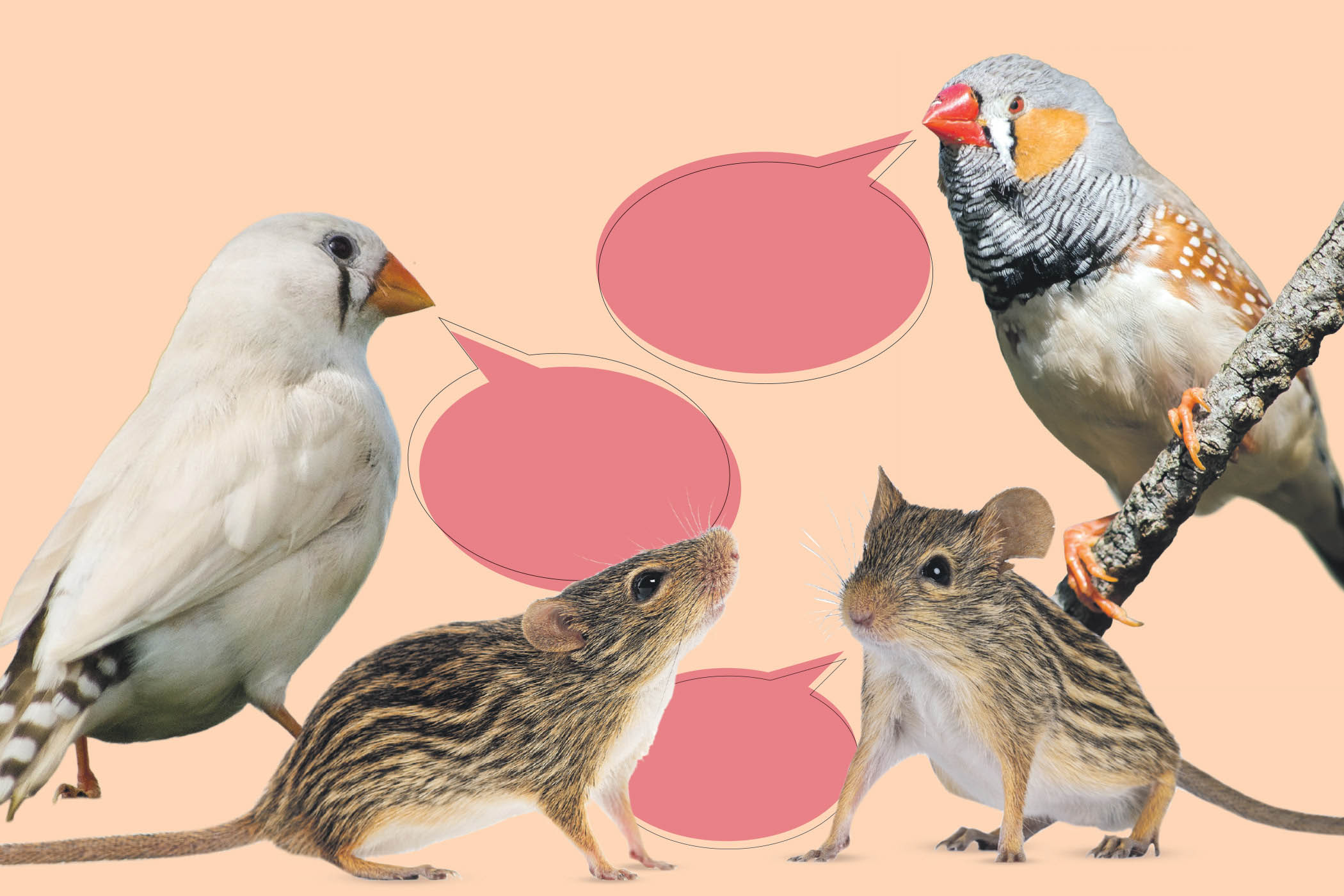



Julie Elie’s voice is rich with birdsong. “Tet is the [name of the] contact call: ‘tuk-tuk, tuk-tuk’,” she says. “It’s very similar to thuk, the alarm call: ‘duk-tk, duk-tk’ – but they mean something totally different.” For 15 years, the researcher has been studying zebra finches, small colourfully striped birds that live in the Australian outback, and there’s joy in her descriptions of their calls. Perhaps it’s because she understands what they mean.
The first time was when she was watching a video of Fledgy, a male bird flitting from bush to bush at the Fowlers Gap research station in New South Wales. He had seen a human filming him: a threat. He chirped a contact call at his family, a rapid call-and-response so they all knew where each other was. Then he made an alarm call.
“I listened back to these recordings and I said: ‘Holy shit, there’s those vocalisations – I can make sense of them,’” she says. “I realised, OK, now the bird is going to fly away.” And he did.
Elie, a computational neuroethologist at the Helen Wills Neuroscience Institute at Berkeley in California, is one of four nominees for the Coller Dolittle Challenge, whose winner will receive $100,000. The annual prize is a taster for the $10m award for whoever is first to do what Doctor Dolittle did: “talk to the animals.”
The money comes from the Coller Foundation, set up by Jeremy Coller, a billionaire private equity investor and animal rights activist. The foundation supports research into what it calls the “inconvenient truths” of intensive farming of animals and last year funded the new £4m Jeremy Coller Centre for Animal Sentience at the London School of Economics (LSE). The aim is an “ethical moonshot” to fundamentally change how people consider animals, and at the centre’s launch last year, Coller likened the challenge to deciphering the Rosetta stone. His motivation is simple: “I want to ask a cow how she feels when her calf is taken away.”
It’s a straightforward ambition, but underneath it are complex questions. Do cows and other animals combine calls in the same way that we combine words into sentences to allow creative expression? Do parents teach calls to their young? Can calls refer to things that are not physically present, meaning animals have a memory? Ultimately, are animal calls hardwired, or do they represent something symbolically, which would make them more like thoughts?
The exciting part of Elie’s experiments with zebra finches is that she discovered they confuse calls that sound very different but have similar meanings, as we might mix up “love” and “heart”. The implication is that they understand these calls symbolically.
Coller’s prize is a new twist on a debate about animal communication. Plutarch argued animals had reason, memory and emotion; the Stoics believed they lacked rational thought. That back-and-forth continued with Francis of Assisi and Thomas Aquinas, and René Descartes, who held that animals were unfeeling machines.
Philosophy gave way to science with Charles Darwin, then the Austrian-born ethologist Karl von Frisch, who in 1927 decoded bees’ waggle dance – the way they tell each other where flowers and water are – which was among the first indications that animals might use symbolic communication. By the 1960s, naturalists were teaching sign language to chimpanzees. But could they really communicate? Or were they just new versions of Clever Hans, the horse that wowed fairground crowds in Germany by counting with his hoof, but was actually responding to his trainer’s unconscious cues?
What transformed the field from circus tricks into the bona fide science of bioacoustics was the invention of high-quality recording equipment, followed by computer audio. Being able to capture sound digitally has built up many more hours of audio than was possible with a reel-to-reel tape recorder.
Newsletters
Choose the newsletters you want to receive
View more
For information about how The Observer protects your data, read our Privacy Policy
Now the arrival of large language models makes it possible to analyse those audio files. In the last few years, AI teams have set up Project Ceti (Cetacean Translation Initiative), which focuses on sperm whales, and the Earth Species Project, which in 2024 released NatureLM-audio, the first large audio-language model tailored specifically to identify features of animal sound.
“You can analyse vocalisations of animals almost in real time now,” says Nicolas Mathevon, professor of bioacoustics at Saint-Étienne University in France, who has also been nominated this year for his work on African striped mice. Advances in recording have been matched by the arrival of cheap, battery-powered loudspeakers, allowing easier “playback” experiments, where researchers can see how animals react to calls.
Mathevon and his team set up microphones and speakers next to bushes in the arid shrublands of the Succulent Karoo in north-western South Africa. Each morning, a family of mice emerges for their daily ritual; 45 minutes of sunbathing and a natter, before heading out to find seeds or patrol their borders.
There is one snag: the mice squeaks are ultrasonic, at about 60,000 hertz (hz) – humans can hear up to about 20,000hz – so researchers need special audio equipment. The squeaks travel only about two metres, as high-pitch sounds dissipate more quickly (think of how we can hear the bassy thumps from a faraway house party but not the singer’s voice).
When you are doing playback experiments, you have to try to think as a mouse
When you are doing playback experiments, you have to try to think as a mouse
Bioacoustics research addresses two questions: what information are animals trying to vocalise and how do their sounds do this? There are also two types of information: the identity of the animal and the context they are describing.
A baby’s cry tells us, first, that it’s our baby, and second, the level of its distress. Mathevon’s team analysed the calls of the African striped mice using a neural network, and demonstrated that their vocalisations had a specific sonic signature for each family group. They also discovered that the mice make long, deeper vocalisations at the fringes of their territory, possibly as a warning to rivals. Mathevon did playbacks of aggressive calls from relatives, neighbouring rivals, and mouse strangers they had never heard before. The mice ignored the family calls. They snarled at neighbour calls. And the strangers? “They flew directly to their nest – they were really scared by this vocalisation,” says Mathevon. It proved that the ultrasonic mouse calls had a sonic fingerprint that was specific to the group it came from.
How close is Mathevon to a two-way, live translation of mouse speech?
“When you do playback experiments, you are communicating with another species,” he says. “But you have to try to think as a mouse.”
One next step is to analyse squeaks in real time and use software to trigger playbacks. Working with striped mice is “very powerful”, he says. “With dolphins and whales, it’s extremely difficult [because] you can’t see them. You cannot do playback experiments. With apes, it’s terribly complicated because their social life is terribly complicated.”
Still, if the aim is to speak to the animals, would a mouse really make a better conversational partner than a dolphin or an ape?
The third nominee, Catherine Crockford, began researching chimp calls when she and her husband, Roman Wittig, took over the Tai Chimpanzee Project in Côte d’Ivoire about 15 years ago. Their most recent study made recordings of 4,323 of vocalisations and identified 16 two-call combinations, called bigrams. Four bigrams had meanings that arose from their combination – such as the way the meaning of “banana skin” is different to that of “banana” and “skin”.
“We know they produce at least 400 vocal sequences,” says Crockford, director of research at the Institute of Cognitive Sciences in Lyon. “There does seem to be this really interesting flexibility in the system that we haven’t really seen before in other species.”
One of the combinations is a “hoo” sound, made when chimps eat, travel and rest, and a pant, a social sound associated with grooming and play. Combined, a hoo-pant indicates that chimps are building a tree nest for the night, to avoid leopards.
AI has helped Crockford and Wittig label and code thousands of audio recordings, but to start understanding longer sequences, they need much more data. Does Crockford, like Elie with her zebra finches, understand chimpanzee calls?
“Yes,” she says. “I was in Tai [national park] last month, and had a really beautiful example of this. There was an intergroup encounter – a lot of tension. The alpha male was ahead, out of sight and he was drumming [against tree trunks].” Behind him were two males, responding to the drums with soft barks – a call and response as they inched forward, towards the other, stronger, group.
“Then, at one point, the guy out front gave the drum, and the guy that we were with, he gave a ‘hoo’ instead of the bark, and I knew he wasn’t going forward any more. He’s announced he’s staying put. And that’s what happened.”
One of the words that crops up talking to the nominees is umwelt: the lived reality of an animal (or insect or anything else that may be sentient). Communication feels intuitively social, so describing context – that second type of information, alongside identity – is partly about allowing others to predict your actions: “I’m about to fly away from a videographer.” Or: “I want our patrol to stop advancing.”
Does that mean understanding there is another being listening to you, and can you empathise with them enough to make an informed guess about what they want? In humans, psychologists call this a “theory of mind”. By the age of five, most children can understand the classic psychological experiment the Sally-Anne test. In it, Sally puts a ball in a basket and leaves the room, at which point Anne moves the ball to a box. The child being tested is asked where Sally will look for her ball when she returns. Younger children get this wrong, saying the box.
I feel we’re at a kind of tipping point now. We’re getting, bit by bit, closer to really understanding animal vocal communication. It’s all to play for
I feel we’re at a kind of tipping point now. We’re getting, bit by bit, closer to really understanding animal vocal communication. It’s all to play for
In animals, it’s harder to tell; but eye-tracking experiments with apes show they can anticipate the actions of characters acting out the Sally-Anne test. And plenty of animals are capable of deception, such as crows, which move food they’ve hidden if they see another bird watching. Designing the right experiment is hard, however.
That’s why umwelt is important; it’s a reminder to researchers to focus on what animals are trying to achieve, rather than how similar or different their calls are to human language. AI is capable of grinding through enormous datasets of animal calls that would be near-impossible for a researcher. It can take an audio file and find patterns in dolphin clicks or chimp grunts that human ears would miss.
But the AIs are blind to animal behaviour; for example, what was happening when the dolphin made that click pattern? It may find patterns that are simply accidents based on how the recordings were made. And animal datasets are tiny compared with the trillions of words that AI chatbots were trained on.
Or perhaps this assumption that communication is social is just another form of anthropomorphism: a perennial problem for researchers. One of the early playback experiments on vervet monkeys in 1980 found that, when they hear a leopard alarm, they climb trees, while they look up when they hear an eagle call.
“But it’s been 40 years and we don’t know if they react that way because the call means ‘there is an eagle’, because the caller says: ‘I’m super afraid’, or because the caller is saying: ‘You have to look up,’” says Mélissa Berthet, the fourth nominee.
The Milan University researcher spent months in a remote village in the Democratic Republic of the Congo studying bonobos. For the first two months, Berthet just observed and classified all the bonobo behaviour she saw. Then she began matching situations with bonobo calls.
“For every vocalisation, I would answer 330 questions,” she says. Questions such as: did at least one individual leave the group? Did at least one individual arrive? “And that gave us an idea of exactly what was happening when the call was emitted.” The result was a map “between the possible meaning and each combination of their repertoire”.
It was, according to her colleague Simon Townsend, professor of comparative communication at Zurich University, a herculean effort: “People have tried to roughly ascertain the broad context – Mélissa got into the nuts and bolts,” he says.
Berthet permits herself one anthropomorphism. “We have a method that allowed us to really look at all the vocalisations, so I call it a ‘dictionary’,” she says. She established that bonobos do combine calls and that sequence matters – the way “ship cargo” differs from “cargo ship”.
A peep, which implies an invitation, combined with a whistle means something like: “Let’s stay together” and is used when travelling. But it can be used in other contexts. “It could be there is some tension and you want to ease the situation – ‘We stay together’ maybe has a more figurative meaning,” says Berthet.
The dictionary still needs to be translated, which will need more observations and, so far, they have only looked at two call combinations, but Townsend says the method formed the groundwork for resolving the Coller Dolittle Challenge.
“I feel we’re at a kind of tipping point now,” Townsend says. “We’re getting, bit by bit, closer to really understanding animal vocal communication. It’s all to play for.”
In his book Man and the Natural World, social historian Keith Thomas describes how western thinking moved away from the medieval idea that humans were created to dominate nature, towards the modern view that we are its custodians and protectors.
The foundation of both philosophies is that humans are different from animals, but that isn’t always a given; Thomas details the special language that everyday country folk spoke to the animals that lived alongside them, directing geese with phrases such as “Yuly, yuly” or “Coom biddy”, or by using whistles and claps to command bees, or treating cows as individuals by giving them names and ribbons.
Educated men tried to separate humans; first via the dogma of the great chain of being, with man below the angels but above animals; and then in scientific attempts to explain why humans were different. But those differences are being whittled away. We know cows use tools, including sticks to scratch with. Bees use symbolic communication with their waggle dances. Dolphins teach their young how to protect their beaks with sponges. If theory of mind and complex language also fall, what is left?
Umwelt again. We need to stay cautious about what we expect from animals. Berthet recalls the 1970s experiments teaching chimps to use sign language. “At the time, a lot of researchers were really disappointed because the apes didn’t have anything interesting to say,” she says. “They were just interested in food, playing, grooming.”
Politics and philosophy are probably off the table. “Your dog will not care about Trump.”
And if we can ask a cow how it feels to have her calf taken away, or if a dog wants to go for a walk, don’t we already know? After calf separation, according to Edinburgh University’s Royal (Dick) School of Veterinary Studies, cows moo more; they play less. They seem to be in distress.
This proof is the ultimate point of Coller’s prize. At the LSE’s Centre for Animal Sentience launch, the financier pointed out that “dismissing cows and pigs and chickens and crustaceans as ‘just animals’ allows us to justify all kinds of abuse, especially in factory farms”.
Understanding what animals say also means understanding what they want, and how they feel. We may learn to talk to animals, but we might not like what we hear.
Illustration by Observer Design / Getty Images