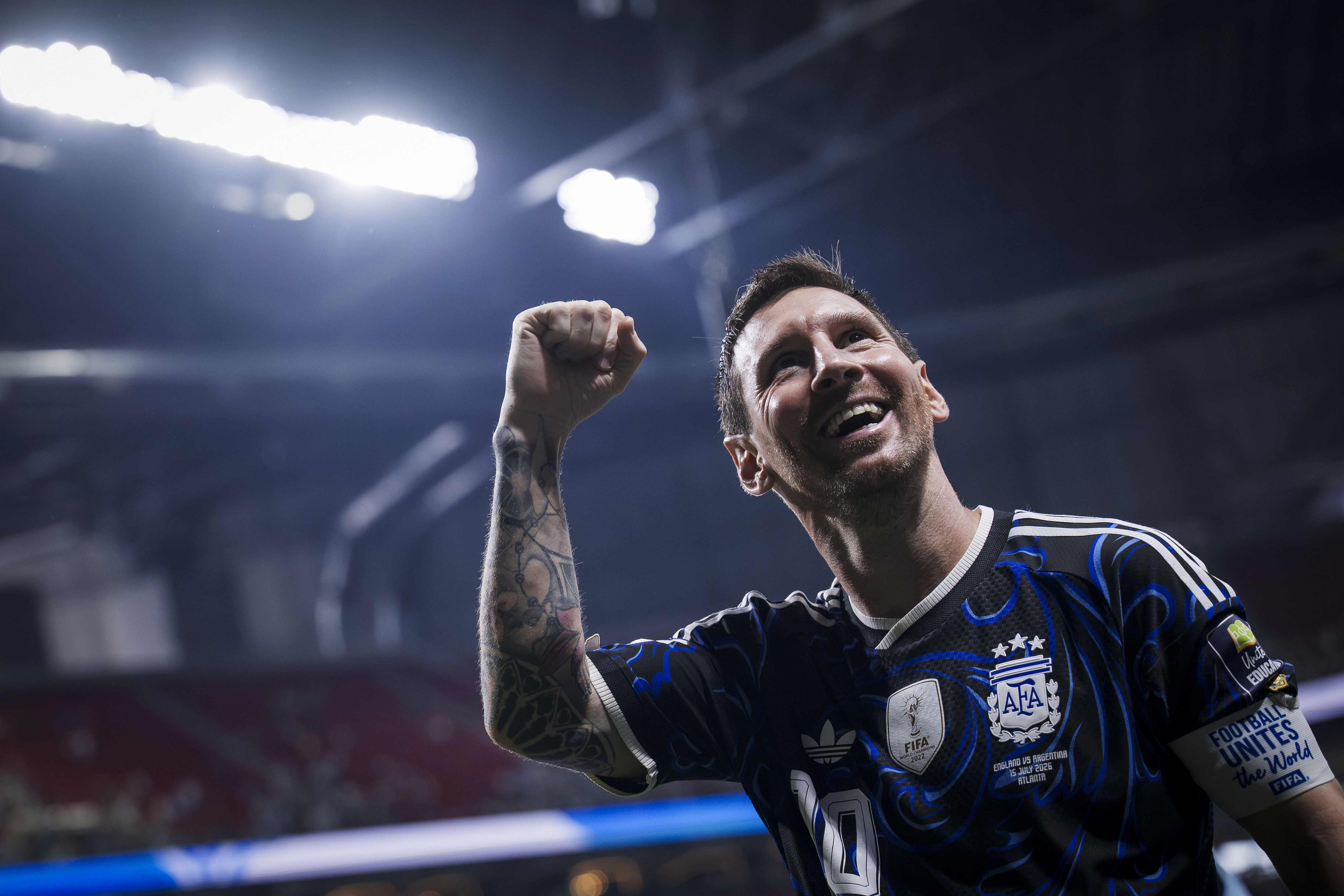


Lionel Messi tried, as best he could, to share the love. He must be used to those moments by now, standing on yet another conquered field in the aftermath of victory and staring up at a towering wave of Argentina fans, chanting his name in holy unison, prostrating themselves before him. But it must, still, feel just a tiny bit awkward.
And so, in Atlanta, with the pitch cleared of his vanquished English opponents, the 39-year-old attempted to persuade his choir to acclaim his team-mates. He might have provided the assists, after all, but it had been Enzo Fernández who had scored the equaliser, Lautaro Martínez who had delivered the winner, and Rodrigo De Paul, his close friend, who had changed the game.
Messi wanted them to have their moment in the sun, to feel a little slice of what he must feel every time he plays football. Slowly – he does everything slowly, now, when there is not a ball at his feet – he span in a circle, pointing at the rest of Argentina’s squad, asking for them to be celebrated too. It did not work in the slightest.
Nobody is in any doubt whatsoever that this World Cup, from an Argentinian point of view, is about Messi. The fans know it: that is why, among the tens of thousands who have made the pilgrimage north, somewhere in the region of 90% are wearing shirts bearing his name. It is why most, or maybe even all of their songs take him as their inspiration.
The players know it too. Argentina’s routine, in the knockout rounds of this tournament, has become familiar. The squad will linger on the field for as long as they can, basking in the adulation washing down on them, or at least on someone standing quite close to them. Occasionally, they will display a banner making a deeply controversial territorial claim.
And then they will head back into the dressing room to continue the celebrations, doing their best to imitate their own fans: bouncing up and down, booming out the chants that have just been directed at them. This is not unique to them, but it feels like it should be counted as a factor in their success: Argentina’s players are very much Argentina fans.
Some, evidently, enjoy it more than others: Fernández and Martínez, for example, could easily have led long and happy lives as ultra capos had they not been so inconveniently talented at football. Messi, as a rule, is a more discreet presence in the footage of those moments. That is probably understandable: his team-mates, after all, are largely singing about him.
They are not afraid to acknowledge that he is their motivation; they are here, pretty explicitly, to try and win the World Cup for him, as much as for themselves or for Argentina. “Por Malvinas, por el Diego, por la última de Leo”, as the lyrics to La Cuarta Estrella, the fans’ semi-official anthem to this tournament, run. (For the Falklands, for Diego, for the last time for Leo.) Messi is used to hero worship, but it is probably a step too far to ask him to chant for himself.
Most of all though, Messi knows it, and he has known it for some time. When he left Paris Saint-Germain for Inter Miami in the summer of 2023, the official explanation for his decision tended to vary a little. Messi himself suggested he wanted to “live football in another way”, although he did also make it reasonably clear that ideally he would have returned to Barcelona.
Jorge Mas, Inter Miami’s co-founder and powerbroker, meanwhile, suggested that Messi had been persuaded to move to the United States not just because of the lure of living in the “unofficial capital of the Americas” – the South American joke about Miami is that it is appealing because it is so close to the United States – but because of the chance to “transform” football in the US. “I said: ‘How many athletes have had the opportunity to change a sport in a country?’” Mas said.
Newsletters
Choose the newsletters you want to receive
View more
For information about how The Observer protects your data, read our Privacy Policy
The suspicion at the time though was that this did not fully explain Messi’s decision. The missing piece of the puzzle was that moving to Major League Soccer – where he tends to skip games taking place on artificial turf – represented a way of conserving energy ahead of helping Argentina become the first team to retain the World Cup since Brazil in 1962.
Should they do so, it will doubtless be presented as incontrovertible proof that Messi has ended the debate around the identity of the greatest player of all time. This is, of course, not correct: that debate is not one that is designed to have an objective answer; if it was, it would have been laid to rest in Qatar anyway.
But victory on Sunday would be something of an ace: Messi would have delivered a World Cup for his nation, like Maradona, and then he would have retained it, like Pelé. That, as much as the commercial benefits of becoming the face of the sport in the United States, seems to have been central to Messi’s thinking. He has been waiting three years for this.
It is no surprise, then, that he has given the impression of wanting to soak up every last minute of it. His tears after Argentina’s comeback against Egypt illustrated just how much this means to him, the pressure and the strain that comes with seeking the perfect goodbye; after beating England, as his team-mates danced and sang, at one point Messi sat down on the pitch, transfixed by the scene, as if wanting to burn every single detail into his memory.
This is, he knows, his last ride. For the last three weeks, every game might have been his last: at the World Cup, pretty much definitely; for Argentina, very probably. Now, he knows for certain. This is where it ends, either in glory or in despair, in front of the eyes of the world. Lionel Messi will step out into the light one last time; it will, as it has always been, all be about him.
Photograph by Nicolò Campo/LightRocket via Getty Images